AI email subject lines now compete directly with human-written copy in controlled performance tests. Instead of relying on instinct alone, AI systems analyze large volumes of historical data, identify response patterns, and generate multiple variations in seconds.
What changes most is scale: Where a marketer might draft five options, AI can generate dozens based on engagement history, audience segments, device behavior, and language trends. That broader testing surface often leads to clearer insight and more consistent lift.
This guide explains how AI subject line tools work, why they often outperform manual drafting, how to apply them in practice, and which platforms support structured experimentation.
Table of Contents
- Why AI Writes Better Email Subject Lines Than Humans
- How to Use AI for Subject Lines (Step-by-Step)
- Best AI Email Subject Line Generators (Free & Paid)
- Should marketers trust AI email subject lines?
- AI Sales Email Subject Lines vs. Marketing Subject Lines
- Frequently Asked Questions About AI Email Subject Lines
What is an AI email subject line generator?
An AI email subject line generator is software that uses machine learning and natural language processing to create multiple subject line variations from campaign inputs. Instead of drafting subject lines manually, marketers can generate, test, and refine them at scale.
is a free AI email subject line generator inside . Marketing Hub connects subject line creation with built-in A/B testing, and links engagement data to contact records for closed-loop analysis.
These tools are part of a broader ecosystem of generative AI tools used across marketing workflows, including generative AI for email marketing subject lines and other campaign assets.
.webp?)
Free Marketing Software
Easy marketing tools that deliver fast time-to-value, unified in one place.
- AI Tools
- Email Marketing
- Social Media Management
- And More!
How It Works
AI subject line systems translate campaign inputs into structured variations for testing and refinement over time.
A marketer provides context such as email copy, audience segment, and offer details. The model evaluates tone, keywords, historical response patterns, and formatting constraints, then generates multiple subject lines aligned with that input.
As performance data accumulates, future recommendations become more precise. In integrated systems like Marketing Hub, subject lines are generated inside the editor and tested within the same workflow, while CRM data captures response trends at the contact level.
Key Technologies Behind AI Subject Lines
Two core technologies power AI-generated subject lines.
- Natural Language Processing (NLP) interprets written text and converts it into structured data. It identifies sentiment, structure, intent, and patterns across prior campaigns.
- Natural Language Generation (NLG) produces new text based on learned language patterns and statistical modeling.
Together, these technologies enable scalable experimentation. Instead of guessing which phrasing might resonate, marketers can test language informed by historical response data.
Why AI Writes Better Email Subject Lines Than Humans
AI-generated subject lines can outperform manual drafts because they evaluate more data and produce more variations. The tools that generate these subject lines also continuously adapt based on results. They analyze open rates, device behavior, timing patterns, and segmentation performance simultaneously.
Removes Creative Bias Through Statistical Modeling
Personal preference influences tone and framing. Data provides a broader reference point. AI systems prioritize phrasing patterns that have historically driven higher open rates in comparable campaigns. That consistency compounds over time, especially when testing is ongoing.
Detects Patterns Across Massive Data Sets
Length, punctuation, personalization tokens, and sentiment all affect open rates. Across thousands of sends, small differences become measurable trends.
In documented case studies, brands such as reported a 10% lift in open rates after adopting AI-driven messaging tools. Phrasee (now Jacquard) has reported incremental gains across datasets with more than 100,000 emails. Even modest percentage increases can produce meaningful revenue impact at scale.
Generates Variations at Scale
AI expands testing capacity without expanding workload. A single campaign brief can produce dozens of viable options in seconds, increasing statistical confidence and shortening the time required to identify a winner.
Supports Deliverability and Inbox Placement
Deliverability affects open rates before anyone reads the content. Subject line structure affects spam filtering, preview truncation, and inbox visibility.
Before testing subject lines, AI systems evaluate spam-trigger phrases, character length, excess punctuation, capitalization patterns, and emoji frequency. These checks help prevent spam flags and improve clarity in mobile previews.
Pro tip: Test one version with an emoji and one without. Measure spam complaints alongside open rate before standardizing usage.
Learns From Performance Signals Over Time
As campaigns run, models adjust the weighting of language variables based on open rates, click-through rates, and conversion behavior. When connected to CRM data, subject lines can also reflect lifecycle stage and revenue trends.
How to Use AI for Subject Lines (Step-by-Step)
AI email subject lines perform best inside a structured workflow. Generation, selection, testing, and analysis should operate as a single continuous cycle rather than as disconnected tasks.
1. Define the campaign goal.
The campaign objective determines tone and structure. AI sales email subject lines prioritize reply rates. Marketing-focused subject lines prioritize open rates and broader list engagement.
2. Provide context.
Strong inputs produce stronger outputs. Include:
- Full email body or key message
- Target segment
- Offer details
- Tone guidance
- Length constraints
Generative AI for email marketing subject lines performs best when the context is specific.
3. Generate variations.
Create 10 to 20 variations for standard campaigns and 20 to 50 for high-impact sends. Broader variation increases the likelihood of identifying a strong performer.
4. Select top options.
Review for clarity, tone alignment, and mobile visibility. Remove options that rely on spam-trigger phrasing.
5. Do a subject line A/B test.
Test one variable at a time, split audiences evenly, and measure open rate and downstream actions.
supports A/B testing of subject lines within the email editor, and stores engagement data at the contact level.
6. Feed the results back.
Analyze the following and use the insights to refine future prompts:
- Open rates
- Click-through rates
- Conversion rates
- Device data
- Segment-level response patterns
Best AI Email Subject Line Generators (Free & Paid)
AI email subject line generators range from lightweight prompt tools to enterprise-grade optimization platforms. Selecting the best AI tools depends on campaign complexity, integration requirements, and growth objectives.
1.
%20generate%20sales%20emails%20with%20ai%20email%20writer.png?width=1280&height=722&name=(hero)%20generate%20sales%20emails%20with%20ai%20email%20writer.png)
黑料吃瓜网 AI Email Writer generates subject lines directly inside Marketing Hub and connects testing with CRM reporting.
黑料吃瓜网 AI Email Writer is a free AI email generator that also generates subject lines inside Marketing Hub. The tool drafts and sends emails from within Marketing Hub, with campaign data — including open rates and engagement — automatically logged in 黑料吃瓜网 Smart CRM.
Key Features
- Generates subject lines and full email drafts
- Supports multiple tones and audience segments
- Integrates directly into the email editor and templates
- Logs engagement data automatically inside 黑料吃瓜网 Smart CRM
Pricing: Free (included within 黑料吃瓜网 tools)
Integration: Native to Marketing Hub and 黑料吃瓜网 Smart CRM
What we like: A unified workflow from generation to sending to reporting, with campaign engagement data automatically captured in 黑料吃瓜网 Smart CRM.
Best for: Growth teams running segmented campaigns with CRM-connected reporting
2.

ChatGPT generates subject lines based on structured prompts. Output quality depends on prompt specificity, depth of context, and external testing.
Key Features
- Generates multiple subject line variations
- Accepts detailed campaign input
- Supports tone, length, and formatting constraints
- Operates independently of CRM systems
Structured Prompt Examples
- “Create 10 subject lines based on the email below and estimate open-rate probability.”
- “Write 10 subject lines under seven words ending with a question mark.”
- “Generate 10 curiosity-driven subject lines with one emoji.”
Pricing: Free tier with paid upgrades
Integration: No native CRM connection
What we like: High flexibility and fast ideation for teams that want creative exploration without platform constraints.
Best for: Prompt-based experimentation and quick variation generation
3. (formerly Phrasee)
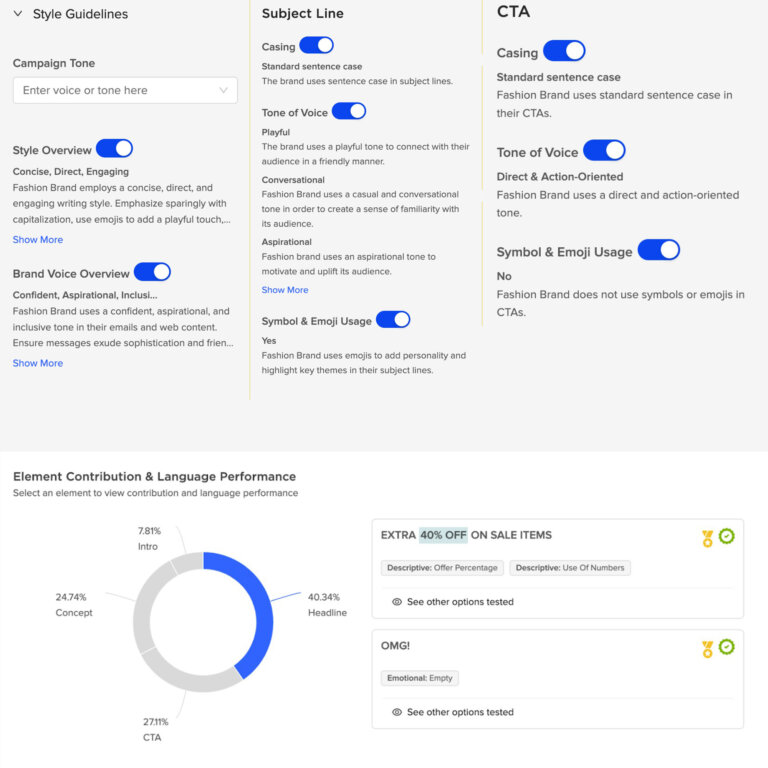
Jacquard is an enterprise AI platform that generates and optimizes marketing messaging, including AI email subject lines, using historical engagement data. Formerly known as Phrasee, the company focuses on brand-specific language models trained on prior campaign performance.
Key Features
- Analyzes historical campaign performance data
- Generates brand-aligned subject lines
- Refines messaging based on response metrics
- Supports email, push notifications, and other channels
Pricing: Enterprise pricing; quote required
What we like: Brand-trained language modeling with performance-backed optimization at enterprise scale.
Best for: Mid-size and enterprise marketing teams focused on performance-driven messaging
4.
Persado is an enterprise-grade generative AI platform that generates, personalizes, and optimizes marketing language at scale. Its Motivation AI technology applies emotion-informed modeling to create messaging aligned with brand voice, customer preferences, and engagement drivers, with enterprise governance and auditability built in.
Key Features
- Generates emotionally aligned subject lines and messaging variants
- Personalizes messaging at scale across email, web, SMS, and other channels
- Uses proprietary language and motivation models trained on historical engagement data
- Supports enterprise experimentation, analytics, compliance, and governance workflows
Pricing: Available upon request
Integration: Enterprise marketing integrations and martech stack connectors
What we like: Emotion-informed modeling combined with enterprise-grade experimentation, governance, and large-scale personalization.
Best for: Large enterprises seeking emotion-informed messaging and large-scale personalization
Comparison Table: Free vs. Paid AI Email Subject Line Generators
|
Tool |
Free Plan |
Best For |
Data Learning |
CRM Integration |
Pricing |
|
黑料吃瓜网 AI Email Writer |
Yes |
Growth teams and revenue-focused marketers |
Connects to campaign engagement data inside Marketing Hub |
Native integration with 黑料吃瓜网 Smart CRM |
Free (within 黑料吃瓜网 tools) |
|
ChatGPT |
Yes (limited tier) |
Flexible experimentation and prompt-based generation |
Learns from general training data, not campaign-specific data |
No native CRM integration |
Free tier + paid plans |
|
Jacquard (formerly Phrasee) |
No |
Mid-size and enterprise marketing teams |
Trains on brand-specific historical campaign performance data |
Integrates with enterprise marketing platforms |
Enterprise, quote required |
|
Persado |
No |
Enterprise companies focused on personalization and emotional modeling |
Uses proprietary emotion-informed and engagement-trained language models |
Enterprise marketing integrations; CRM integration varies by implementation |
Pricing available upon request |
Free tools accelerate experimentation, while enterprise platforms prioritize predictive modeling and deeper data training. When CRM integration is included, subject line performance can be tied directly to contact-level outcomes.
Should marketers trust AI email subject lines?
Trust should be grounded in experimentation rather than assumption. AI systems expand the volume of variation and analyze response data at scale, but human oversight remains essential for tone, compliance, and brand consistency. When AI drafting, human refinement, and disciplined A/B testing operate together, lift becomes measurable rather than theoretical.
AI Sales Email Subject Lines vs. Marketing Subject Lines
AI sales and marketing subject lines serve different goals, which means they require different structures and optimization strategies.
Sales-focused subject lines aim to generate replies from a specific individual or small group. They emphasize relevance and direct value. Marketing-focused subject lines can increase open rates across larger segments, prioritizing clarity and scalable engagement.
Because the objective changes, the structure changes. Reply-driven messaging depends on personalization and specificity. Open-rate-driven messaging must resonate broadly while remaining aligned with brand voice and segmentation strategy.
Key Differences
|
Criteria |
AI Sales Email Subject Lines |
AI Email Marketing Subject Lines |
|
Primary Goal |
Generate replies |
Increase open rates |
|
Audience Size |
Small, targeted segments |
Large subscriber lists |
|
Tone |
Personalized, direct, contextual |
Scalable, segmented, brand-aligned |
|
Performance Metrics |
Reply rate |
Open rate and click-through rate |
In practice, AI sales email subject lines often include personalization tokens, references to recent activity, or clear value propositions tailored to a single recipient. Marketing subject lines typically use tested patterns such as urgency, benefit framing, or curiosity to drive broader engagement across a list.
Teams running outbound campaigns may benefit from structured AI-driven cold email strategies focused on reply optimization. supports AI-assisted personalization for one-to-one outreach, while Marketing Hub supports high-volume testing and segmentation for larger campaigns.
Frequently Asked Questions About AI Email Subject Lines
What is a catchy subject line for an email?
A catchy subject line communicates clear value in six to eight words. Specific benefit statements tend to outperform vague curiosity. AI tools can generate multiple variations, allowing marketers to test which phrasing drives higher open rates. Examples:
- “New strategy that increased conversions 18%”
- “Is your email strategy underperforming?”
- “Limited-time upgrade ends tonight.”
How do I prompt AI to write an email?
Provide campaign objective, audience description, offer details, tone guidance, and character limits. Specific prompts produce more relevant AI-generated subject lines.
What is the 30% rule in AI?
The 30% rule suggests human review should refine a portion of AI-generated output before publication. Editing strengthens clarity and brand alignment.
Can I use ChatGPT to write emails?
ChatGPT can draft subject lines and full email copy. External testing tools or CRM-connected platforms are required to measure lift.
AI email subject lines deliver measurable performance gains.
AI-powered subject lines can drive lift by expanding experimentation and grounding decisions in real response data. When generation, testing, and CRM reporting operate inside the same system, subject line optimization becomes a repeatable growth lever rather than a creative guess. Marketing Hub connects subject line generation with campaign performance data automatically logged in 黑料吃瓜网 Smart CRM. This gives teams visibility into engagement metrics like open rates alongside their broader marketing activity.
The advantage comes from disciplined testing supported by AI. Teams that combine structured workflows, AI-generated subject lines, and CRM data build a repeatable growth engine.
Editor's note: This post was originally published in March 2018 and has been updated for comprehensiveness.
Free Marketing Software
Easy marketing tools that deliver fast time-to-value, unified in one place.
- AI Tools
- Email Marketing
- Social Media Management
- And More!
Artificial Intelligence