
If I were to name one thing I’ve learned over my years as a content marketer, it’s that strategy always comes first. Otherwise, you face the risk of chaos.
You either 1) end up writing on random topics that don’t fit your intent and personas, 2) cannibalize your existing SEO keywords, or 3) run out of ideas altogether (which sucks, I’ve been there). A real plan keeps your work aligned with the B2B marketing funnel and focused on outcomes that actually matter, such as B2B conversion rate optimization and a repeatable customer acquisition strategy.
The B2B marketing stats back this up, too: brands that win in search tend to operate from a documented plan. It’s the same throughline you’ll spot in most SEO success stories, and it’s why approaches like loop marketing and tight B2B SaaS marketing motions lean so heavily on strategy.
Also, considering AI and Google’s bold modifications to their search engine (AI overviews aren’t giving marketers much of a choice these days), you simply can’t operate in B2B search without a solid plan. Whether you’re working to learn SEO from the ground up or considering integrating search and social media marketing, the fundamentals still start with strategy.
In this blog post, I’ll show you how to create a B2B SEO strategy built to sustain today’s search landscape, plus share tips from B2B marketing experts.
Table of Contents:
- B2B SEO vs. B2C SEO
- Understanding Your B2B Buyer Personas and Journey
- B2B Keyword Research: Finding High-Intent Search Terms
What is B2B SEO?
B2B SEO is the practice of optimizing a company’s website and content to rank in search results for the terms business buyers use when researching solutions. Unlike consumer search, the goal isn’t just driving traffic for its own sake.
More specifically, SEO for B2B’s entire purpose is to reach the specific decision-makers who influence a purchase and guide them toward a conversion.
Here’s why this matters: A strong search-focused strategy for B2B connects organic visibility to pipeline, not just page views.
At its core, every effective approach rests on three decisions:
- Keyword targeting: Selecting the terms your buyers actually search, weighted toward intent rather than raw volume.
- Content format: Matching each query to the right asset (i.e., landing page, blog post, comparison guide, or case study).
- Audience clarity: Understanding your buyers’ needs, behaviors, and the questions they ask at each stage.
Now, before we get into the specifics, I’ve pulled together a few plain-language definitions to level-set:
- Search intent: The goal behind a query (i.e., learning, comparing, or buying).
- High-intent keywords: Searches that signal a buyer is close to evaluating or purchasing. High-intent keywords indicate stronger buying or solution-evaluation intent than broad, informational terms.
- Buyer journey: The path from recognizing a problem to selecting a vendor.
.png)
Complete SEO Starter Pack
An introductory kit to optimize your website for search.
- Increase your organic traffic.
- Plan your keyword strategy.
- Debunk SEO myths.
- Build a blog strategy.
Download Free
All fields are required.
Form not available
You're all set!
Click this link to access this resource at any time.
Why B2B SEO Matters
Now, you’re likely wondering, “Why is SEO for B2B such a big deal, Jeanie?”
Well, reader, B2B SEO is a make-or-break topic because it meets buyers during the long, research-heavy stretch when they’re forming opinions (but haven’t yet talked to sales). Plus, search is where that self-education happens, so it’s also where preferences harden before a single rep gets a call.
To help you better understand what sets it apart, here’s a brief rundown of what makes B2B search distinct:
- Longer sales cycles: decisions take weeks or months, so your content has to support sustained research across many visits, not a single one.
- Multiple decision-makers: a committee of six to ten people, each looks for different proof (i.e., ROI for finance, security for IT, usability for end users).
- Lower-volume, higher-intent searches: B2B terms draw fewer searches than consumer queries, but each visitor is worth far more.
- Buyer-journey content needs: each stage of the B2B buyer journey demands a different answer, from “what is X” to “best X for [use case]” to “X vs. competitor.”
This, reader, is also why measurement has to mature. Traffic alone tells you nothing about pipelines.
To prove real impact, B2B SEO success should be measured by:
- Qualified leads
- Conversion rates
- Influenced pipeline
- Revenue
Fixating on sessions or rankings in isolation only gets you vanity metrics.
Pro Tip: Buyers are increasingly consulting AI answer engines and chat assistants, not just the good ol’ results page. gives marketers a scored snapshot of how answer engines represent their brand today; when coupled with , you’ll be able to track how your brand shows up across answer engines over time.
Key Components of a B2B SEO Strategy
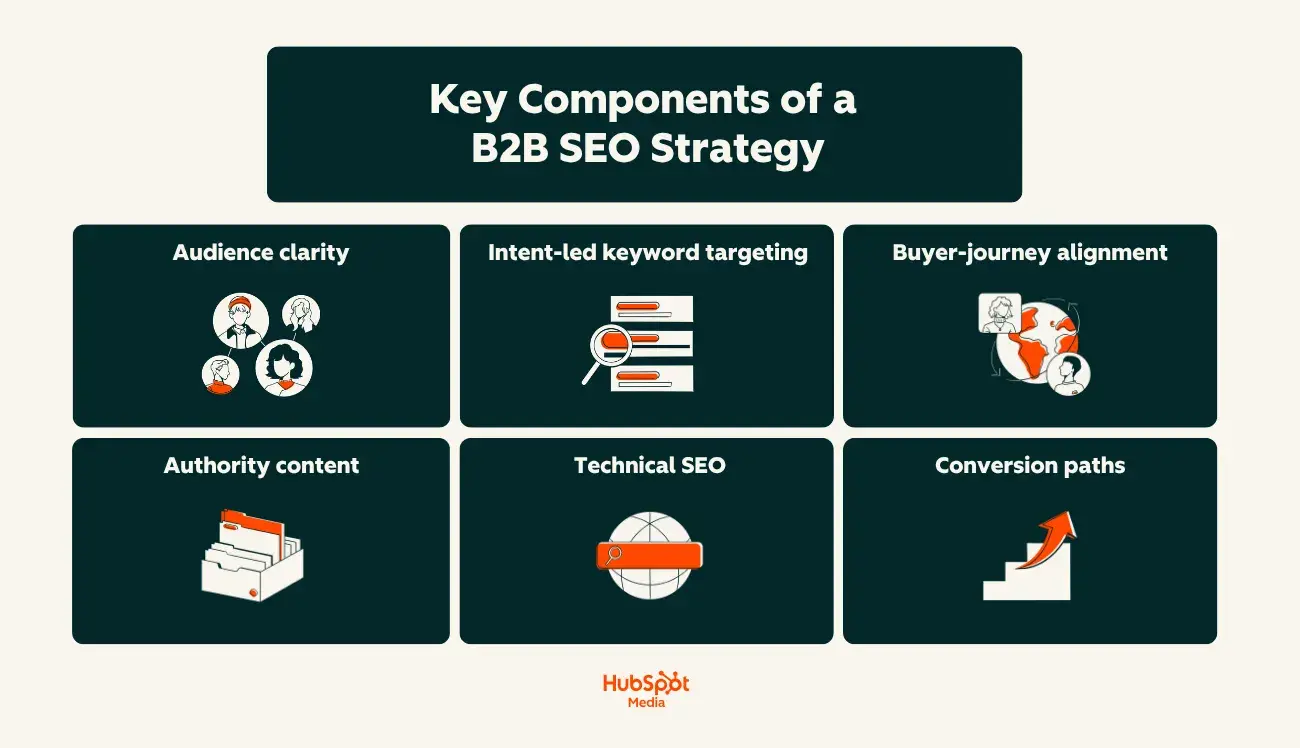
If you take away nothing else from this blog post, I urge you to remember this: At a basic level, B2B SEO best practices share the same pillars.
Each pillar ties search visibility back to qualified demand:
- Audience clarity: Define who you’re targeting and the problems they’re solving before you choose a single keyword. Everything downstream depends on it.
- Intent-led keyword targeting: B2B keyword research favors high-intent keywords over traffic volume. Focus on terms that signal evaluation or purchase rather than casual curiosity.
- Buyer-journey alignment: Tracking the buyer journey helps teams connect content with search intent. A B2B content strategy should include awareness, consideration, and decision-stage content so no buyer hits a dead end.
- Authority content: Depth and credibility win in B2B. B2B link building builds authority and trust for commercial pages and thought leadership content, signaling to both search engines and buyers that you’re a source worth citing.
- Technical SEO: Technical SEO improves crawlability, indexation, site performance, and user experience (for context, this is the foundation that lets your strongest content rank).
- Conversion paths: Every ranking page needs a clear next step (i.e., a demo, trial, or gated resource), so visits convert into a measurable pipeline.
When the pillars are paired together, the throughline is simple: An SEO strategy for B2B marketing focuses on qualified leads and revenue growth but relies heavily on high-intent search to move the right buyers through a complex journey toward a decision.
B2B SEO vs. B2C SEO
Before we dig into how they differ, I want to make one thing clear: B2B and B2C SEO run on the same mechanics, which are:
- Keyword research
- Technical health
- Quality content
However, each discipline optimizes for very different outcomes.
To help you distinguish between the two at a glance, take a look at the comparison chart below:
So, what’s the most important takeaway for content teams? It’s that an SEO-focused B2B strategy can’t simply be a scaled-down B2C playbook.
The fundamentals carry over, but the priorities invert. If you want to master B2B SEO, I suggest prioritizing the following:
- Depth over breadth (fewer, richer pages that fully answer buyer questions)
- Intent over volume
- Pipeline over pageviews
Search Volume Is Lower, but Intent Is Higher
Here’s the tricky thing about only chasing search volume: B2B keywords rarely post the search volumes consumer terms do, but volume is the wrong yardstick. Low-volume keywords can also drive high-value B2B opportunities, particularly when intent is strong.
A more casual consumer term like “cute affordable kitten heels for summer” might pull hundreds of thousands of searches, most of them casual browsing. However, a standard B2B search term — let’s just say it’s something like, “HIPAA-compliant patient scheduling software” — may see only a few hundred. Nevertheless, each searcher could be a five- or six-figure deal.
That’s why B2B keyword research prioritizes high-intent keywords over traffic volume alone. A single-page ranking for a bottom-funnel, solution-aware query can outperform a viral post that converts no one.
In B2B, one qualified visitor often beats a thousand uncommitted ones.
Buyer Intent Is More Complex
In B2C, one person usually searches, decides, and buys. But, because of the meteoric rise of AI in search, this is changing every day.
According to , 41% of marketers say the top trend they’re exploring is updating their SEO strategy to account for changes in search. What’s even more telling is that .
While this might be a big shift to absorb, it makes a ton of sense, especially considering that long before they ever talk to sales. But what does this data mean in the grand scheme of how B2B buyer intent is expressed today?
Well, typically, a single B2B purchase rarely comes down to one searcher. It runs through a buying committee, and each member searches differently.
For example, the same tool can trigger very different queries depending on who’s typing:
- An end user searches “easiest [tool] for small teams.”
- An IT lead searches “[tool] SOC 2 compliance and SSO support.”
- A finance stakeholder searches “[tool] pricing vs. [competitor] ROI.”
What’s relevant here is that each query maps a different person, stage, and concern. By tracking the buyer journey, you’ll easily align content with search intent at each funnel stage, so every stakeholder in the B2B buyer journey finds the proof they need to advance the decision internally.
Pro Tip: As previously stated, the B2B journey typically runs through a committee of stakeholders. These stakeholders are running searches inside AI assistants and answer boxes, not just Google.
To see whether your brand shows up when they ask, use to assess how it appears across answer engines over time.
B2B Content Must Go Deeper
So, what to do when thin content won’t cut it? Go deeper, obviously.
Because B2B buyers are de-risking a high-stakes, multi-stakeholder decision, thin content doesn’t stand up to scrutiny; they demand evidence.
With this in mind, here are a few formats that prove value rather than just describe it:
- Guides and frameworks (awareness): Establish authority and capture early-stage research.
- Comparison and “vs.” pages (consideration): Help evaluators weigh options side by side.
- Case studies and ROI calculators (decision): Supply the proof that finance and leadership demand.
- Product-led content (decision): Docs, interactive demos, and use-case pages that let buyers self-educate.
This depth is also what affirms strong SaaS SEO, where free-trial and comparison searches reward the brand that answers most completely. (The best practices for B2B SEO stay consistent: match format to stage, lead with proof, and make every asset move a real buyer closer to a decision.)
Understanding Your B2B Buyer Personas and Journey
Effective B2B SEO starts with one question: Who are you trying to reach, and how do they buy?
Plus, targeting the right companies (and the right people inside them) is ultimately what turns search traffic into a firm sales pipeline. Map that first, and your keyword and content choices follow naturally.
That said, three particular layers define your target:
- Ideal Customer Profile (ICP): the type of company worth winning.
- Buyer personas: the individuals inside those companies who research and decide.
- Buyer journey: the stages each person moves through before a purchase.
If you get these right, your B2B SEO strategy stops chasing vanity traffic and starts attracting buyers who convert.
Below, I’ve outlined the steps you’ll take to define exactly who it is you’re targeting and how they buy.
Complete SEO Starter Pack
An introductory kit to optimize your website for search.
- Increase your organic traffic.
- Plan your keyword strategy.
- Debunk SEO myths.
- Build a blog strategy.
Download Free
All fields are required.
Form not available
You're all set!
Click this link to access this resource at any time.
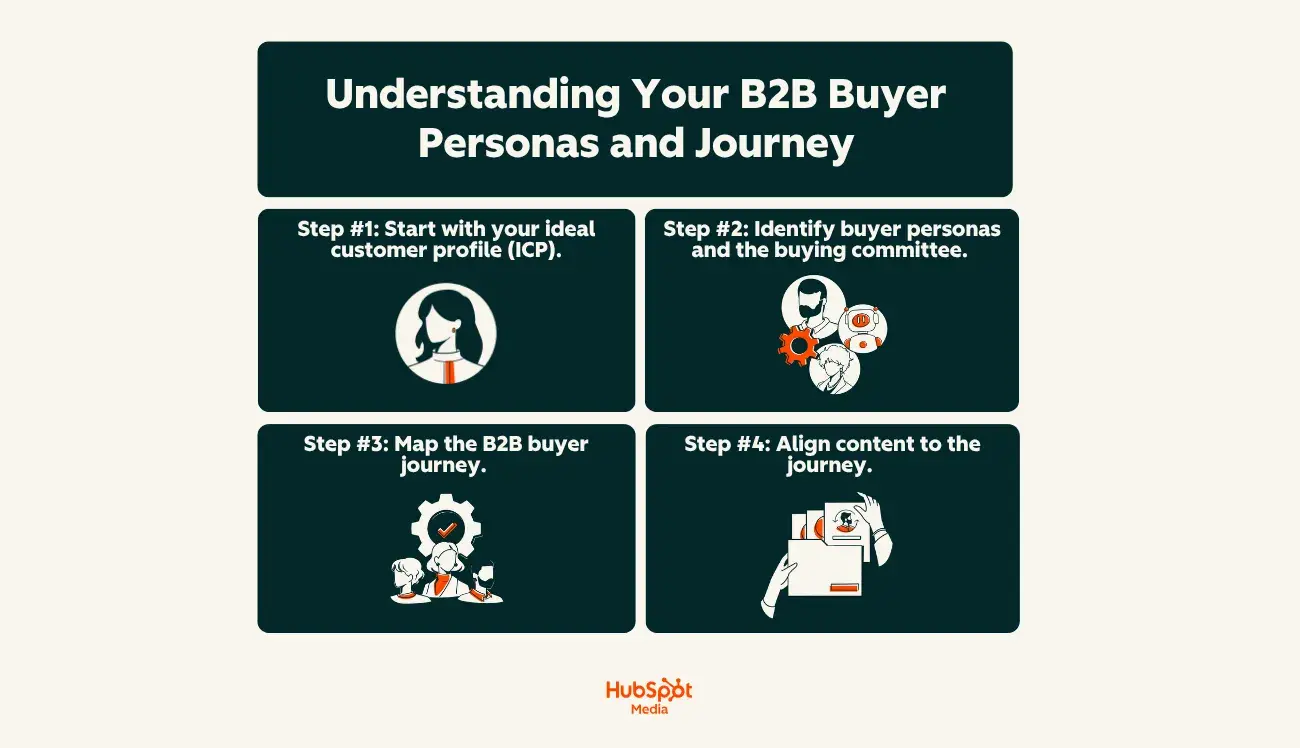
1. Start with your ideal customer profile (ICP).
First and foremost, an ICP describes the best-fit company for your product. These are accounts most likely to buy, succeed, and stay. Think of this criteria as a firmographic filter.
I recommend defining your ICP by attributes like:
- Industry or vertical (e.g., healthcare SaaS, fintech).
- Company size (headcount, revenue).
- Geography and regulatory environment.
- Tech stack or operational maturity.
- Trigger events (new funding, leadership changes, scaling pains).
Then, use those attributes to narrow your SEO targeting.
2. Identify buyer personas and the buying committee.
Secondly, your ICP tells you which companies to target; personas tell you who inside them to reach. (The distinction is important because a typical B2B buying committee includes many decision-makers, and each one searches differently.)
Here’s an example snapshot of how that plays out:
- CFO / finance: searches for ROI, pricing, and total cost — “[category] cost per seat,” “[tool] vs. [competitor] pricing.”
- Operations leader: searches for efficiency and workflow fit — “best [category] for scaling teams.”
- Technical evaluator: searches for security and integration — “[tool] SOC 2 compliance,” “[tool] API documentation.”
Mapping personas to their queries is foundational to B2B keyword research because the same product attracts very different searches depending on who’s typing. And when you capture all of them? Then you support the whole committee.
3. Map the B2B buyer journey.
Next, the B2B buyer journey moves through three broad stages, each tied to a different search intent.
Each stage is as follows:
- Awareness: the buyer recognizes a problem. Searches are broad and educational — “how to reduce customer churn.”
- Consideration: the buyer compares approaches and vendors. Searches get specific — “best churn-prediction software.”
- Decision: the buyer is ready to make a choice. Searches signal action — “[tool] pricing,” “[tool] vs. [competitor],” “[tool] free trial.”
High-intent keywords often indicate stronger buying or solution-evaluation intent, so decision-stage terms deserve priority even when their volume is small.
4. Align content to the journey.
Lastly, once you’ve mapped intent by stage, it’s time to match each query to the content type built to satisfy it.
A traditional B2B content strategy should include awareness, consideration, and decision-stage content to ensure no searcher hits a dead end.
This stage-to-content match is one of the most durable ways to implement SEO for B2B, and it’s especially critical for SaaS SEO, where trial and comparison searches sit closest to revenue.
Pro Tip: Mapping content to the journey only works if buyers actually find it, including in AI answer engines. gives marketers a clear, scored snapshot of how answer engines represent their brand today.
B2B Keyword Research: Finding High-Intent Search Terms
Don’t Google, “what is B2B keyword research?” Instead, I’ll break it down for you right here.
Simply put, B2B keyword research is the process of identifying the search terms your buyers use, then ranking them by intent, not just volume. It’s the bridge between knowing your audience and building content that ranks and converts. Done well, it becomes a revenue input.
The core principle: keyword research for B2B favors high-intent keywords over traffic volume. (For example, a term with 90 monthly searches and clear buying intent can outperform one with 90,000 searches and none. Your job is to find, validate, and organize those high-value terms, then map them to the B2B buyer journey.)
This section breaks that work into five moves. Take a look:
1. Understand B2B search intent.
Every keyword carries an intent (also known as the reason behind the search).
So, sorting terms by intent tells you what content to build and how close the searcher is to making a purchase.
Below, I’ve briefly outlined the five most common intent types in B2B marketing:
- Informational: learning about a problem (i.e., “what is data observability.”)
- Problem-aware: seeking a fix (i.e., “how to reduce data pipeline downtime.”)
- Commercial: comparing options (i.e., “best data observability tools.”)
- Transactional: ready to act (i.e., “[tool] pricing,” “[tool] free trial.”)
- Navigational: looking for a specific brand or page (i.e., “[brand] integrations.”)
Commercial and transactional terms usually sit closest to revenue, so they’ll likely earn priority in an SEO strategy for B2B even when their volumes look modest.
2. Use multiple sources to find real buyer language.
The best keywords for business-to-business marketing often never appear in a tool. They come from how buyers actually talk.
If you want to capture how your buyers actually talk, you’ll need to mine first-party sources for the exact phrasing your prospects use.
Consider these five places to look:
- Sales call recordings: the objections and questions reps hear on repeat.
- CRM notes and lost-deal reasons: language tied directly to the real pipeline.
- Customer success insights: the problems buyers came to solve.
- Demo and sales questions: high-intent, bottom-funnel phrasing.
- On-site search queries: what visitors type when they can’t find something.
Pro tip: For SaaS SEO especially, demo questions and on-site search are goldmines. They surface the precise, solution-aware terms that signal a buyer is moving beyond browsing and actually evaluating solutions like yours.
3. Use keyword tools to expand and validate ideas.
Once you have seed terms from real buyers, it’s time to use keyword tools to expand the list and confirm demand.
Here’s how to do that with a few go-to tools/search features:
- /: volume, difficulty, related terms, and the competitors’ ranking for them.
- : queries you already rank for (plus near-misses sitting on page two).
- : real, in-progress searches as buyers type.
- People Also Ask (Google): adjacent questions that reveal intent and content gaps.
This approach pairs real buyer language with tool data, yielding terms that are both genuine and reachable.
4. Analyze competitor keyword gaps.
Your competitors’ pages reveal terms you’re missing.
If you want to close those gaps, the best solution is to run a gap analysis across their highest-value page types:
- Category pages: the head terms defining your space.
- Comparison / “vs.” pages: decision-stage terms with strong buying signals.
- Use-case pages: persona- and industry-specific intent.
- Industry/solution pages: vertical terms that attract best-fit accounts.
TL;DR — Look past high-volume head terms to the specific, lower-volume queries competitors rank for.
5. Build keyword clusters around real business problems.
Don’t optimize for keywords in isolation.
To effectively put those keywords to work, group them into clusters around the problems your buyers are trying to solve. Buyer journey mapping helps teams align content with search intent at each funnel stage, and clustering operationalizes that mapping.
I recommend organizing each cluster in the following way(s):
- Business problem/pain point: the core need (i.e., “reducing churn”).
- Solution category: the product space that addresses it.
- Funnel stage: awareness, consideration, or decision intent.
This clustered structure is one of the most reliable B2B SEO best practices. It builds topical authority, keeps pages from competing with each other, and ensures every stage of the journey has content built to convert.
How to Build a B2B SEO Strategy
Now for the fun part! Let’s get down to practice.
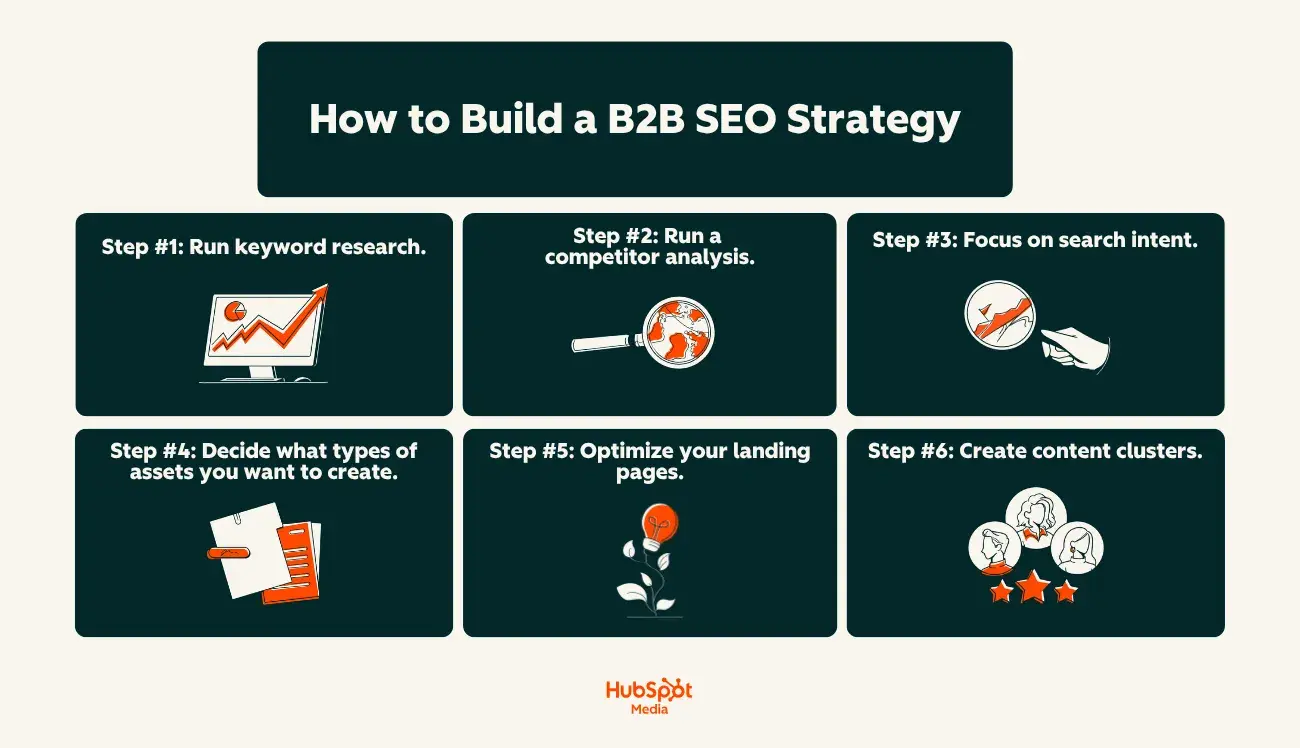
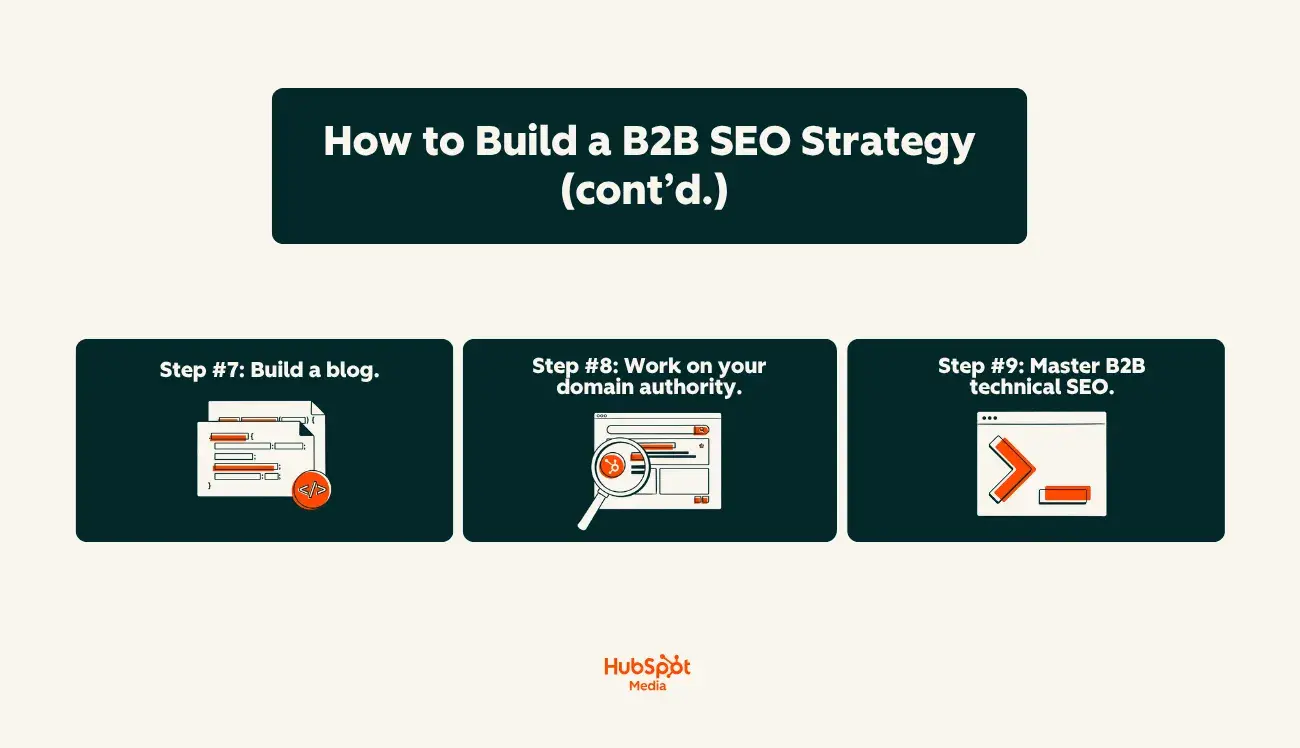
Here are nine, easy-to-follow steps you can take to build an effective B2B SEO strategy:
1. Run keyword research.
The first step is doing comprehensive keyword research. If you know your target audience inside out, this one shouldn’t be too difficult.
Build your search around their problems and needs. This will help you avoid selecting completely irrelevant keywords. There are plenty of tools that you can use, like Ahrefs, Semrush, and Keysearch. I recommend the latter.
Let’s say you work for a software development agency. Here’s a keyword search you could run.
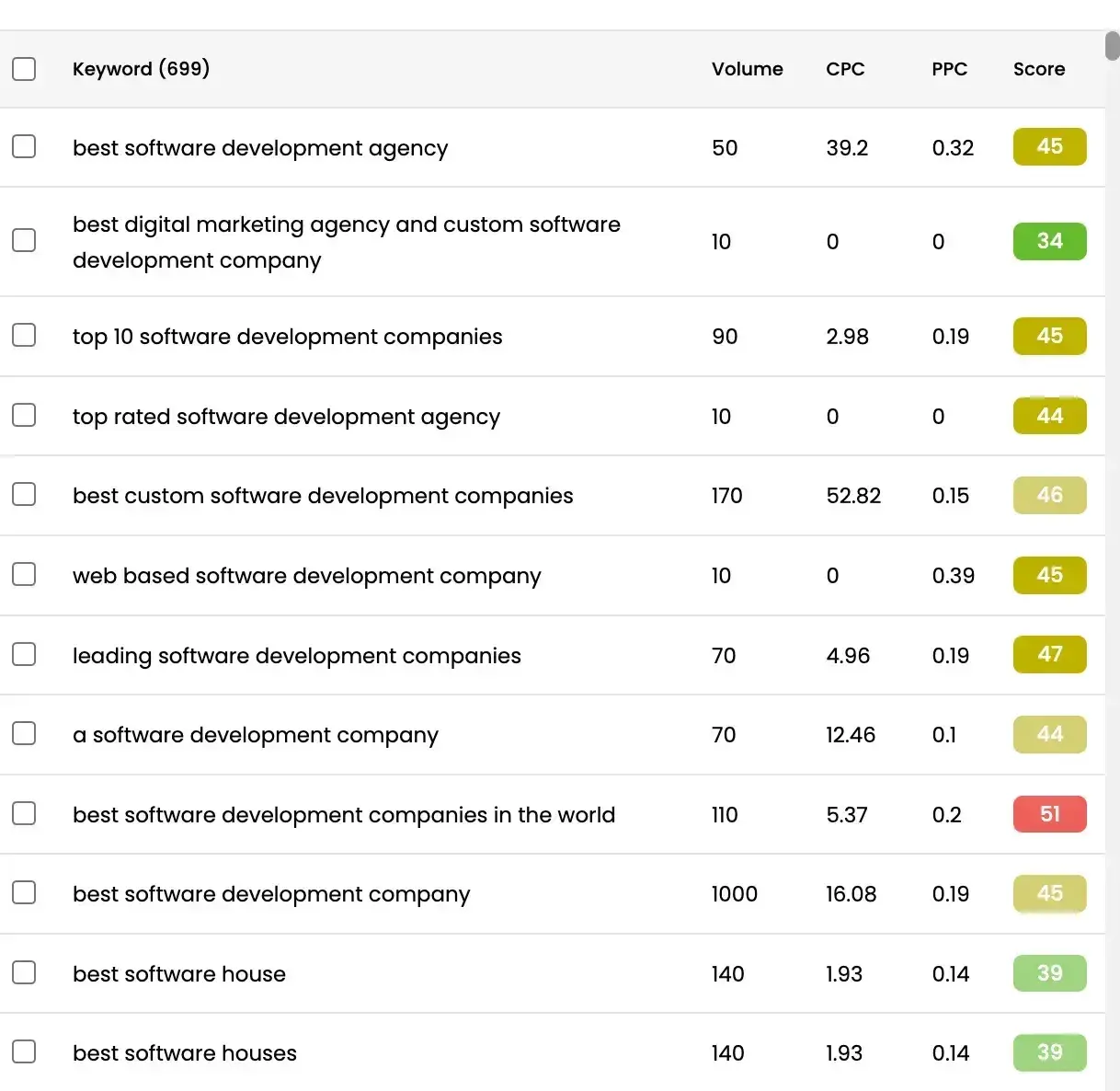
Don’t get discouraged by low volumes. While you might get less traffic from a keyword like “best software development agency” (50 search volume), the search intent indicates that someone is actively looking for a company they could work with.
If the article converts, the content you create around this keyword will quickly pay off.
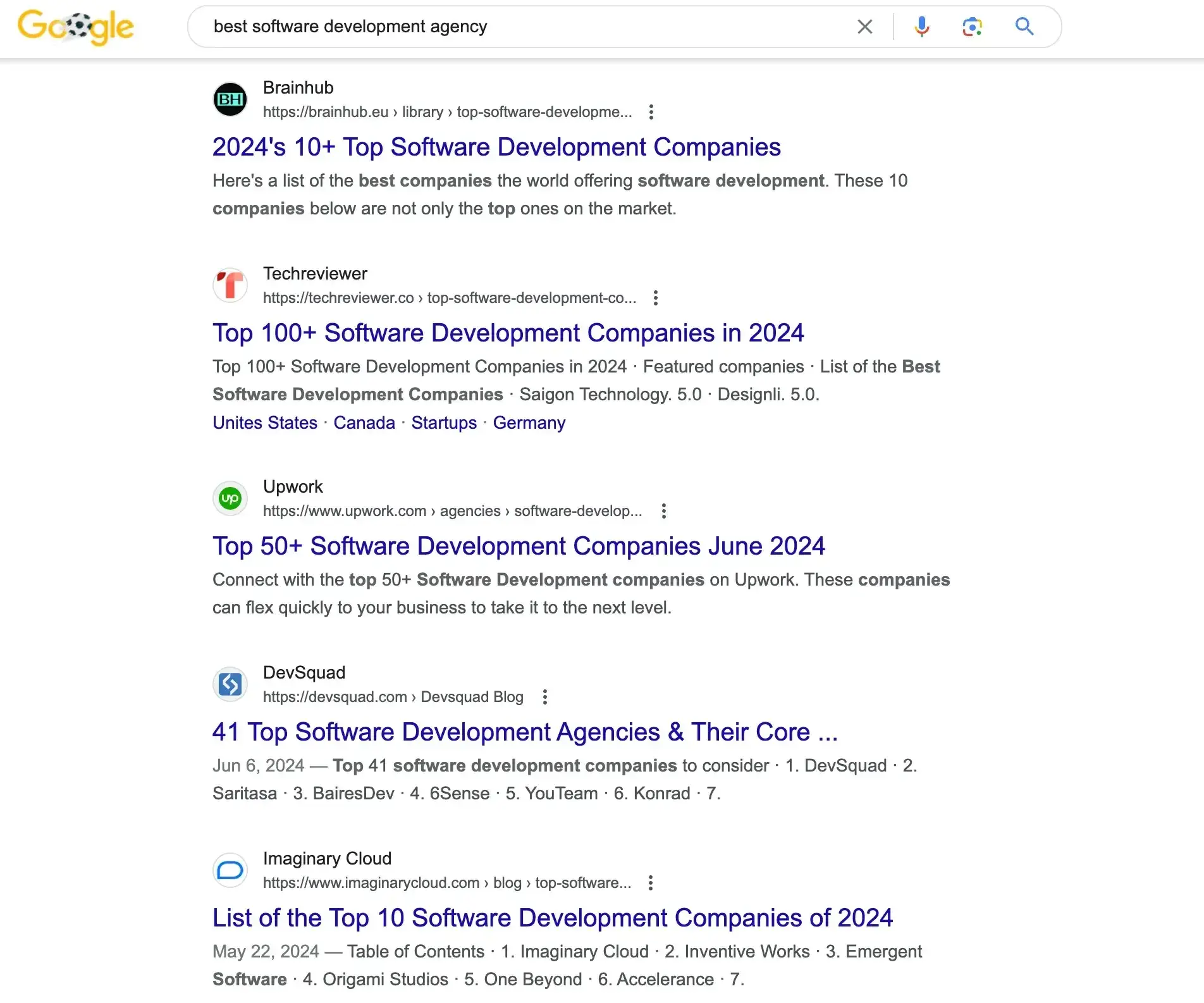
Pro tip: You can also take advantage of tools like to help you craft your strategy.
2. Run a competitor analysis.
Whenever I work on an SEO strategy for a B2B client, I take a deep dive into what their competitors are doing. I not only look at the topics they cover and the content formats they use, but I also run a content gap analysis. (This lets me spot topics that my client hasn’t written about yet or doesn’t rank well for.)
Now, I know this might sound like a lot of work, but luckily, you’re welcome to use an SEO tool — like or — to get your results in a few seconds.
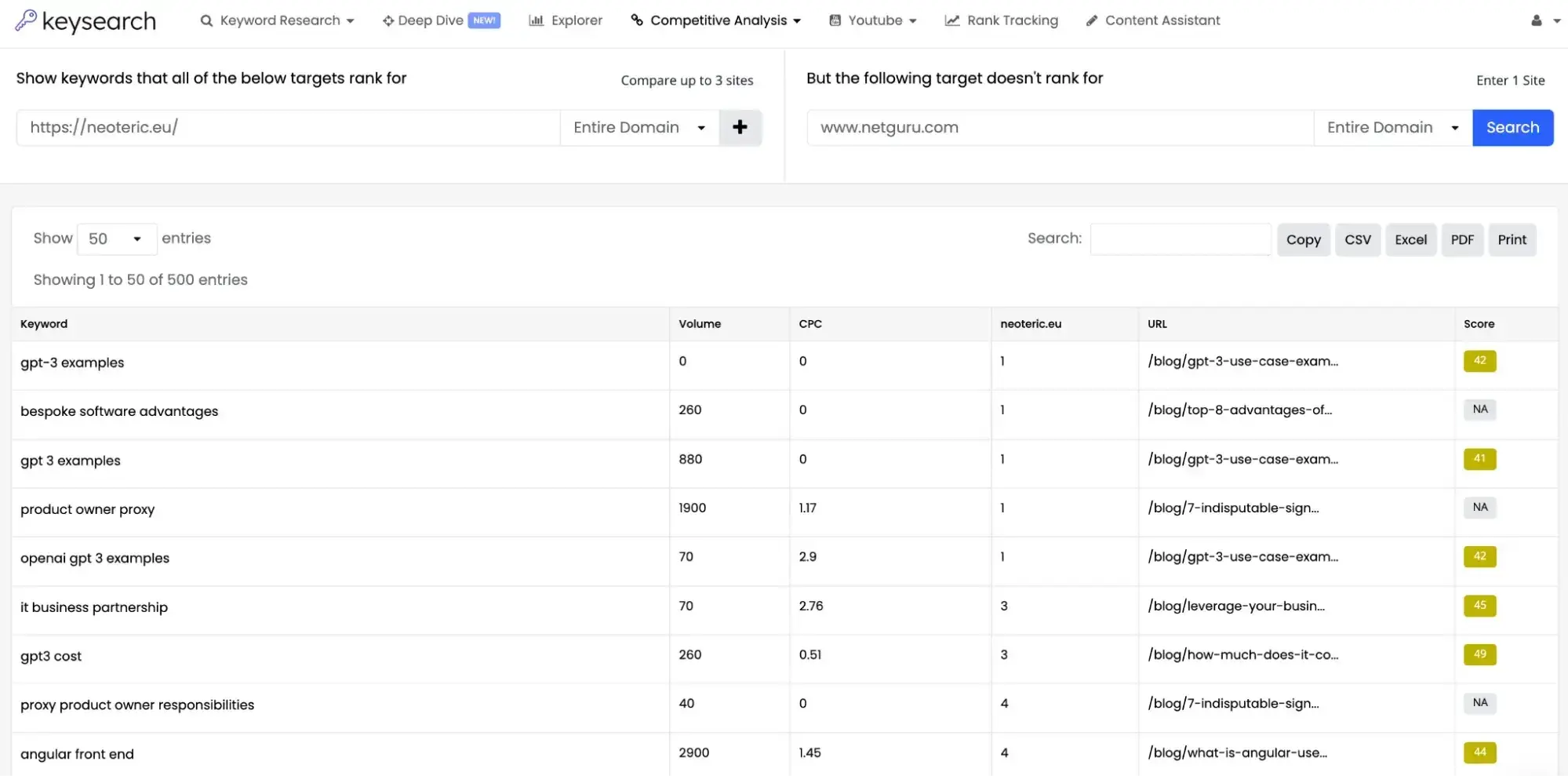
Below I compared two software development agencies, and got a list of keywords that Netguru doesn’t rank for. I could use them as inspiration for coming up with new topic ideas.
3. Focus on search intent.
Think of each phrase in your shortlisted keywords as a separate story. Who’s tapping it into the search bar, and what do they expect to see in the search results?
As you’ll quickly notice, some keywords are general (i.e., indicate that the searcher is just learning about a topic), while others hint that they’re already considering solutions like yours.
, former VP of Marketing at , is a huge advocate for search intent analysis. She used an example from her career in which, despite having rich, high-quality keywords, they weren’t ranking.
“It was then that I realized we were neglecting the ‘Intent’ part of SEO,” says Miller. “We started analyzing our prospect’s search intent thoroughly — are they looking for information, or are they ready to subscribe or make a purchase? This change led us to optimize each piece of content based on the different stages of our customer’s journey.”
The results? Miller says they were far beyond just ranking.
“We were ranking for keywords that our prospects were actually searching for, leading to an 80% increase in organic traffic and a 30% increase in the lead conversion.”
Since then, search intent has remained a non-negotiable element in the company’s SEO strategy.
4. Decide what types of assets you want to create.
When you have keywords with their search intent written down, you can ask yourself the following questions.
What type of content should I use for each of them for? Would it fit a blog post, or maybe an asset further down the funnel, like a case study or landing page?
This strategy worked for , current CEO at . “Several years ago, we identified a significant void in our content that appealed to enterprise-level clients, who wanted more nuanced and granular information as to what our products could do for them,” he says.
From there, they started “building in-depth case studies that demonstrated what we could do, complete with tangible metrics and results.”
Kalvo says that one of their case studies “increased our organic traffic by 25% and produced a 15% lift in lead generation in the first quarter of publication.”
Lastly, Kalvo also shares: “This data-backed storytelling approach has been a true lynchpin in our SEO strategy, helping to get high-value B2B prospects who are ready to engage.”
5. Optimize your landing pages.
Since this is where leads become your customers, you should select specific, high-intent keywords related to your product features or services and use them in your copy.
These will often be long-tail keywords like “CRM for life science companies,” as they indicate a person’s level of awareness.
Optimizing your landing page also relates to structure, of course. Make sure you create sections and relevant headings, and avoid clutter. (Your ultimate goal is to convert clients, but your primary goal should be to keep them engaged on your site for as long as possible.)
On that note, I want to share a piece of personal advice: remember that it’s not the keywords that sell your product or service. It’s the copy on the landing page.
When using SEO phrases, make sure they’re incorporated naturally into the copy.
6. Create content clusters.
Pick an area you’d like to cover in-depth. (Writing about everything won’t do you any good.) You need to build topical authority, and content clusters are the perfect solution.
They’ll help you achieve two things: 1) present yourself as a topic expert, and 2) create a nice content architecture. Both of these will positively impact your SEO rankings (and please your readers).
Each content cluster includes long-form content — we can call it a “guide” or a “pillar page” — that all articles from the cluster link back to.
This approach works for my clients and other brands like . , the company’s CMO, says they use long-form content to dominate specific industry keywords.
“Instead of scattering our efforts, we created a comprehensive, 5,000-word guide on the topic [enterprise cloud solutions],” says Tillerman.
“We started by identifying subtopics through keyword research, pinpointing long-tail keywords our audience frequently searched. Our guide covered everything from benefits, implementation strategies, and case studies, to future trends in enterprise cloud solutions.”
“We also broke down the guide into smaller blog posts, each interlinked to the main guide, creating a robust internal link structure,” Tillerman continues.
Their results were impressive. In just three months, the guide ranked on the first page of Google for “enterprise cloud solutions,” bringing in over 5,000 organic visits per month. Additionally, the overall site traffic increased by 30%, and they saw a 25% boost in qualified leads.
The long-form content strategy not only improved the company’s search rankings but also established them as a thought leader in their industry.
7. Build a blog.
Next, if you want to bring in organic traffic, starting a blog should be a no-brainer.
Keywords with informational intent have the highest search volumes, and the best way to tackle those is with educational articles. But blogging isn’t just about generating traffic.
It’s also about becoming a trusted resource, and creating high-quality content will help you become the domain expert and build credibility. This should translate into more conversions, as people tend to buy from brands they trust.
8. Work on your domain authority.
The topic of domain authority (DA) — or domain rating (as Ahrefs calls it) — has been a subject of hot debate for many years.
If you’ve never heard of it, it’s a metric that ranks websites on a 0 to 100 scale. The more established the website (i.e., the more keywords it ranks for and the more backlinks it has), the higher its score, and, possibly, its position in search results.
To address the elephant in the room: we don’t have an official confirmation from Google that domain authority directly affects SEO. But, still, there’s no doubt that it does affect your B2B SEO strategy at least indirectly, since you can weigh your chances against competitors.
If you have a similar or higher score than others who want to rank for a keyword, then you have a real possibility of winning in the top results.
And how do you build your domain authority, you might be wondering? More on that later.
9. Master B2B technical SEO.
Last but not least, don’t overlook the technical side of your website.
You can run flawless keyword research and publish brilliant content, but if a page won’t load or a crawler can’t reach it, your whole strategy stalls.
Here’s where I suggest pivoting your focus:
- Complex site architecture: B2B sites span products, solutions, industries, and resources. Keep a logical hierarchy, clean internal linking, and a clear URL structure so priority pages sit within a few clicks of the homepage.
- Crawlability and indexation: Audit your XML sitemap, robots.txt, and canonical tags. Clear out orphan pages, redirect chains, and thin URLs that waste crawl budget.
- Gated content handling: Forms hide great assets from search. Keep an ungated, indexable version (like a summary or pillar page) that ranks and routes qualified visitors to the gated piece.
- Long-form page performance: Pillar pages and guides are heavy. Compress images, lazy-load media, and trim render-blocking scripts so depth doesn’t drag down load times.
- Mobile usability: Buyers research across devices, and Google indexes mobile-first, so responsive design and fast mobile load are table stakes.
- Schema markup: Structured data (i.e., Organization, Product, FAQ, Article, BreadcrumbList) helps search engines — and increasingly answer engines — understand your pages and earn rich results.
If you aren’t a technical SEO specialist like me, have no fear. You can monitor the essentials yourself with a monthly audit:
- Tools: , , an or site audit, and PageSpeed Insights.
- KPIs: index coverage, crawl errors, Core Web Vitals — load speed (LCP), responsiveness (INP), and layout stability (CLS) — plus mobile usability errors and any URLs with a high bounce rate.
Pro tip: A high bounce rate is always a bad omen; even when it isn’t a technical glitch, it flags a problem worth addressing. Run this audit monthly, and you’ll catch issues before they quietly erode your rankings.
Complete SEO Starter Pack
An introductory kit to optimize your website for search.
- Increase your organic traffic.
- Plan your keyword strategy.
- Debunk SEO myths.
- Build a blog strategy.
Download Free
All fields are required.
Form not available
You're all set!
Click this link to access this resource at any time.
B2B SEO and AEO
While SEO is the foundation of visibility in search, search is no longer just a list of blue links.
These days, buyers increasingly get answers from AI-powered answer engines — ChatGPT, Google’s AI Overviews, Gemini, and Perplexity — that synthesize a single response rather than returning 10 ranked pages.
Answer Engine Optimization (AEO) is the emerging discipline of earning visibility within those answers, and it complements your B2B SEO strategy rather than replacing it.
Here’s the key distinction:
The two aren’t rivals. They’re layers of the same goal: showing up when buyers search.
Why AEO matters for B2B SEO specifically:
- Buyers use answer engines to compress research across the B2B buyer journey, comparing categories, vendors, and capabilities in a single query.
- For SaaS SEO teams, where comparison and evaluation searches sit closest to revenue, an AI answer that names a competitor instead of you is a lost pipeline.
The good news? Most of your foundation carries over. AEO builds directly on established B2B SEO best practices:
- The same B2B keyword research that shapes your content tells you which buyer questions to answer.
- Structured, semantically clear content and schema help crawlers and answer engines alike parse your pages.
- Authority signals (i.e., citations, original data, demonstrated expertise) influence whether an engine quotes you.
Strong SEO makes you rankable; AEO makes you quotable. Treating them as one connected strategy is how B2B teams stay visible as search evolves.
Mastering SEO for B2B isn’t as scary as you think.
Here’s the good news: Developing a B2B SEO strategy requires fewer steps and less complexity than most marketers assume.
Work through the nine steps, stay focused on buyer intent, and remember that qualified leads and revenue growth are of the utmost importance.
B2B marketers should prioritize qualified leads over traffic volume, especially . Your buyers aren’t only Googling anymore; they’re legitimately asking AI for guidance on real purchase decisions.
That’s where AEO comes in. AEO is the practice of improving how your brand appears in AI-generated answers on platforms like ChatGPT, Gemini, and Perplexity. Integrating AEO with B2B SEO enables brands to achieve visibility across both traditional search results and AI-generated answers — it’s a win-win.
Ready to see how your brand shows up when buyers ask AI? .
Editor's note: This post was originally published in June 2026 and has been updated for comprehensiveness.
Complete SEO Starter Pack
An introductory kit to optimize your website for search.
- Increase your organic traffic.
- Plan your keyword strategy.
- Debunk SEO myths.
- Build a blog strategy.
Download Free
All fields are required.
Form not available
You're all set!
Click this link to access this resource at any time.
SEO Resources
![53 Free Content Writing Tools That Level Up My Workflow [for Writing, Editing & Content Creation]](https://53.fs1.hubspotusercontent-na1.net/hubfs/53/Screenshot-2024-06-14-at-1.21.19%20PM.webp)

![How to search an entire website in Google in 3 steps [example]](https://53.fs1.hubspotusercontent-na1.net/hubfs/53/how-to-do-a-google-site-search-1-20251029-5740198.webp)