


A marketing tech stack is the collection of software tools your team uses to run and measure marketing, from email and SEO to advertising and reporting. Get your marketing tech stack right and it grows with you, automating repetitive work and keeping your customer data connected as your team scales. Get it wrong and you inherit tool sprawl: redundant subscriptions, disconnected data, and dashboards nobody trusts.

The difference usually comes down to planning. A stack built around your goals and the way your team actually works tends to stay lean. One built by adding tools to plug urgent gaps tends to sprawl.
In this post, we’ll cover what a martech stack is, how to build one step by step, the best tools by category, and how to keep it lean enough to grow with you instead of holding you back.
What is marketing technology (martech)?
Marketing technology, or martech, is a term used to describe the software and technology used by marketing teams to attract and retain customers. These tools are time-saving, as they typically streamline and automate processes. They also help marketers analyze the success of their efforts.
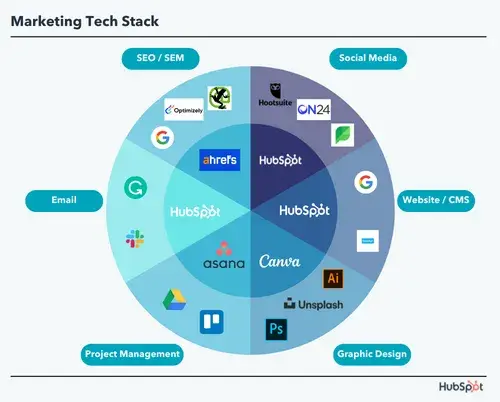
Marketing technology can be used by any type of marketer — even non-digital marketers. One martech tool is typically used for a different marketing discipline.
Here are a few examples of disciplines and a martech tool that can be used for them.
- Search Engine Optimization (SEO): A keyword research tool, such as , is an example of a martech tool for SEO.
- Content marketing: A content management platform such as can be used for content creation.
- Social media marketing: A social management platform such as is an example of a martech tool for social media marketing.
- Search Engine Marketing (SEM): is an example of a martech tool for SEM.
- Event marketing: Lead collection software can be used for lead capture during an event.
- Advertising: A programmatic ad platform such as is an example of a martech tool for advertising.
Instead of adopting a plethora of different tools, some marketers choose a solution where they can achieve it all on one platform, such as .
How is technology used in marketing?
Technology is used by marketers to execute their marketing campaigns. Marketers use software to and collect data so they can get insights related to campaign activity and their impact on customers.
For example, say that your team spends a significant amount of time emailing customers. The action feels repetitive, and it’s keeping people away from more pressing assignments. You may choose to use an , so less time is spent sending emails.
You also want the software you use to related to those emails, so you gain an understanding of how your users interact with them.
In brief, marketers use technology to make their jobs easier and understand their levels of success. The technology that marketers use in their campaigns is known as their marketing tech stack.

The State of Marketing in 2026
黑料吃瓜网's Annual Marketing Trends Report
- AI in Marketing
- Branding and Growth
- Human-Led Creativity
- And More!
What is a martech stack?
A marketing tech stack is the set of tools that marketers use to plan, create, and measure their marketing campaigns. These tools span lead generation, email marketing, social media management, search engine optimization, and customer relationship management.
Let’s say that you primarily focus on SEO and paid ads on social media. Your martech stack might consist of Ahrefs for keyword research and Hootsuite for social media scheduling. Alternatively, you could switch to to take care of both your SEO and social media marketing strategies all on one platform.
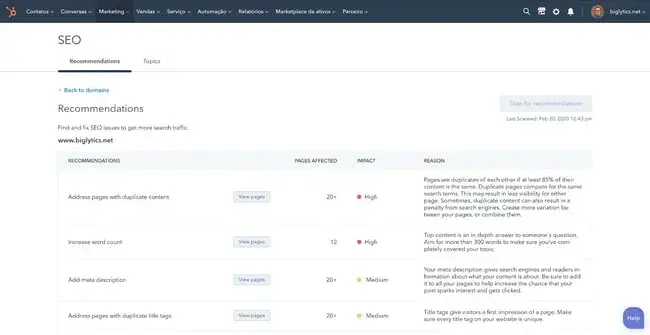
Marketing Hub’s helps you optimize your site with its built-in content strategy and topic recommendation tools, plus as-you-type optimization advice while you’re creating content.
Its will take care of everything related to social media — including post creation and audience engagement analytics. You can even reply directly to comments from the tool.

Why Your Martech Stack Matters More Than Ever
Today’s buyer journeys span search engines, AI answer engines like ChatGPT and Perplexity, social platforms, competitor sites, and email — rarely in a linear order.
“Marketing is made up of fragments and touchpoints, not perfect customer journeys,” Drue Stinnett, Brand and Content Lead at 黑料吃瓜网 for Startups, notes in our report.
Tool sprawl creates data silos and inefficient workflows. A connected martech stack solves that. It improves visibility into the customer journey by turning fragmented activity into a coherent picture across channels and teams.
Core Benefits of an Optimized Martech Stack
An optimized martech stack drives five business outcomes that show up consistently across high-performing teams:
- Connected data. Customer records, campaign activity, and revenue live against the same source of truth, so analytics reflect reality instead of stitched-together exports.
- Team efficiency. A strong martech stack reduces manual work — list segmentation, lead routing, reporting — so marketers can focus on strategy and creative work.
- Personalization at scale. Behavioral signals from one tool power tailored content, ads, and sequences across every other tool in the stack.
- Faster execution. When tools share data automatically, campaign launches skip manual handoffs and one-off CSV uploads.
- Defensible ROI. Multi-touch attribution ties marketing spend back to pipeline and revenue, which are the metrics CFOs actually care about.
How Modern Martech Stacks Work
A modern martech stack runs on a connected data flow centered on the CRM. Five stages link together, with the CRM as the central system of record:
- Data collection. Forms, website analytics, ad pixels, and conversation tools capture every prospect and customer interaction.
- Data enrichment. Integration and sync tools clean records, append firmographic and behavioral signals, and route the result into the CRM.
- Segmentation. CRM and analytics logic group contacts by lifecycle stage, fit, and engagement.
- Activation. Email, social, paid media, and content tools execute campaigns against those segments — often triggered by behavior.
- Measurement. Reporting and attribution tools tie every campaign back to pipeline, then feed results back into the CRM.
Outdated tech stacks have tool sprawl, and tool sprawl creates data silos and inefficient workflows. When the CRM holds the canonical customer record and surrounding tools — analytics, automation, content, advertising, and reporting — read from and write to it, the stack functions as one system instead of disconnected silos.
How to Build a Marketing Tech Stack
Building a martech stack is a business systems decision before it is a software purchase. The strongest stacks start with goals, workflows, and data architecture, then add tools to serve them. Work these steps in order, since each one narrows what you actually need to buy and keeps the stack from drifting into sprawl.
1. Start with your customer journey.
Customer journey mapping comes before tool selection. The stack moves prospects through awareness, consideration, evaluation, decision, and retention, and each tool earns its place by supporting one of those stages. Map four things per stage:
- Audience stages. What a prospect is doing: researching a problem, comparing vendors, requesting a demo, reading reviews.
- Channels. Where prospects show up. A B2B buyer in awareness might search Google, ask ChatGPT for vendor picks, and scroll LinkedIn. Each channel implies a tool.
- Data needs. What to capture to move someone forward, from anonymous page views in awareness to CRM-linked sales signals at decision.
- Drop-off points. Where prospects stall. If demo requests convert at 8% but trials at 1%, the gap between those stages is where a new tool or workflow has to do work.
Drop-off data also shows which categories deserve investment. Strong top-of-funnel traffic with weak mid-funnel conversion calls for lead nurturing, not another SEO subscription.
The State of Marketing in 2026
黑料吃瓜网's Annual Marketing Trends Report
- AI in Marketing
- Branding and Growth
- Human-Led Creativity
- And More!
2. Audit your current tools.
A martech stack audit evaluates tool usage, ownership, integrations, overlap, cost, and business impact. Run it before buying anything new. Teams often find they already own a capability they were about to purchase, or that two tools do the same job at twice the cost. research found that overall martech stack utilization has dropped to 49%. This means marketing teams are leaving more than half of the software capabilities they pay for completely untapped. The audit’s primary job is to identify this underutilization gap and uncover exactly where feature overlap or a lack of team training is draining your ROI.
Inventory each tool against six fields:
- Usage. Who logs in and which features they touch. Low-usage tools are consolidation candidates.
- Ownership. The named person accountable for configuration, renewal, and outcomes.
- Integrations. What the tool connects to, and whether it needs CSV exports or syncs natively with the CRM.
- Overlap. Where two tools do the same job. Pick one and migrate.
- Underuse. Features paid for but never adopted, a downgrade signal.
- Data duplication. The same record in multiple systems with conflicting field values.
贬耻产厂辫辞迟’蝉 marketing operations audit guide and its companion on auditing platform apps walk through more tips.
The output of this step is one document listing every tool, its owner, its usage rate, and a recommendation: keep, consolidate, or cut.
3. Plan your integration architecture.
Integration architecture defines how tools share data and trigger workflows. It answers three questions: which system is the system of record, how data syncs, and what type of integration connects each tool.
- System of record. One tool holds the canonical version of each data object. The CRM owns the contact record; the automation platform owns campaign engagement. When two tools disagree on a field, the system of record wins.
- Sync logic. Decide whether data moves in real time or batches, one direction or both. Most teams start with one-way sync from the system of record, then add bidirectional sync only where a workflow demands it.
- Data flow. Diagram which tool sends what data, to which tool, on what trigger. If you can’t draw it, you can’t troubleshoot it.
Three integration types handle the connections.
- Native integrations are prebuilt by both vendors, such as 贬耻产厂辫辞迟’蝉 ; they install fast and break less often.
- Middleware-driven integrations route data through an iPaaS such as Workato, Boomi, or Zapier when you need to orchestrate many tools at once.
- API-based integrations are custom connections your engineers build when no native option exists.
It’s common for mature stacks to use all three.
4. Identify your primary strategies and goals.
Building a martech stack starts with clear business goals, defined before any tool category enters the conversation. Each category exists to deliver an outcome: CRM owns customer data, automation owns lead nurture, analytics owns attribution, and content tools own organic reach. If you can’t name the outcome a category drives, you can’t justify the spend.
The clearest planning framework moves from goal to strategy to tool category:
- Example 1
- Goal: increase organic traffic
- Strategy: SEO and answer engine optimization
- Category: keyword research, AI search visibility, technical SEO
- Example 2
- Goal: convert more visitors
- Strategy: CRO and on-site personalization
- Category: A/B testing, behavioral analytics, CMS with adaptive content
Categories without a named outcome don’t need a tool. They need a strategy.
5. Survey your team to find their challenges.
Team interviews surface workflow friction that goal mapping alone can’t see. The first sign of a stack problem is usually a manual workaround: a CSV export, a duplicate data entry, a Slack handoff that should be automated. Ask each team owner three questions:
- Which tasks repeat across every campaign? Repetitive list pulling or reporting points to missing automation.
- Where do you wait on another team or tool? Wait states reveal broken integrations or unowned handoffs.
- What data do you rebuild manually? Manual reconciliation signals a data architecture problem.
Tie each challenge to a goal, then to a category. If marketing can’t add CTAs without an engineering ticket, the goal is conversion, and the category is a CMS with drag-and-drop modules. Challenges with no associated goal are usually process problems that a new tool won’t fix.
6. Establish an estimated budget.
Building your dream martech stack means nothing if you can’t afford it. As you begin to determine the types of tools you’ll need, think about the funds you’ll allot for them. When calculating total cost of ownership, budget for five categories, not one:
- Subscription. The recurring per-seat or per-contact fee. Easy to compare, weak as a TCO predictor.
- Implementation. Onboarding, technical setup, data migration, and any required professional services
- Training. Time spent ramping every user to working competency
- Admin time. Ongoing workflow maintenance, user management, and troubleshooting
- Integration and optimization. Engineering or middleware costs to connect the tool, plus the budget to keep improving it
Match the structure to your stage. Monthly subscriptions favor smaller teams that want to cancel easily; annual contracts favor mature teams chasing the discount.
The State of Marketing in 2026
黑料吃瓜网's Annual Marketing Trends Report
- AI in Marketing
- Branding and Growth
- Human-Led Creativity
- And More!
7. Research the tools you’ll consider.
Now that you have your strategies, your tool ideas, and your budget, it’s time to research the actual products you’ll add to your martech stack. Vendor evaluation needs a consistent scorecard to be truly useful. Score each shortlisted vendor against six dimensions:
- Integrations. Native connections to your CRM rank highest; standalone tools with no integration path rank lowest.
- Usability. Time to ramp a new user to working competency
- Scalability. How pricing grows from today’s scale to your one-year projection
- Reporting. Native dashboards, custom reports, and clean export to a central BI tool
- Support. Response times, channel coverage, and access to implementation specialists
- Total cost. Subscription plus the four hidden costs above
Use product roundups and G2 or Gartner Peer Insights reviews to build the shortlist, then run each vendor through the scorecard. Keep it as a spreadsheet, one row per vendor and one column per criterion, and rerun it at every renewal.
8. Consider non-marketing tools for your stack.
Supporting systems often have a bigger workflow impact than the marketing-specific tools beside them. Five categories deserve a spot in the plan:
- Project management. Asana, Trello, or ClickUp for campaign execution and deadlines
- Collaboration and document storage. Google Drive, Notion, or SharePoint for briefs, creative files, and post-mortems
- Communication. Slack or Microsoft Teams for the real-time coordination email can’t handle
- Data sync and integration. iPaaS platforms and native sync tools, including , keep records consistent across systems without manual exports.
- Creative and design. Canva, Figma, or Adobe Creative Cloud to build the visual assets that your channel tools distribute
Run these through the same scorecard. They face the same risk of becoming shelfware if no one owns them.
9. Compile the data you’ll move into the tools.
Data migration can be more overwhelming than expected. Tools install in hours, but moving customer records, segmentation logic, and historical data takes weeks and exposes every hygiene problem accumulated over the years. Plan four components before the first record moves:
- Data cleanup. Deduplicate records, standardize field formats, and reconcile conflicting values. Migrating a dirty database relocates the mess instead of fixing it.
- Naming conventions. Standardize how campaigns, lists, lifecycle stages, and custom properties are labeled. Inconsistent naming is the top reason cross-tool reporting breaks.
- Lifecycle stages. Define one canonical model (subscriber, lead, MQL, SQL, opportunity, customer) and enforce it everywhere.
- Privacy and compliance. Audit consent records, suppression lists, and GDPR/CCPA categorization before the move.
Assign each component a named owner. Migration without ownership produces gaps nobody finds until a report is wrong months later.
10. Assign an owner and a workflow for each tool.
Now, let’s talk governance. The most common reason a stack underperforms is an unowned tool: It accumulates technical debt and renews automatically because no one tracks its value. Give each tool one named owner with three jobs:
- Configuration and workflow design. Set up the tool, build the team’s workflows, and document each one with screenshots and naming conventions.
- Training and rollout. Run a live walkthrough before launch and field questions for the first 30 days.
- Ongoing maintenance. Handle user provisioning, integration health checks, and the annual renewal review.
Document each workflow in one shared location that answers what the tool does, who has access, how to use it step by step, and what the integration touches.
11. Measure success and switch tools when needed.
Martech stack success is measured by adoption, handoff speed, lead quality, attribution, conversion rates, and ROI. Review five signals at each quarterly stack review:
- Adoption. Active users versus licensed seats, by team
- Reporting accuracy. Whether the tool’s numbers reconcile with the CRM
- Handoff speed. Time from a marketing trigger to the downstream action, such as lead to rep or MQL to nurture
- Integration stability. How often syncs fail or fields mismatch
- Business impact. The outcome the tool was bought to drive, from influenced pipeline to organic traffic gained
Schedule reviews quarterly, not just at renewal. A quarterly cadence catches problems early enough to fix them; annual reviews catch them early enough only to cancel.
Martech Stack Tips
As you build your marketing tech stack, you’ll be pulled in all sorts of different directions. When your business is growing, you’ll be tempted to add more complexity to address urgent gaps. We’ve been there. 贬耻产厂辫辞迟’蝉 marketing operations team is all too familiar with the challenge of dealing with more and more as our team grows.
We’ve learned a lot along the way — so we gathered insights from 贬耻产厂辫辞迟’蝉 resident operations experts to ask what they wish they had known when growing 贬耻产厂辫辞迟’蝉 own marketing tech stack.
The State of Marketing in 2026
黑料吃瓜网's Annual Marketing Trends Report
- AI in Marketing
- Branding and Growth
- Human-Led Creativity
- And More!
Strategy first, technology second.
Strategy alignment comes before any tool category decision. Goals, workflows, lifecycle stages, lead management rules, and reporting requirements all have to be defined before a vendor demo gets scheduled. 贬耻产厂辫辞迟’蝉 marketing operations team has this important takeaway: What sets apart truly powerful tech stacks isn’t just about the technology.
“The tools themselves won’t make you successful but rather how you use them,” explains , senior manager of marketing technology at 黑料吃瓜网. Harrington has worked closely with 黑料吃瓜网 Partners, consulting many who were in the midst of building their tech stacks. She taught them to think about their tech stack not as the powerhouse behind their systems, but a vehicle to efficiently and effectively execute their strategy.
If you are still developing your strategy, she says, try drawing out and visualizing your tech stack. This gives you an opportunity to think critically about each tool, the purpose it serves, and where there is any overlap or duplication in your tools.
Keep systems simple.
The “keep it simple, silly” (KISS) principle is as relevant in martech as it is in product design. Simple systems get used and maintained. Complex ones become shelfware that nobody can troubleshoot.
“The #1 driver of complex business systems is complex business rules,” explains , senior director of marketing technology at 黑料吃瓜网. “If you can simplify your go-to-market strategy as much as possible, then regardless of how you structure your systems, you’ll be heading in the right direction.”
Three habits keep a stack simple as it grows:
- Cut overlap before adding tools. If two tools do the same job, pick one and migrate. Parallel platforms produce parallel data and double the admin time.
- Standardize definitions across systems. MQL, lead, opportunity, and customer should mean the same thing in every tool. Different definitions across systems produce different funnel numbers, and nobody trusts the dashboard.
- Avoid premature automation. Automating a broken process accelerates the breakage. Fix the process manually first, then automate when the workflow is stable.
Design for integration.
Your integrations need attention long after you set them up. The build steps earlier covered the big architecture decisions, but keeping those decisions working as your stack grows and your tools update around you is its own ongoing job. Three habits make that easier:
- Pick reliable connections over feature-rich ones. A native integration that runs cleanly every day will serve you better than a feature-rich one that breaks twice a month, and that reliability adds up the longer you run it.
- Map fields explicitly and review them quarterly. Your field mapping drifts as vendors rename properties, add objects, or change data types, so a quarterly review helps you catch that drift before it shows up as a broken report.
- Reduce dependence on manual exports. Any workflow that leans on someone exporting a CSV and uploading it somewhere else will eventually break, and because nothing flags it for you, you often won’t catch the gap until a report comes back wrong. A synced connection is easier to trust, since it surfaces problems as they happen. Wherever you’re moving enough data to justify it, swap those exports for a sync connection or a middleware flow.
Document everything.
Good documentation is what helps your stack survive turnover, role changes, and team growth. Without it, every small change turns into a research project, where you’re digging back through old settings just to figure out why something was built the way it was.
Imagine opening your spice cabinet, ready to cook up a chicken curry, to find that nothing in the cabinet is labeled. Every spice and herb is in the same colored jar, with no ingredient label or expiration date. This is what it’s like to step into a new role only to realize that your new team’s processes and database have not been properly documented.
“I can’t tell you how many times we have to review the history of a change or ‘walk through’ the last couple of years on a topic,” says , senior manager of product marketing at 黑料吃瓜网. “It gets really, really hard if no one has documented anything.”
Make sure your documentation covers these six essentials:
- Integrations: what syncs to what, in which direction, and on what trigger
- Field definitions: the canonical meaning of each property, the system of record, and any allowed values
- Lifecycle rules: the criteria that move a contact from lead to MQL to SQL and back
- Workflow logic: step-by-step descriptions of every automated workflow, with screenshots of conditions and actions
- Naming conventions: standards for campaigns, lists, custom properties, and asset filenames
- Ownership: the named person accountable for each tool, integration, and workflow.
Keep all of it in one shared location your whole team can reach. A single central index will serve you better than a handful of per-tool wikis that slowly drift apart.
The State of Marketing in 2026
黑料吃瓜网's Annual Marketing Trends Report
- AI in Marketing
- Branding and Growth
- Human-Led Creativity
- And More!
Measure what matters.
The best way to judge your stack is by what it actually produces for the business. The metrics worth tracking fall into two groups: operational signals that tell you whether the stack is running smoothly, and commercial signals that tell you whether it’s earning back what you spend on it.
Operational metrics:
- Handoff speed: time from a marketing trigger to the downstream action (lead-to-rep, MQL-to-nurture, signup-to-onboarding)
- Reporting accuracy: whether dashboard numbers reconcile across tools and tie back to the CRM
- Adoption: active users versus licensed seats, segmented by team
- Sync issues: frequency of integration failures, field mismatches, and stale records
Commercial metrics:
- Conversion rates: stage-to-stage conversion against the lifecycle model
- Influenced pipeline: revenue opportunities touched by marketing activity, tracked from first interaction through close
- Cost per outcome: pipeline generated, leads qualified, or content published, divided by total stack spend
If you’re tracking AI search visibility alongside traditional SEO, this is where a tool like fits in. 黑料吃瓜网 AEO tracks your brand visibility across ChatGPT, Perplexity, and Gemini, surfaces where competitors are getting cited instead of you, and shows how that visibility shifts over time, so it lives in the same measurement layer as your web analytics and CRM reporting.
Plan for scale.
The choices you make for a 10-person team rarely hold up once you’re pushing 50 team members. So plan around where you expect to be in 18 months, with the team size, traffic, and data volume you’re growing into, rather than the conditions you have right now.
Four things are worth planning for explicitly:
- Pricing growth: Map each tool’s cost curve from your current contact and seat count to your projected one. A tool whose price 10x’s as your contacts grow calls for a different kind of scrutiny than one with flat pricing.
- Cross-team support: A tool only marketing uses today might be shared with sales, success, and product tomorrow. Look for tools that scale across functions so you’re not boxed into marketing-only seats.
- Reporting maturity: The reporting you need today, like campaign performance and channel ROI, tends to expand into multi-touch attribution, cohort analysis, and revenue forecasting. You want reporting tools that can grow into that work with you.
- Scalability without rework: Your architecture decisions should hold up through a 10x increase in records and a 5x increase in team size. Migrations are already expensive, and reworking a stack while it’s live costs even more.
Switching costs have come down in recent years, thanks to customer data platforms (CDPs) and iPaaS tools that move records between systems without much engineering work. Cheaper doesn’t mean free, though, and selecting for scale up front is still a lot less painful than migrating under pressure later on.
Best Marketing Tech Stack by Category
A category-based view of the stack shows how marketing tools are grouped by function and how each category connects to the others. Buyers evaluate marketing technology one category at a time, against three filters: the outcome the category drives, the integrations that make it useful, and the cost of running it. The categories below map to the build process earlier in this guide.
Foundation: CRM & Marketing Automation
The CRM holds the canonical customer record. Marketing automation triggers campaigns against that record, runs nurture sequences, and writes engagement events back to the CRM. Together, they form the system of record for the stack, and every other tool reads from or writes to them.
Native integration between CRM and marketing automation matters more than feature-by-feature comparisons. Two best-of-breed tools from different vendors stitched together via CSV exports cost more in admin time than a single vendor that handles both natively.
Examples:
- 贬耻产厂辫辞迟’蝉 paired with for connected lead-to-revenue tracking
- Salesforce paired with Marketo Engage for enterprise-scale lead management
- ActiveCampaign for SMB teams running email-led nurture
Best for: Mid-market and enterprise teams that need lead scoring, multi-touch attribution, and pipeline reporting against a single customer record.
Data & Intelligence
Analytics, enrichment, dashboards, and attribution tools convert raw activity into business reporting. Analytics tools count what happened, dashboards display the result, and attribution ties each touchpoint back to revenue.
This category is where reporting credibility lives or dies. Tools in this layer have to reconcile with the CRM, or the dashboards downstream produce numbers nobody trusts.
Examples:
- for website session data
- (formerly Looker Studio) for free dashboards on GA4
- Mixpanel or Amplitude for product analytics
- 贬耻产厂辫辞迟’蝉 for cross-tool reporting against the CRM
Content & Creative
CMS, design, and asset tools own the production side of the stack. The CMS publishes owned media, design tools produce the assets the CMS hosts, and asset management tools store them.
A connected CMS feeds forms, CTAs, and tracked URLs into the CRM. A CMS without CRM integration stops at publishing, and every conversion has to be wired in separately.
Examples:
- for a CMS that ships with native CRM integration, smart content, and pre-built form-to-contact creation
- WordPress for open-source CMS flexibility (with plugins handling forms and tracking)
- Canva or Figma for asset design
- Adobe Creative Cloud for advanced creative production
Email & Marketing Channels
Email, social, and SMS tools execute against owned audiences. They send the message and capture engagement. Their job in the stack is to push that engagement data back into the CRM, so segmentation in one tool reflects behavior across every channel.
Channel tools that don’t sync engagement back create the most common cause of broken personalization: a contact who opened an email three days ago shows up in a social campaign as a cold prospect, because the social tool never saw the engagement.
Examples:
- Marketing Hub’s and for native sync against the CRM
- Mailchimp or Klaviyo for SMB email
- Sprout Social or Buffer for social scheduling and engagement tracking
SEO, AEO, & Content Performance
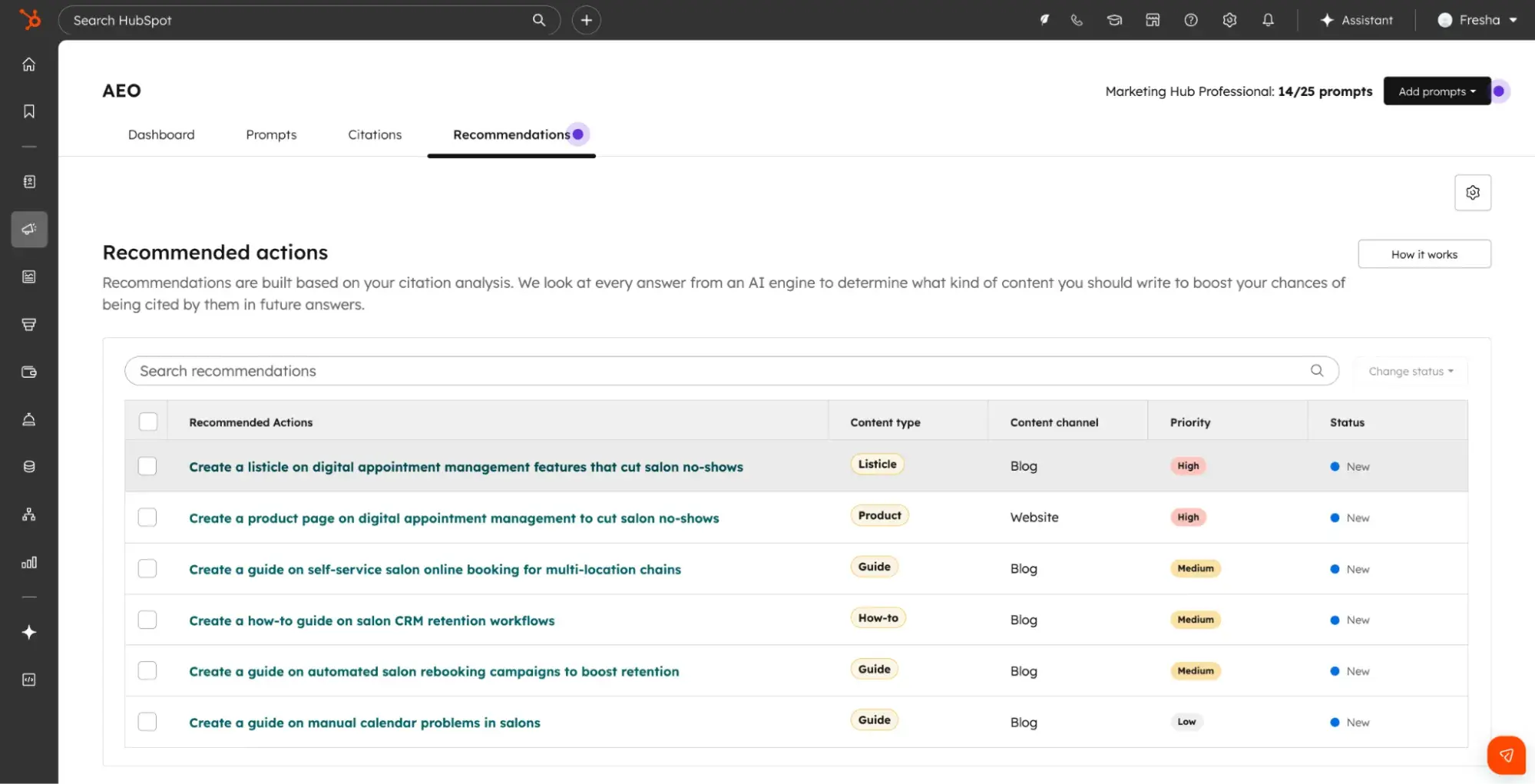
SEO tools target traditional search ranking. AEO tools target answer engine visibility: whether ChatGPT, Gemini, and Perplexity recommend your brand in response to relevant prompts. Content performance tools measure what already-published content is doing.
The category has expanded fast over the last 18 months. SEO tools handle keyword research, rank tracking, and clicks. AEO tools handle the equivalent for answer engines: which prompts are recommending which brands, what content gets cited, and where competitors are showing up that you aren’t.
Examples:
- Ahrefs or Semrush for keyword research, backlink analysis, and rank tracking
- Screaming Frog for technical SEO audits (crawl errors, broken links, sitemap analysis)
- Clearscope or MarketMuse for content optimization against target queries
- , which tracks how a brand appears across ChatGPT, Gemini, and Perplexity, and provides recommendations on how you can improve
Collaboration & Project Management
Project management, document storage, and communication tools coordinate campaign execution. They sit alongside the marketing-specific tools but touch every workflow.
A marketing team without a strong supporting infrastructure executes more slowly than its tool budget would suggest. Campaign timelines live in inboxes, and decisions can’t be traced back to who made them.
Examples:
- Asana, Monday.com, or ClickUp for campaign project management
- Slack or Microsoft Teams for real-time coordination
- Notion, Google Drive, or SharePoint for documentation and asset storage
Advertising & Paid Media
Paid acquisition tools span search ads, paid social, programmatic display, and retargeting. They drive demand against cold audiences and re-engagement against existing ones.
Examples:
- Google Ads for search and YouTube
- Meta Ads Manager for Facebook and Instagram
- LinkedIn Campaign Manager for B2B targeting
Integration & Data Management
iPaaS platforms, ETL tools, and customer data platforms (CDPs) handle the infrastructure layer. They move data between tools, enforce field mapping, and centralize customer records.
For teams running more than a handful of tools, this category is what stops the stack from degrading into a CSV-export operation. iPaaS sits between applications and orchestrates data exchange across many tools at once.
Examples:
- 贬耻产厂辫辞迟’蝉 , built into Data Hub, for native two-way sync between 黑料吃瓜网 and downstream apps
- Workato, Boomi, or Tray.io for enterprise-grade iPaaS
- Zapier for SMB workflow automation
- Segment or RudderStack for CDP-style customer data routing
Best for: Teams with five or more tools where data has to flow between them. Below that threshold, native integrations usually do the job.
B2B-Specific Considerations
B2B martech stacks layer specialized tools onto the foundation. Account-based marketing (ABM), sales intelligence, and B2B attribution all reflect the longer sales cycles and multi-stakeholder decisions that B2B markets work through.
A B2B stack also has to align tightly with sales. Lead-to-rep routing, lead scoring, and sales engagement signals all live at the marketing-sales boundary, and weak alignment shows up as missed SLAs and lost pipeline.
Examples:
- 6sense or Demandbase for ABM and intent data
- ZoomInfo or Apollo for sales intelligence and contact enrichment
- Dreamdata for B2B multi-touch attribution
- 贬耻产厂辫辞迟’蝉 revenue attribution reporting (included in Marketing Hub Enterprise) for source-to-pipeline tracking against the CRM
How These Tools Work Together
The connected stack runs on a hub-and-spoke pattern with the CRM at the center. Every spoke writes data into the hub and reads from it on the way out.
- Content and creative tools publish into channels that drop visitors back into the CRM through forms.
- Email and channel tools read CRM segments and write engagement back.
- SEO and AEO tools identify which queries and prompts are sending traffic, and content tools act on the gaps.
- Paid media tools receive CRM-defined audiences and feed conversion data back through offline conversion uploads.
- Analytics and attribution tools read every touchpoint and tie revenue to source.
- The integration layer keeps all of that in sync.
When the CRM holds the canonical customer record and surrounding tools all read from and write to it, the stack functions as one system. When tools maintain parallel records and reconcile through CSV exports, the same architecture diagram produces a different report every time.
Frequently Asked Questions About Martech Stacks
What are marketing tech stacks?
A marketing tech stack is the collection of software tools a marketing team uses to plan, create, and measure campaigns. Core tool types include CRM and marketing automation (the foundation), analytics and attribution, content management and creative tools, email and channel platforms, SEO and AEO software, paid media managers, and integration tools that sync data between systems. A martech stack functions as one connected system when every tool reads from and writes to a central customer record, typically held in the CRM.
What is an example of martech?
A small B2B team might run 黑料吃瓜网 as its CRM and marketing automation foundation, for the website and blog, Google Analytics for traffic data, Ahrefs for keyword research, for tracking brand visibility across ChatGPT and other answer engines, LinkedIn Campaign Manager for paid ads, and Canva for creative production. Each tool connects to the CRM through native integrations or middleware like Zapier, so contact records, engagement data, and conversion events stay synced across the stack.
How to build a marketing tech stack?
Building a martech stack starts with strategy, not software. Map the customer journey to identify what tools each stage requires. Audit existing tools to surface overlap, low usage, and integration gaps. Plan an integration architecture by defining the system of record and how data flows between tools. Match each tool category to a business goal, then evaluate vendors against a scorecard covering integrations, usability, scalability, reporting, support, and total cost. Migrate data carefully, assign each tool a named owner, and review performance quarterly against adoption, attribution accuracy, and pipeline impact.
What are the 4 technology stacks?
The phrase usually comes from software development, not marketing. There, a stack bundles the layers that run an application, with common examples like LAMP, MEAN, MERN, and .NET. A marketing tech stack works differently. It isn’t a fixed set of four, but a collection of tools grouped by function: CRM and marketing automation, data and analytics, content and creative, marketing channels, SEO and AEO, advertising, and integration. So if you searched “the 4 technology stacks” expecting a marketing answer, the more useful question is which of those categories your stack actually needs, which the section above breaks down.
How many tools should be in a martech stack?
There is no universal number, but most teams perform better with fewer, deeply integrated tools than with many disconnected ones. Tool sprawl creates data silos and unused subscriptions. In fact, Gartner research shows that overall martech stack utilization has dropped to 49%, meaning marketing teams are leaving more than half of the software capabilities they pay for completely untapped. A practical benchmark: Cover each core category (CRM, automation, analytics, content, channels, paid, integration) with one tool, then expand only when a clear gap appears.
What’s the difference between B2B and B2C martech stacks?
B2B martech stacks support longer sales cycles, multi-stakeholder buying committees, and tight sales-marketing alignment. They prioritize CRM integration, account-based marketing platforms, lead scoring, sales intelligence, and multi-touch attribution that tracks pipeline over months.
B2C stacks support shorter, higher-volume purchase decisions made by individual consumers. They emphasize transactional email, loyalty programs, ecommerce integrations, paid social at scale, and real-time personalization based on browsing or purchase behavior. Both rely on a central customer record, but B2B reporting ties to opportunities and deals while B2C reporting ties to orders, lifetime value, and repeat purchase rates.
Build a martech stack that helps you grow better.
With all of the tools available these days, there is no need to use clunky, complex, and time-consuming legacy software. We believe you shouldn’t have to sacrifice productivity to get power, because the best tools combine both power and ease-of-use. When you focus on delighting your customers and creating great experiences instead of managing your software, you will grow better.
Editor’s note: This post was originally published in December 2019 and has been updated for comprehensiveness.
The State of Marketing in 2026
黑料吃瓜网's Annual Marketing Trends Report
- AI in Marketing
- Branding and Growth
- Human-Led Creativity
- And More!