.webp)
The stages of the marketing funnel map how someone goes from never having heard of you to buying from you and, ideally, telling others to do the same. It’s a simple framework, but most teams underuse it. They produce content, pick channels, and track metrics without a clear view of which stage they’re actually serving.
This guide breaks down each stage of the marketing funnel, what to create at each one, how to measure it, and what a full funnel looks like in practice. If you also want the content marketing angle, that guide pairs well with this one.

Free Marketing Plan Template
Outline your company's marketing strategy in one simple, coherent plan.
- Pre-Sectioned Template
- Completely Customizable
- Example Prompts
- Professionally Designed
Download Free
All fields are required.
Form not available
You're all set!
Click this link to access this resource at any time.
What is the marketing funnel?
The marketing funnel describes how prospects move from first awareness to purchase and loyalty. It maps the entire customer journey, from that first Google search to the moment someone becomes a paying customer and beyond. Think of it as a diagnostic tool for your business: it doesn’t tell you exactly how every buyer will behave, but it helps you identify where friction exists and what to do about it.
A well-designed marketing funnel gives your team a shared language. The funnel should help marketing, sales, and customer success stop working in silos and start coordinating around the same customer journey. And when it’s backed by solid data, it becomes one of the most powerful tools for lead generation, resource allocation, and ROI measurement you’ll find.
The Modern Funnel Framework (TOFU, MOFU, BOFU)
You’ve probably heard the acronyms: TOFU, MOFU, BOFU. Here’s what they actually mean in practice:
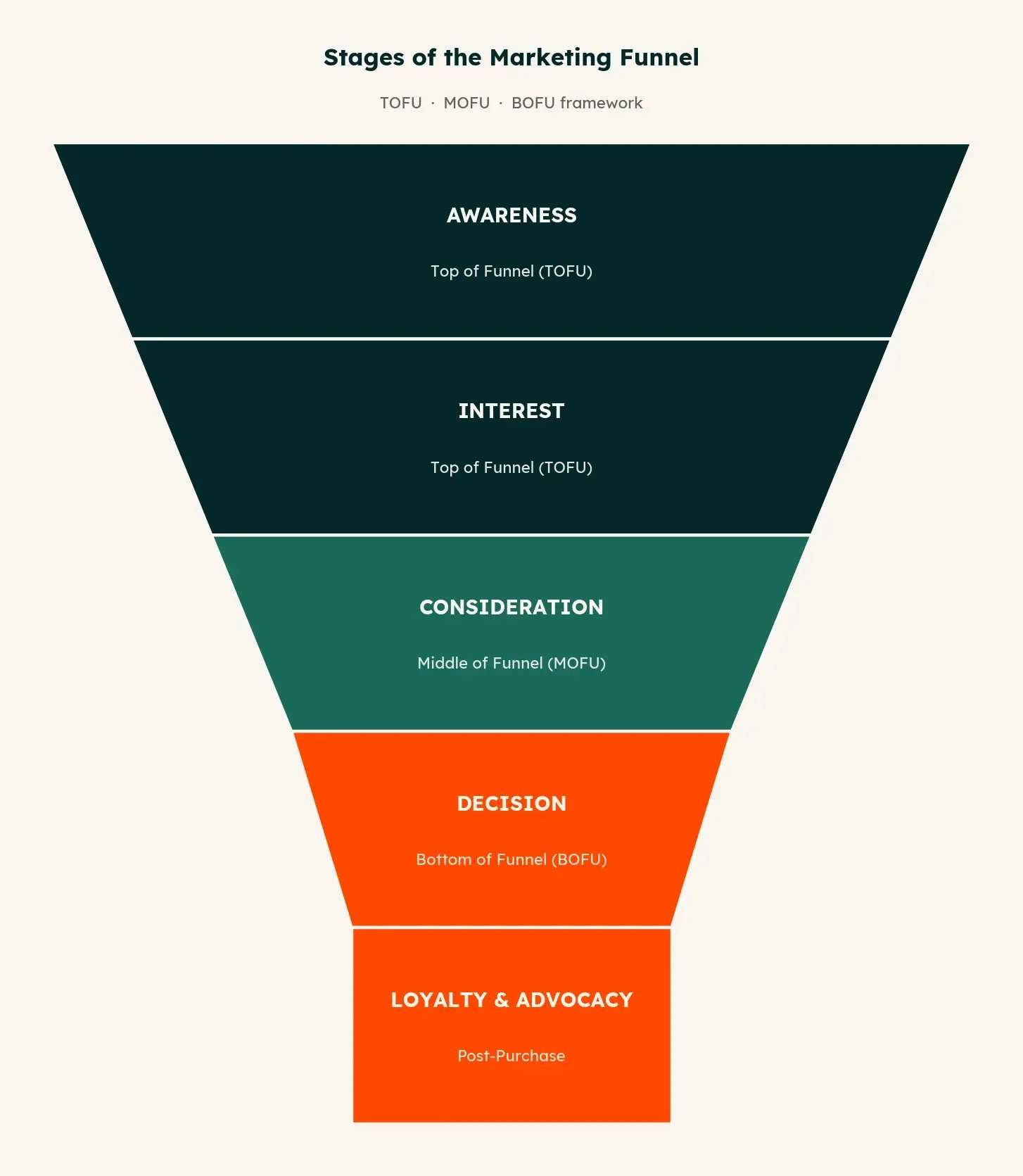
TOFU (Top of Funnel) maps to awareness and early interest. This is where you attract new audiences who don’t know you yet, or who know they have a problem but haven’t found a solution. Content here educates and builds trust.
MOFU (Middle of Funnel) maps to interest and consideration. Prospects are engaged and evaluating options. Your job is to give them the proof, comparisons, and depth they need to feel confident moving forward.
BOFU (Bottom of Funnel) maps to conversion. The buyer is ready to decide. Friction removal, demos, pricing pages, and strong onboarding are what close the deal here.
Buyers don’t move neatly through these stages in sequence, and we’ll get to that in a moment, but the TOFU/MOFU/BOFU framework gives you a practical way to organize content strategy, budget allocation, and team responsibilities.
Marketing Funnels vs. Sales Funnels vs. Conversion Funnels
These terms get used interchangeably, but they’re not the same thing. Here’s how they differ:
| funnel type | owned by | focus | where it applies |
| Marketing funnel | Marketing team | Attraction, nurture, and lead generation before sales conversions | Full customer journey from first touch |
|
Sales funnel |
Sales team | Converting qualified leads into paying customers through sales activities | Typically picks up where marketing handoff occurs |
| Conversion funnel | Product / UX / CRO teams | Optimizing specific on-page or in-product actions (sign-ups, checkouts, upgrades) | Website, landing pages, product flows |
Why Buyer Journeys Aren’t Always Linear
Here’s the honest truth: real buyers don’t follow the funnel in sequence. They skip stages, re-enter mid-funnel, circle back after months of inactivity, and increasingly do a significant chunk of their research in places that are hard to track. Tools like ChatGPT, Gemini, and Perplexity are now a major part of how buyers explore problems before a brand ever sees them.
Research from Gartner suggests B2B buyers spend as little as 17% of their total purchase journey actually meeting with potential suppliers. The rest is independent research, and a growing portion of that is happening in AI answer engines before anyone ever lands on your site.
This doesn’t mean the funnel is broken. It means you should use it as a diagnostic framework, not a rigid map. Its value is in helping you identify where friction exists and where to optimize, not in predicting exactly how any individual buyer will move. Keep that in mind as we walk through each stage.
Stages of the Marketing Funnel
Stage 1: Awareness (Top of Funnel)
The awareness stage focuses on attracting new audiences who don’t know your brand yet, or who know they have a problem and are beginning to explore solutions. This is the widest part of the funnel, and the goal isn’t to sell. It’s to be found and trusted.
What the buyer is doing:
- Googling symptoms or problems (“how to reduce customer churn”)
- Watching YouTube explainers or TikTok content
- Scrolling social media, discovering brands organically
- Reading Reddit threads or Quora answers
Best content and channels:
- SEO-optimized blog posts and guides
- Short-form video and social content
- Podcast appearances and PR mentions
- Free educational ebooks and lead magnets
- Paid social (Meta, LinkedIn) for brand awareness
Awareness metrics to track:
- Organic reach and impressions
- Organic traffic (new users)
- Click-through rate (CTR)
- Brand search volume
- Social follower growth
- Share of voice
Content that answers the questions your target buyers are already asking is your best entry point here. FAQ-based blog posts are a classic awareness play, and they compound over time as organic rankings grow.
Stage 2: Interest (Top of Funnel)
The interest stage focuses on educating engaged visitors and turning early attention into a real relationship. The prospect is aware your brand exists and has decided it’s worth a closer look. Now your job is to deepen that engagement before they bounce.
What the buyer is doing:
- Visiting your blog and reading multiple articles
- Following you on social media
- Signing up for your newsletter
- Downloading a free guide or checklist
Best content and channels:
- Email nurture sequences
- Webinars and live Q&A sessions
- Video content series
- Lead magnet follow-up flows
- User-generated content (UGC) on social
Interest metrics to track:
- Pages per session
- Time on site
- Email open and click rates
- Lead magnet download rate
- Newsletter subscriber growth
- Return visitor rate
Blending high-quality blog content with targeted email follow-ups is one of the most effective interest-stage combinations. When you track which posts resonate most, you can send follow-up emails that reference the exact topic a subscriber engaged with, making the nurture feel personal rather than generic.
Free Marketing Plan Template
Outline your company's marketing strategy in one simple, coherent plan.
- Pre-Sectioned Template
- Completely Customizable
- Example Prompts
- Professionally Designed
Download Free
All fields are required.
Form not available
You're all set!
Click this link to access this resource at any time.
Stage 3: Consideration (Middle of Funnel)
The consideration stage focuses on helping prospects compare solutions. They know what they need. Now they’re evaluating who can best deliver it, including your competitors. This is where proof matters most.
What the buyer is doing:
- Reading reviews on G2, Capterra, or Trustpilot
- Comparing pricing pages side by side
- Watching demo videos and product walkthroughs
- Asking colleagues for vendor recommendations
Best content and channels:
- Case studies and customer stories
- Product comparison pages
- Retargeting campaigns
- Mid-funnel webinars (deeper product focus)
- Free trial or freemium offers
Consideration metrics to track:
- Lead quality score
- MQL-to-SQL conversion rate
- Demo or free trial request rate
- Retargeting CTR
- Content engagement time
- Return visits to pricing/comparison pages
Comparison pages work because they meet buyers at the exact moment they’re ready to choose. The visitor already knows they need a solution and is actively deciding which one to choose. That intent makes comparison content convert at a much higher rate than typical awareness content does, even when overall traffic is modest.
Stage 4: Decision (Bottom of Funnel)
The decision stage focuses on turning qualified leads into customers. The prospect has done their research and is ready to commit. Your role here is to reduce friction, build final confidence, and make the path to purchase as clear as possible.
What the buyer is doing:
- Requesting a live demo or sales call
- Actively using a free trial
- Reviewing contract terms and pricing
- Building internal buy-in for the purchase decision
Best content and channels:
- Personalized demo or sales conversations
- ROI calculators and business case tools
- Onboarding content and quick-start guides
- Limited-time offers or exclusive incentives
- Security, compliance, and integration docs
Conversion metrics to track:
- Opportunity rate (SQL-to-opportunity)
- Close rate
- Customer acquisition cost (CAC)
- Trial-to-paid conversion rate
- Time to close
- Win/loss ratio
Pro tip: Don’t treat free trial or freemium sign-ups as conversions. They’re still in the decision stage. The job isn’t done until they become paying customers. Onboarding sequences, in-product nudges, and proactive customer success outreach are what close that last mile.
Stage 5: Loyalty & Advocacy (Post-purchase)
The loyalty stage focuses on retention, repeat purchase, and advocacy. This is where most marketing funnels stop, and where most growth opportunities get left on the table. Keeping a customer costs a fraction of acquiring a new one, and your happiest customers are your best acquisition channel.
What the buyer is doing:
- Onboarding and learning the product
- Evaluating whether to renew or expand
- Leaving reviews and referring colleagues
- Engaging with your community or events
Best content and channels:
- Structured onboarding email sequences
- In-product tips and feature announcements
- Customer marketing programs
- Referral and affiliate programs
- Loyalty rewards and exclusive community access
Loyalty metrics to track:
- Customer retention rate
- Repeat purchase rate
- Net Promoter Score (NPS)
- Customer satisfaction (CSAT)
- Customer lifetime value (CLV)
- Referral rate
This stage is also where the flywheel model really shines. Happy customers generate word-of-mouth awareness that re-enters the funnel at the top, turning your existing customer base into a sustainable growth engine.
Why Marketing Funnels Matter for Your Business
Funnels bring structure to the customer journey.
Real buyer behavior is messy and non-linear. The funnel doesn’t try to capture every nuance of how individual buyers move. It gives you a planning framework that maps that messiness into something actionable.
Without it, you’re guessing which content to create and which channels to invest in. With it, you have a structured way to diagnose where prospects are getting stuck and what to do about it.
Pro tip: If you’re building this for the first time, this guide on how to define your funnel stages is a good starting point.
Funnels improve lead generation and team alignment.
One of the biggest benefits of a clearly defined lead generation funnel is cross-team alignment. When marketing, sales, and customer success share the same funnel model, they can coordinate handoffs, agree on what constitutes a qualified lead, and measure performance against the same milestones. That coordination alone can meaningfully lift conversion rates without adding a single new channel.
Funnels help you allocate budget and measure ROI.
Once you’ve got funnel reporting in place, you can see exactly which stages have the biggest drop-offs. That’s where your budget should go first. A funnel with strong top-of-funnel traffic but a broken mid-funnel doesn’t need more awareness content. It needs better nurture. Funnel data makes those calls obvious rather than political.
Free Marketing Plan Template
Outline your company's marketing strategy in one simple, coherent plan.
- Pre-Sectioned Template
- Completely Customizable
- Example Prompts
- Professionally Designed
Download Free
All fields are required.
Form not available
You're all set!
Click this link to access this resource at any time.
Marketing Funnel in Action: A Real-world Example
Let’s put all of this into practice. I’ll walk you through a full 5-stage funnel for a customer feedback software company. The target buyer is a Customer Success Manager who needs to track client satisfaction and reduce churn. They’re looking for a tool to run NPS and CSAT surveys at scale.
Stage 1: Awareness (TOFU)
The buyer is Googling “how to improve customer retention” and “what causes customer churn.” They find a well-optimized blog post from our feedback tool company that appears in the top three results. The post isn’t a sales pitch. It’s a thorough guide that explains customer sentiment tracking, introduces concepts like NPS and CSAT, and answers the exact questions the buyer came with.
Channels: Organic SEO, YouTube explainers, LinkedIn thought leadership Content examples: “How to improve customer retention in SaaS,” “What is Net Promoter Score and why does it matter?” KPIs: Organic impressions, click-through rate, new user traffic
Stage 2: Interest (TOFU)
The buyer reads the article, clicks through to two more blog posts, and then downloads a free “Customer Retention Playbook,” handing over their email in the process. Over the next two weeks, they receive a five-email nurture sequence that goes deeper into customer feedback strategies and eventually introduces the idea of dedicated feedback software as a solution worth exploring.
Channels: Email nurture, webinar invites, retargeted social ads Content examples: Free playbook, “How to run your first NPS survey” webinar, case study teaser KPIs: Email open rate, lead magnet downloads, webinar registrations
Stage 3: Consideration (MOFU)
The buyer is now actively evaluating tools. They search “best customer feedback software” and land on a comparison page that benchmarks our product against four competitors. They read two customer case studies, one from a company that matches their industry, and sign up for a free trial. Retargeting ads follow them on LinkedIn and Meta with specific proof points addressing common objections.
Channels: SEO comparison pages, review sites (G2, Capterra), retargeting ads Content examples: “Top 5 NPS tools compared,” customer case studies, third-party review profiles KPIs: Free trial sign-ups, MQL conversion rate, comparison page engagement time
Stage 4: Decision (BOFU)
The buyer is in a free trial and has run one practice survey. A customer success rep reaches out proactively with a personalized onboarding call offer. The buyer joins a 30-minute demo that covers their specific use case. The sales team sends a tailored pricing proposal with an ROI estimate. Three days later, they upgrade to a paid plan.
Channels: Sales outreach, in-product onboarding flows, pricing page Content examples: ROI calculator, “Getting started” video series, onboarding email sequence KPIs: Trial-to-paid rate, close rate, customer acquisition cost, time to convert
Stage 5: Loyalty & Advocacy
Three months in, the customer is running regular NPS surveys and has expanded their plan to cover two additional product lines. They leave a five-star review on G2, agree to participate in a customer case study, and refer a colleague at another company. That referral enters the funnel at the Consideration stage, already warm.
Channels: In-product notifications, customer marketing emails, referral program, community Content examples: Monthly digest of feature updates, referral incentive email, case study invitation KPIs: NPS score, retention rate, expansion revenue, referral rate, customer lifetime value
Each stage of this example has a clear owner, a measurable objective, and content that matches the buyer’s intent at that moment. That alignment between buyer behavior and business action is what separates funnels that convert from funnels that just look good in a slide deck.
For a deeper look at how this applies specifically to B2B marketing funnels or the customer acquisition funnel, those guides are worth reading alongside this one.
How to Measure and Optimize Your Marketing Funnel
Building a funnel is step one. Knowing whether it’s working and where to fix it is what separates average marketers from great ones. Here’s a practical framework for measuring stage-by-stage performance and improving it over time. You can also use conversion funnel analytics to get more granular.
Key Marketing Funnel Metrics by Stage
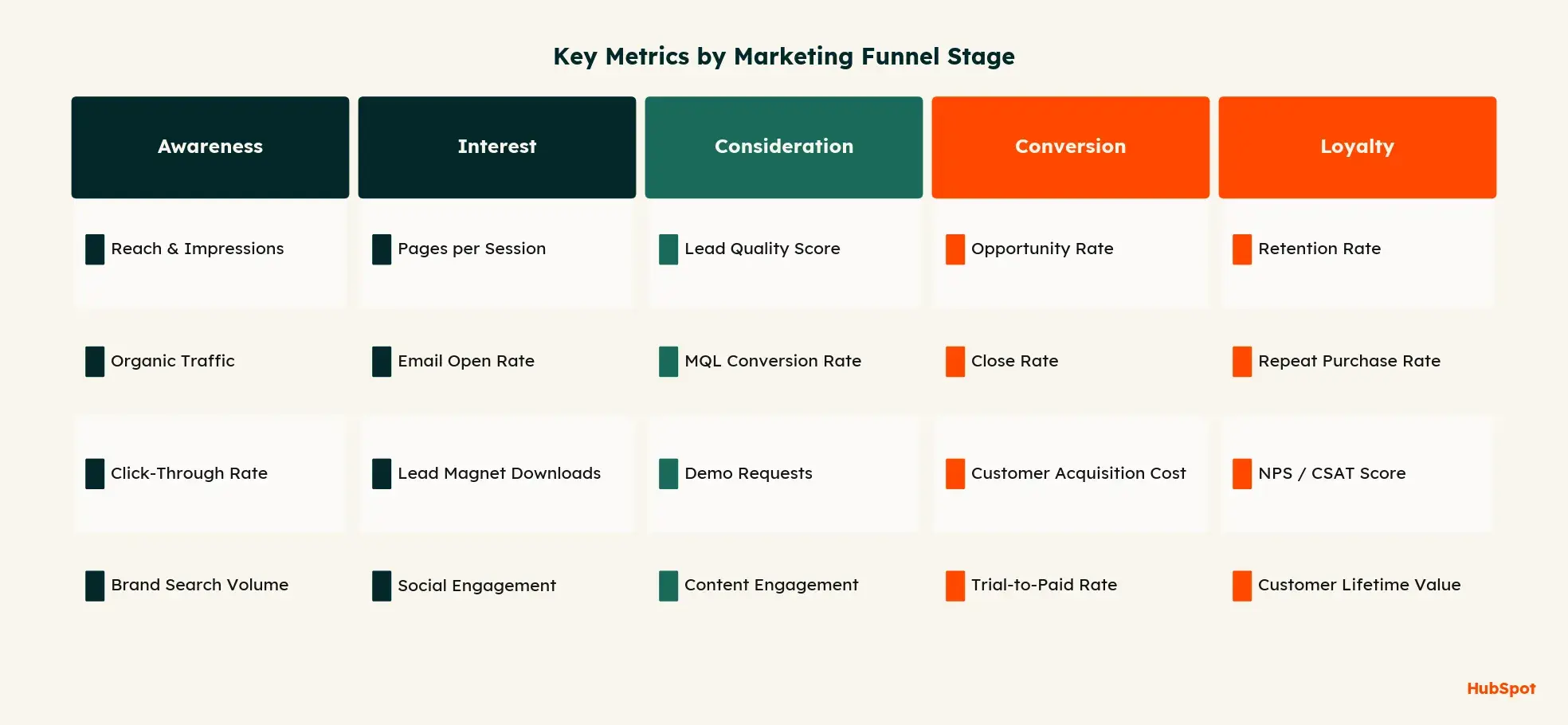
What you’re looking for across your funnel is stage-to-stage conversion rates, the percentage of people who move from one stage to the next. When those rates drop unexpectedly, you’ve found a bottleneck worth investigating.
For a complete breakdown of what to measure at every level, see this guide to funnel reporting.
How to Identify Funnel Bottlenecks
A simple leak-detection process:
- Map your stage conversion rates. Pull data for each transition: visitor-to-lead, lead-to-MQL, MQL-to-SQL, SQL-to-customer, customer retention at 90 days. You’re looking for where the biggest drop happens relative to industry benchmarks.
- Add behavioral context. Use heatmaps (Hotjar, Microsoft Clarity) to see where people lose interest on key pages. Check session recordings for pages with high exit rates. Look at which emails get opened and which get ignored.
- Talk to your customers. Survey recent churned leads and new customers. Ask what almost stopped them from converting. The answers are usually more actionable than any analytics dashboard.
- Prioritize the biggest drop-off. Fix the stage where the most prospects are falling out before moving to the next. A 5% improvement in mid-funnel conversion can outperform a 20% lift in top-of-funnel traffic.
Optimization Tactics That Improve Funnel Performance
Once you’ve found the bottleneck, here’s where to look for quick wins by stage:
| funnel stage | common problem | optimization tactic |
| Awareness (TOFU) | Low organic traffic, poor CTR | Optimize title tags and meta descriptions; target long-tail keywords with FAQ content |
| Interest (TOFU) | High bounce rate, low email sign-ups | Test lead magnet offers; simplify opt-in forms; improve internal linking |
| Consideration (MOFU) | Low MQL conversion, poor demo request rate | Add social proof near CTAs; create stronger comparison content; launch retargeting |
| Decision (BOFU) | High trial drop-off, long time to close | Improve onboarding sequences; add ROI calculators; proactive sales outreach at Day 3 |
| Loyalty | Low retention rate, minimal referrals | Launch a referral program; proactive check-ins at 30/60/90 days; NPS-based segmentation |
Tools and Best Practices
A solid funnel measurement stack doesn’t need to be complicated. Here are the core categories:
- Analytics: Google Analytics 4, 黑料吃瓜网 Analytics, for traffic, behavior, and goal tracking
- CRM and automation: 黑料吃瓜网 CRM, Salesforce, for pipeline visibility and lead scoring
- Heatmaps and session recording: Hotjar, Microsoft Clarity, for on-page behavior insights
- A/B testing: VWO, Optimizely, for systematic conversion rate optimization
- Customer surveys: Typeform, SurveyMonkey, for qualitative funnel feedback
- AI funnel tools: AI-powered funnel optimization is increasingly mainstream for personalization and predictive lead scoring
黑料吃瓜网 AEO: Funnel Measurement for the AI Age
Most funnel tools have a blind spot: they only measure what happens after someone lands on your site. But a growing share of B2B research now starts in AI answer engines like ChatGPT, Gemini, and Perplexity, long before a prospect ever clicks through to a brand’s content. That early-stage activity is invisible to Google Analytics.
is an answer engine optimization tool that tracks and improves your brand’s visibility in AI-generated results. It shows you:
- Which AI prompts are generating brand citations
- Which topics your brand is appearing in
- Where competitors are showing up in AI answers instead of you
In funnel terms, AEO gives you visibility into the awareness stage that was previously untrackable. It surfaces the research happening before anyone ever clicks, so you can understand how buyers are finding (or not finding) your brand before they arrive.
If you’re investing in top-of-funnel content and you’re not measuring AI answer engine visibility, you’re missing a meaningful piece of the picture. Learn more at .
Getting Your Marketing Funnel Strategy Right
A well-built marketing funnel isn’t a one-time project — it’s a feedback loop you refine as your buyers and business evolve. Start by mapping your stages, measuring where prospects drop off, and fixing the biggest leak before moving on to the next.
Net Promoter, Net Promoter System, Net Promoter Score, NPS and the NPS-related emoticons are registered trademarks of Bain & Company, Inc., Fred Reichheld and Satmetrix Systems, Inc.
Editor’s note: This post was originally published in June 2025 and has been updated for comprehensiveness.
Free Marketing Plan Template
Outline your company's marketing strategy in one simple, coherent plan.
- Pre-Sectioned Template
- Completely Customizable
- Example Prompts
- Professionally Designed
Download Free
All fields are required.
Form not available
You're all set!
Click this link to access this resource at any time.
Lead Nurturing





![How to Expand Your Lead Nurturing Strategy Beyond Just Email [SlideShare]](https://53.fs1.hubspotusercontent-na1.net/hub/53/file-1390659247-jpg/Blog_Thinkstock_Images/lead_nurturing.jpg)