
Proving the value of marketing has always been tricky, let alone the value of SEO. You’re investing time, budget, and creative energy, but when stakeholders raise their eyebrows at your budget or strategy, it’s easy to wonder, “Am I tracking the right KPIs in SEO?”
A key performance indicator or KPI in SEO is a data point tied to search performance and business outcomes. Choosing the right ones is how you measure SEO performance, prioritize work, and make a compelling case to leadership for higher budgets or increased headcount.
This article walks through essential SEO performance metrics so you can build a reporting framework that ties them to a business outcome.
Table of Contents
- What are SEO KPIs and why do they matter?
- How to Choose the Right SEO KPIs
- Essential Organic Search KPIs
- Technical SEO KPIs
- Link and Authority KPIs
- Answer Engine Optimization (AEO) KPIs
- SEO ROI and Business Impact KPIs
- Creating Your SEO KPI Dashboard
.png)
Complete SEO Starter Pack
An introductory kit to optimize your website for search.
- Increase your organic traffic.
- Plan your keyword strategy.
- Debunk SEO myths.
- Build a blog strategy.
Download Free
All fields are required.
Form not available
You're all set!
Click this link to access this resource at any time.
What are SEO KPIs and why do they matter?
An SEO KPI is a metric that tells you whether your organic search strategy is working. In other words, it tells you definitively whether it’s contributing to something your business cares about. Not all metrics qualify. Metrics become KPIs when they’re tied to a specific goal, measured consistently, and actionable. All the rest are vanity metrics.
Here’s the difference in short:
- Vanity metrics look good in a report, but don’t tell you much about your actual performance. (i.e., total pageviews, followers on social media, click rate)
- True marketing KPIs measure the percentage of organic visits that complete a desired action and tie directly to pipeline (i.e., Organic conversion rate)
According to Conductor, reported that SEO positively impacted both website performance and marketing goals, but how do they know? It all starts with choosing the right KPIs.
Just getting started with SEO? Download for everything you need to get your website and blog ranking in search.
How to Choose the Right SEO KPIs
The best SEO KPIs depend on what your business actually does.
Start by thinking about what your business needs from its marketing. For example, an e-commerce brand ultimately needs to drive purchases. A B2B SaaS company needs to generate leads and demo requests. A local business needs it to drive calls and foot traffic. Your KPIs must reflect how organic search helps your goals, not just what’s easy to pull from a dashboard.
Next, filter out vanity metrics or metrics that look good on paper, but have any real tie to your business goals. Total pageviews, keyword count, and raw impressions all fall into this trap. A real KPI is tied to an outcome someone in leadership cares about, like revenue, pipeline, conversions, or cost efficiency.
Lastly, keep your list short. Choose 5–7 metrics that span visibility, traffic quality, conversions, and business impact initially. Add more only when your program matures and you have the bandwidth to act on additional signals. This helps prevent your team from overextending itself or focusing on things that don’t really matter.
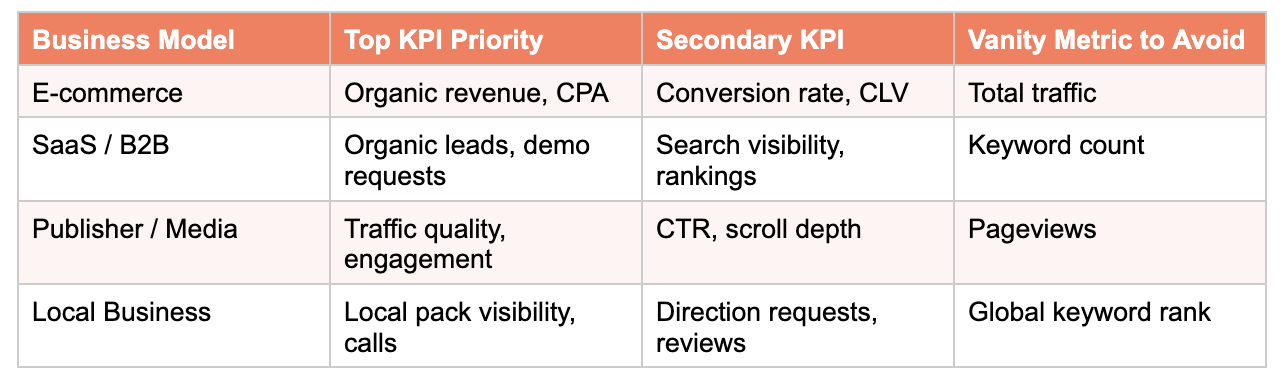
In the rest of this article, we’ll dig into all of the SEO KPIs options, but here’s a quick decision framework based on the most common for different business models:
 Read: B2B Marketing KPIs: 24+ Every Business Should Be Tracking (And Why They're Not The Same As Metrics)
Just find your row, and follow it to see which KPIs to prioritize, which to track as secondary metrics, and which popular metrics to skip entirely.
Essential Organic Search KPIs
Organic search KPIs fall into two categories: traffic metrics and business-impact metrics. Traffic tells you who is showing up, while business metrics tell you whether they matter. Most teams focus on traffic metrics and under-invest in business-impact metrics, but trust, you need both.
Bucket 1: Traffic Metrics
1. Search Visibility
Search visibility is how often a site appears tracked search results. It’s typically shown as a percentage in tools like Semrush or Ahrefs.
A visibility score of 10% means you appear in results for roughly 10% of your tracked keyword set. The higher your percentage, the more you’re showing up.
Why it matters: Visibility is a leading indicator that can help spot and predict traffic changes before they happen. If your visibility score starts dropping, for instance, it can be an early warning that organic sessions are likely to follow, giving you time to act before the damage begins.
- How to track: Semrush Position Tracking, Ahrefs Rank Tracker, or Google Search Console’s Performance report
- How to improve: Target featured snippets, improve rankings for mid-tier keywords, and fix indexation issues
2. Organic Traffic
Organic traffic is the number of visits from unpaid search results. It’s one of the most tracked SEO metrics, but not on its own.
, Sr. Director of Global Growth & Paid at 黑料吃瓜网 puts it well: “Any metric in isolation can be misleading. 黑料吃瓜网’s SEO team used to obsess over organic traffic, and sessions skyrocketed. But we’d lost sight of quality. Leads and signups weren’t following sessions.”
The fix? Pair organic traffic with conversion data for a full picture. is driven by organic traffic across multiple industries, so volume matters, but quality matters more.
- How to track: Google Analytics 4 (GA4) under Acquisition > Traffic Acquisition, filtered to ‘Organic Search’, 黑料吃瓜网 Reporting
Pro Tip: Segment organic traffic by landing page, device, and new versus returning users to assess quality, not just volume.
3. Organic Click-Through Rate (CTR)
Organic click-through rate measures the percentage of search impressions that become clicks.
According to , the average top organic result captures approximately 27.6% of all clicks. CTR drops sharply after position one, so improving even from position three to position one for a key term can meaningfully impact traffic without any link-building.
A page showing up on page one and getting a ton of impressions, but getting a low CTR is a signal that your title tag or meta description isn’t compelling.
- How to track: Google Search Console > Performance > Average CTR, filtered by page or query
- How to improve: Test title tags with numbers, questions, or power words; optimize meta descriptions as ad copy
Pro Tip: GSC shows average CTR by query. Sort by impressions and filter for queries with CTR below 3%. Those are your fastest wins. Better titles alone can lift click volume without changing rankings.
4. Keyword Rankings
Keyword rankings show where pages appear for target queries. Rankings are not a business outcome on their own, but they’re essential leading indicators, especially for conversion-driving keywords.
Focus on rankings for bottom-of-funnel terms (e.g., “CRM software for small business”) over broad informational queries like “What is a CRM?”.
Don’t get me wrong: broad, informational queries can bring in qualified traffic as well, but they’re so early in the buyer’s journey, they’re less likely to lead to immediate sales activity. That said, a page ranking #1 for a branded, high-intent term is worth more than #3 for a head term with low conversion potential.
- How to track: Google Search Console, Semrush Position Tracking, or Ahrefs Rank Tracker
- What we like: Semrush’s ‘Intended Position’ feature lets you set target rankings per keyword, making it easy to report against goals rather than raw positions.
Complete SEO Starter Pack
An introductory kit to optimize your website for search.
- Increase your organic traffic.
- Plan your keyword strategy.
- Debunk SEO myths.
- Build a blog strategy.
Download Free
All fields are required.
Form not available
You're all set!
Click this link to access this resource at any time.
Bucket 2: Business-Impact Metrics
5. Organic Conversion Rate
Organic conversion rate is the percentage of organic visits that complete a desired action (i.e., a form fill, a demo request, a purchase, a signup). This is the most sturdy bridge between SEO and revenue.
At 黑料吃瓜网 we track content leads and user signups alongside organic traffic. Frost explains, “If all three are trending in the right direction, we know we’re generating the right type of traffic.”
- How to track: GA4 > Conversions, segmented by Organic channel. Set up conversion events for each goal action.
- How to improve: Align CTAs to search intent, test landing page copy, improve page speed, and reduce friction in forms.
6. Bounce Rate and Engagement Metrics
Bounce rate in GA4 specifically reflects the percentage of sessions in which a user visits one page and leaves without any further engagement. But GA4’s “Engagement Rate” is more useful, measuring sessions lasting 10+ seconds, having a conversion event, or viewing 2+ pages.
High bounce rates on an SEO landing page signals a mismatch between search intent and your content. For instance, a user who searches “best CRM for startups” and lands on a generic product page will likely bounce, while one who lands on a landing page speaking specifically to how startups can use your CRM is more likely to stick and click around.
- How to track: GA4 > Engagement > Pages and screens; filter by Organic channel
- Also track: Scroll depth, time on page, and session engagement rate for content-heavy pages like blogs.
Technical SEO KPIs
Technical SEO metrics measure the health of your site’s foundation, things on the backend code that you can’t see just by visiting. Things like site speed and image alt text don’t drive traffic directly, but they can limit everything else.
7. Core Web Vitals
Core Web Vitals is a set of metrics developed by Google that measure usability and search performance. As of March 2024, Google confirmed them as a ranking signal. :
- Largest Contentful Paint (LCP): How fast the main content loads. (Target: under 2.5 seconds.)
- Interaction to Next Paint (INP): How quickly the page responds to user interactions. (Target: under 200ms.)
- Cumulative Layout Shift (CLS): How stable the layout is while loading. (Target: under 0.1.)
John Mueller of Google once said Core Web Vitals are “more than a tiebreaker” but less important than content relevance. They are worth fixing, especially on mobile, where rankings are evaluated separately from desktop.
- How to track: Google Search Console > Core Web Vitals report; PageSpeed Insights for field data (not lab scores)
- What we like: Google Search Console’s Core Web Vitals report groups URLs by issue type (Poor, Needs Improvement, Good) and shows which templates are failing. Fix one template, and you can improve hundreds of pages at once.
Important: Only real-user field data affects rankings. Lighthouse scores in PageSpeed Insights are lab data and do not directly impact SEO
8. Crawl Errors and Indexation Status
If Google can’t crawl or index your pages, they won’t rank, period. Crawl errors and index status are technical SEO KPIs you need to monitor, even to have a chance of being seen by Google.
Key KPIs to monitor:
- Indexation rate: How many of your pages are indexed versus submitted in your sitemap
- Crawl errors: 404s, server errors (5xx), and redirect chains that waste crawl budget
- Coverage issues: Pages blocked by robots.txt, no-index tags, or canonical conflicts
- How to track: Google Search Console > Indexing > Pages report shows why pages are excluded or not indexed
Link and Authority KPIs
Backlinks signal external authority and trust. They remain one of the most important ranking factors in off-page SEO, but the quality of your link profile matters far more than the quantity. That’s where these KPIs in SEO come to mind.
9. Backlink Quality and Quantity
Referring domains count the unique websites linking to a site. This is more meaningful than raw backlink count and can be inflated by a single site linking many times.
What to monitor:
- Total referring domains: Growth over time shows whether your authority-building is working
- New versus lost links: Net link growth tells a more accurate story than total backlinks alone
- Anchor text distribution: Diverse, natural anchor text is healthy; over-optimized exact-match anchors can be a red flag. For example, if someone repeatedly links to your landing page using the text “best CRM software,” they’re laying it on a bit too thick, and it begins to be read as spammy.
- Link relevance: Links from topically related domains carry more weight than links from unrelated sites. For a CRM company, you’d rather be linked to on INC than Rolling Stone.
- How to track: Ahrefs Site Explorer or Semrush Backlink Analytics for deep link profile analysis
Pro Tip: Focus on earning links from pages with high URL-level authority, not just high-DR domains. A link from a strong page on a relevant site beats a footer link from a high-DR domain with no relevance. You can learn more about how to evaluate valuable backlinks here.
10. Domain Authority Trends
Domain authority (Moz DA), Domain Rating (Ahrefs DR), and Authority Score (Semrush AS) are third-party scores that estimate how likely a domain is to rank. All run on a 1–100 scale, and none are Google metrics.
Early in my career, we put a lot of emphasis on DA. That is, until John Mueller Google doesn’t use it at all. So, as a marketer, use DA/DR as a benchmarking tool against competitors, not as a signal Google cares about.
According to a , domain authority explains approximately 35% of ranking variance across thousands of SERPs. So, it’s useful for understanding your competitive position, not as a standalone goal.
- How to track: Moz Link Explorer, Ahrefs Site Explorer, or Semrush Domain Overview
- Best for: Competitive benchmarking and tracking relative authority growth over time, not monthly targets
Complete SEO Starter Pack
An introductory kit to optimize your website for search.
- Increase your organic traffic.
- Plan your keyword strategy.
- Debunk SEO myths.
- Build a blog strategy.
Download Free
All fields are required.
Form not available
You're all set!
Click this link to access this resource at any time.
Answer Engine Optimization (AEO) KPIs
You didn’t think we’d talk about SEO and not bring up AI, did you?
While Google still leads the way, AI Overviews, ChatGPT, Perplexity, and Google AI Mode are becoming more popular destinations to search for information. Even if a user does enter a query, if an AI summary appears, compared to results without a summary.
So, traditional KPIs like impressions and rankings now tell only half the story. AEO is a complementary discipline to SEO that focuses on getting your brand cited, mentioned, and sourced inside these AI-generated answers. Here are the metrics you should be looking at when implementing it.
11. Citations
An AEO citation is a reference to your brand or content inside an AI-generated answer, specifically one with a link. Citation frequency measures how often your domain or brand is referenced across AI platforms like ChatGPT, Perplexity, Google AI Overviews, and Gemini.
According to Conductor, citation tracking is now a core AEO KPI. A single page ranking #3 on Google may never appear in AI answers, while a less-ranked page with clear, structured content may get cited frequently.
- How to track: 黑料吃瓜网 AEO (beta), Conductor, Semrush AI mention tracking, or Profound.
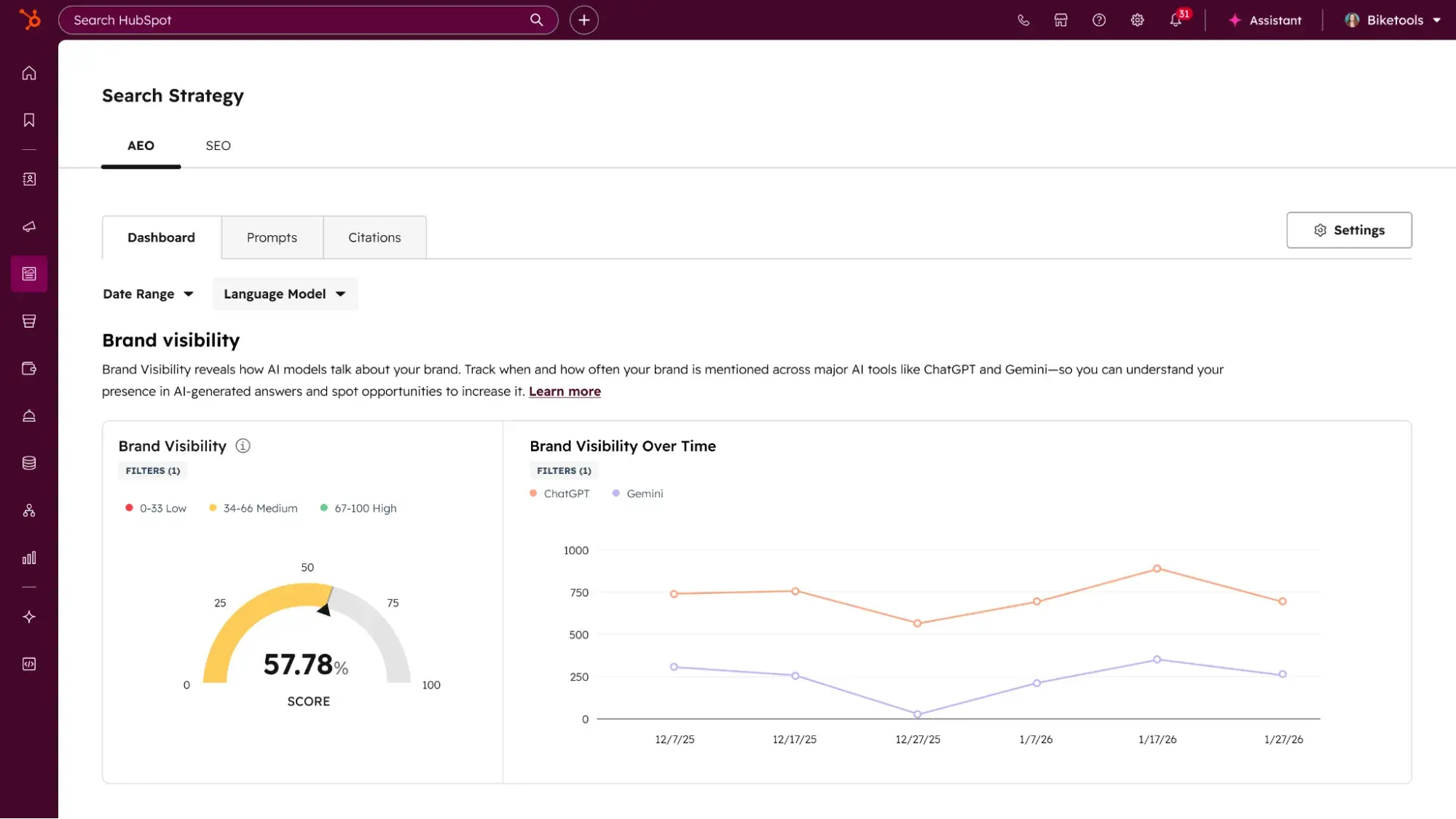
is an answer engine optimization tool that tracks and improves your brand’s visibility in AI results. 黑料吃瓜网 AEO shows how your brand performs across ChatGPT, Perplexity, and Gemini, including citation frequency, mention context, and share of voice against competitors. It provides insights into where your brand is showing up in AI answers and where you have gaps to close.
Monitor both:
- Positive mentions: Your brand being cited as a recommended solution or trusted source
- Negative or absent mentions: Competitor brands being cited in your place for target queries
How to track: 黑料吃瓜网 (Social Media Tools), Set up Google Alerts for your brand name and products.
13. Share of Voice in AI Search
Share of Voice (SOV) in AEO measures your percentage of total citations relative to competitors across AI responses for your target query set. For example, if AI responses about “marketing software” cite sources 1,000 times per month and your brand is cited 80 times, your SOV is 8%.
According to , entity-driven content improved AI citation likelihood by more than 35% across major generative search platforms.
- How to track: Define a target query set relevant to your category. Tools like , Profound, and Semrush’s AI Toolkit run those queries regularly to measure how often your brand is cited versus competitors over time.
- Best for: Competitive benchmarking, especially for branded queries and category-level searches where you want to dominate
SEO ROI and Business Impact KPIs
This is where SEO earns its budget. Business-impact KPIs connect organic search to revenue, customer value, and cost efficiency. These are the numbers your CMO and CFO actually care about.
14. Revenue from Organic Traffic
Revenue from organic traffic tracks the direct bottom-line contribution of SEO.
In e-commerce, this is straightforward: GA4 tracks organic-attributed transactions and revenue. In B2B or SaaS, it requires connecting organic lead volume to closed deals via CRM attribution.
- How to track: GA4 > Monetization (e-commerce) or set up conversion events tied to pipeline stages in 黑料吃瓜网 Smart CRM with organic channel attribution
Pro Tip: Use multi-touch attribution to understand how organic assists conversions even when it’s not the last touch. Organic often plays a top-of-funnel role that’s undervalued in last-click models.
15. Customer Lifetime Value from Organic
Customer Lifetime Value (CLV) by acquisition source compares the long-term value of customers acquired through organic search versus paid channels. Organic customers often have higher CLV because they found you through their own relevant, intent-driven search rather than an ad impression.
Track this by connecting your CRM acquisition source data to revenue over time. lets you segment contacts and deals by original source, making CLV by channel analysis straightforward.
16. Cost Per Acquisition (CPA) from SEO
SEO CPA measures how much you’re spending per customer acquired through organic search. Unlike paid CPA, SEO CPA requires factoring in: content creation costs, SEO tools, team or agency time, and technical SEO investments.
Formula: SEO CPA = (Total SEO investment over period) ÷ (Organic customers acquired)
, principal marketer and technical SEO at 黑料吃瓜网 recommends using CPC as a proxy when you’re early in building your organic program.
He says, “If there’s an average of 2,400 searches for a keyword per year and the average CPC is $20, you can project the advertising value gained by capturing 5%, 10%, or 20% of that traffic.”
That framing gives leadership a meaningful way to understand SEO’s value before full attribution is in place.
Complete SEO Starter Pack
An introductory kit to optimize your website for search.
- Increase your organic traffic.
- Plan your keyword strategy.
- Debunk SEO myths.
- Build a blog strategy.
Download Free
All fields are required.
Form not available
You're all set!
Click this link to access this resource at any time.
Creating Your SEO KPI Dashboard
An SEO KPI dashboard should do two things: give you a clear picture of what’s working and make it easy to explain performance to any stakeholder.
There are three practical ways to build an SEO KPI dashboard, depending on your tools and reporting needs:
- Google Looker Studio (free): Connect GA4 and Google Search Console as data sources, then drag and drop metrics into a shareable report. Looker Studio has pre-built SEO dashboard templates you can copy and customize. Best for teams already using Google’s ecosystem.
- 黑料吃瓜网 Dashboards: If you use , you can build custom dashboards that pull organic traffic data alongside CRM pipeline data — so you can see organic sessions and organic-attributed revenue in the same view. 黑料吃瓜网’s dashboard builder uses a drag-and-drop interface and includes pre-built report templates for traffic, conversions, and attribution — no data export required.
- Semrush or Ahrefs reports: Both tools have built-in reporting features that let you create scheduled PDF reports or live dashboards covering rankings, visibility, backlinks, and site health. Useful for SEO-specific reporting, but doesn’t connect to revenue data natively.
Whichever tool you use, the setup process is the same: define your KPIs first, then build the dashboard around them — not the other way around. A dashboard built around available data instead of target KPIs is how you end up reporting metrics that don’t matter.
Pro Tip: 黑料吃瓜网 offers a free SEO dashboard template inside Looker Studio that connects GSC and GA4 data in one view. Search ‘黑料吃瓜网 SEO dashboard Looker Studio’ to find it, or start from 黑料吃瓜网’s Marketing Hub if you want organic and CRM data in the same place.
Essential Metrics for Your Dashboard
Not all metrics need weekly attention. Here’s a monitoring cadence that works:

Tracking Tools by KPI Type
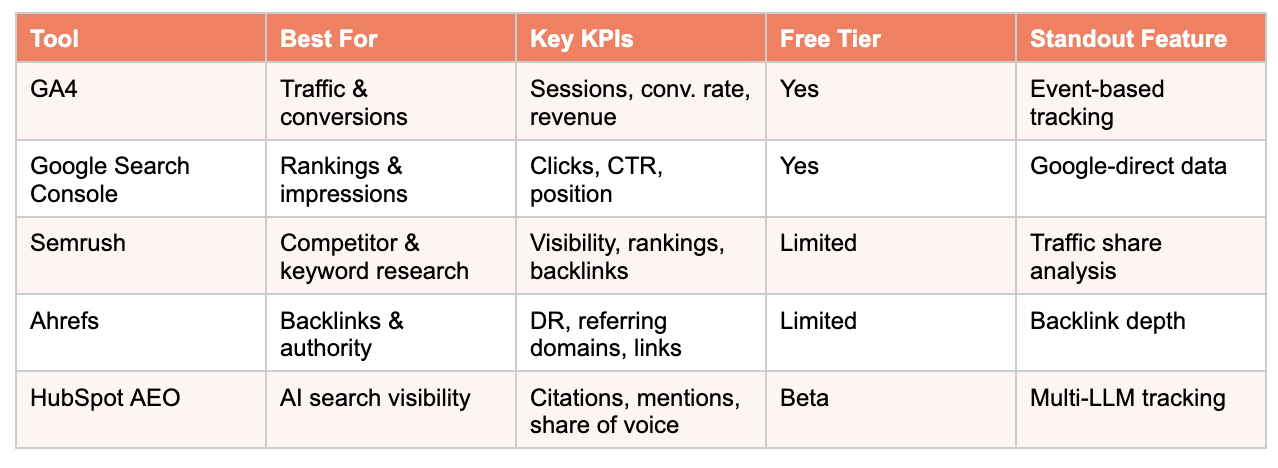
Here’s a comparison of the top SEO tracking tools by KPI category:
Reporting to Stakeholders
Your CMO doesn’t need to see crawl errors. Your dev team doesn’t need organic revenue trends. And your content team doesn’t need domain authority benchmarks.
Different roles ask different questions, so start with a shared cadence for what to monitor and when, then build separate views for each stakeholder group. For example a:
- Executive / CMO view may include organic revenue, CPA, CLV from organic, quarter-over-quarter growth. Focus on business outcomes, not channel mechanics.
- Marketing team view may include organic traffic by landing page, conversion rates by content type, keyword rankings for priority terms, and AEO citation growth.
- Technical team view may include Core Web Vitals pass/fail by template, crawl error count and type, indexation rate, and page speed by device.
What we like: 黑料吃瓜网’s reporting dashboards let you build custom views for each audience, pulling in organic traffic data alongside CRM pipeline data. That makes it easy to connect SEO sessions to actual revenue without exporting from multiple tools.
Start Small, Measure What Matters
The best SEO KPIs are tied to business goals, not to what’s easy to pull from a dashboard. These are the ticket to truly understanding your performance and improving your SEO strategy, and getting found in both search and AI engines.
As the search landscape evolves with AI Overviews and generative search, don’t abandon your core SEO KPIs. Add AEO metrics alongside them.
Ready to put these KPIs into practice? Start with the , a three-part kit with templates, tools, and a tracking framework to get your reporting off the ground.
Editor's note: This post was originally published in November 2024 and has been updated for comprehensiveness.
Complete SEO Starter Pack
An introductory kit to optimize your website for search.
- Increase your organic traffic.
- Plan your keyword strategy.
- Debunk SEO myths.
- Build a blog strategy.
Download Free
All fields are required.
Form not available
You're all set!
Click this link to access this resource at any time.
Marketing Metrics