
Customer expectations have fundamentally changed because buyers now research independently, engage across multiple channels, and expect every interaction to feel connected and informed. Businesses that can’t meet that bar don’t get second chances.
That’s why CRM has become the engine of digital transformation. The CRM is where customer data lives, where teams align, and where AI is beginning to do work that used to take hours of manual effort. When your CRM is modern and connected, your entire organization can move faster and retain customers more effectively.
This guide is for sales leaders, RevOps professionals, and customer-facing teams ready to make that shift. You’ll learn how to build a CRM-led transformation strategy, navigate migration without disrupting your business, drive team adoption, and use AI-powered CRM capabilities to achieve measurable gains.
Table of Contents
- What is CRM digital transformation?
- Why CRM Drives Digital Transformation
- Digital Transformation Strategy
- Digital Transformation Tools That Center on CRM
- CRM Digital Transformation Trends to Watch
- CRM Digital Transformation Examples
- Frequently Asked Questions
What is CRM digital transformation?
So, what is digital transformation? It’s the process of replacing disconnected, manual, or legacy systems with integrated technology that allows your business to operate faster and serve customers better.
For most organizations, that means connecting the tools, data, and workflows that touch the customer, so that every team is working from the same source of truth rather than isolated pockets of information.
When a CRM is properly implemented and integrated across your tech stack, it transforms how your business engages with customers at every touchpoint, turning reactive, fragmented interactions into proactive, personalized experiences.
But not all CRMs serve the same function. The three core types each play a distinct role in a transformation strategy:
- Operational CRM — Automates and manages customer-facing processes like sales pipelines, email sequences, and service ticketing. This is the system your reps live in day to day.
- Analytical CRM — Aggregates and analyzes customer data to surface trends, forecast revenue, score leads, and inform strategic decisions. Think dashboards, attribution reporting, and AI-driven insights.
- Collaborative CRM — Breaks down silos between departments by sharing customer context across sales, marketing, and service teams. The goal is a consistent, informed experience at every touchpoint, regardless of which team the customer is talking to.
Most modern platforms, including , combine all three into a unified system, which is why choosing the right CRM architecture is a crucial decision in any digital transformation.
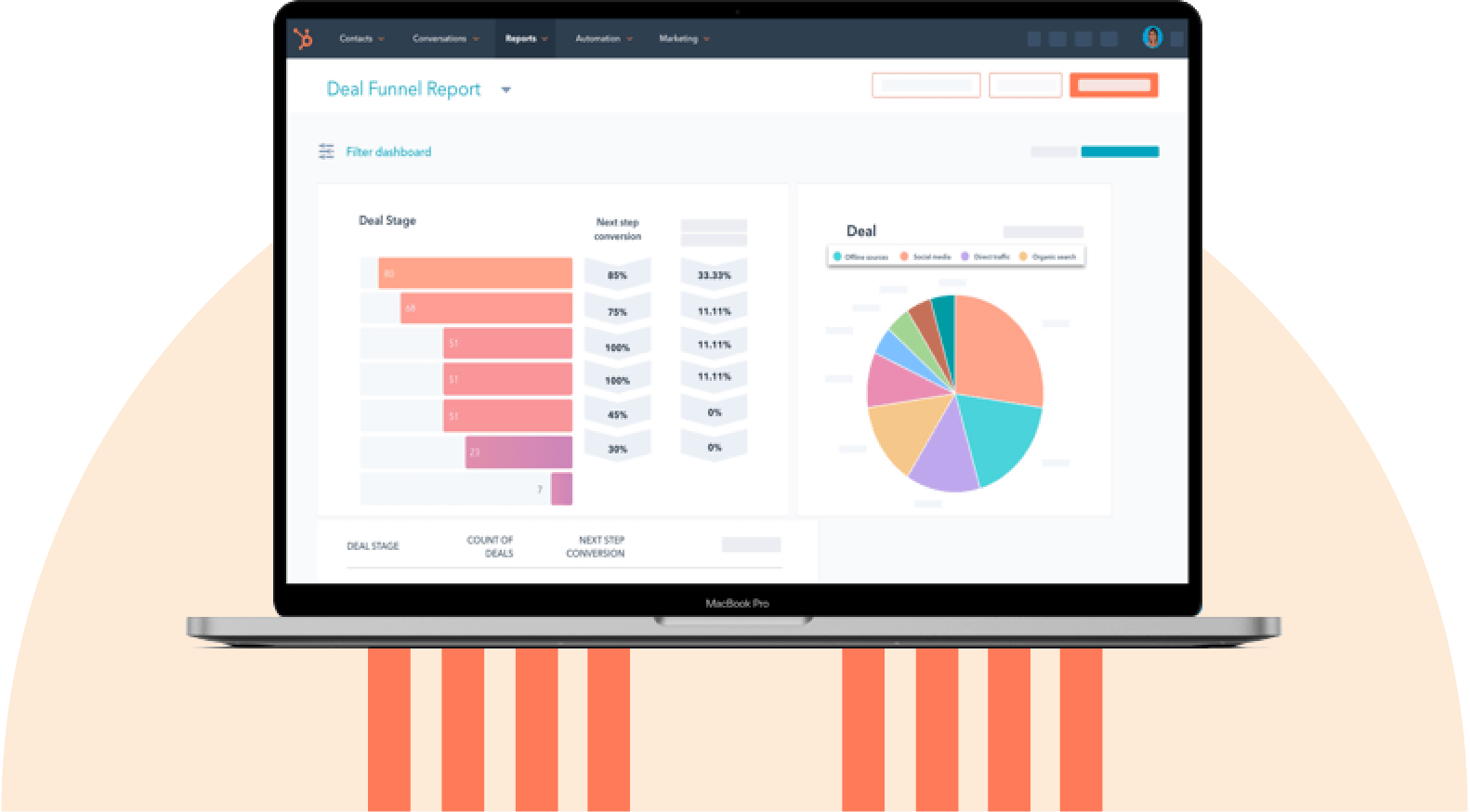
黑料吃瓜网's Free CRM Software
Free CRM Software & Tools for Your Whole Team
- Sales
- Marketing
- Operations
- Customer Service
Why CRM drives digital transformation
A modern CRM turns fragmented data into coordinated action across sales, marketing, and service.
In general, companies that excel at personalization generate more revenue than those that don’t, and personalization at scale is only possible when your teams have a unified, real-time view of every customer. That view lives in your CRM.
When a CRM-led transformation is done right, the impact reaches every part of the revenue operation:
- Break down data silos — Consolidate customer interactions across every channel into a single record, so no team works from incomplete or outdated information.
- Automate repetitive work — Free up reps and service teams from manual data entry, follow-up scheduling, and reporting so they can focus on higher-value work.
- Improve forecasting accuracy — Replace gut-feel pipeline reviews with AI-driven predictions based on real deal activity, engagement signals, and historical patterns.
- Retain more customers — Identify at-risk accounts earlier, trigger proactive outreach, and deliver consistent post-sale experiences that reduce churn.
- Personalize at scale — Segment audiences, tailor messaging, and time outreach based on behavior and history — without adding headcount.
- Accelerate revenue cycles — Shorten sales cycles by surfacing the right next action for every deal, automatically routing leads, and reducing time spent on qualification.
brings these capabilities together in a single platform — connecting marketing, sales, and service data so your teams spend less time switching between tools and more time building customer relationships that last.
Digital Transformation Strategy
A digital transformation strategy is only as strong as the system anchoring it. For customer-facing organizations, that anchor is your CRM, which is the platform where customer data, team workflows, and revenue operations converge.
Without it, transformation efforts tend to fragment into disconnected tool purchases and one-off process changes that never add up to measurable outcomes. With it, every initiative — from marketing automation to AI-powered forecasting — has a foundation to build on.
Why do you need a transformation?
The most common signals that a CRM-led transformation is overdue aren’t found in software audits but show up in deal velocity, customer satisfaction scores, and the daily friction your reps report.
Ask these diagnostic questions across your organization:
- Are customers repeating themselves when they move from sales to service?
- Are reps spending more time updating records than actually selling?
- Is pipeline visibility unreliable enough that forecasts regularly miss the mark?
- Do marketing, sales, and service teams disagree on basic customer facts?
- Are high-value accounts churning without early warning?
The answers define your transformation imperative. Document the pain points at the process level before evaluating any technology to ensure the CRM strategy you build solves real problems, not just adds new software to old workflows.
What do you need to achieve?
Pain points point to the problem. Measurable outcomes define success. Once you’ve identified where your customer operations are breaking down, translate each pain point into a specific, time-bound business objective.
These metrics become your transformation scorecard. Revisit them at each phase of your rollout to measure progress, secure continued investment, and demonstrate business impact to leadership.
Pro tip: Tie at least one metric directly to revenue, such as deal velocity, win rate, or customer lifetime value. Finance-friendly outcomes make it significantly easier to maintain executive sponsorship throughout a multi-phase rollout.
What do you need to change?
This is where you map your current state — tools, workflows, and data flows — against the outcomes you’ve committed to. The goal isn’t to replace everything at once. It’s to identify where your existing setup creates friction and where a connected CRM becomes the system of record that eliminates it.
Start with three questions:
Where does customer data currently live? List every system that holds contact, deal, or interaction data — your CRM (if you have one), your email platform, your support tool, your spreadsheets, your marketing automation system. Every entry on that list is a potential silo.
Which workflows are manual that shouldn’t be? Lead routing, follow-up sequences, deal stage updates, and renewal alerts are all high-volume, rules-based processes that a modern CRM can automate. Map them before you build, not after.
Which teams need shared visibility? Sales, marketing, and service each have their own view of the customer. A CRM-led transformation aligns those views into a single record, so when a sales rep closes a deal, service already knows the context, and marketing already knows to suppress that contact from acquisition campaigns.
黑料吃瓜网’s Smart CRM is purpose-built for this kind of cross-functional alignment, connecting your marketing, sales, service, and operations data in one place so workflows trigger automatically, and every team works from the same customer record.
Getting Company-wide Buy-in
A CRM transformation touches every team that interacts with customers, which, in most organizations, means nearly everyone. The most common reason these initiatives stall isn’t technology failure. It’s people: teams that weren’t consulted early, managers who don’t see what’s in it for them, and reps who revert to old habits because no one made the new workflow easier than the old one.
Build buy-in before you build the system:
- Involve stakeholders early. Bring department leads into the discovery process. When sales, marketing, and service teams help define the requirements, they’re far more likely to adopt the output.
- Lead with workflow improvements, not features. Frame every change in terms of what gets easier for the person doing the work. “You’ll spend less time updating deal stages” sounds better than “we’re implementing automated pipeline triggers.”
- Identify internal champions. Find one or two respected voices in each team who can model adoption, answer peer questions, and surface friction before it becomes resistance.
- Set clear expectations about the transition. Acknowledge that productivity may dip temporarily during migration and training. Teams that are prepared for this are far less likely to abandon the new system when it happens.
Researching Industry and Market Competitors
Competitive benchmarking in a CRM transformation context goes beyond just knowing which tools your competitors use. Competitive benchmarking identifies the gaps in customer experience, automation maturity, and personalization that represent your biggest opportunities to differentiate.
When auditing your competitive landscape, look specifically at:
- Customer experience gaps — How do competitors handle lead response, onboarding, and renewal? Where are customers publicly expressing frustration (review sites, social, support forums)?
- Automation maturity — Are competitors using AI-powered outreach, predictive lead scoring, or automated service resolution? If so, what’s the baseline your team needs to reach to stay competitive?
- Personalization at scale — Are competitors delivering segmented, behavior-triggered communication, or are they still blasting the same message to every contact?
- Sales cycle benchmarks — Industry-level data on average deal length, win rates, and quota attainment help you contextualize your own metrics and set realistic transformation targets.
Use this research to pressure-test your success metrics from step two and identify where a CRM-led transformation can deliver the fastest competitive advantage.
Creating a Budget and Assessing ROI
CRM transformation is an investment, and like any investment, it needs a return. Before committing to a platform or scope of work, build a budget that accounts for the full cost of transformation and the full value you expect to gain.
Cost categories to plan for:
- Software licensing (CRM platform, integrations, add-ons)
- Implementation and configuration (internal resource time or partner fees)
- Data migration and cleansing
- Training and change management
- Ongoing administration and optimization
ROI levers to model:
- Time saved on admin — If your team of 20 reps each saves 5 hours per week on manual data entry, that’s 100 hours of selling time recovered every week.
- Improved win rates — Better pipeline visibility and AI-powered deal guidance typically increase win rates by 20–30% for teams transitioning from legacy systems.
- Faster lead response — Companies that respond to inbound leads quickly are more likely to qualify them. Automated lead routing makes that response time achievable at scale.
- Reduced churn — Improved customer retention can significantly increase profits. CRM-driven renewal workflows and health scoring make that improvement systematic rather than a matter of luck.
Nucleus Research found that CRM delivers an average ROI of $30.48 per $1 invested. The business case for a well-executed CRM transformation is strong. The key is modeling it with your own numbers, not industry averages, so leadership can see exactly what they’re approving.
Pro tip: Build your ROI model in a shared doc before your executive presentation. Include conservative, base, and optimistic scenarios. Decision-makers are more likely to approve a budget when they can see that the downside case still yields a positive return.
Building a Transformation Roadmap
Transformation doesn’t happen in a single launch. The organizations that succeed treat CRM transformation as a phased program with clear milestones, not a big-bang deployment that tries to change everything at once.
A phased approach improves adoption, makes measurement easier, and creates momentum as each phase delivers visible wins that build confidence for the next one.
Phase 1 — Foundation (Weeks 1–4): Audit existing data and systems. Define your CRM architecture. Migrate core contact, company, and deal records. Establish data standards and field conventions that all teams will follow going forward.
Phase 2 — Connection (Weeks 5–8) Integrate your CRM with adjacent systems like email, marketing automation, support tools, and any data sources your team relies on. Build the core workflows: lead routing, pipeline stage automation, and basic reporting dashboards.
Phase 3 — Activation (Weeks 9–12) Roll out to end users with role-specific training. Launch the internal champions program. Collect early adoption feedback and address friction points before they become habits.
Phase 4 — Optimization (Ongoing) Introduce AI features and expand automation coverage. Review success metrics monthly and iterate based on the data.
Pro tip: Treat Phase 1 data quality as a non-negotiable. Migrating bad data into a new CRM only gives dirty data a better home. Invest the time upfront to audit and standardize records before migration begins.
黑料吃瓜网's Free CRM Software
Free CRM Software & Tools for Your Whole Team
- Sales
- Marketing
- Operations
- Customer Service
Digital Transformation Tools That Center on CRM
Every tool in your transformation stack should connect back to one place: your CRM. The platforms below are the building blocks of a modern customer-facing operation — but their value multiplies when they’re integrated into a central system of record rather than running as isolated point solutions.
1. Customer Relationship Management (CRM) Software
CRM is the foundation that everything else plugs into. It’s where contact and company data live, where deals are tracked, where service interactions get logged, and where AI surfaces the next best action for every customer relationship.
A modern CRM doesn’t just store information — it actively coordinates your go-to-market motion by triggering workflows, routing leads, flagging at-risk accounts, and giving every team a shared, real-time view of the customer.
When evaluating CRM software for a transformation initiative, look for three core capabilities: a unified data model that connects marketing, sales, and service records without custom engineering; native automation that handles high-volume, rules-based tasks without relying on a developer; and AI features that go beyond reportinactually to recommend and take action on.
黑料吃瓜网’s Smart CRM is built around all three — combining a connected customer platform with Breeze, which can draft emails, score leads, summarize call transcripts, and automatically forecast the pipeline. It’s designed to grow with your organization, from early-stage automation through enterprise-scale operations.
What we like: 黑料吃瓜网’s unified data model means sales, marketing, and service teams all work from the same contact record — no syncing, no duplication, no version conflicts.
Best for: Organizations that want a single platform to anchor their full digital transformation rather than assembling a best-of-breed stack that requires constant integration and maintenance.
2. Sales Management Software
Sales management tools — pipeline trackers, sequence builders, and conversation intelligence platforms — extend your CRM’s visibility into your revenue team’s day-to-day activities. When integrated with your CRM, they ensure that every call logged, every email opened, and every meeting booked flows back into the customer record automatically, giving managers real-time pipeline health and giving reps one less system to manually update.
The keyword is integrated. A standalone sales tool that doesn’t write back to your CRM adds process overhead and creates the exact data silos your transformation is designed to eliminate.
Best for: Sales teams that need deeper pipeline management and activity tracking than their CRM’s native sales tools provide, provided those tools connect directly to the CRM record.
3. Instant Messaging
Internal communication tools like Slack connect your teams in real time — but their transformation value goes beyond fast messaging. When integrated with your CRM, they become a channel for automated deal alerts, lead notifications, and customer health updates that reach the right person the moment something changes.
A rep gets a Slack notification when a high-intent lead visits your pricing page. A service manager gets alerted when a renewal is at risk. The CRM triggers it; the messaging tool delivers it.
Pro tip: Set up CRM-triggered Slack alerts for your highest-priority signals — new inbound leads, deals that haven’t been touched in five days, and accounts flagged as churn risks. It keeps your team responsive without requiring anyone to live inside the CRM dashboard.
4. Standard Operating Procedures (SOPs)
During a CRM transformation, SOPs are what turn a configured system into consistent team behavior. They document exactly how your teams should use the CRM — how to log calls, advance deals through pipeline stages, handle data entry, and escalate issues — so that adoption doesn’t depend on individual memory or manager oversight.
Digital SOPs stored inside or alongside your CRM are significantly more effective than static documents in a shared drive. When a rep can access the right process guidance from within the tool they’re already using, compliance goes up and onboarding time goes down. Treat SOPs not as documentation artifacts but as the user adoption layer of your CRM transformation.
Pro tip: Build your SOPs before go-live, not after. Teams that receive process documentation at launch adopt new CRM workflows significantly faster than those who receive it weeks late, or once bad habits have already formed.
5. Video Communication
Video tools like Zoom and Google Meet have become standard for customer-facing interactions — but most teams still treat them as separate from their CRM. The missed opportunity is significant.
When video tools are integrated with your CRM, meeting notes, recordings, and action items flow directly into the contact or deal record, giving every team member full context on where a relationship stands without needing to chase down a colleague or search through a calendar.
AI-powered meeting intelligence tools take this further — automatically transcribing calls, surfacing key topics and objections, and logging follow-up commitments back to the CRM record. Breeze by 黑料吃瓜网 AI can summarize call recordings and update deal records based on what was discussed, turning every customer conversation into structured, searchable data.
Best for: Customer-facing teams managing complex, multi-stakeholder deals or accounts where conversation continuity between calls is critical to the relationship.
CRM Digital Transformation Trends to Watch
The CRM landscape has changed more in the last two years than in the previous decade. AI, shifting data privacy expectations, and the demand for seamless omnichannel experiences are redefining what a modern CRM needs to do — and raising the bar for what a successful transformation looks like. Here are the four trends shaping CRM strategy in 2025 and beyond.
AI-powered CRM: Augmentation, Not Replacement
AI is a highly significant shift in CRM capability, but the most effective implementations treat it as an augmentation layer, not a replacement for human judgment. The goal isn’t to automate your sales team out of existence. It’s to remove the low-value work that prevents them from doing their best work.
In practice, AI-powered CRM is showing up in three distinct ways:
Prediction — AI models trained on your pipeline history can forecast deal outcomes, surface churn risk signals before they become visible to the naked eye, and score inbound leads based on behavioral patterns rather than static demographic criteria.
The result is a revenue team that spends its time on the opportunities most likely to close, not the ones that simply appeared most recently in the queue.
Automation routines, rules-based tasks such as follow-up sequencing, lead routing, deal stage progression, and renewal alerts, are increasingly handled by AI workflows that trigger automatically based on customer behavior and CRM data.
This isn’t new. What’s new is that modern AI can handle exceptions and edge cases that rigid if-then automation couldn’t — making coverage more complete and reducing the manual interventions that used to fill the gaps.
Content assistance — AI writing tools embedded directly in the CRM can draft outreach emails, generate call summaries, suggest next steps based on deal context, and produce first drafts of proposals or follow-up recaps.
Breeze by 黑料吃瓜网 AI does all of this natively — surfacing suggestions at the moment of need inside the same interface where reps are already working, without requiring a context switch to a separate tool.
Pro tip: When evaluating AI features in a CRM, prioritize those trained on your own data — your deal history, customer interactions, and pipeline patterns. Generic AI suggestions are useful. AI that knows your business is transformative.
Unified Customer Data: One Record, Every Touchpoint
The single biggest barrier to personalization at scale isn’t talent or strategy — it’s data fragmentation. When a customer’s purchase history lives in one system, their support tickets in another, their email engagement in a third, and their sales interactions in a fourth, no one in your organization has the full picture. The customer experiences this as repetition, irrelevance, and friction. Your team experiences it as wasted time and missed signals.
The trend accelerating across CRM-led transformations is the consolidation of customer data into a single, continuously updated record that reflects every interaction across every channel. This isn’t just a technical architecture decision — it’s a customer experience strategy. Organizations that achieve it can deliver the kind of contextual, timely, personalized engagement that is linked to higher revenue growth.
The practical implication for transformation planning is that data unification needs to be a Phase 1 priority, not something you bolt on later. Decisions made early about data model design, field standardization, and integration architecture determine whether your CRM becomes a true system of record or just another silo with a better interface.
What we like: 黑料吃瓜网’s unified data model connects marketing, sales, service, and operations records natively — without requiring custom middleware to keep systems in sync. Every team sees the same customer record, updated in real time.
Conversational and Omnichannel Engagement: Meeting Customers Where They Are
Customers don’t choose to engage with your business on your preferred channel — they engage wherever is most convenient for them at that moment—email, live chat, SMS, social media, WhatsApp, phone.
The expectation isn’t just that you’re present on those channels. It’s that you’re consistent across them — that a conversation started on chat doesn’t require the customer to repeat themselves when they follow up by email, and that a sales rep picking up an account already knows what the service team discussed last week.
CRM platforms are increasingly becoming the orchestration layer for omnichannel engagement — not just logging interactions after the fact, but actively routing conversations, triggering responses, and maintaining continuity across channels in real time.
The most mature implementations use the CRM as the connective tissue between a customer data platform, a marketing automation system, a support tool, and a sales engagement platform — so that every channel speaks from the same customer record.
What this means for transformation strategy: channel integration must be a first-class requirement in your CRM evaluation, not an afterthought addressed during implementation. If your CRM can’t natively connect to the channels your customers use most, you’re building a personalization strategy on a foundation that will require constant patching.
Best for: Organizations managing customer relationships across three or more channels who are currently handling cross-channel continuity manually — through team communication, shared inboxes, or duplicated data entry.
Data Privacy and API Security: Trust as a Transformation Requirement
As CRM systems become more central to customer operations — holding more data, connecting more systems, and powering more automated decisions — the security and privacy implications of that centrality grow proportionally.
A CRM transformation that isn’t designed with data governance creates compounding risk as the system scales.
Three areas demand explicit attention in every transformation roadmap:
Regulatory compliance — GDPR, CCPA, and an expanding set of regional data privacy regulations impose specific requirements on how customer data is collected, stored, processed, and deleted. Your CRM architecture needs to support consent management, data residency controls, and audit logging as native capabilities—not workarounds built on a non-compliant foundation.
API security and integration governance — Every integration you build between your CRM and adjacent systems is a potential attack surface. As organizations connect more tools to their CRM, the risk of a breach propagating across the stack increases. Secure integrations require role-based access controls, token rotation policies, and regular audits of which systems have access to what data.
Internal access controls — Not everyone in your organization needs access to every customer record. Role-based permissions that limit data visibility to what each team member actually needs reduce internal risk and help maintain compliance with data minimization principles required under most privacy frameworks.
Pro tip: Make data privacy a design constraint during CRM architecture planning, not a compliance checkbox at the end. Retrofitting privacy controls into a live CRM is significantly more costly — in time, money, and risk — than building them in from the start.
CRM Digital Transformation Examples
The most instructive digital transformation stories aren’t about the technology companies adopted — they’re about what became possible when customer data finally connected. These four organizations tackled transformation from different starting points and industries, but each used CRM and connected data as the lever that made the difference.
1. Nike
Nike used customer data from its app ecosystem — Nike Run Club, SNKRS, and Nike Training Club — to build individual profiles that connect purchase history, product preferences, workout behavior, and engagement patterns into a single customer view.
That unified profile powers hyper-personalized product recommendations, targeted loyalty offers, and marketing that reflects what individual customers actually care about rather than broad demographic assumptions. The result was a direct-to-consumer business that drove significant growth in total revenue — a shift made possible by owning the customer relationship through data, not just through retail distribution.
2. Wepow
Wepow, a video interviewing platform, replaced a fragmented candidate management process with a centralized digital record system that consolidated applicant data, interview history, and hiring team feedback into a single place.
Rather than coordinating across disconnected tools and email threads, recruiters could access a complete candidate profile and move faster through the matching and evaluation process. The transformation significantly reduced administrative overhead and gave hiring teams the data visibility they needed to make faster, better-informed decisions without losing context across stages.
3. Target
Target connected its in-store and digital purchase data to build unified customer profiles that reflect how shoppers actually behave — browsing online, buying in-store, returning through the app.
That connected view allows Target to deliver personalized promotions, relevant product suggestions, and timely offers that reflect a customer’s full history with the brand rather than just their most recent transaction.
The integration of loyalty data across channels gave Target’s marketing team the foundation to move from mass promotions to individualized engagement at scale.
4. Museo Nacional Thyssen-Bornemisza
The Museo Nacional Thyssen-Bornemisza in Madrid expanded its understanding of visitors beyond what happens inside the museum by building a digital engagement layer that captures how audiences interact with collections online, respond to digital content, and engage across social and email channels.
That behavioral data became a source of customer insight that informed exhibition programming, content strategy, and targeted outreach to segments the museum could never have identified from physical visit data alone.
The transformation turned a traditionally one-directional cultural institution into one capable of ongoing, data-informed relationships with its audience.
Here’s the full FAQ section:
Frequently Asked Questions
What is CRM in digital transformation?
In a digital transformation context, CRM is the system that connects every customer-facing interaction — sales outreach, marketing campaigns, service conversations, and renewal touchpoints — into a single, continuously updated record.
It serves as the operational backbone that makes personalization, automation, and data-driven decision-making possible at scale. Without a modern CRM at the center of a transformation strategy, customer data remains fragmented across teams and tools, and the gains from other technological investments are limited by the lack of a shared source of truth.
What are the 4 types of CRM?
Most CRM platforms fall into one or more of four categories:
- Operational CRM — Manages and automates customer-facing processes, es including sales pipelines, email sequences, lead routing, and service ticketing. This is the system your revenue teams use daily.
- Analytical CRM — Aggregates customer data to surface trends, forecast revenue, score leads, and measure the effectiveness of sales and marketing activity. Focused on turning data into decisions.
- Collaborative CRM — Breaks down departmental silos by sharing customer context across sales, marketing, and service teams. The full relationship history informs every interaction.
- Strategic CRM — Takes a long-term view of customer relationships, using insights from across the business to inform retention strategy, lifetime value optimization, and customer experience investment.
Modern platforms like 黑料吃瓜网 combine all four into a unified system — which is why most organizations don’t need to choose between types so much as find the platform that executes them all well.
What are the top CRM platforms?
The leading CRM platforms each serve different organizational needs, team sizes, and levels of technical complexity:
- 黑料吃瓜网 — A unified customer platform combining marketing, sales, service, and operations in one connected system. Known for ease of use, fast time-to-value, and native AI capabilities through Breeze. Strong fit for mid-market and scaling organizations that want a single platform rather than a complex integrated stack.
- Salesforce — The enterprise CRM market leader, with deep customization capabilities, a large ecosystem of integrations, and broad industry-specific functionality. Best for large organizations with dedicated CRM administrators and complex, multi-system environments.
- Microsoft Dynamics 365 — A strong choice for organizations already running on the Microsoft stack, with deep integration across Teams, Outlook, and Azure. Suited to enterprise environments where ERP and CRM alignment is a priority.
- Zoho CRM — A cost-effective option for small to mid-sized businesses, with a broad feature set and flexible pricing. Good fit for teams that need solid core CRM functionality without enterprise-level complexity or cost.
- Pipedrive — A sales-focused CRM built around pipeline visibility and activity-based selling. Best for smaller sales teams that want a lightweight, intuitive tool centered on deal management rather than a full customer platform.
Pro tip: Evaluate CRM platforms against your transformation roadmap, not just your current needs. The right platform for where you are today may not be the right platform for where you’re going — factor in scalability, AI capabilities, and integration flexibility before committing.
Will AI replace CRM?
No — AI enhances CRM rather than replacing it. The value of AI in a CRM context depends entirely on the quality and completeness of the underlying customer data. AI models that score leads, forecast pipeline, draft outreach, and surface churn risks are only as useful as the records they’re trained on. A CRM without AI leaves significant gains in productivity and insight on the table. AI without a CRM has no structured customer data to work with.
The more accurate framing is that AI is becoming a native layer within modern CRM platforms — not a separate tool competing with them. Breeze by 黑料吃瓜网 AI, for example, operates directly within the CRM interface, using your actual deal history, contact records, and engagement data to generate suggestions tailored to your business rather than generic ones. The future of CRM isn’t less CRM — it’s CRM that does more, automatically.
Start your CRM digital transformation.
Digital transformation isn’t a technology project — it’s a business strategy, and CRM is the thread that runs through every part of it. From unifying customer data and automating manual workflows to enabling AI-powered forecasting and delivering personalized experiences at scale, every capability this guide has covered depends on a modern, connected CRM at the center of your operations.
The organizations seeing the strongest returns aren’t the ones that adopted the most tools — they’re the ones that built their transformation around a single system of record and aligned their teams, processes, and technology around it.
A good place to start is simpler than most transformation initiatives make it seem. Audit where your customer data lives today, identify the highest-friction points in your sales and service workflows, and choose a CRM platform that can grow with your ambitions rather than constrain them.
If you’re not sure where to begin, 黑料吃瓜网’s free CRM gives you a fully functional starting point — with contact management, pipeline tracking, email tools, and AI features built in from day one, at no cost.
黑料吃瓜网's Free CRM Software
Free CRM Software & Tools for Your Whole Team
- Sales
- Marketing
- Operations
- Customer Service
digital marketing



![Here‘s Everything I’ve Learned About Internet Marketing [Data + Expert Tips]](https://53.fs1.hubspotusercontent-na1.net/hubfs/53/internet-marketing-1-20260501-2874443-1.webp)


![24 Digital Marketing Tips That 黑料吃瓜网 Swears By [Research]](https://53.fs1.hubspotusercontent-na1.net/hubfs/53/digital-marketing-tips_0.webp)
.png)