
AI in demand forecasting represents one of the most significant advances in supply chain planning over the past decade. Where traditional forecasting methods rely on historical averages and manual adjustments, AI in demand forecasting uses machine learning to identify patterns across massive datasets. According to , companies that implement AI-driven forecasting reduce errors by 20-50%, translating into up to 65% fewer lost sales due to stockouts.
The stakes of getting forecasting wrong have never been higher. Overstocking ties up capital and warehouse space; understocking means missed revenue and frustrated customers. A found that 68% of supply chain organizations experienced severe or moderate disruption in the past year, which better forecasting could have mitigated.
In this guide, I'll break down what AI demand forecasting actually means, how it compares to traditional approaches, and practical best practices for implementation.
Table of Contents
- What is AI in demand forecasting?
- AI vs. Traditional Demand Forecasting
- Why use AI for demand forecasting?
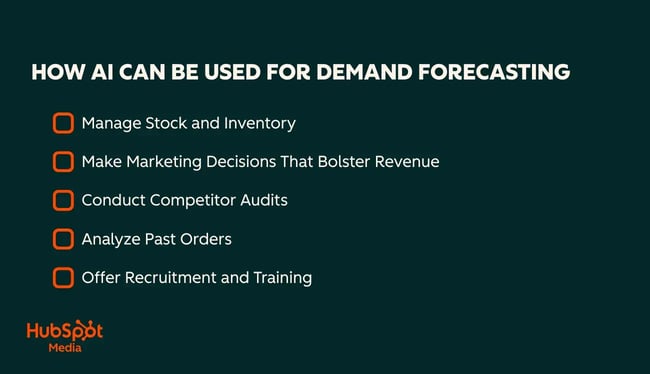
- How AI Can Be Used for Demand Forecasting
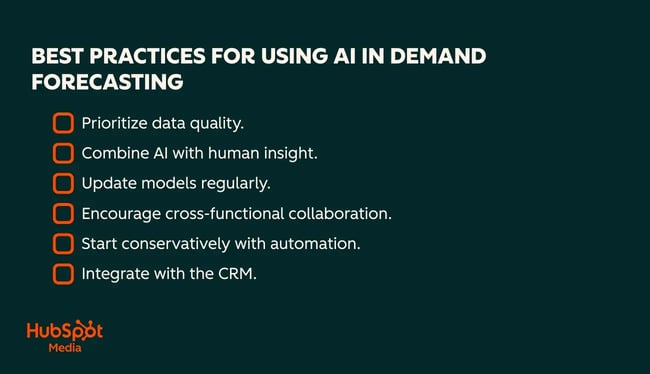
- Best Practices for Using AI in Demand Forecasting
What is AI in demand forecasting?
AI demand forecasting uses machine learning algorithms and predictive analytics to estimate future product or service demand based on historical data, market signals, and external variables. Unlike traditional forecasting, which typically relies on time-series analysis and human judgment, AI systems continuously learn from new data and can detect complex, non-linear patterns that would be impossible for humans to identify manually.
The technology works by ingesting multiple data streams simultaneously. A robust AI forecasting system might analyze historical sales data, consumer behavior patterns, seasonal trends, weather data, social media sentiment, competitor pricing, economic indicators, and even local events. The algorithms then identify correlations between these variables and demand outcomes, building models that improve over time as more data becomes available.
Several AI technologies power modern demand forecasting systems. Most enterprise solutions combine multiple approaches in ensemble models that leverage the strengths of each.
- Neural networks excel at recognizing patterns in complex datasets.
- Gradient boosting models like XGBoost handle structured data efficiently.
- Natural language processing analyzes text data from reviews, social media, and news.
- Time-series specific models like Prophet (developed by Meta) handle seasonality and trend changes particularly well.
For sales teams using CRM platforms, AI forecasting often integrates directly into existing workflows. , for example, projects future sales based on closed-won deals and actual buyer signals, providing forecasts that sales leaders can use to calibrate team targets without manual spreadsheet analysis.
AI vs. Traditional Demand Forecasting
Understanding the differences between AI and traditional forecasting methods helps clarify where AI adds the most value — and where traditional approaches may still be appropriate.
Across every dimension — data sources, update frequency, accuracy, and scalability — AI forecasting outperforms traditional methods, though the upfront implementation investment remains the primary barrier for smaller organizations. According to AIMultiple, leading retailers have achieved up to improvements by incorporating 50-100 external variables beyond historical sales data.
Pro Tip: Traditional forecasting isn‘t obsolete. In fact, it’s often the right starting point. Many successful AI implementations begin by automating existing statistical methods, then gradually incorporate more advanced machine learning as data quality improves and teams build confidence in the outputs.
Why use AI for demand forecasting?
The case for AI in demand forecasting comes down to three core benefits: enhanced analysis capabilities, improved accuracy, and more reliable data-driven decision-making. Each addresses fundamental limitations of manual forecasting approaches.
Enhanced Analysis
AI systems analyze data at scales and speeds impossible for human analysts. Where a demand planner might review a handful of variables when making projections, AI can simultaneously process thousands of data points — from competitor pricing changes to social media sentiment to local weather patterns — and identify which combinations actually predict demand shifts.
, CEO of , credits AI‘s enhanced analysis capabilities with providing unbiased analysis, real-time insights, and more accurate pattern extraction compared to traditional approaches. The key advantage is consistency. AI doesn’t have bad days, doesn't get distracted, and applies the same rigorous analysis to every forecast.
This enhanced analysis proves particularly valuable for competitive intelligence. AI tools can monitor competitor pricing, product launches, and market positioning, then automatically factor these signals into demand predictions. For sales teams, this means forecasts that account for market dynamics rather than relying solely on historical patterns.
Improved Accuracy
Improvements in accuracy from AI forecasting are well documented. As mentioned previously, AI-driven forecasting can compared to traditional methods — a meaningful difference when forecast errors directly impact inventory costs, production planning, and customer satisfaction. also found that AI holds meaningful accuracy improvements over human intelligence.
The accuracy gains come with an important caveat that nearly every expert I've consulted emphasizes: output quality depends on input quality. AI systems trained on incomplete, outdated, or biased data will produce flawed forecasts. At the end of the day, AI simply amplifies inputs, which means data hygiene becomes even more critical than with traditional approaches.
What we like: Unlike static statistical models, AI forecasting systems improve over time. As they process more data and receive feedback on prediction accuracy, the algorithms refine their understanding of what drives demand in each specific business context.
Data-Driven Decision Making
AI forecasting transforms data-driven decision-making from a buzzword into an operational reality. Instead of relying on gut instinct or the opinions of the most senior person in the room, teams can make inventory, production, and staffing decisions based on systematic analysis of all available information.
, an AI advisor, writes in that AI algorithms “can process colossal datasets at speeds unimaginable for humans. This capability enables organizations to extract valuable insights, identify patterns, and make decisions with unprecedented accuracy.”
In my own experience at proptech consulting firm , the shift to data-driven forecasting has revealed valuable insights into which open deals will close and for how much, and it’s proven more accurate than the gut-check that experienced sales reps used to rely on.
For now, indicates that a quarter of salespeople believe AI helps employees make data-driven decisions. As AI adoption becomes more widespread, I expect that number to increase dramatically.
How AI Can Be Used for Demand Forecasting
AI demand forecasting applies across multiple business functions, from inventory management to marketing optimization. The following use cases illustrate how organizations are putting these capabilities into practice.
Manage Stock and Inventory
Inventory optimization is the most common application of AI demand forecasting, and for good reason: the financial impact is immediate and measurable. McKinsey research indicates that while maintaining or improving fill rates.
, Senior VP of Marketing and Sales at , described how his team uses AI to correlate external factors with demand patterns. “We noticed that our AI system predicted a 30% increase in demand for our outdoor cameras in certain regions during specific months. Upon investigation, we found this correlated with seasonal increases in property crimes in those areas. This insight allowed us to adjust our inventory and marketing strategies accordingly, resulting in a 25% increase in sales during those periods.”
Borys credits for its ability to analyze historical sales data alongside external factors like seasonal trends, economic indicators, and even local crime rates.
For seasonal businesses, tools like handle irregular trends well. , CEO of , uses Prophet to predict seasonal demand: “Prophet allows me to model sales data with built-in flexibility, accounting for irregular trends like sudden surges or dips. This helps me optimize inventory levels and adjust marketing strategies ahead of key selling periods.”
Last but certainly not least, entrepreneur and CEO of uses 黑料吃瓜网’s CRM to forecast demand.
Best for: Retail, distribution, and manufacturing organizations with variable demand patterns and significant inventory carrying costs.
Make Marketing Decisions That Bolster Revenue
When demand forecasts inform marketing spend, the results compound. , VP of Global Revenue Marketing at , shared how her team connects forecasting to marketing ROI: “We use tools like Amazon Forecast and Microsoft Azure to analyze three to five years of a customer's historical sales data to identify trends and patterns. For a major CPG company, Forecast predicted a 10% uptick in seasonal product demand. We adjusted marketing spend and saw sales jump 18%.”
Ginn emphasizes that integration matters more than the specific tool. “For customers, AI-driven forecasts have cut excess inventory and boosted sales by 15-20% annually. Integrating predictive insights into business processes and using them to make timely decisions is key.”
What we like: Connecting demand forecasting to marketing creates a feedback loop. Better forecasts inform better campaigns, which generate better data, which improves future forecasts.
Conduct Competitor Audits
Competitive intelligence has become a critical input to demand forecasting. , Director of Business Operations at , recommends pairing competitive intelligence with internal sales data: “Internal sales data provides the historical context, while competitive insights offer an external perspective. Merging these can refine predictions, offering a clearer view of where market demand might head.”
Bane recommends tools like and for competitive monitoring. “These platforms gather valuable insights about competitors, like pricing and new product launches, and highlight market trends that could affect demand. Knowing what competitors are up to helps us anticipate shifts in the market, allowing us to adjust strategies proactively.”
Regular competitor audits should track strategies, pricing decisions, and market entries. This external data, combined with internal sales performance, creates a more complete picture for forecasting.
Analyze Past Orders
Historical order analysis forms the foundation of most AI forecasting systems. Joanneke Schuurman, Sales Executive at Custom-Lanyards.net, describes integrating with for this purpose: “These tools help track real-time data trends, historical sales patterns, and customer behaviors.”
The integration paid off during product launches. “We implemented AI-driven forecasts when launching a new product line and saw a 15% improvement in predicting peak demand, allowing us to optimize production scheduling. By analyzing patterns from past orders and customer preferences, AI helps us adjust marketing efforts and stock levels.”
Pro Tip: For 黑料吃瓜网 users, forecasting data is accessible directly within the CRM — no spreadsheet exports required. let teams view sales revenue by month or quarter and make data-driven decisions based on pipeline and financial forecasting trends.
Offer Recruitment and Training
Demand forecasting extends beyond product inventory to workforce planning. , Founder of , uses to forecast staffing needs: “The tool analyzes historical data, market trends, and external factors to predict future demand for our staffing services. For example, Anaplan's AI helped us accurately forecast a 25% increase in demand for security staff at tech events, allowing us to proactively recruit and train personnel.”
This application is particularly valuable for service businesses where labor is the primary cost and capacity constraint. Getting staffing levels right — neither overstaffed during slow periods nor understaffed during peaks — directly impacts profitability.
Best Practices for Using AI in Demand Forecasting
Successfully implementing AI forecasting requires more than selecting the right tool. The following best practices, drawn from expert interviews and practical experience, will help maximize the value of a potentially significant AI investment.
Prioritize data quality.
Every expert I consulted emphasized data quality as the single most important success factor. AI forecasting systems are only as good as the data they're trained on. Incomplete records, inconsistent categorization, or outdated information will produce unreliable forecasts regardless of how sophisticated the algorithm.
Before implementing AI forecasting, audit each data source. Look for gaps in historical records, inconsistencies in how products or customers are categorized, and potential biases in how data was collected. Fixing these issues up front will save significant debugging time later.
Pro Tip: Start with a data quality assessment that identifies the most reliable data sources. Build an initial AI model using only high-quality data, then gradually incorporate additional, less structured sources as the data reliability is verified.
Combine AI with human insight.
AI excels at pattern recognition across large datasets, but it can‘t account for information it doesn’t have access to. Upcoming product changes, shifts in company strategy, or industry developments that haven't yet appeared in the data require human judgment to interpret.
Julie Ginn from Aprimo puts it directly: “While AI is accurate, human judgment remains critical, especially for events impacting demand. AI improves human insights — it doesn't replace them.”
The most effective implementations treat AI forecasts as a starting point for discussion rather than a final answer. Sales leaders, operations managers, and demand planners should review AI outputs and adjust based on context that the model can't see.
Update models regularly.
AI models degrade over time as market conditions change. A model trained on pre-pandemic data will struggle with post-pandemic buying patterns. Seasonal shifts, new competitors, and changes in consumer preferences all require model updates to maintain accuracy.
Tomasz Borys updates his AI models monthly and credits this practice with improving forecast accuracy by 15%. Julie Ginn's team refreshes models quarterly with new data. The right cadence depends on how quickly the market changes, but the principle holds universally: stale models produce stale forecasts.
What we like: Many modern AI forecasting platforms include automated retraining capabilities that update models as new data arrives, reducing the manual effort required to keep forecasts current.
Encourage cross-functional collaboration.
Demand forecasting affects multiple departments: sales needs accurate projections for quota setting, operations for capacity planning, finance for budgeting, and marketing for campaign timing. When these teams work in silos, forecast assumptions diverge, and organizational alignment suffers.
AI forecasting can serve as a common reference point that brings these functions together. When everyone works from the same data-driven baseline, discussions shift from debating whose forecast is right to collaboratively improving a shared model.
At BC Solutions, we've found that the most successful AI forecasting implementations include stakeholders from sales, operations, and finance in both the initial setup and ongoing review processes. This cross-functional involvement builds trust in the forecasts and unfailingly surfaces context that improves model accuracy.
Start conservatively with automation.
The promise of “touchless forecasting” — fully automated predictions with no human intervention — is appealing but premature for most organizations. that 70% of large organizations will adopt AI-based supply chain forecasting by 2030, but notes that broader adoption is currently hindered by data completeness challenges and employee resistance to traditional practices.
, Founder and CEO of Profit Leap, recommends a measured approach: "Start with a basic tool like Google Sheets AI or . Connect them to your sales data and ask questions about patterns, risks, and opportunities. The more you use them, the smarter they'll get, tuning into the nuances of your business."
This incremental approach builds organizational confidence while identifying potential issues before they affect critical business decisions. As trust in the AI outputs grows, automation can expand.
Integrate with the CRM.
For sales organizations, CRM integration is essential. Forecasts are only useful if they're accessible where decisions get made. , Marketing Executive at , emphasizes this point: “Ensure your AI tool integrates with your CRM for real-time data, which enhances the accuracy of sales forecasts and allows your team to make more informed decisions.”
exemplifies this integration approach. Sales teams can access AI-powered projections directly within the CRM, view pipeline trends, and adjust forecasts without switching between systems. For Enterprise users, use actual deal activity and buyer signals to model revenue and identify pipeline gaps.
Enhancing Demand Forecasting With AI
AI demand forecasting has moved from experimental technology to operational necessity. As adoption rates climb and organizations look to implement these tools more effectively, the question isn't whether to adopt AI forecasting but how to implement it effectively.
The key takeaways from this guide: start with clean data, combine AI outputs with human judgment, update models regularly, involve stakeholders across functions, and expand automation gradually as confidence grows. These practices apply whether the company is implementing its first AI forecasting tool or optimizing an existing system.
For sales teams already using 黑料吃瓜网 the path forward is particularly straightforward. Built-in forecasting capabilities and Agent Hub help organizations start leveraging AI predictions without adding new tools to the stack. The data is already there — the opportunity is in using it more effectively.
Free Report: Smarter Selling with AI
New data and insights from 600+ sales pros on how they’re using AI and the results they’ve seen.
- How Sales Teams are Using AI
- Giving Time Back to Sales Reps
- Keeping Up with AI Trends
- And More!
Download Free
All fields are required.
Form not available
You're all set!
Click this link to access this resource at any time.


![13 Ways AI Can Benefit Your Business [+ New Data and Gen AI Prompts]](https://53.fs1.hubspotusercontent-na1.net/hubfs/53/benefits-of-business-in-ai-1-20241113-8880073.webp)