
As AI adoption becomes standard across sales organizations, AI for sales prospecting is emerging as a practical way to apply automation, predictive insights, and personalization directly to lead research and outreach.
According to 贬耻产厂辫辞迟’蝉 2025 State of Sales Report, 84% of sales professionals report using AI to optimize the sales process. AI tools were also ranked as the highest-ROI sales technology by 31% of respondents, and only 8% report not using AI at all.
When implemented strategically, AI automates prospect research, prioritizes high-intent leads, improves personalization, and helps teams scale prospecting without increasing headcount. The advantage comes from aligning AI-driven insights with disciplined sales execution at every step of the sales process.
This guide explains what AI for sales prospecting is, how it works, how to implement it effectively, and how to measure its impact. Practical ChatGPT prompt templates and a comparison of leading AI prospecting tools, such as 贬耻产厂辫辞迟’蝉 and , are included as well.
Table of Contents
- What is AI for sales prospecting?
- Key AI Technologies in Sales Prospecting
- Purpose-Built AI vs. General AI Tools
- Why AI Transforms Sales Prospecting
- How to Implement AI for Sales Prospecting
- Common AI Prospecting Challenges (And How to Solve Them)
- Frequently Asked Questions About AI for Sales Prospecting
What is AI for sales prospecting?
AI for sales prospecting is the use of artificial intelligence technologies to identify, prioritize, research, and engage potential buyers more efficiently. The AI technologies include machine learning, natural language processing (NLP), and predictive analytics. It helps sales teams automate lead research and qualification, uncover high-intent prospects, and personalize outreach at scale.
Instead of manually researching companies, scoring leads by intuition, or drafting repetitive outreach messages, AI prospecting tools analyze large volumes of CRM data, behavioral signals, firmographic information, and engagement history. These systems surface the prospects most likely to convert and generate relevant messaging suggestions based on available data.
Tools like centralize these insights by combining lead capture, tracking, and prioritization into a single system, making it easier for teams to act on AI-driven recommendations.
AI for sales prospecting does not replace human sellers. It augments their workflow by reducing administrative work, improving targeting accuracy, and providing actionable insights that support stronger conversations.
Free Sales Software
Built for productivity, powered by relevance.
- Sales Automation
- Call Tracking
- Lead Prospecting
- And More!
Key AI Technologies in Sales Prospecting
AI for sales prospecting relies on three core technologies: machine learning, natural language processing, and predictive analytics. Each plays a distinct role in automating lead research, improving prioritization, and enhancing personalization.
Machine Learning
Machine learning enables AI prospecting tools to analyze historical CRM data, engagement patterns, and deal outcomes to identify which leads are most likely to convert. By learning from thousands of past interactions, machine learning models detect patterns that humans may miss.
In practice, machine learning powers features like predictive lead scoring. These systems evaluate:
- Behavioral signals like email opens and website visits.
- Firmographic data like industry, revenue, or company size.
- Sales activity history to rank prospects by conversion likelihood.
Predictive lead scoring identifies high-intent prospects and helps sales teams focus their time where it has the greatest revenue impact.
Natural Language Processing (NLP)
Natural language processing allows AI systems to understand, generate, and summarize human language. In sales prospecting, NLP supports email drafting, conversation analysis, message personalization, and research summaries.
For example, AI-powered email writers use NLP to draft outreach messages tailored to a prospect’s role, industry, or recent activity. NLP also helps summarize company information, surface relevant talking points, and analyze past sales calls for insights. This improves communication efficiency while maintaining relevance.
Predictive Analytics
Predictive analytics uses statistical modeling and historical data to forecast future outcomes. In sales prospecting, predictive analytics estimates win probability, identifies expansion opportunities, and signals which accounts warrant immediate follow-up.
By combining CRM data, pipeline history, and engagement signals, predictive systems help revenue teams prioritize outreach based on likely revenue impact rather than guesswork. Predictive analytics strengthens pipeline visibility and supports data-driven prospecting decisions.
Purpose-Built AI vs. General AI Tools
AI for sales prospecting can be powered by either general-purpose AI tools or purpose-built sales platforms. While both support prospecting workflows, they differ significantly in integration depth, data access, and automation capabilities.
General AI Tools
General AI tools, such as conversational AI models, help sales professionals generate content, rewrite messages, summarize research, and brainstorm outreach strategies. These tools are flexible and widely accessible, making them useful for drafting prospecting emails or creating call scripts.
However, general AI tools typically operate outside the CRM. Sales professionals must manually input context, copy and paste outputs, and verify accuracy. These tools generate content but do not automatically analyze pipeline data, score leads, or trigger workflows based on buyer behavior. However, operates within the CRM.
General AI tools improve speed and creativity, but they rely on the seller to supply data and manage execution. General AI tools are best suited for:
- Drafting personalized outreach messages.
- Repurposing content across channels.
- Generating call scripts or talking points.
- Brainstorming positioning ideas.
Purpose-Built AI Prospecting Platforms
Purpose-built AI prospecting platforms integrate directly with CRM systems and sales workflows. These tools combine machine learning, predictive analytics, and automation to analyze customer data, identify high-intent prospects, draft outreach, and trigger follow-up tasks within the same system. For example, CRM-native AI tools can:
- Automatically surface prioritized leads based on engagement data.
- Generate personalized emails using real CRM records.
- Recommend next best actions based on pipeline activity.
- Sync outreach with sales sequences and reporting dashboards.
贬耻产厂辫辞迟’蝉 AI-powered prospecting capabilities — including within Sales Hub — monitor buying signals, research prospects, and draft personalized outreach directly within the sales workspace. Because these tools are embedded in sales workflows, they reduce manual data transfer and improve adoption across teams.
Purpose-built platforms are best suited for:
- Scaling prospecting across teams.
- Improving lead prioritization accuracy.
- Reducing administrative workload.
- Aligning AI insights with measurable revenue outcomes.
Comparison of AI Prospecting Tool Types: Which approach is better?
The right AI sales tool depends on the team’s goals and infrastructure. General AI tools enhance individual productivity, while CRM-native AI platforms improve workflow efficiency and data-driven prioritization at scale.
Sales teams often combine both: General AI tools for ideation and drafting, and purpose-built AI prospecting software for automation, scoring, and workflow integration.
Why AI Transforms Sales Prospecting
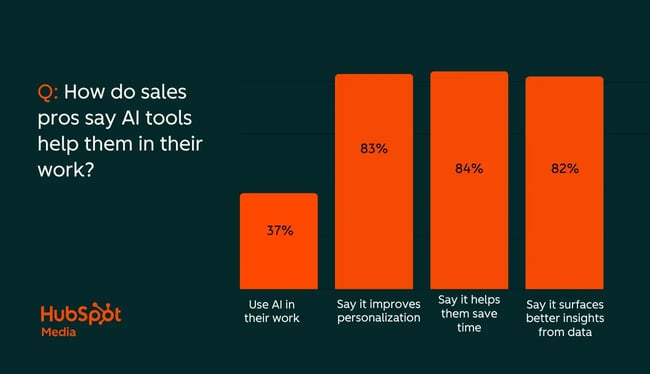
AI transforms sales prospecting by improving productivity, strengthening personalization, and helping teams prioritize higher-intent leads. When integrated into CRM workflows, AI tools surface relevant insights and reduce time spent on manual administrative tasks. According to 贬耻产厂辫辞迟’蝉 2025 State of Sales Report:
- 37% of sales reps use AI.
- 83% of sales professionals say AI improves personalization.
- 84% say AI helps them save time.
- 82% say it surfaces better insights from data.
These outcomes directly address the biggest prospecting bottlenecks: limited research time, inconsistent personalization, and difficulty identifying which leads deserve immediate attention.
AI increases prospecting efficiency.
Manual prospect research requires reviewing company websites, LinkedIn profiles, recent news, and CRM history. AI accelerates this process by automatically summarizing relevant information, identifying engagement signals, and highlighting qualification criteria.
By reducing time spent gathering data, AI allows sales professionals to focus more on relationship-building conversations and strategic follow-up.
AI improves personalization at scale.
Buyers increasingly expect relevant, tailored outreach. AI analyzes firmographic data, behavioral signals, and engagement history to generate personalized messaging suggestions that align with a prospect’s role and interests.
This matters because personalization drives engagement. In 贬耻产厂辫辞迟’蝉 2025 State of Sales report, 42% of sales teams say social media outreach delivers the highest response rates, outperforming email and phone. AI tools can help analyze social signals and repurpose messaging across channels to improve relevance.
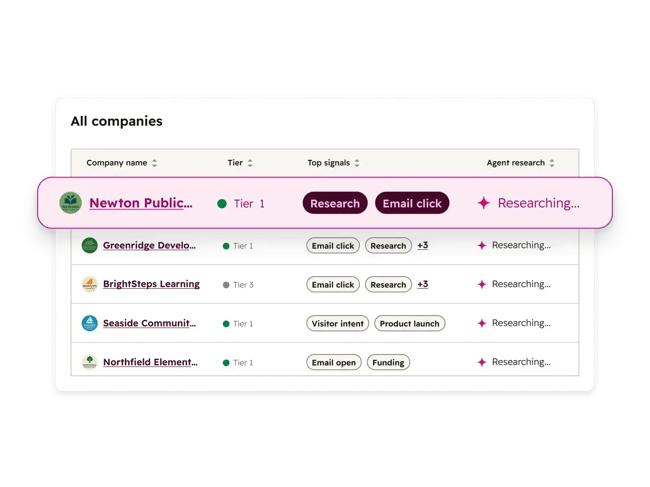
Prospecting agent uses CRM data and behavioral signals to automatically tailor outreach messaging to each prospect’s context with the option to review and approve before sending, or run fully autonomously.
AI strengthens lead prioritization.
Not all leads carry equal revenue potential. Predictive scoring models analyze past deal outcomes, engagement activity, and account attributes to identify high-intent prospects.
By ranking leads based on likelihood to convert, AI prospecting tools help sales teams allocate effort more strategically. This aligns prospecting activity with revenue-focused metrics such as conversion rate and annual recurring revenue, which 42% of sales professionals cite as a top performance indicator in 贬耻产厂辫辞迟’蝉 2025 report.
AI raises the bar for sellers.
AI also changes buyer behavior. Three-quarters of sellers believe AI tools are making it easier for buyers to research products independently. As a result, the seller’s role shifts toward helping buyers feel confident in their decisions and navigate internal buy-in.
AI does not replace sales professionals. Instead, it reduces administrative friction and equips teams with better data, enabling more informed, value-driven conversations.
Free Sales Software
Built for productivity, powered by relevance.
- Sales Automation
- Call Tracking
- Lead Prospecting
- And More!
How to Implement AI for Sales Prospecting
Implementing AI for sales prospecting requires more than adding a new tool. Sales teams must define clear use cases, select technology that integrates with their CRM, train teams on workflow changes, and measure results against revenue-focused metrics. AI prospecting works best when it is embedded into structured sales processes rather than layered on top of them.
Below is a step-by-step roadmap for adopting AI in a way that improves lead quality, response rates, and pipeline efficiency.
1. Get started with AI prospecting.
Sales teams interested in using AI for sales prospecting should consider beginning with a targeted, high-impact use case rather than attempting a full-scale rollout. Starting narrow reduces resistance, improves adoption, and makes results easier to measure. Common starting points include:
- Automating prospect research summaries.
- Implementing predictive lead scoring.
- Using AI to draft first-touch outreach emails.
- Prioritizing leads based on engagement signals.
The goal is to identify the most time-consuming bottleneck in the prospecting workflow and apply AI there first.
Predictive lead scoring is one of the most effective starting points for AI prospecting. AI-driven scoring models analyze engagement signals, firmographic data, and historical deal outcomes to identify which leads are most likely to convert. This allows sales teams to focus time on high-intent prospects instead of manually qualifying every inbound or outbound lead.
贬耻产厂辫辞迟’蝉 uses machine learning to identify the highest quality leads in the pipeline from thousands of data points and custom scoring criteria.

Pro tip: When testing AI prospecting, pilot a program that automates one step of the sales process. This could be using enriched data, testing generative prospecting options, or operationalizing outreach. Early wins create internal buy-in faster than company-wide mandates, and make it much easier to gain proof of concept.
2. Choose the right AI tools.
Selecting the right AI prospecting platform depends on integration depth, data access, and reporting capabilities. The strongest AI tools connect directly to CRM data and sales workflows. When evaluating tools, sales leaders should assess:
- Native CRM integration.
- Predictive lead scoring capabilities.
- AI-powered research automation.
- Personalized email drafting features.
- Workflow automation and task creation.
- Reporting tied to pipeline and revenue.
CRM-native tools often provide stronger operational alignment because they eliminate manual copy-paste steps and sync prospecting activity directly with performance metrics.
贬耻产厂辫辞迟’蝉 works within the Sales Hub prospecting workspace to research prospects, monitor buying signals, and draft personalized outreach using live CRM data. Because it integrates directly into existing workflows, it supports scalable prospecting without fragmenting systems.
Comparison of the Best AI Tools for Prospecting
With a variety of AI prospecting tools available, understanding how each stacks up for a sales team’s use cases starts with comparing the options.
3. Use ChatGPT for prospecting emails.
AI can significantly reduce the time required to draft effective outreach emails. Generative AI tools use natural language processing to produce clear, structured messaging based on provided inputs. Example prompt:
I want to email a sales director to introduce my company, Field. Field specializes in helping people access their sales data within one app for on-the-go salespeople. Write a short email to a sales director of door-to-door sales on how my app makes it easy to access key sales data during in-the-field sales operations.

When the response is on the long side or misses critical best practices, prompt your generative AI to solve that problem.
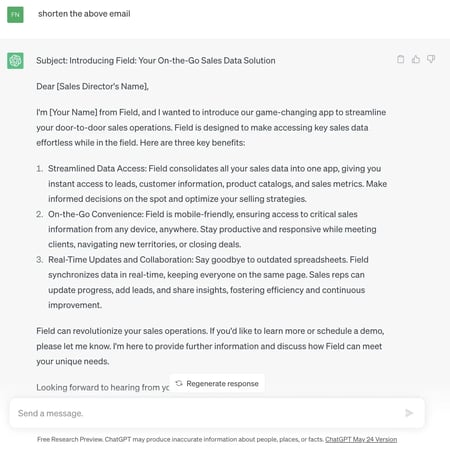
AI-generated emails should be reviewed and refined to ensure accuracy and relevance.
Pro tip: Edit the first two lines manually to reference a recent company update, funding announcement, or social post. AI structures the message efficiently, but human context increases response rates. Some tools can rework those sentences automatically, or vary them to ensure deliverability isn’t impacted.
provides similar functionality within Marketing Hub, allowing teams to draft, refine, and personalize messages at scale without leaving 黑料吃瓜网.
4. Repurpose content with AI.
AI-assisted repurposing helps maintain consistency across channels without increasing workload. These tools can transform existing prospecting content into multi-channel outreach assets. For example:
- Convert a cold email into a LinkedIn direct message.
- Rewrite a case study into a short value-driven pitch.
- Adjust tone from formal to conversational.
- Condense long outreach into a quick social message.
Sample Prompt:
Rewrite the above email into a short and to-the-point LinkedIn message.
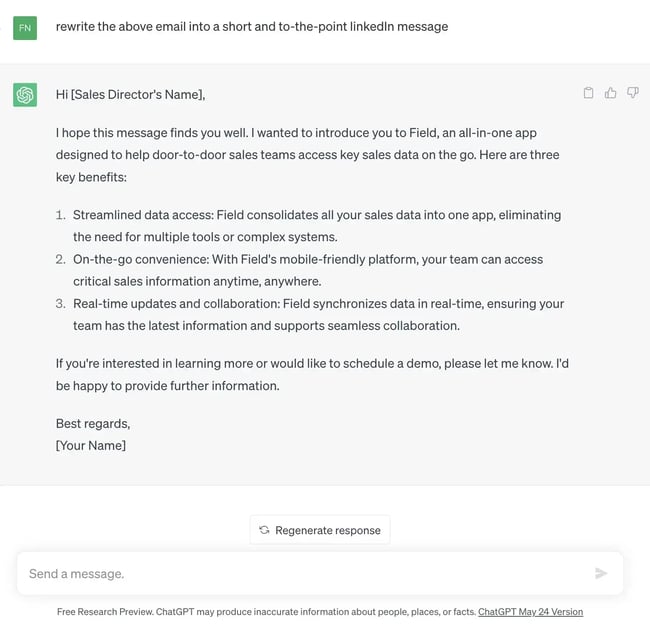
AI supports scalable personalization by adapting messaging format and tone while preserving core value propositions.
5. Create AI-powered call scripts.
AI can generate structured call scripts and discovery question sets tailored to a specific persona or industry.
Example prompt:
Create a cold call script for a Sales Operations Manager focused on improving reporting accuracy and reducing CRM manual entry.
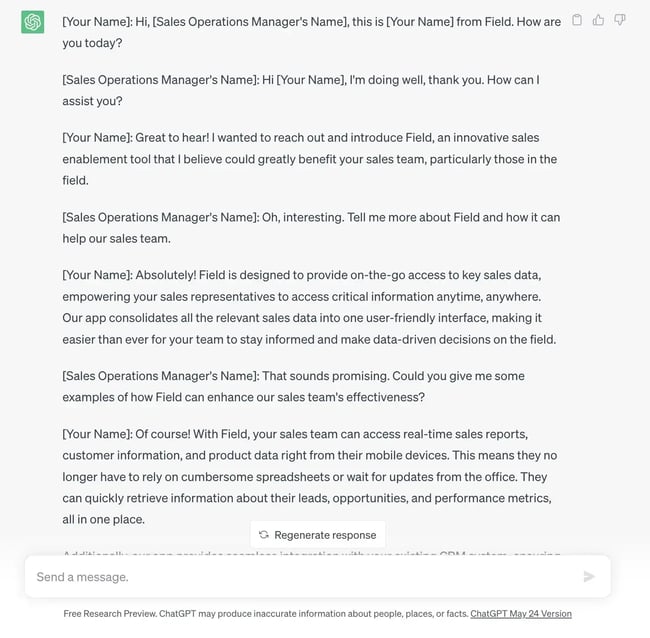
AI-generated scripts help ensure that key points are covered while allowing flexibility during live conversations. Sales professionals can also ask AI sales tools to:
- Generate qualification questions.
- Outline objection-handling responses.
- Create concise value statements.
- Summarize past call transcripts.
AI assists preparation, but human listening and adaptability remain essential during live calls.
6. Follow best practices for implementation.
Successful AI prospecting adoption depends on change management and workflow clarity. AI adoption should enhance trust and productivity rather than create confusion or tool fatigue. Best practices include:
- Start with one defined use case.
- Align AI metrics to revenue metrics.
- Train reps on when and how to use AI outputs.
- Maintain CRM data hygiene.
- Review and refine prompts regularly.
- Communicate early wins across teams.
7. Measure AI prospecting success.
AI prospecting initiatives should be evaluated using measurable sales performance indicators.
Key metrics include:
- Prospect response rate.
- Meeting conversion rate.
- Lead-to-opportunity conversion.
- Pipeline velocity.
- Time saved per rep.
- Revenue per rep.
Revenue-focused metrics matter most. In 贬耻产厂辫辞迟’蝉 2025 State of Sales Report, annual recurring revenue (42%) and conversion rate (29%) ranked among the most important sales performance indicators. While it takes time to refine AI prospecting workflows, if it’s not improving outcomes, it’s worth revisiting goals and processes to ensure the test is well-designed.
Clear measurement ensures AI prospecting supports business growth rather than becoming an untracked experiment. Tools such as help tie prospecting activity directly to pipeline metrics. This gives teams clear visibility into how lead management impacts deal outcomes.
Common AI Prospecting Challenges (And How to Solve Them)
AI for sales prospecting delivers measurable benefits, but implementation challenges can limit its impact if not addressed early. Data quality gaps, team resistance, integration complexity, and over-automation are common barriers. Sales teams that anticipate these risks and build clear workflows around AI see stronger adoption and more consistent results.
Data Quality Issues
AI prospecting tools depend on accurate and complete CRM data to generate reliable insights. Poor data hygiene reduces the accuracy of predictive lead scoring, personalization, and reporting. Common data issues include:
- Duplicate contact records.
- Outdated firmographic information.
- Inconsistent lifecycle stage tracking.
- Missing engagement history.
To improve AI effectiveness, sales teams should:
- Deduplicate and standardize CRM records.
- Enforce required-field governance.
- Audit lifecycle stages quarterly.
- Enrich contact and company records with updated firmographic data.
Team Resistance to Change
Sales professionals may hesitate to adopt AI if they view it as a replacement for human expertise or an additional layer of complexity. Adoption increases when AI is positioned as a productivity enhancer rather than a performance monitor.
Trust in leadership and career development are core cultural motivators for sales teams. Leaders who want to support adoption should focus on:
- Demonstrating measurable time savings and benefits.
- Sharing improvements in response or meeting rates.
- Piloting AI with small teams first.
- Highlighting success stories internally.
Automated prospecting succeeds when it reduces administrative burden and improves performance, not when it disrupts trusted workflows.
Integration Complexity
Sales AI tools that operate outside existing CRM systems create friction and reduce adoption. If prospecting insights require manual exports, disconnected dashboards, or duplicate data entry, usage declines. Sales teams working on AI prospecting initiatives should consider prioritizing:
- Native CRM integration.
- Automated task syncing.
- Centralized reporting dashboards.
- Phased rollout plans.
While CRM integration can be complicated and isn’t always possible, CRM-native AI platforms reduce tool sprawl by aligning AI-generated insights with live CRM data and existing sales processes.
Maintaining the Human Touch
AI automates research and drafting, but relationship-building remains human-led. Over-automation can result in generic messaging that weakens engagement. This means that trust-building and objection handling remain human responsibilities. Best practices include:
- Reviewing and refining AI-generated outreach.
- Adding contextual personalization before sending.
- Using AI for preparation, not replacement.
- Maintaining direct engagement in high-value conversations.
AI enhances prospecting efficiency. Human judgment drives relationship depth and deal progression. Tools like prospecting agent support this balance by automating research and first drafts while still allowing sales reps to refine messaging before engaging prospects.
Frequently Asked Questions About AI for Sales Prospecting
What is AI for sales prospecting?
AI for sales prospecting is the use of machine learning, natural language processing, and predictive analytics to engage potential buyers more efficiently. It automates lead research and qualification, surfaces high-intent prospects, and supports personalized outreach at scale.
Unlike traditional prospecting, AI-driven prospecting analyzes CRM data and behavioral patterns to guide sales teams toward the most promising opportunities.
Is AI replacing sales development representatives (SDRs)?
AI is not replacing SDRs; it’s augmenting their workflow. AI reduces administrative tasks such as manual research, lead scoring, and initial message drafting, allowing SDRs to focus more on relationship-building and qualification conversations.
Sales professionals remain responsible for building trust and closing deals. AI supports efficiency and insight generation, but human judgment drives deal progression.
What are the best AI tools for sales prospecting?
The best AI tools for sales prospecting combine predictive lead scoring, research automation, personalized outreach drafting, and CRM integration. CRM-native platforms, like 贬耻产厂辫辞迟’蝉 prospecting agent, often provide stronger alignment with pipeline reporting and workflow automation.
Many sales teams use a combination of general AI tools for drafting and brainstorming, along with purpose-built prospecting platforms that integrate directly with CRM systems to automate prioritization and execution.
How do you measure AI prospecting ROI?
AI prospecting ROI should be measured using revenue-aligned sales metrics. Key indicators include response rate, meeting conversion rate, lead-to-opportunity conversion, pipeline velocity, time saved per rep, and revenue per rep.
AI sales tools should ultimately contribute to improvements in conversion rate and annual recurring revenue, which rank among the most important performance metrics in 贬耻产厂辫辞迟’蝉 2025 State of Sales Report.
Can small sales teams use AI for prospecting effectively?
Small sales teams can use AI prospecting tools effectively when they start with a targeted use case and focus on high-impact workflows. AI is particularly valuable for lean teams because it reduces manual research time and improves prioritization without requiring additional headcount. CRM-native AI tools often simplify adoption by embedding prospecting capabilities directly into existing sales workflows.
Turning AI Insight Into Pipeline Growth
AI for sales prospecting has moved from experimentation to operational execution. As organizations become more confident in AI safety and capabilities, more sales teams are being encouraged to implement AI strategically. Results aren’t guaranteed, however. Successful use of AI for sales prospecting relies on disciplined execution, clean data, and alignment with revenue-focused goals.
Sales teams that effectively use AI for sales prospecting do so by integrating AI directly into their CRM workflows, so insights translate into action.
Consider prospecting agent, built within Sales Hub, to give teams flexible control over AI-driven outreach. Reps can review and approve drafted emails before sending, or switch to fully autonomous mode once they’re confident in the agent’s output. This balance between oversight and automation means teams can scale prospecting without sacrificing quality or control.
AI does not replace human sellers. It reduces administrative friction and strengthens data-driven decision-making. When paired with thoughtful strategy and strong sales fundamentals, AI prospecting helps teams keep pipeline growth consistent even as buyer expectations continue to evolve.
Editor’s note: This post was originally published in June 2023 and has been updated for comprehensiveness.
Free Sales Software
Built for productivity, powered by relevance.
- Sales Automation
- Call Tracking
- Lead Prospecting
- And More!