.png?width=112&height=112&name=Image%20Hackathon%20%E2%80%93%20Vertical%20(30).png)

Most teams make a critical mistake: They treat customer visits as routine check-ins instead of strategic opportunities. According to , forcing organizations to replace nearly 70% of their audience annually.
The stakes are high. . However, most customer visits lack the strategic planning needed to capitalize on this advantage.
The difference between a routine check-in and a transformative customer visit comes down to preparation — and that's exactly what this guide addresses.
Table of Contents
- What is a customer visit?
- What are the benefits of customer visits?
- Types of Customer Visits
- How to Prepare for and Execute a Customer Visit
- Creating Your Customer Visit Report
- Customer Visit Agenda Template
- Frequently Asked Questions About Customer Visits
What is a customer visit?
A customer visit is a strategic in-person meeting at a client's office or facility designed to deepen relationships, gather insights, and align on business objectives. Unlike virtual check-ins or transactional sales calls, a customer visit provides the opportunity to observe how customers use a product in their actual working environment, meet multiple stakeholders across different teams, and build the kind of trust that cannot be replicated through screens.
The effectiveness of customer visits is well-documented. of attendees feel in-person events are the most trusted way to learn about products and services. Additionally, they build stronger, more meaningful business relationships during in-person meetings. These face-to-face interactions create lasting impressions that transcend the limitations of video calls and email correspondence.
Customer visits typically involve meeting with executive leadership, spending time with product end users, observing workflows in action, and often culminating in a dinner where relationships can develop outside the confines of the office. These visits serve multiple purposes simultaneously: strengthening relationships, gathering feedback, identifying opportunities, and aligning with strategy.
.png)
61 Templates to Help You Put the Customer First
Email, survey, and buyer persona templates to help you engage and delight your customers
- 6 buyer persona templates
- 5 customer satisfaction survey templates
- 50 customer email templates
Download Free
All fields are required.
Form not available
You're all set!
Click this link to access this resource at any time.
What are the benefits of customer visits?
Strategic customer visit planning delivers measurable returns that justify the investment of time and travel costs. The benefits extend far beyond a single meeting, creating a lasting impact on retention, revenue, and relationship quality.
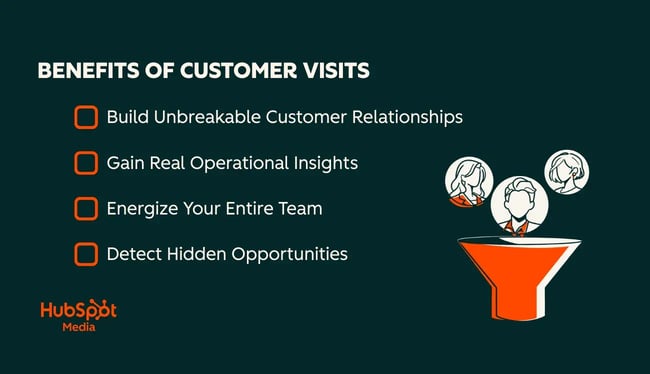
Build Unbreakable Customer Relationships
In-person customer visits create relationship bonds that virtual interactions simply cannot match. . The research backs up what many customer success leaders already know: there's no substitute for being there in person.
When you visit customers on-site, you‘re not just selling a product — you’re selling the people, vision, and passion behind it. Your expertise comes across more powerfully. Your authenticity shows through. The shared meals, office tours, and casual conversations between scheduled meetings create connection points that become the foundation for long-term loyalty. .
As Jason Lemkin, founder of SaaStr and EchoSign, famously said: “I never lost a customer I actually visited.” This bold statement reflects a truth that experienced customer success professionals understand — the relationships forged during in-person visits create retention advantages that no amount of email nurturing can replicate.
Gain Real Operational Insights
Virtual meetings provide limited visibility into how customers actually use a product. In-person visits reveal the full context: the physical environment, the tools and systems surrounding the solution, the workarounds teams have created, and the real workflows that don't appear in usage dashboards.
When physically present at a customer's office, reps notice things that never come up on calls. Are teams printing reports to pin on walls? Do employees walk across the floor to share screens? What other software systems are integrated with yours? What hardware limitations exist? These observations provide invaluable insights that inform everything from product development priorities to renewal strategies.
The contextual intelligence gathered during customer visits enhances every future interaction. When renewal conversations begin, or expansion opportunities arise, reps can draw on deep knowledge of customer operations, challenges, and goals — a distinction that separates good account management from exceptional relationship stewardship.
Energize Your Entire Team
Remote work and endless video calls can create emotional distance from the impact of the work. Customer visits reconnect teams with the “why” behind what they do. When customer success managers meet the people using their product, hear firsthand stories of impact, and see the real business problems being solved, it reignites motivation in ways that internal meetings never can.
This motivational boost extends beyond the individual team member. When the customer success team returns from site visits with stories, insights, and renewed passion, it energizes product teams, sales colleagues, and leadership. The human connections made during these visits remind everyone that behind every account is a team of real people working to achieve meaningful goals.
For newer team members who joined during remote work periods, customer visits are especially transformative. Many have never experienced the energy of meeting customers face-to-face or the satisfaction of solving problems in real time while sitting alongside the people affected. These experiences shape how they approach every aspect of their role going forward.
Detect Hidden Opportunities
Customer visits uncover expansion and upsell opportunities that remain invisible during scheduled calls. When teams spend extended time on-site, meeting with different departments and observing various workflows, they naturally discover use cases and pain points that weren‘t on anyone’s agenda.
A conversation with the marketing team might reveal they‘re struggling with a problem your product solves — but they don’t know your company offers that capability. Walking past a whiteboard covered in manual calculations might expose a workflow that your automation features could transform. These serendipitous discoveries often lead to the most valuable expansion opportunities because they address genuine pain points rather than manufactured needs.
Beyond direct upsell opportunities, customer visits frequently generate high-quality referrals. When building genuine relationships during in-person meetings, it's natural to ask, “Are there other companies you work with that might benefit from our solution?” The trust and rapport developed during the visit make customers more willing to make introductions — and those referrals convert at significantly higher rates than cold outreach.
Types of Customer Visits
Not all customer visits serve the same purpose. Understanding the different types helps teams plan appropriately, set the right expectations, and structure agendas that accomplish their specific objectives. The two primary categories of customer visits are ideation-focused visits and implementation-focused visits, each requiring distinct preparation and execution approaches.
Ideation-Focused Customer Visits
Ideation visits center on discovery, strategy alignment, and relationship building. These visits typically occur during the early stages of a customer relationship, before major renewals, or when exploring expansion opportunities. The primary goal is understanding the customer's business challenges, strategic priorities, organizational dynamics, and how the solution fits into their broader ecosystem.
During ideation visits, success teams might spend time interviewing stakeholders across different departments, observing how teams currently solve problems, facilitating strategic planning sessions, or conducting workshops to identify future opportunities. The atmosphere is collaborative and exploratory rather than prescriptive. Use this time to gather intelligence, build relationships with key decision-makers, and position the company as a strategic partner rather than just a vendor.
These visits often involve less structured agendas, allowing for organic conversations and spontaneous discoveries. Activities might include whiteboarding sessions, informal office tours, extended lunches with leadership teams, or roundtable discussions with power users. The deliverables from ideation visits typically include strategic recommendations, opportunity assessments, and relationship maps that inform future engagement strategies.
Implementation-Focused Customer Visits
Implementation visits are tactical and action-oriented, designed to drive specific outcomes like training, troubleshooting, process optimization, or feature adoption. These visits typically occur during onboarding, when rolling out new capabilities, or when addressing adoption challenges that require hands-on support.
The agenda for implementation visits is highly structured, with clear objectives for each session. Customer success reps might conduct hands-on training workshops, review configuration settings alongside IT teams, observe users working in the system to identify friction points, or facilitate change management sessions with team leaders. The focus is on ensuring successful adoption and maximizing the value customers extract from the product.
Implementation visits often involve bringing in technical specialists, solutions engineers, or training experts. The deliverables are concrete: configuration documentation, customized training materials, adoption roadmaps, and action plans with specific next steps and owners. While relationship building still matters, the emphasis is on demonstrating tangible value through improved product usage and business outcomes.
How to Prepare for and Execute a Customer Visit
Thorough preparation combined with strong execution separates forgettable check-ins from transformative customer visits. The key is to research the customer beforehand, so the team knows what their current pain points are. can help teams do their homework so they arrive at visits prepared.
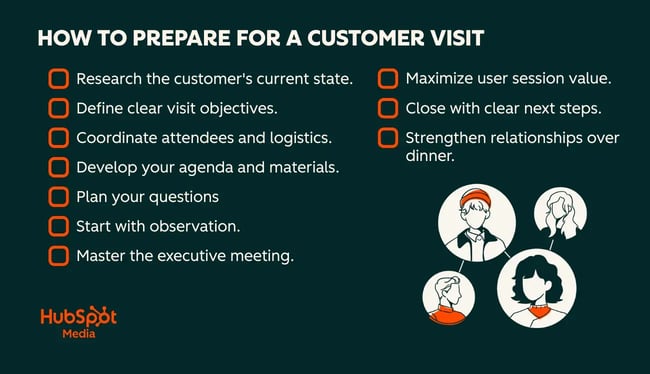
Research the customer's current state.
Before any customer visit, invest time in understanding where the account stands. Review product usage data in the to identify adoption patterns, feature utilization, and any declining engagement trends. Examine recent support tickets to understand pain points and outstanding issues. Review the complete interaction history — who from your company has been talking to whom, what topics have been discussed, and what commitments were made.
Beyond the company’s internal systems, research the customer‘s external context. Are they in the news? Have they announced new strategic initiatives, leadership changes, or market expansions? What’s happening in their industry that might affect priorities? Check their company blog, press releases, and LinkedIn updates to understand their current narrative. This external intelligence provides conversation starters and demonstrates that you view them as more than just an account number.
Compile this intelligence into a pre-visit briefing document that you share with anyone from your team attending the meeting. Include key contacts, org charts, product usage summaries, open issues, renewal timeline, and relevant business context. This shared understanding ensures the entire team arrives prepared and coordinated.
Define clear visit objectives.
Every customer visit should have two to four specific, measurable objectives that guide agenda development and success criteria. Avoid vague goals like “strengthen the relationship” or “check in on their satisfaction.” Instead, define concrete outcomes: “Identify at least three product improvement priorities from end users,” “Secure executive commitment to expand usage to the marketing department by Q2,” or “Document current workflow challenges to inform our renewal proposal.”
Share these objectives with the customer contact when scheduling the visit. Transparency about goals helps them prepare appropriately, involve the right stakeholders, and allocate sufficient time. Most customers appreciate the clarity — it signals professionalism and respect for their time.
The objectives should balance business needs with genuine value creation for the customer. If the only goal is securing a renewal signature, the visit will feel transactional. Better objectives create mutual value. Understanding customer challenges helps the organization serve accounts better and identify expansion opportunities. Gathering user feedback improves the product and demonstrates customer-centricity.
Coordinate attendees and logistics.
The people brought to a customer visit send powerful signals about how seriously the company takes the relationship. For strategic accounts or executive meetings, consider including senior leaders from your organization — VP of Customer Success, Chief Product Officer, or even the CEO. For implementation-focused visits, bring solutions engineers or product specialists who can address technical questions on the spot.
Work with the customer contact to identify the right attendees on their side. A well-rounded visit typically includes time with executive leadership (the economic buyer or strategic sponsor), the operational owner who oversees day-to-day usage, and end users who work in the product regularly. Depending on visit objectives, it may also be worth requesting time with teams in departments that could benefit from expansion.
Handle logistics well in advance. Book flights and hotels early. Confirm the customer's office address and parking instructions. If planning a dinner, make reservations at a restaurant that accommodates various dietary restrictions and provides a conducive environment for conversation. Send calendar invitations with detailed agendas at least one week before the visit, giving everyone time to prepare.
Develop your agenda and materials.
A well-structured agenda demonstrates professionalism while ensuring the team accomplishes its objectives within the available time. Start by outlining the major components: welcome and introductions, executive meeting, user sessions, wrap-up discussion, and dinner. Within each component, specify topics to cover, questions to ask, and who will lead each section.
Build flexibility into the agenda. While structure is important, the best customer visits often involve spontaneous conversations, unexpected introductions, or impromptu office tours that weren‘t on the schedule. Don’t pack the agenda so tightly that there's no room for serendipity — some of the most valuable insights emerge during unplanned moments.
Prepare any materials needed: presentation slides, product demos customized to their use cases, printed handouts with reference information, or discussion guides for feedback sessions. Make sure everything is polished and professional — sloppy materials undermine the credibility being built. Use capabilities to pull personalized account insights that can be referenced throughout the visit.
Plan your questions.
The questions asked during a customer visit reveal what reps care about and how deeply they understand their business. Prepare thoughtful questions in advance, organized by audience. For executives, focus on strategic priorities, business challenges, and success metrics. For operational managers, explore workflow efficiency, team adoption, and integration pain points. For end users, dig into daily usage patterns, feature requests, and workarounds they've created.
Avoid yes/no questions that generate minimal insight. Instead of “Are you satisfied with our product?”, ask “What's the one thing we could improve that would have the biggest impact on your team's productivity?” Instead of “Do you see value in our solution?”, ask “Can you walk me through a recent example of how our product helped you solve a problem?”
Include questions that probe for expansion opportunities without being pushy: “Are there other teams in your organization facing similar challenges?” or “What adjacent problems would you love to solve if you had the right tool?” These questions keep you focused on value creation while naturally uncovering revenue opportunities.
Start with observation.
Arrive early enough to observe the customer‘s environment before formal meetings begin. Notice the energy in the office, the technology they’re using, the physical layout of workspaces, and the culture expressed through office design and employee interactions. These observations provide context that informs how to communicate throughout the day.
During the office tour or welcome session, pay attention to everything. Note how the product appears on screens and how it's being used. Competing products or complementary tools spotted in the environment are worth flagging for later discussion. Inefficient processes or manual workarounds often signal potential opportunities to provide value.
Take discreet notes throughout the day. Capture specific quotes from customers, particularly when they describe pain points or express appreciation for certain features. Document the names and roles of people met throughout the visit — this information will get referenced in follow-up communications and future planning. Use a mobile device to update the with real-time insights between meetings.
Master the executive meeting.
The executive meeting sets the tone for the entire visit. Start by thanking them for their time and briefly reminding everyone of the meeting objectives. Then shift immediately to listening mode. Ask strategic questions about their business priorities, competitive landscape, and success metrics. Let them talk. — take advantage of this format to go deeper than possible on a video call.
When discussing the product or service, frame everything around their business outcomes rather than features. Instead of “We've released a new dashboard,” say “Based on what you've shared about needing better visibility into the pipeline, let me show you how our new dashboard addresses exactly that challenge.” Connect every capability to a problem they've expressed.
Address any outstanding issues directly and transparently. If they raise concerns about support response times, product bugs, or missing features, acknowledge them without becoming defensive. Explain what you're doing to address the issues and, when possible, provide specific timelines. Executives respect accountability more than perfection.
Maximize user session value.
Time spent with end users often generates the most actionable insights from customer visits. These are the people who live in the product daily, encounter friction points that executives never see, and create workarounds that signal unmet needs. Structure user sessions to maximize learning while providing genuine value to participants.
Consider sitting side-by-side with users as they work through actual tasks in your product. Watch where they hesitate, which features they bypass, and what questions they ask. This observational approach reveals usability issues that users might not articulate in a traditional feedback session. Take notes on specific workflows, but resist the urge to immediately offer solutions — sometimes just watching and learning is more valuable.
Balance listening with teaching. If users are observed taking the long route to accomplish something the product does more efficiently, show them the better way. These mini-training moments create immediate value and position the customer success rep as a helpful expert rather than just someone extracting feedback. Users will remember the practical help provided long after the visit ends.
Close with clear next steps.
The wrap-up meeting is the opportunity to synthesize what reps have learned, align on action items, and reinforce the value of the visit. Schedule at least 30 minutes for this session, ideally with key stakeholders who participated throughout the day. Begin by summarizing the major themes heard, the opportunities identified, and the issues that require attention.
Create a clear action item list with owners and deadlines. Be specific: “Sarah will send configuration documentation by Friday” rather than “We'll follow up on the configuration question.” Assign owners from both your team and theirs. This shared accountability increases the likelihood that action items actually get completed.
Set expectations for your customer visit report. Tell them when they'll receive a detailed wrap-up document summarizing the visit, capturing key insights, and outlining next steps. This report serves as the official record of your visit and keeps momentum going after you leave. Commit to a timeline — typically within 48-72 hours — and deliver on it.
Strengthen relationships over dinner.
The dinner component of a customer visit serves a different purpose than daytime meetings. While business topics will naturally arise, the primary goal is to build relationships through more relaxed, personal conversation. This is where reps move beyond vendor-client dynamics into genuine professional relationships.
Choose a restaurant that facilitates conversation — quiet enough for everyone to hear each other, with good ambiance and food options for various dietary preferences. If unfamiliar with the area, ask the customer contact for recommendations. Letting them choose a favorite spot often works better than imposing a selection.
During dinner, balance personal connection with strategic awareness. Learn about the customers as people — their backgrounds, career paths, interests outside work, and aspirations. These conversations create memorable connections while also providing context that helps serve them better. Someone passionate about sustainability might appreciate hearing about the company's environmental initiatives. Someone with young children might relate to discussions about work-life balance.
Creating Your Customer Visit Report
The customer visit report is where insights become action. This document serves multiple audiences: the internal team needs intelligence to inform strategy; the customer needs evidence that reps listened and will follow through; and future team members need context about the relationship history. A well-constructed report maximizes the return on visit investment by ensuring insights don't get lost.
Structure Your Report Effectively
Begin the customer visit report with an executive summary that captures the most important takeaways in 3-5 bullet points. Busy stakeholders should be able to read this section in 60 seconds and understand the visit outcome. Include the overall health assessment, the major opportunities identified, the critical risks that need attention, and the key action items.
Organize the report's body around major themes rather than chronologically recounting every meeting. Group related insights together: product feedback, expansion opportunities, relationship dynamics, competitive intelligence, and operational observations. This thematic organization makes the report more useful for different audiences — product teams can quickly find feature requests; sales can easily locate expansion opportunities.
Include specific details and quotes that bring insights to life. Instead of “Users want better reporting,” write “Three members of the marketing team mentioned they spend 4-5 hours weekly manually compiling data that should be in automated reports. As Maria said, 'We love the product, but we're drowning in manual reporting work.'” Specific details make the report more credible and actionable.
Document Action Items Clearly
The customer visit report should include a dedicated action items section listing every commitment made during the visit, with clear owners and deadlines. Separating action items into two categories prevents dropped balls and miscommunications:
- Internal action items: commitments the customer success team will complete
- Customer action items: commitments the customer made during the visit
Make sure action items are specific and measurable. “Follow up on reporting request” is vague. “Solutions Engineering team will provide a custom report template addressing marketing team needs by January 31st.” is concrete. When action items are specific, accountability increases and completion rates improve.
Track action items in your with due dates and reminders. The customer visit report documents commitments, but your CRM ensures they actually get completed. Create tasks for each action item, assign them to the appropriate team members, and set follow-up reminders.
Tailor Reports for Different Audiences
Consider creating two versions of the customer visit report: an internal version for the team and an external version for the customer. The internal version can include sensitive information like competitive intelligence, renewal risk assessments, or internal-only action items. The external version focuses on insights you gathered, value you're committing to deliver, and mutual action items.
The external report demonstrates professionalism and reinforces that you listened carefully. Customers appreciate receiving a well-organized summary of what they shared, what you committed to, and what happens next. This document keeps you accountable while also serving as a reference point for future discussions.
For internal distribution, consider creating a highlight reel for executives (one page), a detailed report for the account team (3-5 pages), and specific sections for specialized teams (product team gets all feature requests; sales gets expansion opportunities; support gets technical issues). Tailoring content to each audience increases the likelihood that insights drive action.
Customer Visit Agenda Template
The following template serves as a starting point for planning a customer visit. Timing, participants, and topics should be customized based on visit objectives and customer needs. Sharing the agenda with the customer contact at least one week before the visit ensures appropriate stakeholder involvement and adequate time allocation.
Before the visit, teams should also prepare an internal-only notes section not shared with the customer.
Internal Notes Section
At the bottom of your agenda, include internal notes meant only for your team:
? Renewal timeline and risk assessment
? Expansion opportunities to probe for
? Outstanding issues that must be addressed
? Competitive intelligence to gather
? Key talking points for each meeting
Frequently Asked Questions About Customer Visits
How do I justify the cost of customer visits to leadership?
Customer visits are best framed as strategic investments rather than expenses when linked to measurable business outcomes. Data showing that a helps make the case, alongside examples of how in-person visits strengthen retention for high-value accounts.
Calculating the lifetime value of target accounts and comparing it to travel costs makes the ROI clear. Competitive intelligence, expansion opportunities, and product insights derived from on-site observation further strengthen the business case. Most leaders approve customer visit budgets when presented with clear connections to retention, expansion revenue, and strategic relationship building. can support this process by tracking customer interactions and identifying which accounts would benefit most from in-person visits, making it easier to build a data-backed case for investment in visits.
How often should I visit each customer?
Visit frequency depends on account value, relationship health, and strategic importance. For enterprise accounts generating significant revenue, quarterly visits during the first year establish a strong foundation, transitioning to semi-annual visits once the relationship matures. Mid-market accounts typically benefit from annual visits, with additional visits triggered by renewal periods, expansion opportunities, or signs of churn risk.
Smaller accounts may not warrant regular visits unless they represent strategic growth opportunities or reference value. Prioritize visits based on where face-to-face interaction creates the most value: new customer onboarding, renewal risk mitigation, expansion discussions, or executive relationship building. Consider regional visit planning to maximize efficiency — when traveling to visit one customer, schedule meetings with nearby accounts to optimize travel investment. can help teams prioritize visit cadences by surfacing account health signals, relationship context, and engagement trends in one place.
What if a customer declines a visit or says video calls are sufficient?
When customers initially decline in-person meetings, the issue is usually timing or an unclear value proposition rather than genuine resistance. Reframe your request by articulating specific value: “I'd like to spend time with your team to understand how you're using the product so we can identify optimization opportunities” is more compelling than “Let's schedule a visit.”
Offer flexibility around timing and scope — perhaps a half-day visit rather than a full day, or alignment with an existing event or conference they're attending. If they still prefer virtual meetings, respect their preference while planting seeds for future visits:
- “I understand. Let's plan to connect virtually this quarter, and perhaps we can revisit an in-person meeting in Q3 when you're preparing for renewal.” Sometimes, initial reluctance transforms into openness once trust deepens through consistent virtual engagement.
How do I make customer visits valuable for small accounts with limited budgets?
For smaller accounts where dedicated visits are difficult to justify financially, employ regional clustering strategies. When visiting a larger account in a specific geography, schedule shorter meetings with nearby smaller accounts on the same trip. A 90-minute meeting over coffee or lunch can deliver relationship-building benefits without requiring separate travel.
Alternatively, align customer visits with industry conferences or events where multiple customers gather — schedule individual meetings around the conference to maximize face time efficiency.
Consider a hybrid approach: maintain regular virtual touchpoints, supplemented by occasional in-person meetings during strategic moments such as renewals or expansions. Finally, evaluate whether smaller accounts might represent future growth potential — sometimes the small customer today becomes the enterprise account tomorrow, and early relationship investment pays long-term dividends.
Make Customer Visits Your Competitive Advantage
Customer visits deliver four core benefits that directly impact retention and revenue:
- They build unbreakable relationships through face-to-face trust building
- They provide operational insights impossible to gather remotely
- They energize teams by connecting them with real customer impact
- They surface hidden expansion opportunities through spontaneous discoveries
The most common objection to customer visits is cost, but the real cost is the revenue lost when competitors invest in relationships while your team remains on video calls. The second objection is time, but customer visits don't add to the workload; they multiply the effectiveness of everything else customer success teams do. One day on-site generates insights that inform six months of virtual interactions.
The agenda template and preparation framework in this guide provide a starting point for making customer visits a consistent part of the customer success strategy.
61 Templates to Help You Put the Customer First
Email, survey, and buyer persona templates to help you engage and delight your customers
- 6 buyer persona templates
- 5 customer satisfaction survey templates
- 50 customer email templates
Download Free
All fields are required.
Form not available
You're all set!
Click this link to access this resource at any time.
customer experience