
When comparing virtual vs. face-to-face communication, there’s no set formula. , while . Sales teams are left to balance flexibility with effectiveness.
Video conferences, messaging apps, email, and collaborative software can be incredibly helpful when teams or prospects sit in different parts of the world. But, face-to-face meetings give greater context, allowing reps to assess body language, tone, and immediate feedback. Both methods serve distinct purposes in modern business, and understanding when to deploy each approach directly impacts team productivity, relationship quality, and sales outcomes.
This guide examines the latest data on both communication methods and provides practical frameworks for choosing the right approach.
Table of Contents
- What is face-to-face communication?
- Benefits Comparison: Face-to-Face vs. Virtual Communication
- Conflict Resolution: Virtual vs Face-to-Face Communication
- The Hidden Costs of Virtual Communication
- How to Choose Between Face-to-Face vs. Virtual Communication
- Frequently Asked Questions About Virtual vs. Face-to-Face Communication
What is face-to-face communication?
Face-to-face communication involves getting attendees in the same room. Participants can observe and respond to the full range of verbal and nonverbal cues in real time. These elements combine to create communication richness that digital tools still struggle to replicate fully.
In sales contexts, face-to-face communication plays a particularly critical role. . In fact, companies that prioritize in-person client meetings see a . The physical presence creates trust signals — like consistent eye contact and attentive posture — that influence buying decisions at subconscious levels.

25 Voicemail Script Templates
25 voicemail script templates for any occasion.
- Referrals
- Partner Acquisition
- Cold Outreach
- Voicemail Greeting Templates
Download Free
All fields are required.
Form not available
You're all set!
Click this link to access this resource at any time.
Benefits Comparison: Face-to-Face vs. Virtual Communication
Both face-to-face and virtual meetings offer distinct advantages depending on business context, relationship stage, and goals. Understanding these comparative benefits enables leaders to make strategic choices rather than defaulting to convenience.
Benefits of Face-to-Face Communication
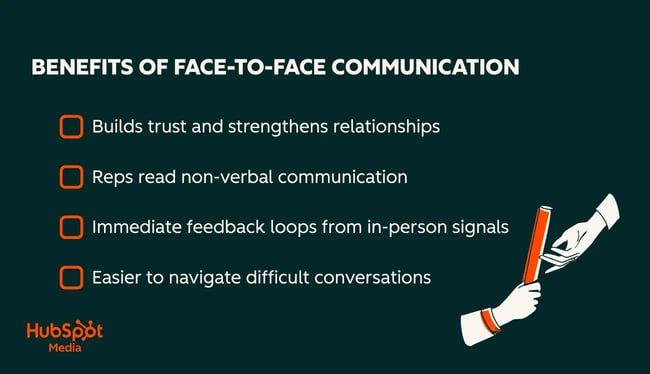
Face-to-face communication excels at building trust and strengthening relationships. , reflecting the unique trust-building capacity of in-person interaction. When people meet face-to-face, they process thousands of micro-expressions, vocal tone variations, and body language cues that build credibility and rapport.
In-person meetings also enable richer information exchange. Complex negotiations, sensitive conversations, and strategic planning sessions benefit from the bandwidth that physical presence provides. , recognizing that high-stakes conversations require the nuance that screens cannot capture.
The ability to read the room, adjust messaging based on nonverbal feedback, and build consensus through physical presence makes face-to-face communication irreplaceable for critical business moments.
For sales professionals, the benefits of face-to-face communication translate directly to revenue impact. In-person sales meetings create memorable experiences that virtual calls cannot match. The shared meal, the office tour, the spontaneous conversations between scheduled sessions — these touchpoints accumulate into relationship capital that influences deal velocity and contract value.
Sales teams leveraging to schedule both virtual and in-person appointments strategically can optimize their communication approach based on deal stage and relationship maturity.
Benefits of Virtual Communication
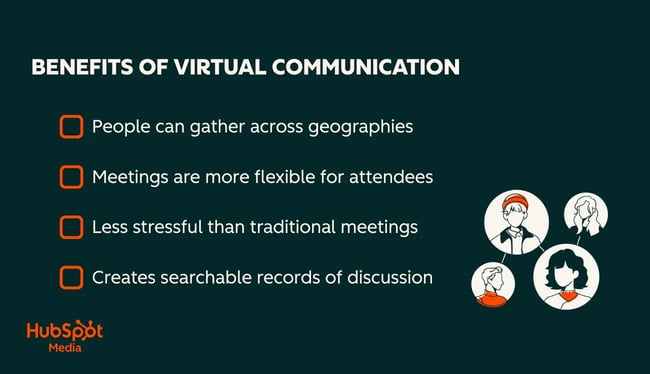
Virtual communication delivers scalability and efficiency advantages that face-to-face interactions cannot match. With employees now attending an , organizations have adapted workflows to leverage digital communication's core strengths:
- Eliminating travel time and costs.
- Enabling global collaboration across time zones.
- Creating searchable records of discussions.
- Facilitating quick information sharing.
The flexibility of virtual meetings also accommodates diverse work styles and personal circumstances. , reflecting the reduced pressure of formal office environments. For routine check-ins, project updates, and informational briefings, virtual communication provides sufficient context without the coordination complexity of in-person gatherings.
Virtual communication also creates opportunities for asynchronous collaboration. Tools like allow sales professionals to send personalized video communications that prospects can review on their own schedule, combining the warmth of face-to-face interaction with the convenience of asynchronous communication. This hybrid approach addresses the key advantage of both methods simultaneously.
Conflict Resolution: Virtual vs Face-to-Face Communication
Workplace conflicts require careful navigation regardless of communication channel, but the effectiveness of electronic vs. face-to-face communication varies significantly when addressing disagreements and tension. Understanding when to leverage each method directly impacts resolution speed and relationship preservation.
Face-to-face conflict resolution offers distinct advantages. , recognizing that physical presence reduces the risk of misinterpretation.
When colleagues address conflicts in person, they can observe emotional responses in real time, adjust their approach based on nonverbal cues, and use empathetic body language to de-escalate tension. The shared physical space creates accountability — people generally speak more carefully and listen more attentively when facing someone directly.
Virtual conflict resolution, while less ideal, sometimes offers unexpected benefits. The slight emotional distance that screens provide can help highly charged situations cool down.
Text-based communication allows people to craft thoughtful responses rather than reacting impulsively. However, the absence of nonverbal cues makes misunderstandings more likely — a neutral statement can read as aggressive, and attempts at humor may fall flat without facial expressions to provide context.
For sales contexts, the conflict resolution method matters significantly. When addressing client concerns or internal team disagreements, face-to-face meetings demonstrate commitment that virtual calls cannot convey. A sales manager who flies to meet an unhappy customer signals that the relationship matters more than convenience. Similarly, addressing team conflicts in person shows respect for the individuals involved and a commitment to resolving them.
The practical guidance: Address minor conflicts virtually if necessary, but escalate to face-to-face communication when disagreements involve emotional intensity, relationship stakes, or unclear accountability. Use to coordinate in-person meetings quickly when conflicts arise, preventing small disagreements from escalating during extended virtual back-and-forth exchanges.
The Hidden Costs of Virtual Communication
While virtual communication delivers obvious efficiency gains, it also generates less visible costs that accumulate over time. Understanding these hidden expenses helps organizations make more informed decisions about when to invest in face-to-face interaction. These hidden costs fall into four categories: cognitive fatigue, relationship degradation, lost serendipity, and attention fragmentation.
The Zoom Fatigue Phenomenon
Video conference fatigue is among the most studied disadvantages of face-to-face communication conducted virtually. , with . The cognitive load of video calls stems from multiple factors:
- Constant self-monitoring through camera view.
- Interpreting nonverbal cues through limited visual fields.
- Managing technical distractions.
- And maintaining focus without natural conversation breaks.
Interestingly, recent evidence suggests adaptation may be occurring. , with video meetings under 44 minutes actually proving less exhausting than other meeting types.
This evolution suggests that organizations and individuals have developed better virtual communication practices over time. However, the initial fatigue costs during the learning curve represented a significant hidden expense, resulting in reduced productivity and employee well-being.
Relationship Degradation Over Time
Virtual-only relationships gradually lose strength without periodic in-person reinforcement. While for transactional exchanges, longer-term relationship quality follows a different trajectory.
Client relationships built exclusively through screens lack the depth that physical presence creates. The spontaneous conversations, shared meals, and informal moments that build genuine connection simply don't occur in back-to-back Zoom calls.
This degradation particularly impacts sales outcomes. Clients who never meet their account managers in person are more likely to switch to competitors. The relationship feels transactional rather than personal. Without the investment signal that traveling to meet someone sends, clients perceive the relationship as less valuable.
Sales professionals using to review virtual meeting insights can identify when relationships show signs of weakening — declining engagement, shorter meetings, less personal conversation — signaling the need for in-person intervention.
Lost Serendipity and Innovation
Virtual communication's scheduled nature eliminates spontaneous interactions that drive innovation and problem-solving. Office hallway conversations, impromptu whiteboarding sessions, and casual lunch discussions disappear in fully remote environments. While scheduled virtual meetings address planned topics efficiently, they miss the unplanned insights that emerge from serendipitous encounters.
For sales teams, this translates directly to missed cross-selling opportunities, delayed problem identification, and slower knowledge sharing. Knowledge transfer that happens naturally through office proximity only occurs in virtual environments through formal documentation or scheduled training — if it happens at all.
Attention Fragmentation and Multitasking
Virtual meetings enable — and even encourage — divided attention. , and having cameras off provides even more opportunities for distraction. While some multitasking improves perceived productivity, the quality of engagement suffers. Participants miss nuances, fail to contribute meaningfully, and require information to be repeated.
This attention fragmentation particularly impacts virtual sales presentations and client meetings. When prospects can check email, respond to Slack messages, or browse other tabs during a sales presentation, conversion rates decline.
The physical presence of in-person meetings creates natural accountability — walking away or pulling out a phone during a face-to-face presentation sends strong negative signals that most people avoid. Teams can use to analyze virtual meeting engagement patterns and identify when critical conversations warrant the upgrade to in-person interaction.
How to Choose Between Face-to-Face vs. Virtual Communication
Strategic communication requires matching the method to the purpose. Rather than defaulting to virtual meetings for convenience or insisting on face-to-face interaction out of tradition, effective leaders make intentional choices based on communication objectives, relationship stage, and business context.
The following comparison outlines the core strengths of each communication method to help teams make more intentional choices.
When to Choose Face-to-Face Communication
Prioritize in-person meetings for relationship-building, as these moments shape long-term outcomes. High-stakes conversations and strategic discussions generally warrant face-to-face interaction. Specific situations where in-person communication delivers the most value include:
- First meetings with prospective clients, where the investment signals seriousness and creates stronger initial impressions.
- Annual business reviews with major accounts, demonstrating that the relationship matters more than convenience.
- Negotiations involving significant contract value or complex terms, where trust-building and nuance-reading are critical.
- Difficult feedback, conflict resolution, or sensitive personnel matters, where physical presence reduces misunderstanding.
- Strategic planning sessions involving multiple stakeholders and complex decision-making.
- Relationship repair or restoration when client engagement has declined, or misunderstandings have accumulated through virtual channels.
With , prioritizing in-person interaction for high-stakes moments remains a competitive advantage regardless of how distributed a team is.
When Virtual Communication Works Best
Virtual communication excels for routine operational exchanges. where efficiency and speed matter more than relationship depth. Specific situations where virtual communication delivers the most value include:
- Weekly team standups, project status updates, quick check-ins, and informational briefings.
- Geographically distributed collaboration across time zones, where in-person gathering is impractical.
- Time-sensitive coordination requiring immediate connection.
- Technical discussions with screen-sharing requirements.
- Follow-up conversations that reference documented agreements and benefit from searchable records.
- Introverts and communication contexts where written preparation produces better outcomes than spontaneous verbal exchanges.
, reserving face-to-face interaction for high-value moments becomes necessary to prevent calendar saturation.
The Hybrid Approach
The most effective communication strategies combine both methods strategically. — gatherings where some participants join in person while others connect virtually. This flexibility accommodates diverse needs while maintaining connection.
For sales relationships, consider a rhythm that alternates between virtual and in-person touchpoints. Initiate relationships face-to-face when possible, maintain momentum through regular virtual check-ins, and reinforce the relationship with periodic in-person visits at strategic moments. This pattern maximizes relationship strength while efficiently managing time and travel costs.
Tools like digital customer service platforms and customer service technology enable this hybrid approach by providing virtual touchpoints that complement strategic in-person interactions. The strongest communication strategies pair virtual efficiency with face-to-face relationship depth, deploying each method based on conversation stakes and relationship stage.
FAQs About Virtual vs. Face-to-Face Communication
How is virtual communication different from face-to-face?
Virtual communication relies on digital platforms to connect people across distances, using video, audio, text, or asynchronous messaging. Face-to-face communication occurs when people share physical space, enabling direct observation of body language, facial expressions, and nonverbal cues without technological mediation.
Tools like streamline scheduling for both virtual and in-person appointments, making it easier to deploy the right communication method at the right moment.
Why is communicating in person better than online?
In-person communication isn't universally “better”— but it excels for specific purposes where relationship depth and nuanced understanding matter most. Physical presence enables humans to process thousands of micro-expressions, vocal tone variations, and body language signals that build credibility and rapport. precisely because these subtle cues influence trust at subconscious levels.
What is virtual communication?
Virtual communication encompasses any information exchange conducted through digital technology rather than physical co-presence. This includes video conferencing platforms (Zoom, Microsoft Teams, Google Meet), messaging applications (Slack, email), collaborative software, and asynchronous tools like recorded videos or voice messages.
Modern virtual communication has evolved beyond simple video calls to include sophisticated features like screen sharing, breakout rooms, and AI-powered transcription. Tools like enhance virtual communication by automatically capturing key discussion points.
Why do people prefer face-to-face communication?
People prefer face-to-face communication for important conversations because it aligns with how humans evolved to interact. , reflecting deep-seated comfort with physical presence for high-stakes exchanges.
Making Strategic Communication Choices
The virtual vs. face-to-face communication decision isn‘t binary — it’s strategic. Both methods deliver value when deployed appropriately, and the path forward involves intentional integration rather than choosing sides.
For sales professionals and business leaders, the framework is clear: use face-to-face communication for relationship-building moments and high-stakes decisions. Leverage virtual communication for operational efficiency, routine updates, geographically distributed collaboration, and quick information exchange.
Hybrid rhythms reinforce key relationships through periodic in-person touchpoints while maintaining momentum virtually between visits. Teams that master that judgment build stronger relationships, close more deals, and lead more effectively, regardless of where members sit.
25 Voicemail Script Templates
25 voicemail script templates for any occasion.
- Referrals
- Partner Acquisition
- Cold Outreach
- Voicemail Greeting Templates
Download Free
All fields are required.
Form not available
You're all set!
Click this link to access this resource at any time.




![Active Listening Techniques To Use On Your Next Sales Call [+ Examples]](https://53.fs1.hubspotusercontent-na1.net/hubfs/53/active-listening-1-20250218-4164086.webp)

![How to Reply to a Sales Rejection Email From a Client [+ Templates]](https://53.fs1.hubspotusercontent-na1.net/hubfs/53/timing-objection-responses-1.jpg)