Prospects are not losing the ability to focus; they are becoming more selective about what deserves their attention. The real challenge in modern sales is not "shorter attention spans.” Reps are competing with crowded inboxes, constant notifications, and buyers who are actively filtering out irrelevant outreach.
has even debunked the popular “goldfish attention span” myth, showing that the problem is not that humans cannot focus; it is that they choose not to when something feels low value or poorly targeted.
For sales reps, learning how to get a prospect’s attention means understanding those filters and designing outreach that feels relevant, timely, and low effort to engage with. The following frameworks and examples show how to get a prospect’s attention in those first critical seconds and keep it long enough to earn real conversations.
Table of Contents
The Psychology Behind Capturing a Prospect’s Attention
A combination of novelty, relevance, and perceived effort drives attention in sales. Traditional “spray and pray” outreach fails because it looks and feels like everything else in the inbox, forces prospects to do cognitive work, and often arrives at the wrong moment. By contrast, effective prospect engagement strategies lean on pattern breaks, personalization, and clear next steps that reduce friction. Prospect attention is triggered by relevance, novelty, and low-effort next steps
In B2B, many buyers now research independently and actively avoid suppliers who send irrelevant outreach. found that 73% of B2B buyers deliberately ignore vendors whose messages feel off-target or generic. The takeaway is simple: attention is still available, but it has to be earned with specificity and respect.
The biggest jump in my reply rates did not come from one clever trick; it came from treating attention as a scarce resource that prospects are lending, not giving away. Outreach that demonstrated understanding of their role, context, and timing prompted prospects to lean in. Generic, automated touches got ignored.
50 Free Sales Email Templates
Save time, find new ways to reach out to prospects, and send emails that actually convert.
- First-Touch Emails
- Follow-Up Emails
- Break-Up Emails
- ChatGPT Email Prompts
Download Free
All fields are required.
Form not available
You're all set!
Click this link to access this resource at any time.
How to Get a Prospect’s Attention
Learning how to get a prospect’s attention starts with designing the first touchpoints in a sequence to be clear, distinct, and anchored in the buyer’s world. Each of the tactics below combines psychology, messaging, and channels in a way that can be measured and refined over time. Effective prospect outreach requires clear targeting, personalization, and pattern-breaking tactics.
The goal is not to use every tactic at once. The goal is to build a repeatable system where the first eight seconds signal “this is for you,” not “this is another sales blast.”
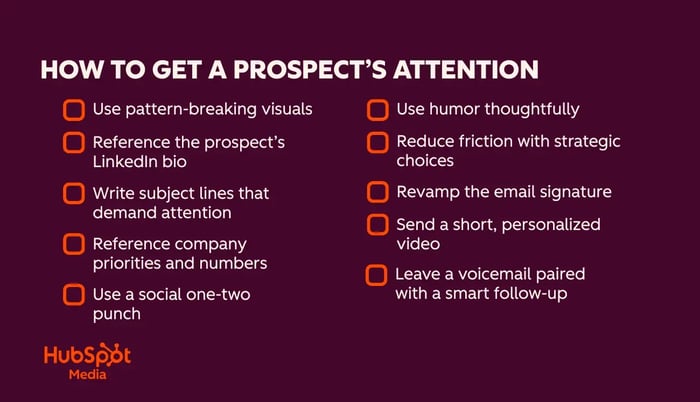
Use pattern-breaking visuals (including GIFs)
Static text in a crowded inbox blends into the background, while a well-chosen visual can interrupt that pattern and invite a second look. Visuals, including simple GIFs or screenshots, work best when they clarify a point, illustrate a before-and-after, or bring a mini-story to life, rather than serving as decoration.
In practice, a short looping GIF of a broken dashboard, a spinning status wheel, or a simple progress bar can instantly communicate a pain point or outcome that might take three sentences to explain. Visuals should be lightweight, on-brand, and clearly related to the message, not random memes that confuse stakeholders.
The most effective visuals make prospects think “that looks like my day.” A quick GIF mockup of how a prospect’s current process could look with a cleaner often earns a reply purely because the prospect feels seen.
What we like: Visuals that mirror a prospect’s current reality or future state, not generic reaction gifs.
Reference the prospect’s LinkedIn bio with specificity
A prospect’s LinkedIn profile is one of the easiest places to find relevant context, but the common sales mistake is stopping at surface-level personalization. Generic lines like “I see you are the VP of Sales at X” do not earn attention; they signal automation.
A better approach is to reference something concrete that connects to the problem the solution actually solves. That could be a line from their About section about “scaling a mid-market motion,” a recent post about onboarding challenges, or a specific responsibility like “owning global pipeline coverage.”
My most reliable replies came from first lines that sounded like I had been in their sales meetings. Referencing a post where the prospect shared their goal to reduce ramp time, then connecting it to a specific piece of enablement or process, changed the tone of the conversation from “cold outreach” to “continuation of something they already care about.”
Pro tip: prospecting agent, can help SDRs research accounts and contacts so those first lines reflect real responsibilities and initiatives, not guesses.
Use a social one-two punch
When prospects see a new name in their inbox, they subconsciously ask whether that person sits inside their world or outside it. Light, relevant engagement on social before an email can shift that perception from “stranger” to “familiar name,” which increases the odds that the email gets a fair look.
A social one–two punch might look like this: interact with a recent LinkedIn post (thoughtful reaction or short comment), send a connection request with a clear, non-pitch note, then follow up with an email that references the topic they shared publicly. This sequence shows respect and context rather than appearing from nowhere.
Social touches that precede the email by a day or two, boost open and reply rates noticeably. The name and topic land in the prospect’s mental feed first so the email feels like part of an ongoing conversation, not an interruption.
can help coordinate these touches by logging social interactions in the CRM and pairing them with email sequences, so prospect engagement strategies stay organized across channels.
Write subject lines that demand attention
Subject lines are often the first and only chance to earn a click. between 2023 and 2025 have found that roughly one-third of recipients decide whether to open an email based on the subject line alone, and strong subject lines can boost open rates by 35–50% compared with weak ones.
Effective subject lines are specific, relevant, and low on hype. They often reference the prospect’s company, role, or current initiative and hint at a clear benefit or curiosity gap, without sounding like spam.
The best subject lines feel like they were written for a single person, even when they are used at scale. They sound like something colleagues would send each other, not like a mass marketing blast.
Some formulas that consistently work:
- “Idea for [Company]’s [team/process]
- “Question about [metric they care about]
- “[Mutual connection] suggested I reach out
- “Video on [specific outcome] for [Company]
Including the word “video” in the by around 6%, especially when paired with a short, personalized clip inside the email. For more inspiration, sales reps can dig into 黑料吃瓜网’s guide to sales email subject lines that get prospects to open, read, and respond.
Best for: First touches where the goal is simply to earn a high-quality open and start a relevant conversation.
Reference real company priorities and numbers
Prospects pay more attention when outreach maps directly to priorities they already recognize, such as revenue targets, expansion goals, cost savings, or headcount plans. Public earnings calls, blog posts, job descriptions, and interviews often reveal numbers and themes that can anchor stronger outreach.
An email mentioning a specific initiative like “expanding EMEA mid-market revenue by 25%” or “hiring 10 new AEs this quarter” signals that the rep has done their homework. That relevance makes it easier for prospects to quickly understand why the message matters.
In my experience, emails that reference a company’s stated goals and then connect a single, clear idea to those goals tend to spark replies even when prospects are not actively shopping. The outreach feels like a contribution to their existing plan, not a random pitch.
and together can help teams capture this context at the account level, so those insights are reusable across sequences and not lost in private notes.
What we like: Short, specific sentences that tie one idea to one priority, instead of generic claims about “increasing revenue” or “saving time.”
Use humor thoughtfully
Humor is a powerful pattern breaker, but it can backfire if it feels forced, insensitive, or disconnected from the buyer’s reality. The most effective use of humor in sales outreach tends to be light, self-aware, and grounded in shared experience, not jokes at the prospect’s expense.
When a sales rep opens with a playful line that acknowledges something real, such as “I know your inbox is a crowded city right now, so I’ll keep this under 90 seconds,” it can lower defenses and humanize the interaction. The key is to keep the humor supportive, not sarcastic or overly familiar.
Humorous openers work best when context already exists, such as after a previous call, social interaction, or mutual introduction. Used carefully, humor can transform a cold follow-up into a message that feels like it comes from a trusted peer.
Pro tip: Use humor to show empathy for the prospect’s day, not to show off wit. The goal is to create a moment of recognition, not a punchline.
Reduce friction with strategic choices
Choice architecture is a simple psychological lever that can turn silence into engagement. When prospects are presented with an open-ended question like “What do you think?”, the mental effort required to respond is high. When they receive a short set of specific options, the response cost drops and replies become more likely.
This is why multiple-choice follow-ups, especially after a few unanswered emails, are effective strategies for engaging prospects. The prospect can respond with a single letter or short phrase that accurately reflects their situation, rather than composing a full reply.
These “respectful choices” emails work best later in a sequence, after value has been offered. They serve as a clean way to either move the conversation forward or gracefully close the loop.
Examples:
“To make things easy, which of these is closest to where you are right now?
A) This is important. Let us find a time to talk.
B) Interesting, but timing is off this quarter.
C) We are not a fit, please close the loop on your end.”
“Quick pulse check on this topic:
- We want to solve this in the next 90 days.
- It is a 2026 initiative.
- We decided to go in a different direction.”
黑料吃瓜网 sequences and templates make it easy for teams to standardize these choice-based follow-ups while still customizing the language to each persona. For additional ideas, 黑料吃瓜网’s tips for getting an unresponsive prospect talking again offer more angles for re-engaging quiet accounts.
Revamp the email signature to signal credibility
An email signature is small, but it carries more weight than most teams realize. It acts as a credibility signal and an extra micro-channel for engagement. Signatures that highlight a clear title, social proof, and one relevant resource often earn clicks and replies that the body of the email would not get alone.
A signature with a photo, role, company, and one relevant link is more trustworthy than a bare name and phone number. Small personal touches, such as “Currently reading…” or “Latest article on [topic],” can also humanize the interaction and invite low-stakes clicks.
In my own outreach, I have watched prospects ignore the main CTA yet still click a case study or “meet the team” link in the signature. Those micro-engagements often warmed up the next touch and shortened the distance between stranger and partner.
Sales teams can use 黑料吃瓜网 to standardize signatures across the organization and tie signature banners to current campaigns, content, or events, turning every outbound email into a small but meaningful marketing asset.
What we like: Signatures that feel like a concise digital business card plus one relevant “next step,” not a cluttered billboard.
Send a short, personalized video
Video is one of the most effective ways to stand out in a text-heavy inbox, because it combines visual pattern breaks with tone of voice and body language. show that including video in email can increase click-through rates by roughly 200–300%, and B2B marketers who add video to campaigns often see CTRs grow two to three times compared with text-only emails.
The key is not cinematic production value; it is clear intent and personalization. A 45–60 second screen or webcam recording that addresses a specific problem or shows a quick walkthrough of a relevant idea is often enough to grab attention and earn a reply.
Simple videos such as “Quick idea for your SDR ramp” or “Walkthrough of how similar teams reduced no-shows” consistently outperform long text emails. Prospects appreciate seeing a real person who took time to think about their situation.
黑料吃瓜网 Sales Hub’s 1:1 Video Messaging feature lets reps embed personalized videos directly into CRM emails and track engagement, so teams can see which messages resonate and refine their approach over time.
Leave a voicemail paired with a smart follow-up
Despite all the digital channels, voicemail still plays an important role in getting a prospect’s attention, especially for busy executives who screen calls. A concise, respectful message can introduce a name and topic, even if the prospect does not pick up, and set up the next email or LinkedIn touch.
Effective voicemails are short (around 30 seconds), lead with the caller’s name and company, and clearly articulate a single reason for the call plus a simple next step. They are not mini demos. The magic happens when the voicemail is followed by a timely email that references the call and gives the prospect an easier path to respond.
Voicemails work best as part of a coordinated sequence, not as a one-off. When the follow-up email lands within an hour, prospects often reply to the email even if they never return the call itself.
and AI Call Transcript Enrichment can help managers review call patterns, including voicemails, and coach reps on clarity, tone, and structure. Call notes and transcripts are then tied directly to the contact and deal record, so nothing gets lost.
Attention is earned, not hacked
Capturing a buyer’s attention is not about chasing the newest trick; it is about aligning outreach with how modern buyers think, decide, and protect their time. The most effective prospect engagement strategies combine relevance, personalization, and clear next steps, delivered through channels that feel natural to the prospect. Successful prospect attention strategies require research, personalization tools, and buyer-first messaging.
From what I have seen across different teams and industries, the sales reps who consistently win attention are the ones who treat every touch as a small promise: “I will make this worth your time.” They do the research, they use tools like 黑料吃瓜网 Sales Hub and Breeze to personalize efficiently, and they review their own calls and emails with the same discipline they expect from their buyers.
For sales professionals who want to go deeper on this, 黑料吃瓜网 Academy’s Inbound Sales and Frictionless Sales courses offer structured guidance on building systems that support these behaviors over the long term. The tactics in this guide are a starting point. The real leverage comes from testing, measuring, and refining them inside a consistent, buyer-first process.
50 Free Sales Email Templates
Save time, find new ways to reach out to prospects, and send emails that actually convert.
- First-Touch Emails
- Follow-Up Emails
- Break-Up Emails
- ChatGPT Email Prompts
Download Free
All fields are required.
Form not available
You're all set!
Click this link to access this resource at any time.
Sales Prospecting
.webp)