


Advocacy marketing is driven by those moments when people have such a remarkable experience with a brand that they naturally want to share it. Customer advocacy marketing turns those organic moments into a structured strategy, focusing on encouraging people to share real stories that influence how others discover and trust a business.
When people promote a company, they become brand advocates. They carry significant weight because recommendations from friends or peers are often trusted far more than traditional advertisements. This approach builds on that foundation of trust by amplifying authentic voices rather than relying solely on brand-created content.
The sections below explore the inner workings of this strategy, why it matters so much in today’s market, and how to build a customer advocacy marketing plan that supports long-term growth.
What is advocacy marketing?
Advocacy marketing is a strategy that encourages satisfied customers to promote a brand through reviews, social media posts, and real-life conversations. In other words, it focuses on creating experiences so positive that customers actually want to talk about a brand.
Customer advocacy programs, on the other hand, are structured systems that companies create to support advocacy marketing. They give customers specific ways to participate and share their opinions through referral programs, ambassador communities, or review campaigns.
So, advocacy marketing is the broader strategy and outcome of customer advocacy programs. Brands that are aware of having a happy client base can use these methods to gain visibility through genuine brand promotion.
Community Management Templates
3 templates to help you build, grow, and connect with your community.
- Community Member Journey Map
- Community Member Profile
- Community Launch To-Do List
Download Free
All fields are required.
Form not available
You're all set!
Click this link to access this resource at any time.
What is a customer advocate?
A customer advocate is a person (or group of people, if it’s a B2B client) who actively supports and promotes a brand based on their real experiences. It’s important not to confuse them with paid promoters. Even if a customer advocate receives an incentive, the foundation must still be real satisfaction.
Typical customer advocate behaviors include:
- recommending a brand to those within their circle, referring others who may benefit from the product or service
- writing reviews, testimonials, or ratings on platforms such as social media, review sites, or business pages
- defending the brand when it receives criticism, offering personal positive perspectives
- providing feedback or ideas on how to improve products, services, or experiences.
Types of Customer Advocacy
Customer advocacy can take place both online and offline. Each type plays a different role in building trust and influencing new buyers. The most common types include organic word-of-mouth, reviews, testimonials, and case studies.
1. Organic Word-of-Mouth
This form of advocacy is the most natural one. Customers recommend a brand during everyday conversations with colleagues, friends, or peers. These recommendations carry high credibility because they are unsolicited and informal. For many businesses, this type of advocacy has the greatest impact, even though it is the hardest to measure.
2. Public Reviews and Ratings
Customers share their opinions on review platforms, marketplaces, or app stores. These reviews often describe specific benefits and help future buyers understand if it’s a good fit for their needs. Because reviews are visible at the moment of decision-making, they strongly influence conversions and brand perception.
3. Social Media Posts
Some customers choose to talk about brands on social platforms. That can include tagging a company, posting screenshots, writing short opinions, or responding to others’ questions. However, some audiences may still assume these are sponsored posts, especially when creators or power users regularly mention brands. Not everyone will notice that these referrals lack a disclaimer indicating a brand partnership or sponsored promotional post.
4. Website Testimonials
These are the types of positive feedback clients often share with brands voluntarily. They usually appear in conversations, and companies ask for their permission to use it on their website as an endorsement. They help communicate value quickly and clearly, especially when prospects are comparing similar solutions.
5. Referrals
Referral advocacy happens when customers actively introduce new prospects to a brand. Because these referrals occur between individuals who share trust, they often lead to faster decisions and higher conversion rates.
6. Case Studies
Longer formats, such as customer stories or success narratives, go deeper into context. They‘re usually published on the company’s website and explain the customer’s situation, the challenge they faced, and how the product or service helped address it. These stories are common for B2B customer advocacy marketing, where decisions require more detailed proof.
7. Online Communities
Online communities give customers a central place to connect with each other and the brand, ask questions, share advice, and talk about how they use a product. In these spaces, members help solve problems, offer tips, and share real-world examples that others find useful. Over time, these discussions create steady support for the brand that feels natural rather than promotional.
These can be online forums on portals like Reddit, as well as owned channels. A good example is , where users actively share their experiences and tips for using the tools more efficiently.
Tip: Identifying customer advocates does not have to rely solely on tracking brand mentions on social media or in reviews. You can identify likely advocates earlier by tracking customer health, feedback, and engagement in 黑料吃瓜网. For example, teams can use 黑料吃瓜网 Smart CRM and to monitor satisfaction trends and other signals indicating potential promoters before they speak up publicly.
Which customer advocacy model framework should you use?
The most universally accepted customer advocacy model is known as “PAA”, which stands for Purchase, Adoption, and Advocacy. This framework has three stages:
Step 1: Purchase
The customer buys a product to solve a problem or to reach a goal. Trust is still forming at this stage, and expectations are high. Marketing, sales, and first impressions matter most.
Step 2: Adoption
The customer uses the product in their daily work or life. If the company gives customers a smooth onboarding experience, quick wins, and reliable support, it turns the product into a trusted tool. Adoption happens when customers consistently rely on it to achieve results.
Step 3: Advocacy
Advocacy emerges after repeated positive experiences. Satisfied users become active promoters, recommending the company, writing reviews, sharing stories, or referring others. It’s authentic, voluntary, and built on genuine trust.
Why is advocacy marketing important?
Brand advocates are highly valuable brand assets because:
- Your most loyal customers tend to spend more than the average customer.
- They're typically well-versed on your brand and your products.
- Brand advocates are a great source of information for leads and prospective customers.
- They also contribute positive reviews and help boost brand awareness.
The Effectiveness of Advocacy Marketing
Advocacy marketing is every marketer‘s dream — it’s cost-effective and high-yielding.
The data speaks for itself: Brands see a for every dollar invested in advocacy marketing. When it comes to attracting new customers and boosting revenue, it's worth the work.
Ready to get started? We've compiled a list of tips to help.
How to Create Customer Advocates
Customer advocacy programs turn satisfied customers into active supporters who speak on the brand’s behalf. These programs prioritize long-term relationships rather than one-off promotions. When done well, advocacy creates trust, supports growth, and strengthens brand credibility.
At the core of effective advocacy are the three Cs:
- Commitment reflects the customer’s willingness to stand behind your brand.
- Connection describes the emotional and professional bond customers feel with your company.
- Credibility ensures advocacy feels authentic because it comes from real experiences.
The strategies below outline practical ways to build and sustain customer advocacy at scale.
- Provide an excellent product or service.
- Deliver an unforgettable brand experience.
- Operate with a customer-first mentality.
- Collaborate with marketing and sales.
- Make it easy for customers to become advocates.
- Proactively seek out brand advocates.
- Give your customers a voice.
Here are seven ways to motivate customers to become advocates for your business.
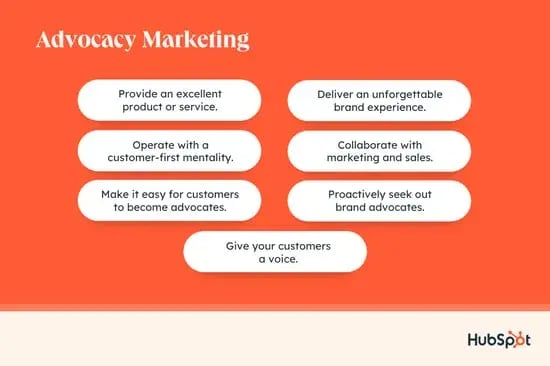
We'll review each in more detail below.
1. Provide an excellent product or service.
While marketing strategy and customer experience are essential, they can’t quite make up for a product or service that misses the mark. Before diving into the nuances of promotion, the primary goal should always be delivering consistent, reliable value.
Building a base of loyal advocates comes down to a simple habit, i.e., listening and taking action. Feedback provides an honest look at how people interact with a design or navigate a new feature. These insights are the best tools available for spotting friction, closing gaps, and ultimately making the experience better for everyone involved.
Gathering this information doesn't have to be complicated. A few effective methods include:
- Usability testing to see exactly where people hit a wall.
- In-product surveys to catch the mood right after a major milestone.
- Support tickets and interviews to highlight recurring struggles or unmet needs.
The real magic happens during the follow-through. Collecting data is a great first step, but the impact comes from applying it. This might mean using usability insights to simplify a clunky workflow or letting survey trends shape the product roadmap. When customers see their input lead to tangible improvements, it builds trust. That trust is exactly what turns a casual user into a lifelong advocate.
2. Deliver an unforgettable brand experience.
Every single interaction contributes to the bigger picture. From that first moment of discovery to long-term support, each touchpoint shapes how a brand lives in someone’s memory. A truly great brand experience feels intentional, consistent, and, above all, human at every stage of the journey.
Getting this right usually starts with a detailed map of the customer journey. By documenting every phase and the specific interactions within them – whether it’s a sales conversation, an onboarding flow, or a quick support chat – teams can see the path more clearly.
This process helps highlight the “make or break” moments that carry the most emotional weight. These snapshots can decide whether a person becomes a vocal supporter or simply drifts away.
Once those key moments are clear, the focus shifts to making them memorable. That might be a warm, intuitive onboarding process, proactive help during those first few days of use, or a thoughtful follow-up after a problem is solved. It’s often the smaller details like a timely update, a consistent voice, or a clear set of next steps that leave the deepest impression.
At the heart of it all are clear service standards. Setting expectations for empathy, speed, and genuine problem-solving ensures that the experience feels reliable, regardless of the channel. When these standards move from abstract values into daily habits through training and clear processes, they become the backbone of the business. Over time, this reliability makes it easy for customers to remember their positive experiences and, more importantly, share them with others.
3. Operate with a customer-first mentality.
A company culture rooted in a customer-first mindset creates a natural sense of loyalty and mutual respect. When a brand prioritizes the needs of the people it serves, it lays a foundation for advocacy to truly flourish.
One of the most effective ways to foster this culture is to genuinely listen and ensure people feel heard throughout the process. Publicly acknowledging questions or responding to social media comments in real time shows that there is a real person behind the screen who cares about the conversation. It turns a one-way broadcast into a two-way relationship.
Reliability is another cornerstone of this approach
Sticking to a brand’s word, whether that involves meeting a specific shipping window or following through on a promised feature, builds a deep sense of trust. When a brand is dependable, customers feel more confident standing behind it and recommending it to others.
It’s also helpful to remember that advocacy is often born in the support queue. Customer-first teams treat support, onboarding, and feedback as advocacy moments, turning every problem into an opportunity to strengthen a bond. When these teams handle support with empathy and a “people-first” lens, it transforms a standard transaction into a reason for a customer to stay for the long haul.
4. Collaborate with marketing and sales.
Advocacy marketing reaches its full potential when the entire organization participates. Since marketing, sales, and customer success teams each play a role in how stories are gathered and shared, staying on the same page is essential. When these teams work toward shared advocacy goals, the customer’s voice becomes a powerful engine for both a better experience and steady growth.
Example: Workday
Define shared criteria for what counts as an advocate, who owns customer story collection, and how those stories move from customer success to marketing to sales. A great example of this in action is the approach taken by companies like . Their program focuses on turning loyal users into brand ambassadors who share authentic success stories.
The marketing side of the house focuses on amplifying these narratives through case studies, video testimonials, and visual assets. These stories highlight real-world impact and serve as valuable resources for anyone in the awareness or education stages of their journey.
Sales teams can then take those same stories and apply them in more personal, direct ways. Peer-to-peer engagement, such as customer reference calls, allows prospects to hear firsthand accounts that address specific concerns and build deep trust in the final stages of the decision-making process. This shared pool of advocacy assets ensures a smooth, continuous experience from the very first interaction to the final handshake.
By aligning advocacy with the full buyer journey, teams ensure that customer stories do more than just sound good – they support actual pipeline movement and revenue goals. In 黑料吃瓜网 teams can use shared records, notes, and lifecycle data to keep advocacy efforts aligned across marketing, sales, and service. This ongoing collaboration keeps every effort focused, measurable, and firmly grounded in real customer outcomes.
5. Make it easy for customers to become advocates.
Some customers are natural-born cheerleaders, always looking for a way to shout about a positive experience. Others feel just as enthusiastic but might not know where to start or how to put their thoughts into words. In both cases, the likelihood of someone becoming an advocate increases significantly when the process is effortless and the path is clear.
Provide ready-to-use resources
One of the best ways to encourage this is by providing ready-to-use resources that do the heavy lifting. Advocacy toolkits filled with pre-written social posts, email templates, and quick talking points allow customers to share their stories without the pressure of starting from a blank page. These templates not only save time but also help keep the message accurate and consistent with the brand’s voice.
Simplifying the actual act of sharing is just as important. Small touches, like branded hashtags or one-click social sharing links, remove the extra steps that often lead to a “do it later” mentality. When the tools are easy to find and even easier to use, sharing a positive experience starts to feel like a natural, rewarding part of the day rather than another task on a to-do list.
6. Proactively seek out brand advocates.
Many people are happy to share their positive experiences as long as there is a clear place to do so. By creating structured opportunities for feedback, a brand allows these authentic voices to rise to the surface. That helps build advocacy and identify where the product or service still needs work, and where they can go next.
Gathering these stories can happen across a variety of channels. Traditional tools like NPS or satisfaction surveys are great for capturing sentiment at key milestones. At the same time, open-ended questions give people a chance to describe their journey in their own words. Beyond surveys, valuable insights often lie in community discussions, online reviews, and daily conversations with support and account teams.
The real impact begins when customers share these stories with the world. Brands can transform a short quote or a deep insight into a powerful testimonial, a social media post, or even a helpful piece of internal training material. When brands weave customer voices into marketing and various touchpoints, it builds a natural sense of credibility and inspires others to join the conversation. Using the right feedback tools helps keep everything organized, making it easy to track trends and stay in sync with how people feel over time.
Pro tip: Use software like to regularly track who's engaging with and advocating for your brand online.
7. Give your customers a voice.
Most people are more than willing to share a positive experience when they find a welcoming space to do so. By creating a dedicated forum for these voices, a brand can surface the kind of authentic perspectives that form the true foundation of advocacy.
There are plenty of effective ways to invite these stories into the light.
- Life-cycle surveys: Using NPS or satisfaction surveys helps capture a snapshot of how people feel at specific milestones.
- Open-ended questions: These invite customers to describe their hurdles and wins in their own words, providing much more depth than a simple rating.
- Community & review forums: Public spaces and community boards are often where the most candid and detailed feedback lives.
- Internal feedback loops: Conversations held with support and account teams can surface “hidden” success stories that might otherwise go unnoticed.
After gathering these stories, share them in ways that benefit the entire organization:
- Social proof on landing pages: Short, punchy quotes and star ratings add immediate human credibility to marketing pages.
- In-depth spotlights: Develop longer narratives into blog posts or case studies that explore a customer’s journey in detail.
- Sales enablement: Use real-world stories in sales presentations or reference calls to build deep trust with prospects.
- Internal growth: Sharing feedback internally helps guide training and keeps product decisions grounded in real-world outcomes.
Using feedback tools to manage these responses makes it easier to track recurring themes and stay in tune with how the community’s sentiment evolves.
Pro tip: Take advantage of the many survey tools and software available to help you manage your surveys, track responses, and measure customer sentiment.
Examples of Advocacy Marketing
1. User Generated Content for Colour Pop
Colour Pop is a makeup, skincare, and beauty brand. The brand frequently features posts from both influencers and customers across social media. Followers can see how real people use the products in the real world — from every day make up to wearable artwork.
By using the products, customers showcase both their creativity and how Colour Pop fits into their lives.
What we like: User-generated content is a great way to get customers advocating for products. Brands can pay for these initiatives or offer opportunities for organic engagement.
2. Apple's Product Advocacy
Apple is arguably one of the most popular global brands. They release new products yearly, and most stores battle an impressively long line of customers waiting for the latest release.
It's no secret that Apple has created a brand people love to share, and it took advantage of that through its recent challenge.

This challenge invited iPhone 13 Pro and iPhone 13 Pro Max users to share photos they took with their iPhones on social media using the #ShotOniPhone hashtag.
Apple used the winning photos across its online channels and digital campaigns, and featured them in print at its in-store locations and on public billboards.
What we like: The authenticity of this content created buzz around an already well-known brand, and it was super easy to participate. That propelled more customers to share photos and more iPhone users to buy the new model.
3. Ledo Pizza's Social Media Giveaway
is a (very good) pizzeria and restaurant chain that originated in Maryland and has recently expanded along the East Coast.
Every so often, Ledo runs an X (formerly Twitter) giveaway that incentivizes customers to retweet and follow their account for a chance to win a $50-$100 gift card.

They also have several partnerships with local sports teams that help add visibility to their campaign. Like the University of Maryland‘s men’s basketball team, for example.
What we like: Ledo does a good job of tying its advocacy marketing into current events (e.g., ) and meeting customers where they are. It’s always part of the local conversation when it comes to pizza and sports.
Harness the Power of Advocates
Advocacy marketing isn't as much a marketing strategy as a way of doing business.
When you offer an unbeatable product and unforgettable customer experience, it's easy for customers to fall in love with your business — and tell others why they feel the way they do.
Community Management Templates
3 templates to help you build, grow, and connect with your community.
- Community Member Journey Map
- Community Member Profile
- Community Launch To-Do List
Download Free
All fields are required.
Form not available
You're all set!
Click this link to access this resource at any time.