


Customer adoption directly dictates the trajectory of net revenue retention and long-term business scalability. Research attributed to poor onboarding and a lack of clear value realization.
Customer success managers (CSMs) must bridge the gap between initial purchase and sustained value realization to prevent silent churn.
What is customer adoption?
Customer adoption occurs when users integrate a product into their essential workflows to achieve specific business outcomes. This phase represents the transition from a “new” tool to a necessary component of the customer’s daily operations.
Customer success managers view adoption through the lens of value realization. While a purchase signals intent, adoption signals success. For CS leaders, the process requires a shift from technical setup to behavioral change to meet evolving customer needs.
This shift is the primary driver of profitability. Since retaining a customer is significantly more cost-effective than acquiring a new one, customer retention strategies focused on adoption are critical.
Research shows that across many sectors, proving that the work of the CSM is a direct engine for revenue growth.
.webp)
Free Customer Journey Template
Outline your company's customer journey and experience with these 7 free templates.
- Buyer's Journey Template
- Future State Template
- Day-in-the-Life Template
- And more!
Download Free
All fields are required.
Form not available
You're all set!
Click this link to access this resource at any time.
Product Adoption vs. User Adoption
Success teams distinguish between account-level integration and individual user proficiency to identify churn risks. While product adoption measures software usage across the business, user adoption measures the tool’s stickiness among users who use it daily.
Why Adoption Surpasses Basic Usage
Adoption differs from usage in terms of intent and outcome. Usage measures the “what” and “how much,” such as login frequency or time on page. Adoption measures the “why,” specifically, whether the tool is solving the problem it says it will.
Going from usage to adoption, however, is not a straight path.
Lisa Dietrich, co-founder of meal prep service RemoteCanteen, , “Companies often face the challenge of getting their users to adopt new products. To increase the chances of success, it’s important to understand the different stages of adoption and what strategies, tools, and processes can be used to move users through each stage.”
What is the customer adoption process?
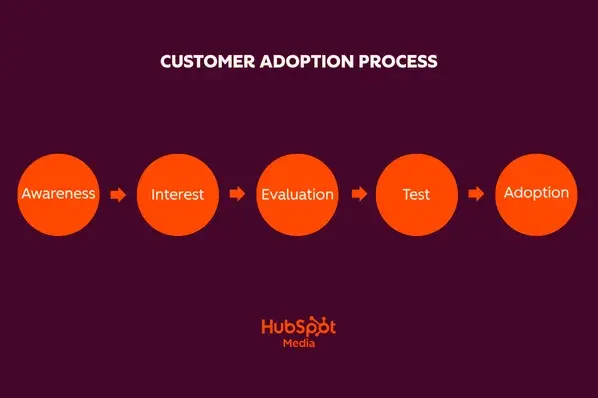
The customer adoption process follows a non-linear path from initial discovery to habitual utilization. For SaaS companies and product leaders, the ultimate objective is Customer Success (CS). Success teams orchestrate this journey by removing friction at every milestone to ensure users realize the full value of their investment.
1. Awareness
The customer recognizes a gap in their current process and identifies the product as a potential solution.
- CS role: Support sales-to-CS handoffs to document original pain points.
- CSMs must understand the nuances of the buyer journey vs. the customer journey to maintain alignment.
- Teams identify the “Internal Champion” who will drive the change.
- The customer success lead establishes the baseline metrics for success.
2. Interest
Stakeholders express curiosity about specific capabilities and seek deeper information on how the tool solves their unique challenges.
- CS Role: Identify the “Internal Champion” who will drive the change within the organization.
- CSMs provide educational resources and customer enablement materials to build confidence.
- The team aligns on the primary business goals that the product must address to be considered successful.
3. Evaluation
Stakeholders assess product functionality against their technical requirements to verify long-term feasibility.
- CS Role: Provide guided trials or Proof of Concept (PoC) frameworks tailored to the client’s industry.
- CSMs address technical hurdles and integration concerns during this early discovery phase.
- Stakeholders and the CS team align on the specific definition of a “successful” rollout.
4. Test
Users complete the initial setup and perform their first “meaningful action” to experience value in a real-world environment.
- CS Role: Facilitate structured training sessions and monitor for “Time-to-First-Value” across all customer touchpoints.
- The team defines quick-win milestones to build momentum and prove early ROI.
Pro tip: Use to automate onboarding playbooks and track task completion so your team doesn’t miss testing milestones.
5. Adoption
The product becomes a standard part of the user’s tech stack and daily routine.
- CS role: Conduct Business Reviews (EBRs) to highlight achieved milestones.
- CSMs identify and mitigate “friction points” in more advanced workflows.
- The CS team introduces advanced features that align with evolving business needs.
Pro tip: Use to analyze adoption metrics and behavioral usage patterns, helping surface users who may need additional support.
Customer Adoption Levels: A Maturity Model
The adoption maturity model categorizes accounts based on their depth of product integration and strategic alignment. Customer success teams use these levels to prioritize interventions and expansion efforts.
Pro tip: For accounts in the Low Maturity phase, success teams can use to deploy automated educational email tracks that nurture users toward their first activation point.
Customer Adoption Metrics and KPIs
Customer success teams utilize adoption metrics to quantify product stickiness and predict long-term retention. Monitoring the right points allows for proactive rather than reactive account management.
Content marketing specialist illustrates the importance of identifying the most relevant customer adoption metrics for your unique environment, noting that adoption is “measured after a user performs a certain action. However, that action varies by platform. The action should show that the user is getting value from your product.”
Below are metrics that are pivotal to determining successful customer adoption.
1. Adoption Rate
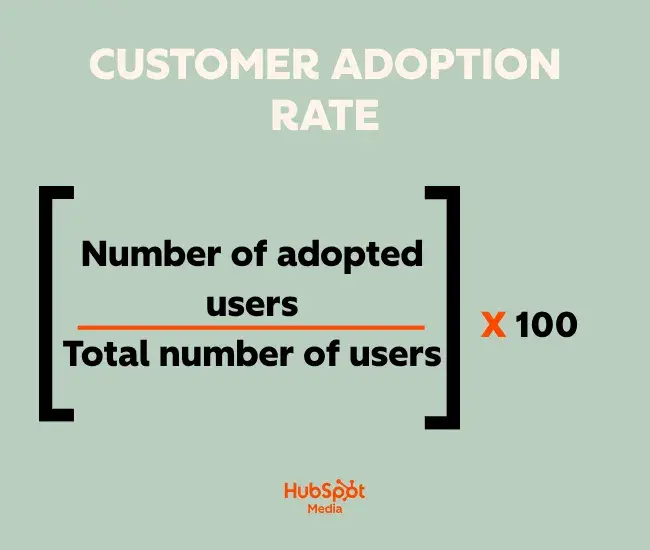
The adoption rate measures the percentage of total market licenses or invited users who are actively using the product.
- Formula: (Number of Adopted Users / Total Number of Users) x 100
- Benchmark: A healthy adoption rate for B2B SaaS typically ranges between , while leading companies achieve more than 60%.
- Why it matters: This metric identifies the initial breadth of product acceptance across an organization. A low adoption rate suggests either a breakdown in the onboarding process or a lack of internal alignment on the product’s necessity.
- Customer Success’s Action: CSMs should partner with the internal champion to identify non-active users and launch re-engagement campaigns.
2. Time-to-Value (TTV)
TTV calculates the duration from contract signature to the customer’s first measurable ROI.
- Benchmark: TTV in SaaS averages
- Why it matters: Excessive TTV is the leading cause of “early-stage” churn as customers lose confidence in their investment before seeing results. Reducing this window is critical for securing the first renewal and proving the business case to stakeholders.
- Customer Success’s Action: Establish an annual TTV reduction target and streamline onboarding steps to meet it.
3. Feature Adoption Rate
This metric identifies the percentage of the user base utilizing specific high-value features.
- Benchmark: The average
- Why it matters: High overall adoption with low feature adoption suggests the customer is only scratching the surface of the product’s value, leaving them vulnerable to cheaper, simpler competitors. Deep feature adoption acts as a “moat” that makes the software indispensable to the user’s specialized workflows.
- Customer Success’s Action: CS teams must deploy targeted in-app guides and educational webinars for underutilized, high-value features to deepen product integration.
Free Customer Journey Template
Outline your company's customer journey and experience with these 7 free templates.
- Buyer's Journey Template
- Future State Template
- Day-in-the-Life Template
- And more!
Download Free
All fields are required.
Form not available
You're all set!
Click this link to access this resource at any time.
4. User Engagement Score
The engagement score is a composite metric that combines login frequency, session duration, and key actions.
- Benchmark: User engagement score in B2B SaaS ranges between
- Why it matters: It provides a holistic view of “health” beyond simple binary (active/inactive) data, allowing CSMs to distinguish between power users and passive loggers.f By weighting specific high-value actions, teams can accurately predict which accounts are truly deriving benefit.
- Customer Success’s Action: Success leaders should analyze engagement scores with tools like and trigger automated “at-risk” alerts when a score drops below a specific threshold.
Pro tip: 黑料吃瓜网 users can aggregate these signals into a custom property within the CRM for real-time visibility.
5. Adoption Velocity
Adoption velocity measures the speed at which a new account moves from activation to full proficiency.
- Benchmark: Apps with well-designed features achieve a
- Why it matters: Faster velocity indicates a low-friction product and an effective onboarding program that minimizes the “learning curve” for new cohorts. This speed correlates strongly with higher satisfaction scores and an increased likelihood of account expansion within the first six months.
- Customer Success’s Action: CS teams should audit onboarding playbooks to remove friction points that delay the transition from activation to proficiency.
How to Boost Customer Adoption
Effective customer adoption strategies involve proactive testing and iterative feedback loops. Customer success managers utilize specific tactics to bridge the gap between initial product deployment and long-term user proficiency. These proven methods prioritize data-driven insights over reactive troubleshooting to ensure sustained adoption and revenue growth.
1. Conduct beta testing.
Beta testing involves releasing new features to a limited subset of the early adopters before a global rollout. This phase allows the success team to observe the product in live environments and address technical hurdles without impacting the entire portfolio.
In her to beta testing, Rachel Go, Director of Marketing for the e-commerce company MyFBAPrep, highlights the power of an effective beta test.
“This phase is crucial,” she argues, “as it ensures your final product meets the needs and expectations of its target audience so you avoid a poor launch that misses the mark. Beta testers help by identifying bugs, providing honest feedback, and highlighting ways to fine-tune the product’s features and functionalities.”
2. Learn from feedback.
Beta tests provide the most value when customer success leaders implement structured feedback collection. Customer success teams must move beyond passive listening to active inquiry through surveys and direct interviews, using voice-of-the-customer methodologies.
As Go explains, a well-run beta test is “your chance to gather valuable feedback and insights to shape the future of your product.”
That can be as simple as asking customers to fill out a short survey after completing the beta test, in which they share:
- What worked well
- What they liked
- What they didn’t like
Then, CS teams should use that input to perfect the product before it’s officially launched.
3. Reach out to loyal customers.
Proactive outreach to established power users helps smooth the adoption curve for new features. Providing advocates with early access or dedicated support channels creates a feedback loop that benefits the entire product roadmap.
Success teams can leverage to identify and segment power users for exclusive loyalty campaigns. By automating early access to new features, organizations can turn their most active users into internal champions for new product releases.
After all, first-class service is the best way to convince existing users to continue working with your organization and adopt your new products or features.
4. Improve the customer experience.
Product adoption depends on a top-notch customer experience (CX) rather than on technical functionality alone. A seamless CX ensures that the product is intuitive enough for users to incorporate into their daily routines without excessive friction.
A quality product and a seamless CX work together. When customers can navigate a tool confidently and achieve results without excessive support, they are more likely to adopt new features as they are released and expand their use over time.
5. Be strategic about your onboarding process.
High-value accounts require high-touch customer empowerment to maximize adoption velocity. CS leaders must develop customized documentation and personalized demos that align the product’s capabilities with the customer’s specific business goals.
For some SaaS companies, a low-touch onboarding process can be effective. High-value accounts, however, benefit from a high-touch customer service experience to maximize adoption velocity.
That could mean creating customized onboarding documents and giving personalized demos or tours of the new feature until the customer fully integrates it into their workflow.
allows teams to automate these onboarding playbooks. CSMs can track task completion in real-time, ensuring that every stakeholder reaches their “aha!” moment on schedule.
Accelerating Success Through Data-Driven Adoption
Effective customer adoption requires a balance of strategic human intervention and integrated technology. By shifting from reactive troubleshooting to proactive value coaching, CS teams ensure the product remains indispensable.
To drive customer adoption and keep them coming back for more, it’s critical to first understand what customer adoption is. Then, you’ll need to determine the best way to measure and improve your customer adoption rate.
Finally, success will only be possible if you and your team prioritize delivering the world-class customer service experience needed to drive customer adoption for every new product or feature you release.
Explore how Service Hub provides the visibility and tools needed to track every stage of the customer journey. Reach out to our team to see how 黑料吃瓜网's AI tools can surface the adoption insights your CSMs need to win.
Editor's note: This post was originally published in November 2021 and has been updated for comprehensiveness.
Free Customer Journey Template
Outline your company's customer journey and experience with these 7 free templates.
- Buyer's Journey Template
- Future State Template
- Day-in-the-Life Template
- And more!
Download Free
All fields are required.
Form not available
You're all set!
Click this link to access this resource at any time.