%20(8).webp)
Modern consumers expect brands to understand their needs, preferences, and buying behaviors before delivering a marketing message. Yet many businesses still rely on broad campaigns that reach large audiences but fail to connect with the people most likely to convert. Without a clear target marketing strategy, businesses risk wasting ad spend, lowering engagement, and missing valuable opportunities to build customer loyalty.
Target marketing helps solve this problem by enabling marketers to identify high-fit audiences and tailor campaigns around their interests, behaviors, and intent. From segmentation and personalization to advanced tactics like account-based marketing (ABM), predictive analytics, behavioral triggers, and geofencing, modern targeting strategies allow brands to deliver more relevant experiences at every stage of the customer journey.
This article reviews the basics of target marketing, reviews foundational tactics like segmentation and personalization, and explores 11 often-overlooked strategies so marketers can better find their target audiences.
Table of Contents
- What is target marketing?
- 11 Missed Target Marketing Strategy Opportunities
- Frequently Asked Questions About Target Marketing
- Use targeted marketing strategies to your advantage.

TL;DR: Target marketing improves campaign performance.
Target marketing is the practice of identifying a specific group of buyers and tailoring the messaging, offers, and campaigns to their needs, behaviors, and preferences. Businesses use foundational tactics like segmentation and personalization alongside more advanced strategies such as account-based marketing (ABM) or predictive analytics to improve campaign performance, reduce wasted ad spend, and create more relevant customer experiences.
What is target marketing?
Target marketing is the practice of matching the right people with the right content at the right time. Target marketing helps businesses focus their campaigns on a specific group of consumers who are most likely to buy a product, sign up, or take another desired action.
Target marketing strives to highly customize marketing communications and offerings to align with the traits and preferences of a specific target segment to click with them and prompt them to take action instantly.
A great example is Under Armour’s strategy of blending research design with marketing to develop the signature . By implementing athletes’ real-time feedback, the company iterated the product design so it deeply resonated with their target audience. This led to increased sales, loyal customers, and a 2019 Runner’s World Recommendation Award.

Under Armour’s marketing and R&D teams made quite an endeavor to design unique shoes and click with its target audience. Not every company needs the same measures. So, let’s first look over common (but fruitful) target marketing tactics.
Common Marketing Strategies Used
The goal of target marketing extends beyond merely selling a product; it involves creating lasting relationships with a business’s most valued audience. To achieve this, marketers can put numerous actionable strategies into practice.
1. Segmentation
Segmentation is categorizing the audience into groups based on shared characteristics like age, location, or interests to address specific segments’ unique needs and pain points.
Example: Consider a company that is selling food for Labrador dogs. If they target all dog owners instead of Labrador owners, the interest-based segmentation will be broad, and the business will miss out on potential consumers while burning marketing budgets.

2. Positioning
Positioning is when the marketing message caters to the target audience’s perceptions and needs. It aims to create a unique perception of a product or brand that sets it apart in the marketplace.
Example: A tech company positions its new watch as a luxury device with high-end features and wants to compete with well-established premium brands. However, the company uses messaging that contradicts the essence of luxury.
The advertisements contain terms like “affordable,” “budget-friendly,” or “sale.” Consequently, the campaign falls short due to a misalignment between the pre-defined positioning and actual messaging, thus confusing potential customers.
3. Personalization
Personalization is the process of creating individualized content and interactions for different . It requires a deep understanding of customer behavior to deliver a truly personalized experience.
Example: Think of an ecommerce website that uses customers’ browsing history to send product recommendations. A customer is browsing gift options for a friend with no intention of buying it. The company misinterprets the customer intent and indicates personal interest rather than a one-time search for a gift.
Based on a single interaction, this assumption leads to persistent follow-up emails with similar product recommendations. Not surprisingly, it irritates the customer, creating a sense of discomfort. From a business perspective, the follow-up campaign results in a low ROI.
4. Behavioral Targeting
Behavioral targeting uses consumer behavior data to customize marketing messages and offers. Common signals include:
- Browsing history
- Purchase patterns
- Other online interactions
The goal is to deliver the right message at the right time.
Example: An online jewelry retailer is employing behavioral targeting to reach new potential customers based on their online behavior. A user, named Alex, is browsing engagement rings to find the perfect one.
The system indicates that the user wants to get engaged and sends him numerous targeted ads, promotions, and emails featuring diamond engagement rings. This could lead to an effective marketing campaign, as Alex is not the intended recipient or the target audience.
5. Geo-Targeting
Geo-targeting is a marketing strategy that helps businesses tailor marketing to specific regions. It often uses factors such as:
- Local preferences
- A person’s geolocation
- Regional events
Example: A winter gear retailer produces snow jackets, boots, and accessories. The company decides to implement a geo-targeting campaign to boost sales during the winter season. However, inaccurate geo-targeting reaches people in diverse climate regions. This leads to confusion and wasted marketing resources as winter gear promotions are irrelevant (or less relevant) to residents in warmer climates.
6. Retargeting
Retargeting is when ads target users who have previously interacted with a brand. Its goal is to re-engage these users through personalized ads, move down the funnel, and convert them into customers.
Example: An online shoe retailer is implementing a retargeting campaign to re-engage users who abandoned their carts. A user, let’s call him David, browsed the website for running shoes and added a pair to a cart but decided not to buy anything at that time.
The retargeting campaign assumes that David is ready to make an instant purchase and bombards him with the same running shoe ads across diverse online platforms. However, it fails to address the user at different stages of the conversion funnel, as David might have been in the initial research phase during the first interaction.
11 Missed Target Marketing Strategy Opportunities
Ad spending in digital advertising is projected to reach in 2023. So there is too much juice in target marketing. This section will cover how marketers from different companies catch up on opportunities that often get overlooked.
Learn from real-life examples.
1. Couchbase’s data-backed content strategy.
Account-based marketing (ABM) is a strategic method within target marketing, concentrating on personalized and targeted interaction with particular high-value accounts or customers. Unlike more general marketing approaches, it is extremely customized and seeks to establish a more individualized relationship with each account.
Case study: Couchbase is an enterprise-class NoSQL solutions provider. The company was competing with SQL and no SQL providers that were already established in the market.
To overcome the challenge, Couchbase implemented a data-based , combining real-world behavior with research-generated social personas. By merging customer behavior with the personas of their existing customers, they were able to create content that was tailored to their target accounts. This approach generated $1.5 million in pipeline opportunities.
2. Dynamic content in UserGems’ advertising.
Deploying dynamic content in digital advertisements involves tailoring the displayed information based on the viewer’s characteristics or behavior.
Case study: Apart from 黑料吃瓜网 I also create senior-level content for Belkins, a lead generation agency, as highlighted on my LinkedIn profile.
This drew the attention of UserGems, and apparently, Belkins aligned with their ideal customer profile (ICP). Subsequently, both my colleagues and I at Belkins were exposed to these personalized ads featuring dynamic elements such as a customized logo, first names, and company names.
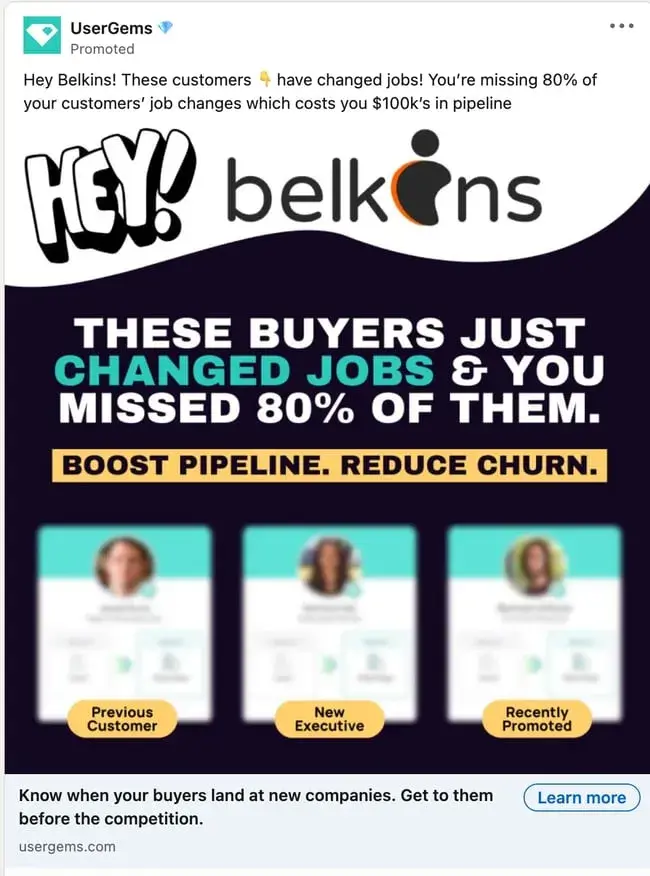
With , users can create automatically personalized ads featuring each professional’s own LinkedIn profile data, like photos, company names, job titles, and more. This allows sending highly-targeted messages and introducing and familiarizing a business with its target audience. Marketers can launch the campaign, track its effectiveness, and optimize results directly in the Campaign Manager.
3. Netflix uses predictive analytics to keep users on the platform.
Using historical data, machine learning algorithms, and artificial intelligence, predictive analytics identifies patterns to predict future actions and preferences of customers. Through predictive analytics, real-time customer data can be used to customize marketing strategies and deploy personalized ad campaigns on a large scale.
Case study: Netflix employs AI-powered algorithms to make predictions based on user watch history, search patterns, demographics, ratings, and preferences.
Through the examination of extensive user data, the premier streaming service offers personalized content recommendations. These boast an accuracy rate of 80% in anticipating what content the user may want to watch next. Additionally, Netflix uses predictive analytics to pinpoint content genres, themes, or specific shows with significant demand or potential popularity.

This approach helped Netflix make informed decisions and allocate resources to projects that gained immense popularity among viewers. As of 2023 Q1, the California-headquartered media giant has over worldwide.
4. Notion micro-segment customers for highly customized ads and user experience.
Micro-segmentation divides a market into smaller, highly specific groups for more targeted campaigns. Common variables include:
- Demographics
- Product usage
- Purchasing behavior
- Social context
- Time-based factors
- Buyer mood
Case study: is a note-taking software platform that micro-segments its users and creates highly customized templates for them. By categorizing customers according to their industry, company size, and job profile, it offers templates for different use cases.
Moreover, users can create a customized note-taking template depending on whether they are in the design, marketing team, or engineering department.

5. Content syndication in ABM by Cognism.
Content syndication revolves around distributing and promoting content to a broader audience outside the company’s channels. 黑料吃瓜网, websites, or newsletters are the most common channels for it.
In ABM, companies first identify and prioritize high-value target accounts. The next step is to develop content specifically for the identified target accounts. Content syndication also involves partnering with third-party platforms or publishers to distribute the tailored content. This ensures that the content reaches the decision-makers in the target accounts so sales reps can build sturdier relationships with stakeholders within organizations.
Case study: Cognism is a premium sales intelligence software. At some point, the company faced challenges when trying to scale marketing and enablement support for its rapidly growing sales team. As a solution, they partnered up with to save marketing time by swapping out customized decks for an easily curated digital experience.
allow sales reps to pull in relevant content for what buyers care about most and simplify the process of accessing branded materials and personalizing presentations. Furthermore, Seismic keeps sellers updated on the latest product updates or new releases, ensuring that they stay relevant and effectively sell the company offerings. All of these efforts resulted in 99.5% product marketing content utilization by sales agents.
Watch more about Digital Sales Rooms to align marketing and sales teams.
6. Informa Markets reduced CPC by 18 times with intent-based targeting.
Identify customer data with intent signals, which may include search queries, website visits, and overall browsing history. The objective is to show tailored advertisements when buyers are most inclined to make a purchase.
Intent-based targeting relies mostly on external data. Businesses often gather that data from:
- Intent data platforms like Leadfeeder, Bombora, and KickFire
- Search behavior
- Website visit patterns
- Product reviews
- Web traffic analytics
These signals help marketers identify accounts that are actively researching a topic or solution.
Case study: Informa Markets connects buyers and sellers by creating platforms for them to trade, innovate, and grow. The company struggled to find leads with the right intent, so they implemented third-party Company Surge? Intent data to identify accounts researching relevant intent topics.
With it, they narrowed down their huge list of contacts by which businesses are currently interested in relevant Intent topics and which are not. As a result, Informa accomplished 10 times higher CTR on their intent-driven campaign and reduced the CPC costs by 18 times.
7. Personify’s targeted ad campaigns increased engaged website visitors.
Targeted ad campaigns are designed to connect with particular segments through relevant content and messaging. When it comes to publishing target ads, businesses can choose from various channels, including incorporating offers in email newsletters and initiating advertising campaigns on social media platforms like Facebook, Instagram, etc. Another way is to showcase ads on the Google Display Network.
Case study: Personify is a market-leading constituent management and engagement (CME) platform. The company wanted to build an account-based program as they found that traditional demand generation tactics weren’t working for Personify’s target market.
They teamed up with to import their target account lists. Then, by using Rollworks’ data and machine learning capabilities, they managed to target key decision-makers across channels and devices. Next, they set up a series of digital ad campaigns that were personalized based on company, persona, sales stage, and more. This resulted in a whopping 39 times increase in engaged website visitors.
8. AirBnB’s behavioral email triggering.
Behavioral emails are sent automatically to subscribers when specific conditions are met. Triggers include viewed products, abandoned carts, watched videos, etc. Instead of one-size-fits-all emails, this approach tailors email communication based on user interactions, preferences, and engagement history.
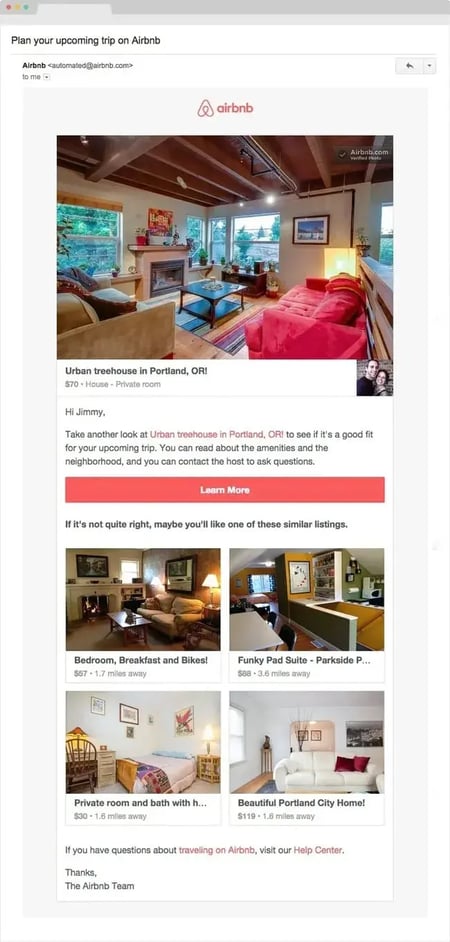
Case study: Airbnb tracks customer behavior and identifies accounts that indicate booking-ready behavior. These are accounts that are actively searching for listings, reading reviews, browsing images, etc. As a direct result of such behavior, the company sends a behavioral email one day after a customer views the listing but doesn’t complete a booking.
The email contains the same listing the customer viewed one day earlier, as well as other relevant listings within the same price range and location. The personalized offer drives more engagement and lets customers come back to the listing where they left off.
9. Contractbook’s multi-touchpoint drip campaigns.
Multi-touchpoint drip campaigns are automated marketing sequences strategically created to engage and nurture leads or customers over an extended period. The sequence of messages is predetermined and triggered based on user actions or predefined timelines.
By providing timely and relevant content, these campaigns guide leads through the customer journey and spark opportunities for engagement at different stages. Marketers can create and send email drip campaigns with the .
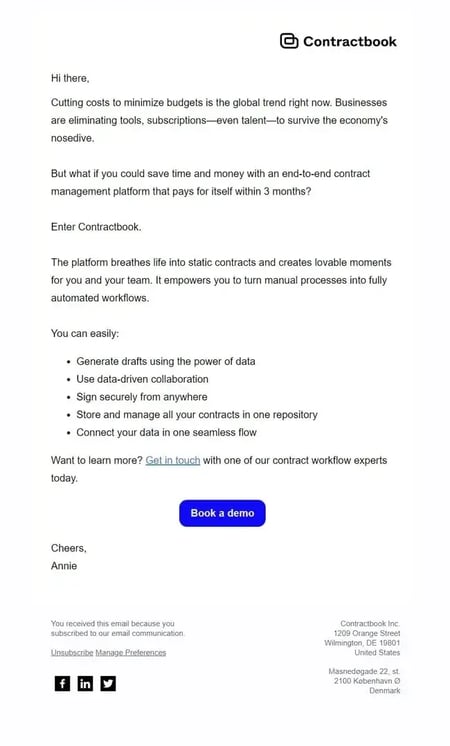
Case study: Contractbook uses drip campaigns to gradually engage accounts and nurture their interest. In the example below, they send the first email and invite prospects to check out a detailed post on a relevant topic.

After the first email, Contractbook sends a series of short emails, including one that invites their audience to schedule a demo.
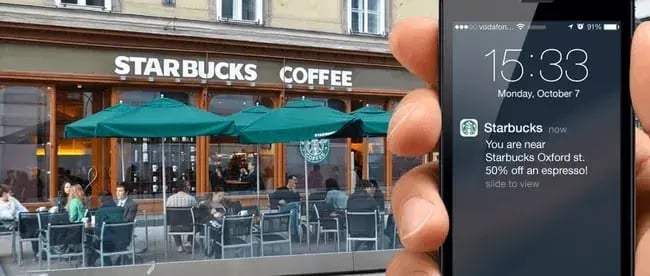
10. Starbucks’s geofencing for localized marketing.
Geofencing is a location-based marketing strategy used to deliver specific messages, promotions, or ads to individuals in designated areas. This strategy uses GPS (Global Positioning System), RFID (Radio-Frequency Identification), Wi-Fi, or cellular data to recognize when a user’s device enters or leaves the defined geographic zone.
also impacts local SEO. With customers evaluating local businesses on Google before making a purchase, it helps companies improve their local SEO by providing accurate and up-to-date location information for their business listings.
Case study: Starbucks uses geofencing to advertise its drinks effectively. They send push notifications whenever customers are close to a Starbucks shop. To make the campaign more engaging, they reward users with stars and badges for visiting different stores.
11. Casper’s innovative content strategy.
In this content-is-king era, capturing audience attention and standing out from competitors requires a creative and forward-thinking approach. An innovative content strategy often includes interactive and immersive formats, such as:
- Quizzes
- Polls
- Surveys
- Dynamic infographics
- Virtual reality experiences
- Augmented reality experiences
Case study: , a mattress retailer, achieved remarkable success, reaching $750 million in just four years by adopting an innovative content strategy. They revolutionized the mattress world by introducing the concept of a “mattress in a box.”
As the name suggests, customers get a mattress box. Then, they remove it from its plastic packaging and allow it 45 minutes to an hour to regain its original shape. Not surprisingly, it became a trend, and buyers started uploading unboxing videos on YouTube.
Additionally, they created ToFu content that’s fun and humorous — without being salesy. Interestingly, rather than asking for an email address on their website, Casper incentivizes customers to submit a survey about their sleeping habits, offering a $25 discount as a reward.
Frequently Asked Questions About Target Marketing
What are the 4 types of target marketing?
The four common approaches to target marketing are mass marketing, differentiated marketing, niche marketing, and micromarketing. Each approach changes how narrowly a business defines its audience and tailors its messaging.
What is the difference between a target market and a target audience?
A target market is the broader group of buyers a business wants to reach, while a target audience is the more specific segment a campaign speaks to. In practice, the target audience is often a subset of the target market.
How do I identify my target market?
Marketers should start by analyzing their current customers, segmenting them by shared traits like demographics, behavior, needs, or location, and then identifying which segments are most likely to buy. From there, they can build messaging and campaigns around the highest-fit group.
Why is target marketing important?
Target marketing helps businesses reduce wasted ad spend, create more relevant messaging, and improve conversions by focusing on the people most likely to buy. It also makes it easier to personalize campaigns as a company grows.
What is market segmentation in target marketing?
Market segmentation is the process of dividing a broad audience into smaller groups based on shared characteristics such as age, interests, location, or behavior. It gives marketers a practical way to apply target marketing more precisely.
What is the 3-3-3 rule in marketing?
The 3-3-3 rule in marketing usually refers to a framework for structuring messaging or campaigns around three key audience segments, three core benefits, or three repeated touchpoints. Because the term varies by context, marketers should define how they’re applying it before using it in a strategy.
Use targeted marketing strategies to your advantage.
Target marketing helps businesses match the right people with the right content at the right time. When marketers understand audience behaviors, motivations, and intent, they can create campaigns that feel more relevant, personalized, and valuable to potential buyers.
Start by reviewing your current audience data and identifying where your campaigns are too broad or missing high-intent segments. From there, experiment with one or two advanced strategies covered in this guide. Small improvements in targeting can lead to meaningful gains in conversions, customer retention, and long-term growth.
Editor’s note: This article was originally published in March 2013 and has been updated for comprehensiveness.

Free Marketing Plan Template
Outline your company's marketing strategy in one simple, coherent plan.
- Pre-Sectioned Template
- Completely Customizable
- Example Prompts
- Professionally Designed
Download Free
All fields are required.
Form not available
You're all set!
Click this link to access this resource at any time.
Marketing Strategy





![The state of inclusive marketing in 2025 [new data + expert insight]](https://53.fs1.hubspotusercontent-na1.net/hubfs/53/inclusive-marketing-report.webp)
![How marketers are navigating a possible recession (and advice about what you should do during it) [new data]](https://53.fs1.hubspotusercontent-na1.net/hubfs/53/image12-May-27-2025-02-18-19-8390-AM.png)