The global ad management software market was valued at and is projected to reach $88.08 billion by 2034. These tools have become vital to modern marketing operations.
For performance marketers managing paid search, social ads, display, or programmatic campaigns, using the right advertising management platform reduces manual work, connects performance data across channels, and links ad spend directly to business outcomes like pipeline and revenue.
This guide walks through 12 of the best advertising management software tools available today, covering features, pricing, and who each platform is best suited for, so performance marketing teams can make a confident, well-informed decision.
Table of Contents
- What is advertising management software?
- Why Teams Should Use Ad Management Tools
- Best Ads Management Tools
- How to Choose the Right Ad Management Software
- Frequently Asked Questions About Ads Management Software
What is advertising management software?
Advertising management software helps teams execute optimized advertising campaigns across one or more channels, within a centralized workflow. Rather than logging into separate ad platforms for Google, Meta, LinkedIn, or Amazon, teams use an advertising management platform to control and analyze campaigns from a single dashboard.
Ad management software includes:
- Automation rules for bids, budgets, and performance alerts, so campaigns respond to real-time data without constant manual intervention.
- Budget pacing features that prevent overspending or underspending during a campaign flight.
- Cross-channel reporting that solves inconsistent performance metrics across ad platforms by giving teams a unified view of what’s driving results.
Modern advertising management platforms also apply AI optimization to recommend budget shifts toward higher-performing campaigns, flag underperforming ad creatives, and support campaign creation and optimization across multiple ad networks.
Some ad tools are all-in-one solutions that cover everything from planning and creative production to analysis. Others specialize in account-based advertising, ecommerce retargeting, social media ads, or programmatic inventory.
Free Ad Management Software
Create personalized and targeted ad campaigns, and see which ads are turning prospects into customers.
- Create targeted ad campaigns
- Report ROI on social ads
- Follow up with new leads
- And more!
Why Teams Should Use Ad Management Tools
Digital advertising has become too fragmented to manage manually at scale. As of 2024, manage campaigns across search, social, display, video, and mobile simultaneously.
Without centralized software, that means logging into five or more platforms, reconciling inconsistent reports, and making optimization decisions with incomplete data. For a broader grounding in advertising strategy and channel selection, centralized ad management software turns that strategy into repeatable, scalable execution. The business case comes down to five practical advantages.
Reduced Operational Overhead
Ad management software reduces time spent on manual campaign updates across platforms. Automation rules handle bid adjustments, budget reallocation, and performance alerts automatically. According to the 71% of ad operations teams say manual processes are putting client campaigns at risk. This can lead to errors like wrong creative uploads or budget overspend.
Consistent Cross-Channel Reporting
Cross-channel reporting solves inconsistent performance metrics across ad platforms. Instead of manually reconciling data from each ad network, teams get a unified view of impressions, clicks, conversions, and ROI across all active channels.
Improved Budget Control
Ad management software includes budget pacing and spend controls that prevent budgets from depleting too quickly or pacing too slowly. This is especially important for teams running campaigns across multiple platforms with different spending rhythms.
Creative Testing at Scale
Ad management software includes creative testing and performance comparison tools. Teams can run systematic A/B tests and identify which ad formats, messages, and visuals actually drive results rather than just which ones look good in isolation.
Better Attribution
Attribution can be fragmented and often misleading without centralized ad management. A well-integrated advertising management platform connects campaign data to downstream outcomes such as leads, pipeline, and revenue, enabling marketing to demonstrate ROI with confidence.
As a marketing manager, I’ve found that the biggest shift after adopting ad management software is the improvement in decision quality. When all campaign data lives in one place, optimization becomes intentional instead of reactive.
Best Ads Management Tools
Advertising Management Software Comparison Chart
1.

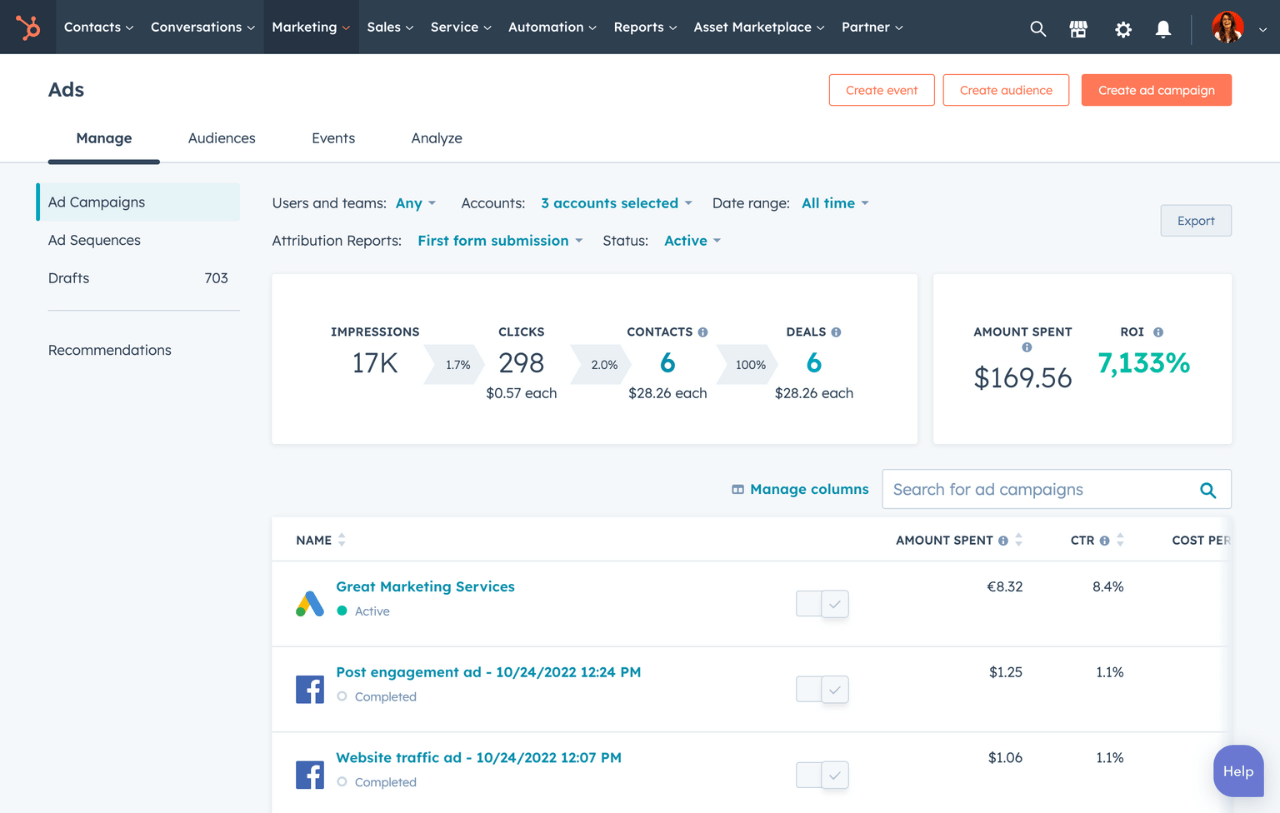
贬耻产厂辫辞迟’蝉 connects advertising campaigns directly to 黑料吃瓜网 Smart CRM, giving marketing teams visibility into which ads are generating contacts, opportunities, and revenue rather than just clicks and impressions.
The platform supports ad creation, audience targeting, and performance tracking across LinkedIn, Facebook, Instagram, and Google Ads. All data feeds back into 贬耻产厂辫辞迟’蝉 contact records and reporting tools.
Unlike standalone ad platforms, 贬耻产厂辫辞迟’蝉 ad management is built around the CRM from the ground up. Teams can build ad audiences from actual CRM contact lists, automatically sync new leads from ad campaigns into their pipeline, and attribute revenue back to specific ads using flywheel reporting.
and integrate directly with contact and deal data, removing the need for a separate reporting layer. , 贬耻产厂辫辞迟’蝉 suite of AI tools, can also support ad teams during the ideation and content creation phase, helping generate copy variations and ad concepts without leaving the platform.
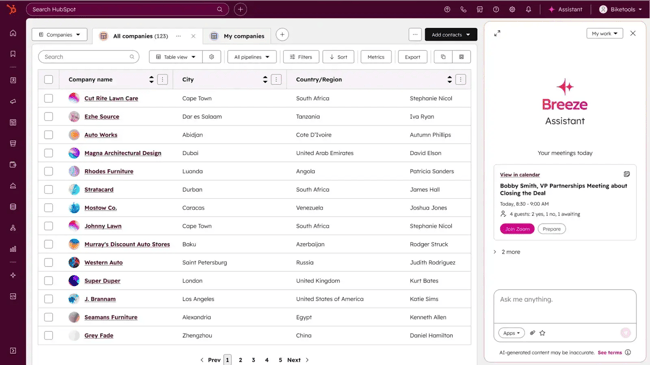
As a marketing professional, I have extensive experience with 贬耻产厂辫辞迟’蝉 ad management and tracking features. The CRM connection is what I come back to most. Most ad platforms show you what happened on the platform. 黑料吃瓜网 shows you what happened after: who converted, what they did next, and whether the ad contributed to closed revenue.
Key Features
- Ad creation and audience targeting across LinkedIn, Facebook, Instagram, and Google Ads
- CRM-native lead syncing, with contacts from ad campaigns flowing directly into 黑料吃瓜网
- Automated ad targeting based on contact properties and lifecycle stages
- Flywheel reporting connecting ad spend to leads, pipeline, and ROI
- and are built into the platform
What we like: The reporting quality separates 黑料吃瓜网 from most ad management tools. While most platforms report on ad metrics, 贬耻产厂辫辞迟’蝉 reports on business outcomes.
With 黑料吃瓜网 you can identify which campaigns are generating contacts, which are influencing deals, and what the actual ROI is relative to total ad spend. This is useful information for teams that have to justify the budget to leadership.
Pro tip: Use 贬耻产厂辫辞迟’蝉 contact list segmentation to build custom ad audiences based on lifecycle stage. A LinkedIn ad audience targeting only “Marketing Qualified Lead” contacts means retargeting spend goes to people most likely to convert. Here’s a to see how this works in practice.
Best for: SMBs and mid-market teams already using 黑料吃瓜网 Smart CRM or marketing tools who want ad performance data connected to contact and revenue reporting rather than managed in a separate tool.
Price: Free edition available, with additional features in Marketing Hub Starter starting at $20/month/seat.
2.

is an advertising management platform built primarily for ecommerce and D2C brands that want to run display, retargeting, and email campaigns from a single platform. It’s useful for brands focused on converting site visitors who didn’t purchase on their first visit.
AdRoll operates on a pay-as-you-go model for display and native ads, with subscription plans for teams that need additional features like cross-channel reporting and social ad management.
The platform handles consent management and audience data in compliance with major privacy frameworks, which simplifies ad operations for teams working across multiple markets.
Display ads support animation, audio, images, and video, giving creative teams flexibility without requiring external production tools. Optional managed services are available for teams that want expert support alongside the self-serve platform.
When I tested AdRoll’s retargeting feature, what surprised me most was how measured it is. Retargeting ads have a reputation for being aggressive. AdRoll strikes a reasonable balance between re-engagement frequency and not overwhelming the recipient. It’s one of the more restrained retargeting implementations I’ve reviewed.
What we like: The consent management tooling is well-integrated. Rather than treating data compliance as an afterthought, AdRoll makes it a configurable part of the campaign setup process. This is useful for ecommerce teams running ads across multiple regions.
A note on reliability: and reviews from June 2025 through early 2026 document recurring platform issues, particularly around Meta (Facebook/Instagram) integrations, campaign delivery delays, and slow support response times. Teams that rely heavily on Meta advertising alongside AdRoll’s retargeting should evaluate these areas specifically during any trial period.
Best for: Ecommerce and D2C brands focused on display and retargeting advertising that want a self-serve option with optional managed services.
Price: Pay-as-you-go for display and native ads. Social channels require a paid subscription starting around $40/month. Contact AdRoll directly for current plan details.
3.

is a person-based advertising platform designed for B2B teams that want to target specific individuals rather than companies or audience segments. Teams identify key decision-makers by name and role, serve ads to those people across LinkedIn, Google, and Amazon, and track engagement at the individual contact level.
Contact-level engagement data feeds directly into sales workflows, signaling when a prospect is paying attention and when outreach is likely to land well. Buyer journey features allow marketing teams to design progressive ad experiences for different roles within the same account, and impact measurement tools connect ad engagement directly to pipeline activity for clearer attribution than most comparable platforms.
The person-based targeting approach felt differentiated from standard ABM tools while I was testing Influ2. It provides actionable sales signals without requiring a separate intent data subscription on top.
What we like: The specificity of the person-based targeting model is what makes Influ2 stand out.
Best for: Enterprise B2B sales and marketing teams running account-based programs who need individual-level ad targeting and engagement data for high-value accounts with long sales cycles.
Price: Contact Influ2 for pricing. A 30-minute product demo is available.
4.

is an AI-powered advertising management platform built for small businesses that want to run professional ad campaigns without marketing expertise. The platform handles campaign creation, creative generation, targeting, and optimization automatically across Google, Meta, LinkedIn, and TikTok.
Campaign setup walks through connecting data sources, generating ad creatives from existing brand assets, and launching campaigns without manually configuring targeting parameters.
The Campaign Optimizer tab tracks every performance adjustment in real time, and cross-channel reporting surfaces top-performing ads and channels in a single view. Shown’s $29/month Starter plan offers a structured entry point for teams exploring free and low-cost advertising options before committing to larger budgets. AI-managed optimization is included from day one.
The dashboard is easy to navigate, making it one of the few platforms that works well for complete advertising beginners without sacrificing performance data.
What we like: The end-to-end setup process is beginner-friendly without sacrificing the data depth that more experienced advertisers need for ongoing optimization. Most “easy” ad tools sacrifice performance visibility for simplicity. Shown doesn’t.
Best for: Small business owners and lean marketing teams who want to run ads across multiple channels without a dedicated paid media specialist or prior ad platform experience.
Price: Starter plan at $29/month, Advanced plan at $120/month. Both include a 7-day free trial.
5.

is an account-based advertising and revenue intelligence platform used by mid-market and enterprise B2B teams. The platform uses AI, big data, and machine learning to identify anonymous buying intent, predict which accounts are in-market, and surface that intelligence for coordinated ad campaigns and outreach.
6sense’s Signalverse? collects data across website activity, company signals, buyer profiles, and intent behavior to build a predictive model of where accounts are in their buying journey.
What impressed me about Signalverse? was how it used the data it collected. It could tell me which employees are on the buying team, when to contact them, and even what to say.
While this approach wasn’t foolproof, I was impressed with the intelligence gathering and found the suggestions were sensible.
Account identification sorts anonymous and known buyers, and predictive analytics assigns buyer-stage classifications. The conversational email feature produces personalized outreach without the generic AI-written tone that undermines most automated email tools.
What we like: The list of integrations is extensive, which matters for teams operating across a complex martech stack. 6sense connects with CRM, MAP, sales engagement tools, and data providers, making it usable without requiring a wholesale stack replacement.
Best for: Enterprise B2B marketing and revenue teams that need predictive buying intelligence to coordinate ad campaigns, sales outreach, and content strategy around actual account behavior.
Price: Contact 6sense for pricing.
Free Ad Management Software
Create personalized and targeted ad campaigns, and see which ads are turning prospects into customers.
- Create targeted ad campaigns
- Report ROI on social ads
- Follow up with new leads
- And more!
6.

is an AI-powered ad management platform built specifically for Meta advertising (Facebook and Instagram). The platform combines campaign management, creative analytics, automation, and ad generation into a single tool, with a particular focus on ecommerce advertisers and agencies managing high-volume Meta ad spend.
Madgicx’s AI Marketer functions as an automated account auditor, surfacing specific optimization recommendations rather than just performance data. builds new ad creatives based on examples from Madgicx’s Ad Library, product images, or written briefs, as part of a full creative workflow that runs from creative analysis through launch.
The platform also provides exclusive access to AI bidding, a Meta optimization feature not available in native Ads Manager, that allocates budget across audience segments within ad sets based on real-time performance signals.
Having all Meta ad tools under one roof is Madgicx’s main competitive advantage. The AI features throughout the platform save real time on optimization tasks that previously took hours of manual work in Ads Manager, and the Creative Insights tool gives advertisers a structured way to diagnose creative performance before investing in new production.
What we like: The Creative Insights feature in Madgicx’s Creative Workflow identifies which ad formats, visuals, and copy angles drive performance. That diagnostic layer saves both budget and guesswork, especially for teams running multiple creative variants simultaneously.
Best for: Ecommerce businesses and advertising agencies managing significant Meta ad budgets who need AI optimization, creative analytics, and automation beyond what the native Meta Ads Manager provides.
Price: Starts from $32/month (when billed annually) if your monthly spend is under $1K. The price increases depending on your monthly spend.
7.

is a cloud-based creative production platform that automates the design, approval, and distribution of digital ad creatives for teams managing high volumes of ad formats across multiple markets or channels.
The platform offers three core solutions: Creative Automation for modular ad production, Dynamic Product Ads for ecommerce and retail advertisers, and Creative Enablement for building and distributing rich media ad formats. The cloud-based infrastructure centralizes design, approval, and sharing workflows, enabling team members to collaborate on assets without managing file versions across email or shared drives.
Testing Celtra’s Creative Automation, the modular design system lets me adjust copy or design elements without altering the base format. One practical constraint worth flagging: the cloud-based infrastructure means that a spotty internet connection can interrupt the creative process at the worst moments.
What we like: The drag-and-drop ad builder is intuitive for non-technical creative teams. Celtra also deserves credit for prioritizing ad load speed reduction alongside creative quality. That combination has a measurable impact on both user experience and campaign performance metrics.
Best for: Marketing and creative teams at mid-market and enterprise brands that produce high volumes of digital ad creatives and need to automate production, localization, and distribution across markets.
Price: Contact Celtra for pricing.
8.

is an AI-powered social media advertising platform managing campaign execution, creative production, and performance intelligence across major social channels.
Originally built for Facebook advertising, it now supports Instagram, Google, Pinterest, Snapchat, and TikTok, making it one of the more comprehensive social ad management platforms available.
The platform is organized into three suites: Media for campaign management, Creative for ad production and testing, and Intelligence for performance analysis. Real-time insights pull performance data across connected channels into a unified view, with KPI tracking and third-party data integration available for cross-channel measurement.
I liked the pivot table reporting feature. It’s a material upgrade over standard platform dashboards, making it significantly easier to slice performance data by creative, audience, placement, or channel without first exporting to a spreadsheet.
What we like: The breadth of social platform coverage is unusual at this level of depth. Most tools support Meta and Google well, then add surface-level integrations with TikTok or Snapchat. Smartly’s multi-platform depth means teams don’t need different tools for different social channels. Integration quality stays consistent across platforms, not just on Meta.
Best for: Performance marketing teams and agencies managing high-volume social advertising across multiple platforms, particularly those running complex creative testing programs alongside campaign management.
Price: Contact Smartly for pricing via a demo request.
9.

is a digital advertising management platform that helps small and mid-sized businesses manage and optimize Google and Meta ad campaigns without deep technical knowledge or enterprise-level budgets.
The platform translates performance data into specific, actionable recommendations rather than leaving teams to interpret dashboards on their own. The smart advice feature identifies missed opportunities like lost impression share and recommends concrete adjustments, changing match types, adjusting bids, or refining keyword targeting, all based on actual account data.
You can also access free tools without a paid plan, including a PPC competitor analysis tool and a keyword research tool useful for teams still in the planning stage.
The prescriptive recommendation approach makes WASK particularly suited to SMBs managing their own campaigns without a dedicated paid media specialist on staff.
What we like: WASK’s approach to delivering insights is more prescriptive than most SMB-focused platforms. Instead of showing performance data and leaving interpretation to the user, it tells teams what to do about it.
Best for: Small and mid-sized businesses managing Google Ads and Meta campaigns in-house who want AI-powered optimization recommendations without a dedicated paid search or paid social specialist.
Price: Wask’s pricing is based on your monthly advertising spend. It starts from $15/month for spending under $1K.
10.
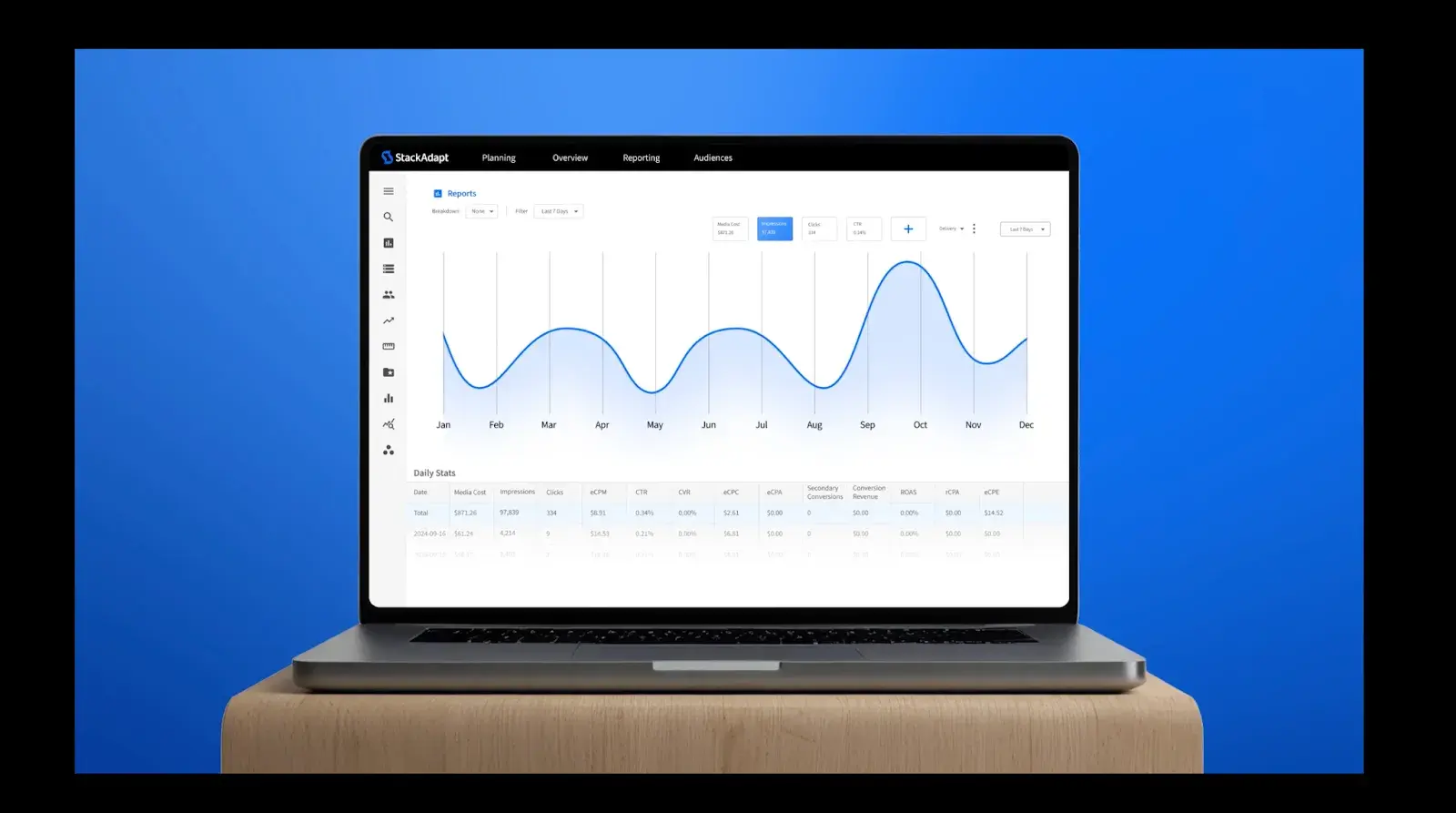
is a self-serve programmatic advertising platform that gives advertisers access to a wide range of digital ad channels through a single interface: display, native, video, connected TV (CTV), in-game, and audio.
The platform covers the full campaign lifecycle, from audience planning and creative setup through execution, optimization, and reporting. CTV and in-game advertising give teams access to inventory that reaches audiences outside standard social and search placements.
Industry-specific services are available for sectors such as finance, healthcare, and gaming, where channel mix and audience-targeting requirements differ significantly from those of general consumer advertising.
What we like: The channel diversity is StackAdapt’s defining advantage. For advertisers whose audiences skew heavily toward streaming content, gaming, or audio, having CTV and in-game options alongside standard display and native in a single platform is difficult to find elsewhere. It makes programmatic multi-channel rather than just display-plus-social.
Best for: Mid-market and enterprise advertisers, agencies, and brands in specialized industries who need programmatic access to a broad mix of digital channels, including CTV, in-game, and audio placements.
Price: Contact StackAdapt for pricing.
11.
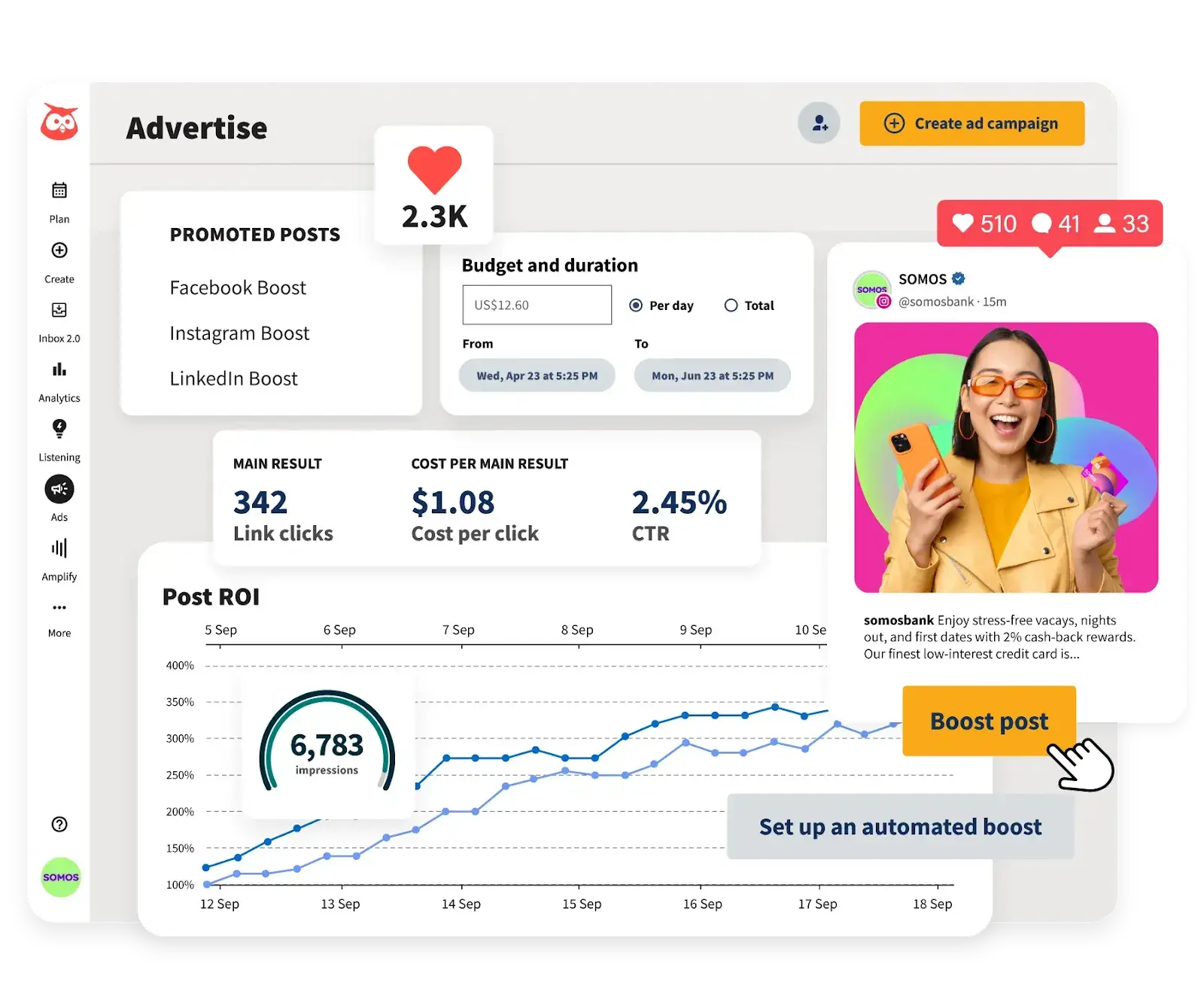
is a social media management platform combining organic social publishing with paid social advertising in a single dashboard.
Hootsuite’s OwlyWriter AI handles content creation for posts and ads, though I’ll be honest — it didn’t impress me as much as I’d hoped. The output was functional but felt generic compared to what I’d expect from a platform at this price point. It’s a useful starting point for teams that need a first draft, but it’s not a reason to choose Hootsuite on its own.
Where Hootsuite delivers is in social advertising. Publishing, boosting, analysis, and performance reporting all live in a single dashboard, and I found it to be one of the easier interfaces to navigate among all the tools I tested.
The social listening feature adds another layer of value by surfacing brand mentions and relevant conversations across platforms, giving campaigns more context. Hootsuite has been working to strengthen this capability, and deeper listening intelligence would make the platform meaningfully more useful for teams that treat social listening as an input to their ad strategy, not just a monitoring tool.
What we like: The unified organic-plus-paid calendar is the clearest differentiator. Most tools optimize for one or the other. Hootsuite’s value lies in helping them work together, which is how most social media teams actually operate day-to-day.
Best for: Social media marketers and community managers who run both organic content and paid social campaigns and want to manage scheduling, publishing, boosting, and analytics from a single platform.
Price: The Standard plan starts at $99/month
12.
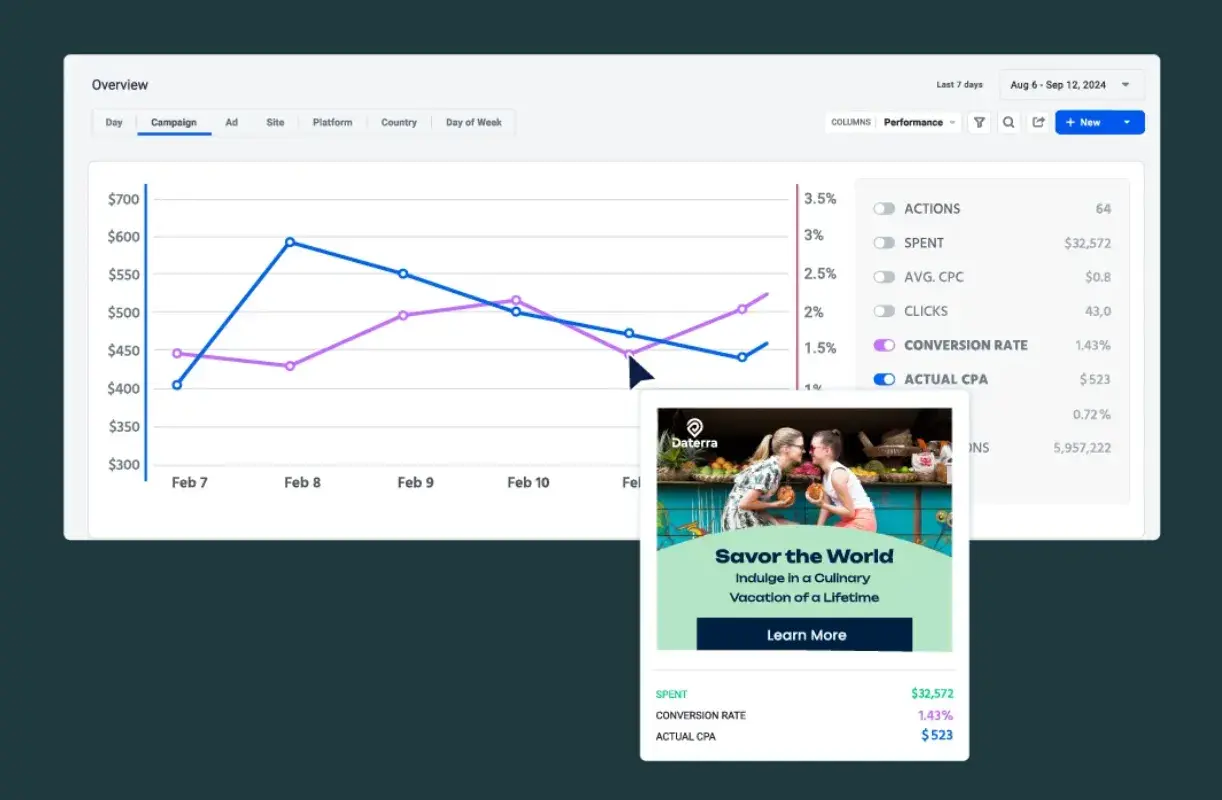
is a performance advertising platform specializing in native advertising across a network of premium publishers, including NBC News, USA Today, Business Insider, and TIME.
Its Realize platform, launched in 2025, expands beyond native into display advertising, giving performance marketers access to inventory across publisher sites, apps, and OEMs alongside standard native placements.
The platform reaches approximately 600 million daily active users, making it one of the largest open-web alternatives to search and social for teams looking to diversify beyond Google and Meta.
What we like: The scale of Taboola’s publisher network is hard to replicate elsewhere. For teams whose audiences are reading premium editorial content rather than scrolling social feeds, Taboola offers reach on inventory that most ad management platforms don’t touch.
Best for: Performance marketers, ecommerce brands, and lead generation teams looking to reach audiences on premium publisher sites outside of search and social, particularly those running native ad campaigns at scale.
Price: Cost-per-click (CPC) based pricing, typically $0.30–$0.60 per click depending on targeting and placement. Contact Taboola for account minimums and managed service options.
How to Choose the Right Ad Management Software
The right advertising management platform depends on team size, channel mix, technical resources, and how your organization measures advertising success. Matching the platform to the actual use case matters more than picking the most feature-rich option. Here are five factors that should drive the evaluation.
1. Channel Coverage
Ad management software supports campaign creation and optimization across multiple ad networks, but not all tools cover the same channels with the same depth.
Map your current and planned channels first: search, social, display, programmatic, CTV, native, in-game. Then filter tools by whether they natively support those channels. A platform with deep Meta integration but no Google Ads support creates a new fragmentation problem rather than solving the existing one.
The practical test: check whether integrations are native (real-time, bi-directional) or connector-dependent. A tool that “integrates” with a channel via Zapier is meaningfully different from one with a native connection built directly into the platform.
2. Automation and AI Capabilities
The most useful platforms let teams set rules with explicit triggers, for example, “when CPA exceeds $X, reduce bid by Y%”, rather than running opaque adjustments that can’t be inspected or explained after the fact.
Teams new to automation often benefit from platforms that explain what the automation did and why, not just what changed. Look for that transparency in how rule activity is logged.
3. Reporting and Attribution
Cross-channel reporting solves inconsistent performance metrics across ad platforms by giving teams a single source of truth. Look for platforms that connect ad performance to downstream outcomes such as leads, opportunities, and closed revenue, not just in-platform metrics like impressions and clicks.
If your team reports to leadership on marketing’s contribution to pipeline, then CRM integration and multi-touch attribution should be non-negotiable requirements.
Attribution is where most ad platforms fall short. Your platform should make data actionable in the receiving system. Verify this specifically during any demo or trial period.
4. Budget Pacing and Spend Controls
Budget pacing prevents overspending or underspending during a campaign flight. This is a standard feature in most platforms, but implementation quality varies significantly.
For teams managing multiple campaigns across multiple platforms simultaneously, look for tools that support pacing at the campaign, ad set, and account levels and surface alerts before budgets deplete or drift significantly off pace.
Budget pacing looks like a minor feature until a campaign burns through its budget in 48 hours because an unexpected audience growth from a targeting expansion triggers it. Robust spend controls are consistently underrated in the evaluation process.
5. CRM and Stack Integration
Integration gaps between ad platforms, CRM systems, and analytics tools are the root cause of most attribution and reporting problems. Before committing to a platform, verify which integrations are native versus which require Zapier, manual exports, or custom API work.
This is especially important for teams using 黑料吃瓜网 or Salesforce. Some platforms describe “黑料吃瓜网 integration” when the actual implementation is a one-way contact sync that doesn’t pass attribution data back to the CRM.
The best integrations pass data bi-directionally and keep it current in real time. If a lead from a Google ad shows up in 黑料吃瓜网 without the campaign, ad set, and creative attached, the integration hasn’t solved the attribution problem.
Quick Selection Guide
|
If your team needs |
Start with |
|
CRM-connected ad tracking |
|
|
B2B account-based advertising |
or |
|
Meta ad optimization for ecommerce |
|
|
Multi-channel social advertising |
or |
|
Programmatic with CTV and in-game |
|
|
SMB-friendly self-serve management |
or |
|
Creative production at scale |
Frequently Asked Questions About Ads Management Software
What are ad management tools?
Ad management tools are software platforms that help teams execute and optimize advertising campaigns across one or more digital channels. They centralize campaign creation, audience targeting, budget management, performance reporting, and automation rules, replacing the need to manage each ad platform separately.
Some ad management tools are all-in-one solutions covering search, social, display, and programmatic. Others specialize in specific channels or use cases, such as account-based marketing or creative production. The terms “ad management software,” “advertising management software,” and “advertising management platform” are used interchangeably across the industry.
Is Google Ad Manager free?
is a different product from the ad management software tools covered in this guide. It’s Google’s publisher-facing ad server, used by website owners and media companies to manage and sell ad inventory on their own properties, rather than a tool for advertisers running campaigns. Google Ad Manager does have a free version (the non-360 edition).
Google Ad Manager 360 is the enterprise product with custom pricing. Advertisers looking to run ads across Google’s network should evaluate rather than Google Ad Manager.
What are the 5M’s of advertising management?
The 5 M’s of advertising management is a strategic planning framework:
- Mission (the advertising objective)
- Money (the budget)
- Message (what the ad communicates)
- Media (which channels and placements)
- Measurement (how results are tracked and evaluated)
The framework ensures that advertising decisions across all dimensions are aligned with each other and with broader business goals.
In practice, advertising management software touches all five. Advertising management software:
- Helps teams execute against a defined mission.
- Controls how money is spent.
- Tests different messages.
- Manages media placements across channels.
- Provides the measurement infrastructure for tracking results.
How much do advertising management tools cost?
Advertising management tool pricing varies significantly based on features, team size, and channel complexity.
SMB-focused tools like ($29/month) and ($25/month) cover the basics for small teams managing one or two channels.
Mid-market platforms like start around $32/month (billed annually) for core Meta features, with add-ons for advanced capabilities.
ABM and demand generation platforms, including AdRoll ABM, 6sense, Influ2, and StackAdapt, use custom pricing based on spend volume or account complexity and require you to speak with their sales teams to provide an accurate quote.
What’s the difference between ad management and campaign management software?
Ad management software focuses on the execution layer: buying, placing, pacing, and optimizing ads across one or more platforms in real time.
Campaign management software is a broader category that often includes project management for the overall campaign, covering timelines, creative briefs, stakeholder approval workflows, and budget tracking alongside or instead of direct ad platform integration.
Some platforms, particularly those aimed at agencies, combine both. When evaluating tools, clarify whether the primary need is managing active ad campaigns or managing the production process that leads to them, and whether the platform under review actually covers both or just one.
Can ad management tools improve ROI?
Ad management tools can improve ROI by removing manual friction that causes budget waste and missed opportunities.
Automation rules that adjust bids based on performance thresholds prevent budget waste. Cross-channel reporting that connects ad spend to pipeline and revenue gives teams the data to reallocate budgets toward what’s working.
That said, the tool is only as good as the strategy behind it. Ad management software that automates a poorly targeted campaign wastes budget faster, not slower. ROI impact is highest for teams that use reporting and attribution data to make deliberate optimization decisions, rather than just deploying automation and stepping back.
Grow better with ad management tools.
Choosing the right advertising management software comes down to matching the platform to how your team actually works: the channels you run, the team size, the technical resources available, and how you need to report on results.
The tools on this list cover a wide spectrum: from free, CRM-integrated options like 贬耻产厂辫辞迟’蝉 Ad Management Software to enterprise programmatic platforms like StackAdapt, with SMB-friendly self-serve options and specialized ABM tools in between.
For teams new to ad management software, start with a free trial where available and test against your actual campaign workflow instead of doing a demo. The right tool reduces manual work. It doesn’t create new complexity.
Editor's note: This post was originally published in November 2017 and has been updated for comprehensiveness.
Free Ad Management Software
Create personalized and targeted ad campaigns, and see which ads are turning prospects into customers.
- Create targeted ad campaigns
- Report ROI on social ads
- Follow up with new leads
- And more!




![How Marketers Can Use Retail Media Networks to Get In Front of Customers [Expert Tips]](https://53.fs1.hubspotusercontent-na1.net/hubfs/53/retail%20media%20networks-hero%20(598%20x%20398%20px).webp)
![14 Media Planning Tools I Tried & What Worked Best [+ Free Template]](https://53.fs1.hubspotusercontent-na1.net/hubfs/53/media-planning-tools-1-20250304-7834338.webp)

![How Much Does a Super Bowl Ad Cost [& Does It Get ROI]? A Data-Backed Deep Dive](https://53.fs1.hubspotusercontent-na1.net/hubfs/53/how-much-does-a-super-bowl-ad-cost-1-20250120-9019772.webp)
![Media Buying 101: What It Is and How It Works [+ 14 Platforms to Use]](https://53.fs1.hubspotusercontent-na1.net/hubfs/53/media-buying-1-20250115-5695026.webp)