Demand forecasting vs. sales forecasting is a common source of confusion for sales, operations, and supply chain leaders — they are closely related but serve different business needs. Demand forecasting predicts future customer demand for products or services, while sales forecasting estimates how much revenue a company expects to generate from its sales pipeline. Confusing the two often leads to inventory issues, missed revenue targets, or misaligned resource planning.
For sales, operations, and supply chain leaders, understanding how demand forecasting differs from sales forecasting — and when to use each — is essential for making accurate, coordinated decisions. This guide explains what demand forecasting is, how it works, how it compares to sales forecasting, and how organizations can use both approaches together to plan more effectively.
Table of Contents
- What is demand forecasting?
- What is sales forecasting?
- Demand Forecasting vs. Sales Forecasting
- When to Use Demand Forecasting
- When to Use Sales Forecasting
- Integrating Demand Forecasting and Sales Forecasting
- Demand Forecasting Methods and Tools
- Frequently Asked Questions About Demand Forecasting
What is demand forecasting?
Organizations looking to answer “What is demand forecasting?” can define it as the process of estimating future customer demand for a company’s products or services using historical data, market trends, and external factors.
Demand forecasting helps organizations anticipate changes in demand so they can plan inventory levels, staffing, production capacity, and supply chain operations more accurately.
Rather than focusing on revenue outcomes, demand forecasting focuses on volume and timing — how much demand is likely to occur and when. This makes it a foundational input for operational planning, pricing strategy, and long-term growth decisions.
In manufacturing and product-based businesses, demand forecasting often estimates the number of units customers are expected to purchase. In professional services businesses, demand forecasting may estimate demand for project types, service packages, or billable hours.
Example units in a services organization might include:
- Monthly retainers
- Brand or messaging engagements
- Website or campaign builds
- Strategy or planning sessions
In these cases, having sufficient “supply” means ensuring adequate team capacity and expertise to meet expected demand.
Pro tip: For businesses operating in complex logistics environments, demand forecasting helps balance customer demand with real-world constraints. One business owner notes that demand forecasting requires understanding how much product to have on hand and on order at any given time — while accounting for shipping timelines and regional limitations.
At its core, demand forecasting is about identifying patterns in customer demand and preparing the business to respond efficiently as those patterns change.
Free Sales Software
Built for productivity, powered by relevance.
- Sales Automation
- Call Tracking
- Lead Prospecting
- And More!
How Demand Forecasting Works
This demand forecasting process typically involves collecting historical data, incorporating qualitative insights, and updating forecasts as conditions change.
Demand forecasting works by combining quantitative data with qualitative insights to estimate future demand over a defined time period. Most organizations use a mix of historical performance data and forward-looking indicators to account for both predictable trends and changing market conditions.
Quantitative inputs typically include:
- Historical sales or usage data
- Seasonality patterns
- Product lifecycle data
- Pricing and promotion history
Qualitative inputs often include:
- Market and economic conditions
- Changes in customer preferences
- Competitive activity
- Regulatory or supply chain considerations
Some organizations rely on passive demand forecasting, which emphasizes historical data and internal performance trends. Others use active demand forecasting, which incorporates near-real-time data and external signals to adjust forecasts as conditions change.
Because demand is influenced by factors outside a company’s control, forecasts should be reviewed and updated regularly. Demand forecasting is most effective when treated as a living process rather than a one-time exercise.
Pro tip: Qualitative insights gathered from customers, account teams, and market research often provide critical context that raw data alone cannot capture.
Benefits of Demand Forecasting
Demand forecasting supports more accurate planning and decision-making across multiple business functions. By understanding expected demand patterns, organizations can align resources more effectively and reduce unnecessary risk.
Key demand forecasting benefits include:
- Improved inventory and resource planning.
- More efficient supply chain operations.
- Better staffing and capacity management.
- More informed pricing and promotion strategies.
- Stronger alignment between marketing, operations, and finance.
Demand forecasting is particularly valuable in industries with cyclical demand, long lead times, or complex fulfillment requirements. When forecasts are accurate and regularly updated, teams can respond more confidently to both growth opportunities and demand slowdowns.
Demand forecasting is most useful for operations leaders, supply chain teams, finance teams, and marketing leaders responsible for long-term planning and capacity decisions.
Kali Bennett owns , an Alaska-based hot tub business that sells hot tubs, saunas, and swim spas. She says, “In my business, demand forecasting means understanding how much product I need on hand and on order at any given time while balancing the logistical challenges of shipping to Alaska.”
What is sales forecasting?
Sales forecasting estimates future revenue by analyzing historical sales performance, current pipeline data, and market conditions. It helps organizations predict how much revenue they are likely to generate within a specific time frame, such as a month, quarter, or year.
While demand forecasting focuses on anticipated customer demand, sales forecasting focuses on revenue outcomes. It answers questions such as how much business is likely to close, which deals are expected to convert, and whether sales teams are on track to meet revenue targets.
Sales forecasts are commonly used to set quotas, guide hiring decisions, motivate teams, allocate sales resources, and inform short-term financial planning.
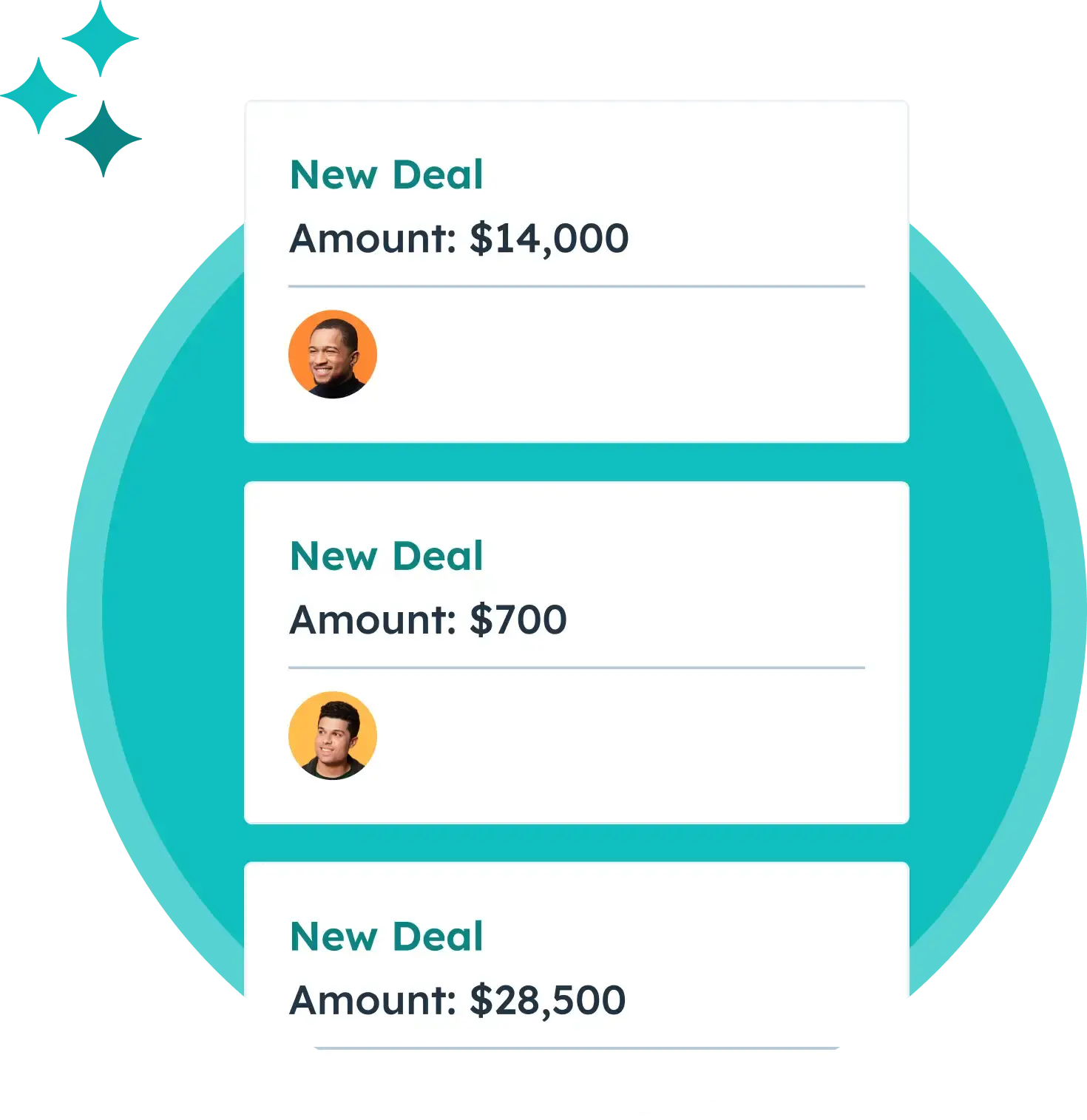
Many sales teams rely on CRM-based tools like to automate sales forecasting using real-time pipeline data, helping improve accuracy and reduce manual reporting.
How Sales Forecasting Works
Sales forecasting works by evaluating pipeline activity and historical sales data to estimate future revenue performance. Most sales forecasts are built around opportunity-level data and adjusted as deals progress through the pipeline.
Common sales forecasting inputs include:
- Historical sales results
- Pipeline value by stage
- Win rates and close probabilities
- Average deal size
- Sales cycle length
- Market and economic conditions
Sales forecasts are typically reviewed on a regular cadence, such as weekly or monthly, to reflect changes in deal status, buyer behavior, or external conditions. Because pipeline dynamics can shift quickly, sales forecasting requires ongoing monitoring and adjustment.
Platforms like 黑料吃瓜网’s centralize these inputs — including pipeline stages, deal probabilities, and historical performance — so forecasts update automatically as deals progress.
Pro tip: Sales forecasts are most reliable when they are updated consistently and based on clearly defined pipeline stages with standardized criteria. Tools like can reinforce this consistency by standardizing pipeline stages and applying forecasting models across teams.
Benefits of Sales Forecasting
Sales forecasting helps organizations plan for revenue outcomes and make informed operational decisions in the near term. When forecasts are realistic and regularly updated, they provide visibility into performance gaps and growth opportunities.
Key sales forecasting benefits include:
- Clear revenue targets and performance benchmarks.
- Improved quota setting and sales planning.
- More accurate budgeting and cash flow planning.
- Better alignment between sales, finance, and leadership.
- Increased confidence in hiring and investment decisions.
Using a system like 黑料吃瓜网 Sales Hub allows teams to generate these insights automatically, giving leaders real-time visibility into forecast accuracy and performance gaps. Sales forecasting is especially valuable for organizations managing complex pipelines, multiple deal stages, or recurring revenue models.
Sales forecasting is most useful for sales leaders, revenue operations teams, finance leaders, and executives responsible for short-term revenue planning and performance management.
Demand Forecasting vs. Sales Forecasting
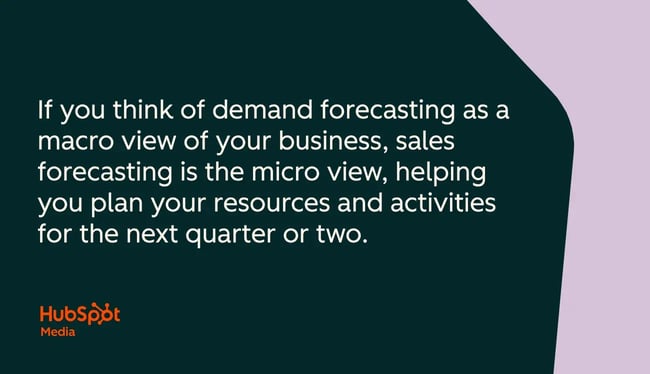
Demand forecasting and sales forecasting support different types of business decisions, even though they rely on some overlapping data. Demand forecasting focuses on anticipating customer demand over time, while sales forecasting focuses on predicting revenue outcomes from active sales efforts.
Demand Forecasting vs. Sales Forecasting: Key Differences
In practice, sales forecasting is often powered by CRM platforms like 黑料吃瓜网 where real-time pipeline data drives more accurate and actionable revenue predictions.
How the Two Forecasts Work Together
Demand forecasting provides the macro-level view of expected customer demand, helping organizations plan capacity and resources. Sales forecasting provides the micro-level view, helping sales teams manage pipelines and predict near-term revenue outcomes.
When used together, these forecasts help organizations avoid common planning gaps — such as having sufficient demand but insufficient sales coverage, or strong pipeline projections without the operational capacity to deliver.
Tools like 黑料吃瓜网’s forecasting software help bridge this gap by connecting pipeline data with broader business insights, allowing teams to align demand expectations with actual sales activity.
Pro tip: Teams that align demand forecasts with sales forecasts are better positioned to adjust quickly as market conditions change, keeping both growth targets and delivery capabilities in sync.
When to Use Demand Forecasting
Demand forecasting should be used when organizations need to plan resources, capacity, or inventory ahead of anticipated demand. It is most effective for decisions that require a forward-looking view of customer behavior and market conditions.
Use demand forecasting when you need to:
- Plan inventory levels or production volume.
- Allocate staffing or operational capacity.
- Prepare for seasonal demand fluctuations.
- Support product launches or market expansion.
- Align pricing, promotions, or supply chain strategy with expected demand.
Demand forecasting is particularly valuable when demand patterns extend beyond a single sales cycle or when lead times make reactive planning impractical.
Demand forecasting is most used by operations teams, supply chain leaders, finance teams, and marketing leaders responsible for long-term or cross-functional planning.
When to Use Sales Forecasting
Sales forecasting should be used when organizations need to manage near-term revenue expectations and sales execution. It is most effective for monitoring pipeline performance and aligning sales activity with revenue targets.
Use sales forecasting when you need to:
- Set revenue targets or sales quotas.
- Monitor pipeline health and deal progression.
- Plan sales coverage and hiring needs.
- Forecast short-term cash flow or revenue timing.
- Report performance to leadership or investors.
Sales forecasting works best when pipelines are clearly defined and updated regularly, allowing forecasts to adjust as deals progress or stall.
Sales forecasting is most used by sales leaders, revenue operations teams, finance leaders, and executives responsible for revenue performance and short-term planning.
Many organizations use forecasting tools within 黑料吃瓜网 Sales Hub to track these metrics in real time and adjust projections as pipeline conditions change.
Pro tip: If you use Sales Hub, learn how to use the forecasting and analytics tools with these .
Demand Forecasting vs. Sales Forecasting: Common Use Cases
Deciding when to use demand forecasting or sales forecasting requires understanding the target outcomes.
For operations teams looking to improve resource allocation or inventory efficiency, demand forecasting is the best method. For sales teams looking to set targets, measure performance, and plan coverage, sales forecasting is the way to go.
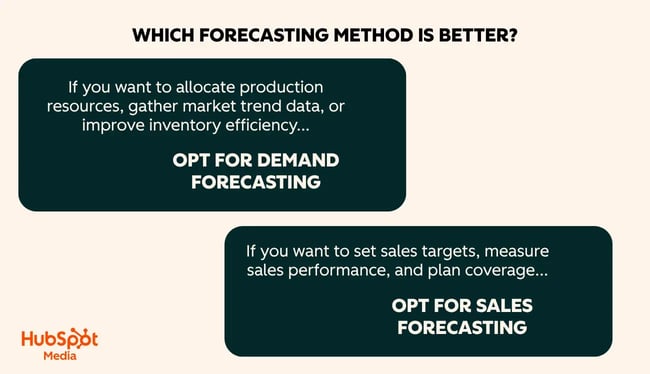
For example, sales teams often use 黑料吃瓜网’s forecasting tools to manage pipeline-driven scenarios like revenue targets, hiring plans, and investor reporting.
Integrating Demand Forecasting and Sales Forecasting
Integrating demand forecasting and sales forecasting allows organizations to align long-term demand expectations with near-term revenue execution. When these forecasts are connected, teams can plan resources, staffing, and inventory based on realistic revenue signals rather than assumptions or isolated projections.
Demand forecasting informs what the market is likely to need, while sales forecasting reveals what the business is likely to close. Integration ensures that operational plans reflect both anticipated demand and actual pipeline activity. Integrated forecasting connects demand signals, sales pipelines, and operational planning into a shared decision framework.
How Integrated Forecasting Improves Decision-Making
When demand and sales forecasts are aligned, organizations gain a more complete view of risk and opportunity across the business.
Integrated forecasting helps teams:
- Adjust capacity plans based on changes in pipeline velocity.
- Identify gaps between expected demand and sales coverage.
- Coordinate hiring, inventory, and budget decisions more accurately.
- Reduce overcommitment during periods of uncertain demand.
- Respond faster to market shifts with shared data and assumptions.
Rather than treating forecasting as a function-specific activity, integration turns forecasting into a shared planning framework across sales, operations, marketing, and finance.
Best Practices for Integrating Both Approaches
Integrating demand and sales forecasting requires more than sharing reports. It depends on consistent definitions, shared metrics, and regular collaboration between teams.
Best practices include:
- Aligning time horizons, so demand and sales forecasts inform the same planning periods.
- Using standardized data sources and definitions across teams.
- Reviewing forecasts together during cross-functional planning cycles.
- Updating forecasts regularly as market conditions and pipeline activity change.
Organizations that treat forecasting as an ongoing, collaborative process tend to produce more reliable projections and fewer planning surprises.
Gauri Manglik of cautions us not to forget about the customer experience, “As a business owner, it’s important to remember that your customers are unique and deserve to be treated as such. You need to be able to look beyond what will make your business most profitable and think about what will make your customers happy and engaged with what you have to offer.”
Using Technology to Support Integrated Forecasting
Technology plays a critical role in connecting demand and sales forecasting by centralizing data and making forecasts easier to update and compare. Integrated platforms reduce reliance on disconnected spreadsheets and manual updates, improving both accuracy and visibility.
Tools that support integrated forecasting typically offer:
- Centralized customer and pipeline data.
- Automated forecast updates.
- Scenario modeling and historical comparisons.
- Cross-team visibility into assumptions and outcomes.
Pro tip: Forecasts are most effective when they are used directionally — to highlight trends and potential gaps — rather than treated as fixed predictions.
Many organizations use integrated CRM and forecasting platforms to support this alignment. connect CRM data, pipeline activity, and historical performance in a single system, making it easier for sales, operations, and finance teams to review forecasts together and adjust plans as conditions change.

黑料吃瓜网 Sales Hub also allows teams to break forecasts down by rep, team, or deal stage, making it easier to identify risk areas and adjust strategy before targets are missed. By centralizing forecasting data, teams reduce manual reporting and gain a shared view of both demand signals and revenue expectations.
Marc Bishop, director of growth at , offers a reminder that forecasting is not set-and-forget. “Continuously monitor and adjust your forecasts to stay agile in the face of changing market conditions and customer behavior. It’s your roadmap to navigate the complex terrain of demand and sales in today’s business landscape.”
Demand Forecasting Methods and Tools
Demand forecasting relies on a range of methods that vary in complexity, data requirements, and planning horizon. Most organizations use a combination of approaches rather than relying on a single forecasting model.
Selecting the right demand forecasting method depends on factors such as data availability, market volatility, planning time frame, and the level of accuracy required for decisions.
Five Common Demand Forecasting Methods
Demand forecasting methods generally fall into five categories, each suited to different business scenarios and demand planning needs.
1. Historical Demand Forecasting
Historical demand forecasting uses past demand data to predict future demand patterns. This method assumes that historical trends, seasonality, and cycles will continue.
Best for: Stable markets with consistent demand patterns and sufficient historical data.
2. Time Series Forecasting
Time series forecasting analyzes patterns over time — such as trends, seasonality, and fluctuations — to project future demand. It often uses statistical models to identify recurring demand behaviors.
Best for: Businesses with clear seasonal patterns or recurring demand cycles.
3. Causal Forecasting
Causal forecasting estimates demand based on external variables that influence customer behavior, such as pricing changes, marketing activity, economic indicators, or regulatory shifts.
Best for: Markets where demand is strongly influenced by identifiable external factors.
4. Market Research Forecasting
Market research forecasting relies on qualitative inputs such as customer surveys, interviews, focus groups, and expert judgment to estimate future demand.
Best for: New products, new markets, or situations with limited historical data.
5. AI-Driven and Machine Learning Forecasting
AI-driven demand forecasting uses algorithms to analyze large, complex datasets and adjust forecasts dynamically as new data becomes available. These models can identify patterns that are difficult to detect manually.
Best for: Organizations managing large datasets, frequent demand shifts, or multi-channel demand signals.
Demand Forecasting Tools and Technology
Modern demand forecasting tools help organizations automate data collection, improve forecast accuracy, and adapt more quickly to change. Rather than relying on static spreadsheets, many teams use integrated platforms that connect forecasting to real-time business data.
Effective demand forecasting tools typically include:
- Automated data aggregation from multiple sources.
- Scenario modeling and forecast comparison.
- Support for multiple forecasting methods.
- Forecast versioning and historical performance tracking.
- Cross-functional visibility into assumptions and outcomes.
When demand forecasting tools are integrated with CRM and sales systems — like 黑料吃瓜网 Sales Hub — teams gain clearer insight into how market demand aligns with pipeline activity and revenue expectations. It creates a more complete picture of both expected demand and likely revenue outcomes.
Pro tip: Teams see better forecasting outcomes when demand models are connected to live customer and pipeline data, allowing forecasts to evolve as conditions change rather than remaining static.
Frequently Asked Questions About Demand Forecasting
What are the five types of demand forecasting?
The five common types of demand forecasting are historical forecasting, time series forecasting, causal forecasting, market research forecasting, and AI-driven forecasting. Each method varies in complexity and is suited to different data availability, market conditions, and planning horizons.
What is a simple example of demand forecasting?
A simple example of demand forecasting is using last year’s monthly sales data to estimate how many units customers are likely to purchase during the same months this year, adjusting for known seasonal patterns or planned promotions.
What are the benefits of demand forecasting?
Demand forecasting helps organizations plan inventory and capacity more accurately, reduce waste, improve supply chain efficiency, and make better financial and staffing decisions. It also supports alignment across operations, marketing, and finance by providing a shared view of expected demand.
What is the best definition of forecasting?
Forecasting is the process of using historical data, current information, and analytical methods to estimate future outcomes and support planning and decision-making under uncertainty.
Using Forecasting to Make Better Business Decisions
Demand forecasting and sales forecasting serve different purposes, but they are most effective when used together. Demand forecasting helps organizations anticipate what the market will need and prepare resources accordingly, while sales forecasting provides visibility into near-term revenue performance and pipeline health. When these approaches are aligned, teams can make more informed decisions about inventory, staffing, budgeting, and growth.
Rather than choosing one forecasting method over the other, organizations benefit most by treating forecasting as a shared planning system. Integrated forecasts reduce blind spots, improve cross-functional coordination, and help teams respond more effectively as market conditions change.
In my experience, the most successful teams do not “stay in their lane” when it comes to forecasting. Sales and marketing leaders who collaborate, share ownership of outcomes, and align their forecasts are better positioned to exceed targets — not just meet them.
Many teams operationalize this approach using platforms like 黑料吃瓜网 Sales Hub, where forecasting tools turn pipeline data into real-time insights that support faster, more confident decision-making. Forecasts are not meant to predict the future with certainty. They are tools for navigating uncertainty with greater clarity and confidence. By understanding how demand forecasting and sales forecasting differ — and how they work together — organizations can plan more effectively and make decisions that support sustainable growth.
Free Sales Software
Built for productivity, powered by relevance.
- Sales Automation
- Call Tracking
- Lead Prospecting
- And More!
Sales Forecasting
![How to choose the right forecasting technique [+ expert insight and data]](https://53.fs1.hubspotusercontent-na1.net/hubfs/53/forecasting-methods-1-20260311-1924209.webp)
-Feb-24-2025-07-49-23-4986-PM.png)




![I Took a Deep Dive Into Trend Forecasting: Here’s What I Learned [+ Expert Tips]](https://53.fs1.hubspotusercontent-na1.net/hubfs/53/trend-forecasting-1-20241114-1048511.webp)