
In my 16 years in sales, I’ve seen sales pitches succeed when they begin with the buyer’s problem and fail when they turn into product monologues. A sales pitch should start or advance a conversation by giving the buyer a relevant reason to keep talking.
Today’s buyers often form strong opinions before speaking with a seller. In a , the winning vendor appeared on the buyer’s Day One shortlist 95% of the time. Sellers, therefore, need to contribute context and perspective that buyers cannot get from independent research alone, especially when cold outreach competes for attention.
In this guide, I’ll explain how to structure, write, and deliver an effective sales pitch. I’ll also share nine channel-specific sales pitch examples for phone calls, voicemail, email, presentations, elevator pitches, video, social media, websites, and follow-up.
Table of Contents
What is a sales pitch?
A sales pitch is a short, persuasive message designed to start or advance a sales conversation. It connects a buyer’s problem to a relevant outcome and gives the buyer a reason to continue the discussion.
A sales pitch differs from a sales presentation in length, depth, and immediate goal. A pitch earns attention or a next step; a presentation explores the problem, solution, evidence, and proposed plan in greater detail.
Strong pitches communicate a clear value proposition without trying to answer every possible question. An elevator pitch is one short type of sales pitch, but not every sales pitch must fit within an elevator ride.
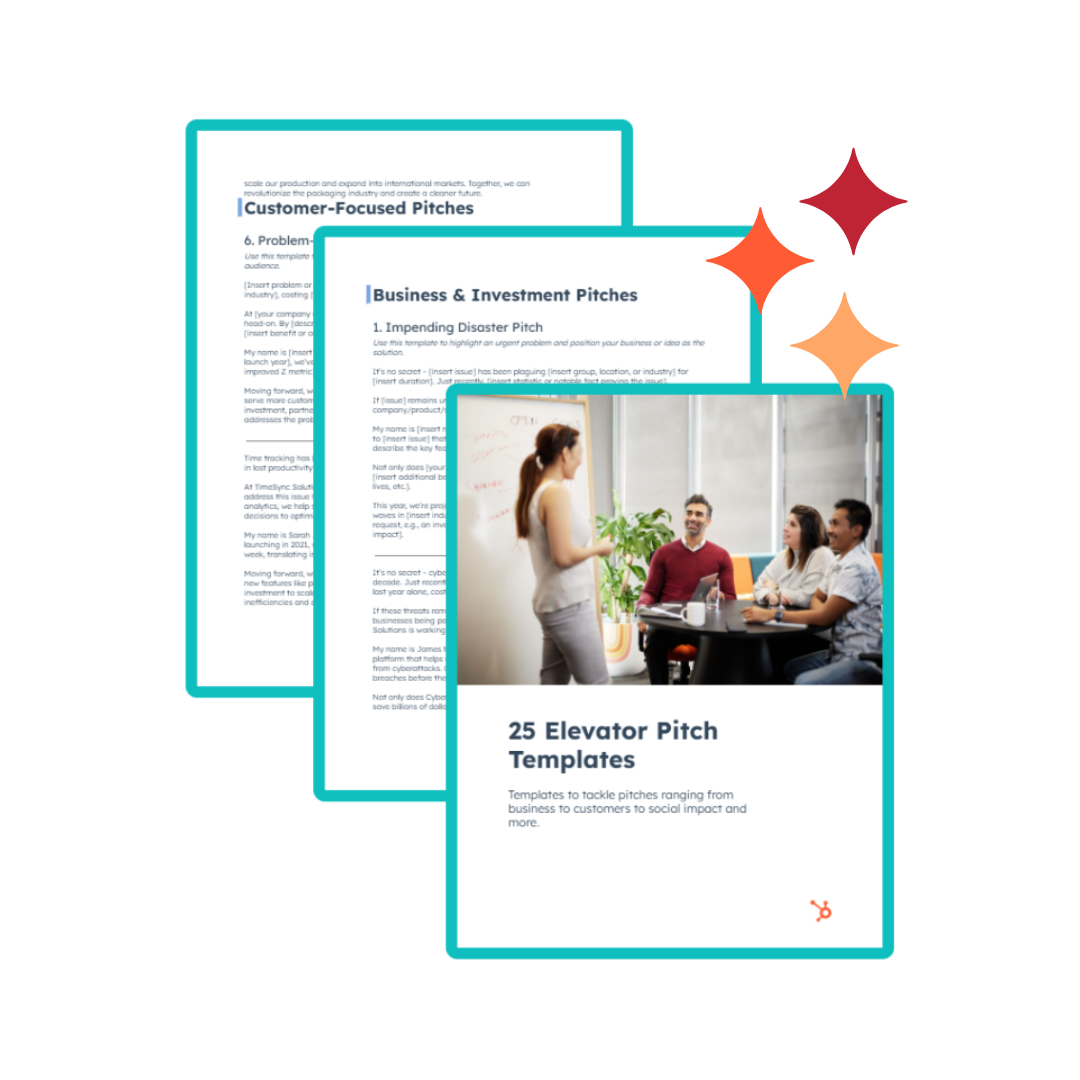
Download Now: Free Elevator Pitch Templates
E-pitch templates to better sell your product, fund your business, or network.
- Business and investment pitches
- Personal branding pitches
- Customer-focused pitches
- And more!
Download Free
All fields are required.
Form not available
You're all set!
Click this link to access this resource at any time.
What is a product pitch?
A product pitch focuses on one product or service. It explains the customer problem the product addresses, the outcome it can deliver, how it works, and why it fits the buyer’s situation. Strong product marketing gives sellers the positioning and customer evidence needed to make that explanation clear.
In my own product pitches, I go deeper into how the product works and connect its capabilities to the customer’s pain points and desired results.
A broader business pitch may present an organization’s full range of services rather than one offering. For example, a consulting firm might pitch its overall expertise instead of one service, while a software seller might focus on a specific product such as .
How to Structure a Sales Pitch
A strong sales pitch structure moves from relevance to value, differentiation, evidence, and conversation. The channel may change the pitch’s length and format, but the underlying sequence remains useful across the different types of sales pitches.
The six-part structure below helps sellers organize a pitch without turning it into a rigid script.

1. Start with a problem-led opener.
A problem-led opener earns attention by showing that the seller understands a relevant challenge, trend, or priority. Leading with a product description or a list of credentials gives the buyer little reason to listen.
Three reliable opening approaches are:
- A personal anecdote that reflects the buyer’s day-to-day reality.
- A statistic that challenges an assumption.
- A thoughtful question about a current process or result.
The opening should match the buyer’s industry, role, and immediate priorities. Sellers can also strengthen the opening by explaining the consequence of leaving the problem unresolved. See these additional techniques for opening a sales call.
Pro tip: Introduce the risk of inaction without exaggerating it. The buyer should understand what is at stake, not feel manipulated.
2. Deliver a clear, buyer-centric value statement.
A buyer-centric value statement explains the outcome the buyer can achieve. It avoids feature-heavy “we” language and positions the buyer, rather than the seller, as the central character.
Compare these two fictional fitness-brand examples:
- “Our weightlifting program offers a seven-day shortcut to getting shredded.”
- “Many work-from-home parents want to build strength without spending every evening in the gym. Our program gives them a focused routine they can complete in 30 minutes.”
The second statement works because it reflects the customer’s situation and desired result. As B2B sales expert explains, effective outreach encourages prospects to reflect on themselves and their own practices rather than merely thinking about the seller’s brand.
Keep the statement concise, specific, outcome-focused, and free of jargon.
Pro tip: The best sales pitches answer “Why should I care?” without sounding like a product advertisement. A useful pitch can feel less sales-focused because it begins with the buyer’s reality.
3. Explain what makes the solution different.
Differentiation explains why a buyer should choose one approach over the available alternatives, including the option to make no change. A useful point of differentiation identifies when and for whom the solution is the strongest fit.
Customer indecision deserves attention alongside named competitors. Matthew Dixon and Ted McKenna’s The JOLT Effect examines how fear of making the wrong decision can prevent an interested buyer from acting.
Buyers also compare several options. , B2B buyers evaluated an average of 5.1 vendors. Clear differentiation helps buyers understand why one option belongs at the top of that list.
Pro tip: Do not attack competitors. Explain the circumstances in which the proposed solution is the right fit and acknowledge when another approach may fit better.
4. Add proof points.
Proof points show that the seller’s claims are credible. A verified customer result, benchmark, demonstration, or independently supported statistic is more persuasive than a general promise to “improve efficiency.”
|
|
Question it answers |
Goal |
|
Proof points |
“Can it work?” |
Establish credibility with verified evidence. |
|
Customer stories |
“Can it work for someone like me?” |
Help the buyer picture a comparable outcome. |
Use the most relevant evidence available rather than cramming several statistics into one pitch. State the population, timeframe, and result accurately whenever the proof depends on quantitative research.
5. Tell a relevant customer story.
A customer story connects the evidence to a situation the buyer recognizes. It should explain the customer’s initial problem, the change the customer made, and the verified outcome.
The customer should remain the hero of the story. The product’s role should emerge through the customer’s progress rather than dominate the narrative.
Pro tip: Choose a customer with a similar industry, business model, team structure, or challenge. Relevance usually matters more than the customer’s name recognition.
6. Close with an open-ended question.
An open-ended close gives the buyer room to react and helps the seller understand the buyer’s priorities. It advances the conversation without forcing an immediate calendar commitment.
Useful closing questions include:
- “How does this compare with what your team does today?”
- “Is this a challenge your team is seeing right now?”
- “Would it be useful to see how another company approached this?”
- “Where does this issue sit among your current priorities?”
The closing question should connect directly to the problem and evidence already presented.
Pro tip: When possible, help the buyer quantify the status quo through lost time, avoidable cost, missed revenue, or another relevant consequence. Use figures the buyer can verify rather than speculative estimates.
Download Now: Free Elevator Pitch Templates
E-pitch templates to better sell your product, fund your business, or network.
- Business and investment pitches
- Personal branding pitches
- Customer-focused pitches
- And more!
Download Free
All fields are required.
Form not available
You're all set!
Click this link to access this resource at any time.
How to Write a Sales Pitch
Writing a sales pitch requires six decisions: whom to address, how much to say, which language to use, what to personalize, which outcome to emphasize, and what evidence to include. The writing process should remain separate from delivery technique, objection handling, and follow-up.

1. Research the prospect.
Prospect research makes a pitch relevant. Start with the ideal customer profile (ICP), then connect the proposed solution to the specific account’s goals, challenges, growth initiatives, and competitive environment.
Useful research sources include company announcements, earnings reports, executive interviews, LinkedIn posts, funding announcements, job listings, and industry news.
For example, a company hiring across several departments may be preparing for rapid growth. An HR technology seller could connect the pitch to the onboarding bottlenecks and early productivity losses that often accompany expansion.
can research accounts, monitor buying signals, research enrolled accounts and surface relevant contacts, and draft personalized outreach. Reps can review that research alongside the company’s sources before deciding which insight belongs in the pitch.
Pro tip: In a complex sale, speak with people who experience the operational problem before presenting to senior leadership. Their perspective can help a seller arrive with an informed hypothesis rather than a list of questions the company’s public materials already answer.
2. Keep it short.
A short pitch gives the buyer enough information to understand the problem, opportunity, and reason to respond. It does not attempt to answer every possible question.

In a 2025 analysis of more than 28 million cold emails, found that messages of 100 words or fewer performed best. The accompanying data shows a 2.6% reply rate for emails between 51 and 100 words, compared with 1.6% for emails between 151 and 200 words.
The appropriate length still depends on the channel. A presentation can contain more detail than an initial email, but each pitch should make one coherent point and create a reason for the buyer to continue.
3. Make it clear.
Clarity helps buyers understand what the seller offers, whom it serves, and why it matters. According to April Dunford, clearer positioning helped a former employer double revenue in two months while she served as vice president of marketing. Three tests can improve clarity.
- Simple language: Use familiar words and direct sentences.
- Concrete language: Replace jargon, vague acronyms, and inflated claims with observable details.
- The outsider test: Ask someone outside the industry to explain what the product does and why a buyer would choose it.
Pro tip: Review real sales conversations for repeated questions, objections, and misunderstood terms. can capture supported call data in 黑料吃瓜网 Smart CRM and surface recurring objections, competitive themes, and coaching opportunities.
Once the pitch consistently resonates, avoid rewriting it without a reason. As positioning expert explains, a pitch reflects the underlying positioning. Revisit it when the market, product, buyer, or competitive landscape changes.
4. Personalize the message.
Personalization shows that the seller understands the prospect’s professional context. It should do more than mention a hobby, school, or personal detail found online.
A personalized pitch connects an account-specific signal to a business implication. For example, a funding announcement matters only if the seller explains what the funding may require the company to do next.
The audience may also be a buying group rather than one person. Different participants evaluate different concerns:
- CFOs and budget holders assess cost, risk, and long-term value.
- Legal and compliance teams assess security and contractual exposure.
- End users assess usability and day-to-day impact.
- Executive sponsors assess strategic outcomes.
- Internal champions need credible evidence they can share with colleagues.
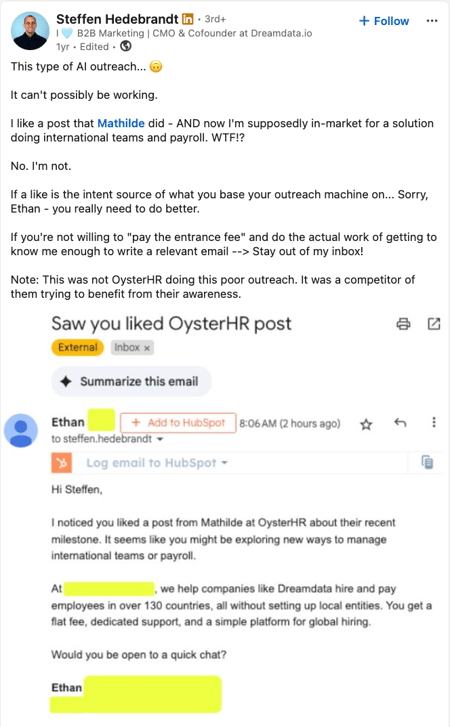
can turn effective pitch emails into reusable templates while allowing reps to customize the message for each recipient.
5. Show the outcome.
An outcome explains what becomes easier, faster, less expensive, safer, or more profitable after the buyer makes a change. Features become meaningful only when the pitch connects them to that result.
Instead of saying that software automates reporting, explain that it gives managers more time for coaching and helps them identify problems sooner. Instead of listing dashboard functions, explain which decision the dashboard helps a leader make.
Use outcomes the seller can substantiate. A hypothetical estimate should be labeled as an estimate, while a customer result should match the underlying case study.
6. Add proof.
Proof gives the buyer a reason to believe the outcome is achievable. The strongest proof may be a verified customer result, a relevant case study, a product demonstration, independently published research, or an implementation example.
Match the evidence to the claim. A general customer-satisfaction statistic does not prove a specific productivity result, and a result from an enterprise deployment may not reflect a small business’s likely experience.
Use one strong proof point when it makes the argument. Additional statistics should earn their place rather than crowd the pitch.
Tips for Delivering a Winning Sales Pitch
Delivering a sales pitch well requires more than reading polished copy. The seller must adapt the message to the audience, speak naturally, make the central idea memorable, connect the problem to its consequences, and prepare for the buyer’s response.
1. Tell a story.
A sales story gives the buyer a simple progression to follow: someone wants an outcome, encounters an obstacle, makes a change, and reaches a better result. The story can be one sentence or a full customer example.
One useful approach is : identify the customer’s problem, explain the solution, and describe the successful outcome.
For example: Many growing companies lose customer context across disconnected tools. unifies customer information, conversations, and tools so teams can act from the same source of truth.
2. Personalize every pitch.
Personalization should continue during delivery. A seller may begin with one hypothesis, then adjust the examples, evidence, and questions as the buyer reveals more about the situation.
For a finance leader, emphasize cost, risk, and expected value. For an end user, emphasize workflow and day-to-day impact. For an executive sponsor, connect the solution to a strategic outcome.
Personalization does not require improvising the entire pitch. Keep the core positioning consistent and adapt the evidence and framing that make it relevant to each participant.
Download Now: Free Elevator Pitch Templates
E-pitch templates to better sell your product, fund your business, or network.
- Business and investment pitches
- Personal branding pitches
- Customer-focused pitches
- And more!
Download Free
All fields are required.
Form not available
You're all set!
Click this link to access this resource at any time.
3. Practice until it feels natural.
Practice helps sellers deliver the pitch fluently without sounding memorized. Begin with internal role-playing, then test the message in appropriate conversations and refine it based on observable reactions.
A practical rollout can begin with one or two experienced reps. After each conversation, gather specific feedback:
- Which point created curiosity?
- Which word or phrase caused confusion?
- Which objection appeared repeatedly?
- Which question moved the conversation forward?
Existing customers can provide useful feedback, but their established knowledge of the company differs from a new buyer’s perspective. Include feedback from qualified prospects when evaluating whether the opening and positioning work without prior brand familiarity.
4. Create a wow moment.
A wow moment is the idea the buyer is most likely to remember. It may be a counterintuitive insight, a relevant customer result, a distinctive capability, or a newly visible cost of the status quo.
Focus on what surprises the buyer rather than what impresses the product team. Audit sales conversations for moments when prospects pause, ask follow-up questions, or repeat an idea in their own words.
Strategic narrative expert recommends asking customers, “How have we changed your life?” The answers can reveal which result deserves the most attention in the pitch.
5. Lead with emotion, then support it with facts.
Buyers need to understand why a problem matters before a list of features or statistics will feel relevant. Name the human or business consequence first, then support that consequence with evidence. Consider this fictional coaching example:
- Initial request: “We need better visibility into sales coaching.”
- Surface response: A seller immediately demonstrates a coaching dashboard.
- Deeper problem: Managers spend so much time reconstructing calls that coaching happens late and inconsistently.
- Evidence: The seller shows a verified customer result demonstrating how a similar team reduced review time and increased coaching frequency.
6. Prepare for objections and follow-up.
Objections may reflect uncertainty about value, budget, timing, implementation, risk, or available alternatives. Anticipate the most common concerns and prepare relevant proof points, customer stories, implementation examples, and questions.
When an objection arises, pause before defending the product. Ask a question that clarifies what is behind the concern.
Pro tip: gives reps access to scripts, processes, and structured guidance within the sales record. Teams can use playbooks to standardize objection-handling guidance while leaving room for a natural conversation.
Preparation should also include the next contact. A follow-up can recap the buyer’s concern, supply one useful resource or proof point, and suggest a simple next step. See these additional tips for winning the next sales pitch.
9 Sales Pitch Examples to Steal
The following sales pitch examples show how the same principles work across nine channels. Each example includes adaptable wording and a brief explanation of why the approach works.
1. Phone Sales Pitch
A phone sales pitch is a brief spoken message that establishes relevance, identifies a likely challenge, and invites the prospect into a conversation. Because the exchange happens in real time, the seller can respond to the prospect’s questions and adjust the message.
In my experience, reaching a prospect by phone can feel like winning the lottery because I can establish a personal connection immediately.
Phone pitches work in cold calls, warm calls with existing leads, and follow-up conversations. The following fictional opener shows the structure:
“Hi Jordan, this is Maya from Acme Analytics. I saw Northstar is expanding its sales team, and companies hiring quickly often struggle to keep coaching consistent. We recently helped a similar software company standardize call reviews across its managers. How are you handling coaching as the team grows?”

What we like: The opener gives a clear reason for the call, connects a visible business signal to a likely challenge, and ends with a question the prospect can answer without committing to a meeting.
Pro tip: Use these for additional structures and opening language.
2. Voicemail Sales pitch
A voicemail sales pitch is a short message that explains why the seller called and gives the prospect a reason to check another channel or respond. The strongest voicemail creates curiosity without compressing an entire product presentation into the recording.
I keep a voicemail pitch ready because even a well-planned phone call can turn into a game of phone tag.
The following fictional script is brief and specific:
“Hi Jordan, Maya from Acme Analytics. I noticed Northstar is adding several sales managers. I sent an email with a two-page coaching benchmark that may be useful as the team grows. No need to call back—just reply to the email if you’d like the full comparison.”

What we like: The message identifies the caller, connects the outreach to a timely business signal, and directs the prospect to one low-effort next step.
Pro tip: A voicemail can support an email rather than demand a callback. Keep the message focused on the reason the accompanying email is worth opening.
For more examples, use 贬耻产厂辫辞迟’蝉 .
3. Email Sales Pitch
An email sales pitch is a concise, personalized message that connects a relevant prospect signal to one problem, one outcome, and one easy response. Email gives the prospect time to review the pitch, but it also requires the seller to earn attention in a crowded inbox.
Avoid sending the same generic message to every prospect. The research, proof point, and call to action should reflect the recipient’s situation. The following fictional example is under 100 words and includes one proof point:
Subject: Sales coaching at Northstar
Hi Jordan,
I saw Northstar is adding several sales managers. Acme Analytics recently helped a comparable software company cut call-review time by 40% while giving every manager the same coaching framework.
Open to seeing the one-page workflow they used?
Maya

What we like: The email connects the pitch to a visible company development, includes one relevant result, and asks whether the prospect wants a useful resource rather than immediately requesting a meeting.
Pro tip: Turn effective messages into reusable starting points, then personalize the research and evidence for each account. 黑料吃瓜网 also offers .
4. Sales Presentation Pitch
A sales presentation pitch uses a deck or another visual format to explain the problem, cost of inaction, proposed solution, evidence, and next steps in greater depth than an initial sales pitch.
When I have the opportunity to pitch in person, I prepare a sales deck that supports the conversation rather than replacing it. Sellers can build decks in PowerPoint, Google Slides, Keynote, or with . The following fictional presentation language shows a concise progression:
“Northstar’s managers currently spend 12 hours each week reconstructing calls before they can coach a rep. As the team grows, that delay makes coaching less consistent and lets problems stay hidden longer.
Acme Analytics puts call reviews, coaching notes, and follow-up actions in one workflow. A comparable software team reduced review time by 40% during its first quarter.
Today, I’ll show the current workflow, the proposed process, the result from that customer, and the three steps required for a pilot.”
The offers a visual example. BrightCarbon created an animated version for live delivery and a static PDF that could be shared afterward.

What we like: The deck uses visuals to explain the shopper journey and gives the presenter a structured story to follow. Its animated and static formats also support both live delivery and post-presentation review.
After sharing a proposal or deck, can show when prospects open, view, or share the document.
Pro tip: 贬耻产厂辫辞迟’蝉 can provide a starting point for a new deck.
5. Elevator Pitch
An elevator pitch is a short, memorable explanation of whom the seller helps, which problem the offer solves, and what outcome it enables. The wording should be easy to remember and repeat without sounding rehearsed.
I like to keep a quick pitch ready for networking events, conferences, interviews, and unexpected sales opportunities.
The following fictional example leads with the outcome:
“Acme Analytics helps fast-growing sales teams coach consistently as they add new reps and managers. It brings call reviews, coaching notes, and follow-up actions into one workflow, so managers spend less time reconstructing conversations and more time helping reps improve.”

What we like: The pitch identifies the audience, problem, approach, and results in a few sentences. It also avoids beginning with a long company history or feature list.
Pro tip: For more structures that work in sales, networking, and investment settings, use 贬耻产厂辫辞迟’蝉 .
Download Now: Free Elevator Pitch Templates
E-pitch templates to better sell your product, fund your business, or network.
- Business and investment pitches
- Personal branding pitches
- Customer-focused pitches
- And more!
Download Free
All fields are required.
Form not available
You're all set!
Click this link to access this resource at any time.
6. Video Sales Letter
A video sales letter presents a sales pitch through recorded narration and visuals. The format can demonstrate a product, add personal context, and communicate tone in ways that a text-only message cannot.
A personalized video should explain why the seller recorded it for that specific prospect. The following fictional opening uses the medium to create context:
“Hi Jordan — I recorded this because I noticed Northstar is adding several sales managers. I’ll show you the two points in a coaching workflow where fast-growing teams usually lose consistency, then walk through how one shared review process addresses them.”
Glorify’s background-removal video sales letter presents the problem visually, demonstrates the product, and explains the solution.
What we like: The video introduces a recognizable ecommerce problem immediately, uses animation and audio to hold attention, and lets viewers see how the tool works.
7. Social Sales Pitch
A social sales pitch is a relevant, value-first message sent through a social platform as part of an existing interaction or relationship-building process. It should feel like a continuation of the conversation rather than an abrupt product advertisement. This fictional example follows a prospect’s post:
“Jordan, your post about keeping coaching consistent during a hiring push stood out. We recently mapped the three workflow gaps that create the most review delays for growing sales teams. I’m happy to send the one-page breakdown if it would be useful.”
This approach supports social selling by contributing something relevant before asking for time.

What we like: The message begins with the prospect’s existing conversation, offers a specific resource, and lets the prospect decide whether to continue.
Pro tip: Use 贬耻产厂辫辞迟’蝉 for additional relationship-building techniques.
8. Website Sales Pitch
A website sales pitch is the core message that explains the customer problem a company solves, the outcome it delivers, and the evidence that makes the promise credible. The message should help a visitor understand the offer and move toward a relevant action. The following fictional homepage copy includes all three elements:
Sales coaching should not break as the team grows.
Acme Analytics gives every sales manager one place to review calls, record coaching decisions, and track follow-up actions. Managers spend less time reconstructing conversations and more time helping reps improve.
Rated 4.8 out of 5 by more than 300 verified reviewers.
The current demonstrates another approach by connecting the company’s origins in sound-based technology to its present proximity-engagement products.

What we like: The page explains where the company started, how its offering evolved, and which broader customer problem the technology now addresses.
9. Follow-Up Pitch
A follow-up pitch reconnects the message to an earlier conversation, adds something useful, and proposes a simple next step. It should move the discussion forward rather than repeat the original pitch.
When a prospect does not respond, I use the follow-up to supply new context or evidence instead of sending another version of “just checking in.” The following fictional example references the earlier discussion and adds value:
Subject: Coaching workflow from our conversation
Hi Jordan,
Thanks again for explaining how Northstar’s managers review calls today. I pulled together the two-minute checklist I mentioned, including the handoff that tends to create the longest delay.
Would it be useful to compare it with your current process next week?
Maya
Follow-up can happen by phone or email, depending on the prior conversation and the prospect’s preference.

What we like: The message reminds the prospect where the conversation left off, provides the promised resource, and suggests one easy next step.
Pro tip: 贬耻产厂辫辞迟’蝉 can provide a starting structure, but each message should reflect the previous interaction.
Why a Short Sales Pitch Is a Good Pitch
A short sales pitch makes the message easier to understand and gives the buyer room to respond. The nine examples above each focus on one problem, one outcome, and one next step instead of trying to complete the entire sales process at once.
Brevity is not a universal two-minute rule. The appropriate length depends on the channel, the buyer’s existing knowledge, and the purpose of the conversation. Remove filler, company history, and secondary features, then stop once the buyer has enough information to react. These additional sales-pitch delivery tips can help sellers decide what to emphasize.
Frequently Asked Questions About Sales Pitch Examples
What is the 3-3-3 rule in sales?
In this guide, the 3-3-3 rule is a simple way to prepare a pitch: identify three possible attention hooks, three ways to frame the buyer’s problem, and three concise points that explain the solution’s value. The seller then selects the most relevant option from each group for the final message.
The framework prevents the pitch from becoming a feature list while giving the seller several ways to adapt the message to the buyer.
What are the 5 key elements of a pitch?
The five key elements of a sales pitch are the buyer’s problem, a clear value proposition, a relevant differentiator, credible proof, and a question-based close. Together, those elements explain why the issue matters, what outcome is possible, why the proposed option fits, why the buyer should believe the claim, and how the conversation can continue.
What is a sales pitch in one sentence?
A sales pitch is a brief, buyer-focused message that connects a specific problem to a relevant outcome and gives the prospect a reason to continue the conversation.
What makes a great sales pitch example?
A great sales pitch example identifies a specific buyer problem, describes a meaningful outcome, includes credible evidence, and closes with a low-friction question or next step.
The example should also fit its channel. A voicemail may create curiosity in 20 seconds, while a presentation may develop the same message through visuals, customer evidence, and a proposed plan.
A sales pitch is a conversation starter, not a close.
The best sales pitches across every channel share one trait: they give the buyer a reason to keep talking. Whether you’re leaving a voicemail, sending a cold email, or presenting to a buying group, the structure stays the same: lead with the buyer’s problem, connect it to a meaningful outcome, and close with a question that opens the door.
Building that discipline at scale requires the right tools. Sales Hub gives teams everything needed to research prospects, personalize outreach, standardize objection-handling with playbooks, and track which messages actually move deals forward — all connected to the same CRM your whole team works from. Start with one strong pitch, test it, and refine it. The nine examples above give you the raw material; the next conversation is where it gets sharp.
Editor’s note: This post was originally published in June 2019 and has been updated for comprehensiveness.
Download Now: Free Elevator Pitch Templates
E-pitch templates to better sell your product, fund your business, or network.
- Business and investment pitches
- Personal branding pitches
- Customer-focused pitches
- And more!
Download Free
All fields are required.
Form not available
You're all set!
Click this link to access this resource at any time.
Sales Pitch

![23 elevator pitch examples to inspire your own [+ templates & expert tips]](https://53.fs1.hubspotusercontent-na1.net/hubfs/53/elevator-pitch-examples-1-20260802-8635889-1.webp)
![12 best sales presentations to inspire your sales deck [+ 5 tips]](https://53.fs1.hubspotusercontent-na1.net/hubfs/53/sales-presentation-guidelines-1-20251024-8016063.webp)
.png)


.jpg)

.jpg)