


Customer experience (CX) ROI is the financial return your business generates from investing in how customers interact with your brand. It’s one of the most powerful levers for sustainable business growth and one of the hardest things to explain to a skeptical CFO.

Without proof that customer experience optimization efforts are working, teams are asking leadership to keep funding a program without clear evidence.
This guide walks through how to define and calculate CX ROI, connect it to the financial metrics your leadership team actually cares about, and use AI-powered tools to measure and improve it over time.
What is customer experience ROI?
Customer experience ROI, often shortened to CX ROI, measures the financial return a business earns from investments in improving customer interactions.
In simple terms, it answers one question: Are our CX efforts paying off?
The formula itself is straightforward: (Financial gains ? CX investment) / CX investment x 100. The hard part is identifying what counts as a benefit, and then tracing it back to your CX efforts.
CX metrics matter to leadership because they transform a traditionally “soft” function into a measurable business driver.
If a team can show that a 10-point increase in Net Promoter Score (NPS) correlates with a 5% increase in retention, it has made a financial argument, not just a customer satisfaction one. These connections are what turn CX from a support function into a driver of real business outcomes.
7 Smart Customer Success Playbooks
Step-by-step guidance, proven strategies, and industry best practices to help you overcome challenges and achieve remarkable results.
- Execute a churn mitigation plan
- Highlight customer progress
- Reengage a disengaged customer
- And more!
Download Free
All fields are required.
Form not available
You're all set!
Click this link to access this resource at any time.
Financial Benefits of Investing in CX
The business impact can be significant. According to Bain & Company, a — a return driven largely by the compounding value of loyal customers who spend more, refer others, and cost less to serve
Customer experience leaders outperformed the broader market by relative to the S&P 500 Index, generating returns 7.8 times those of CX laggards over 18 years, according to Watermark Consulting.
On the cost side, CX investment pays off through lower acquisition costs (happy, loyal customers refer new customers), reduced support volume (fewer complaints), and more efficient operations.
Non-Financial Benefits That Still Move the Needle
Not every return on experience shows up directly in revenue. Brand reputation, employee morale, and customer trust are harder to quantify but have real downstream financial impact.
According to , consumers are 3.0 times more likely to recommend and 2.2 times more likely to purchase from an organization after a highly satisfying experience compared to an unsatisfying one.
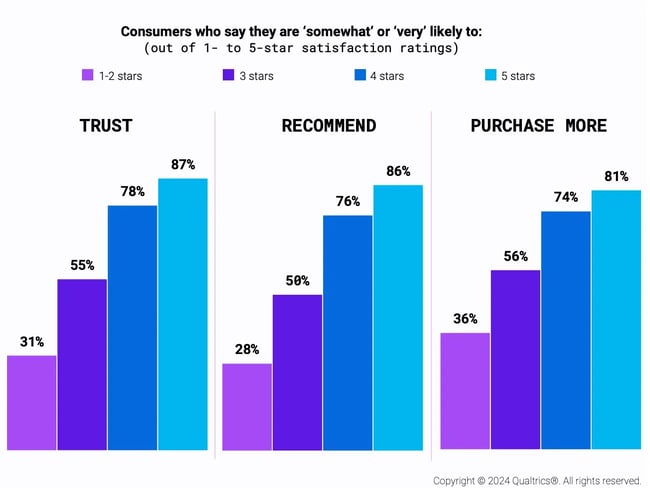
Satisfied customers don’t just stick around — they actively grow your business for you. Word-of-mouth advocacy reduces your acquisition costs and shortens sales cycles. Employee morale improves when teams see that their CX work has a visible impact, reducing turnover costs.
The cost of poor CX is measurable, as well. XM Institute estimates that $ will be at risk due to poor customer experiences in 2025.
And according to Emplifi’s , 70% of customers will abandon a brand after just two bad experiences.
The return on experience isn’t just what you gain from great CX; it also shows up in what you protect by not letting bad CX quietly drain revenue.
How to Prove the ROI of Customer Experience to Leadership
Connecting customer experience metrics to financial data can create more questions than answers. Does answering emails faster actually help keep customers longer? How much more would a customer spend if you streamlined your checkout?
These questions can be difficult to answer, but there are practical ways to build the case. Here’s how to start:
1. Calculate the company’s current customer lifetime value and churn rate.
Before arguing for an expansive budget for a customer experience strategy, the first step is showing leadership where the revenue gaps exist. Two metrics do that better than anything else: customer lifetime value (CLV) and churn rate.
CLV shows how much revenue a single customer generates over their relationship with your business. Churn rate tells how many a brand is losing in a given period.
If a company is churning 15 customers a month, those customers have a short lifetime value, which is a direct hit on revenue potential. These two numbers set the stage for showing what’s possible with better CX investment.
2. Collect feedback from customers who’ve churned and use this data as a benchmark.
Once you know how many customers you’re losing, the next question is why. Collecting customer feedback from exit surveys, churn interviews, and canceled account data can all surface hard evidence that your CX program needs more investment.
If customers are leaving because competitors offer better service, that’s a direct case for CX spending. If they’re leaving over price, CX is still your answer — because nearly will pay more for a better experience.
Use c to capture qualitative signals, and score them with:
- Customer Satisfaction Score (CSAT)
- Net Promoter Score (NPS)
- Customer Effort Score (CES)
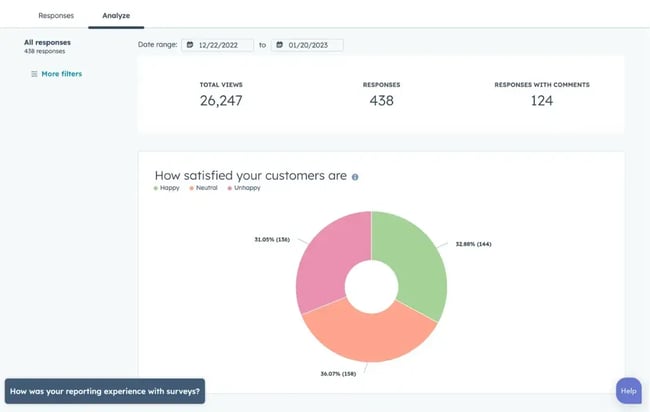
Once you have baseline scores, you can track changes over time and connect improvements to shifts in retention and revenue.
3. Calculate how much your company would earn if you retained even 1, 5, or 10 more customers per month.
This step is the most important in CX ROI measurement. Once the gaps in customer lifetime value or customer churn rate are identified, it’s possible to calculate additional revenue or profit. That metric is important because it shows how customer experience can directly influence revenue.
Showing the potential itself in the short term isn’t enough. To give leadership a more complete view of the revenue impact of exceptional customer experience, consider calculating how much more money the business would earn per quarter and per year if it retained just 1 to 10 more customers. In addition, consider calculating the revenue potential further into three, five, and even ten years.
Multiplying the potential revenue over a longer timeline will demonstrate to leadership that CX is worth investing in as a long-term strategy. This step should also include a calculation of how much revenue the company stands to lose without investment in customer experience.
4. Subtract program and team costs from the projected revenue.
Showing potential revenue gains is only half the story. To give leadership a true picture, subtract what CX actually costs: team salaries, CX software/tools, training, and program overhead.
The result is a rough but honest net return — and it’s the number that tends to move executives, because it stops looking like a soft benefit and starts looking like any other investment decision they make.
5. Leverage AI and advanced analytics.
Traditional CX measurement tells teams what already happened. AI and predictive analytics tell teams what’s about to happen. That forward visibility is often where the real ROI advantage is.
Predictive modeling uses machine learning to identify at-risk customers before they churn, flag accounts likely to upgrade, and anticipate support issues before they escalate into complaints.
found that a global telecom company using AI-powered predictive analytics to proactively address billing-related dissatisfaction reduced churn by 59% and increased revenue by 5% to 8%.
Real-time optimization is another concrete application. Rather than waiting for quarterly feedback reports, AI tools analyze sentiment signals, ticket volume patterns, and behavioral data continuously — flagging friction points as they emerge so your team can act immediately rather than retroactively.
Businesses using predictive models report a , and companies with AI-led processes are compared to peers.
Automated insights also reduce the manual work required to prove CX ROI to leadership. AI-powered CX platforms can automatically surface correlations between experience metrics and financial outcomes, showing, for example, how a dip in CSAT in a specific customer segment statistically links to a rise in churn three months later.
Now that we’ve shown how to demonstrate the ROI of customer experience, let’s look at the metrics to monitor.
7 Smart Customer Success Playbooks
Step-by-step guidance, proven strategies, and industry best practices to help you overcome challenges and achieve remarkable results.
- Execute a churn mitigation plan
- Highlight customer progress
- Reengage a disengaged customer
- And more!
Download Free
All fields are required.
Form not available
You're all set!
Click this link to access this resource at any time.
Customer Experience ROI Metrics
NPS, CSAT, CES, and First Reply Time are standard indicators of CX program health. But to make the business case to leadership, those experience metrics need to be connected to financial outcomes.
Customer Lifetime Value
Customer lifetime value projects how much money a single customer will spend on a company’s products. Calculate it by multiplying customer value by average customer lifespan.
Churn Rate
The churn rate is the percentage of customers who cancel or leave a business within a given period. Calculate it by dividing the number of customers who churned by the number of customers acquired. But, to save some time, use this handy instead.
Cost of Support
Support costs are expenses that don’t relate to production or manufacturing. That includes things like quality assurance and customer service programs. These costs should be closely compared with customer satisfaction metrics.
Average Transaction Size
The average transaction size is total revenue for a given period divided by the total number of sales during that period. That gives teams an idea of how their customers shop and which products they prefer most.
Average Contract Value
For subscription-based companies, average contract value might replace average transaction size. Fortunately, it’s calculated the same way: by dividing the total value of contracts signed during a period by the total number of new customers acquired.
Connecting customer experience to the metrics above involves combining data so that each customer’s profile includes contextual information. A or a data analytics tool is useful for this task.
Here’s an example of what that might look like.
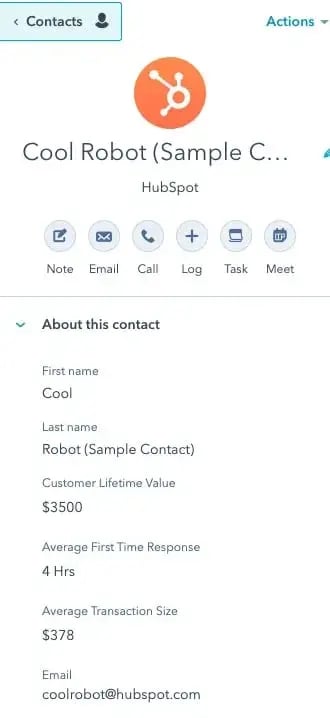
From here, we can find trends in the data, so we know what makes one customer spend thousands while another walks out the door.
How to Improve Your ROI on Customer Experience
Companies just starting with customer experience analysis may begin by looking at NPS or CSAT scores. Measuring these metrics over time will certainly uncover trends, but without digging deeper, it’s impossible to know what actions to take to improve overall performance.
Improving return on experience requires an ongoing, structured approach to identifying friction in the customer journey and systematically acting on it, a practice often called customer experience optimization. Here are some concrete steps to deepen your understanding of your customers and squeeze more ROI from your customer experience program:
1. Segment your customer base.
To better understand the customers in a portfolio, categorize them by personal characteristics and behaviors. Not every customer behaves the same way, and identifying distinct buyer personas can uncover opportunities to increase revenue.
Here are some ways to segment the customer base.
- Product/Plan Purchased
- Contract Value/Average Transaction Size
- Number of Daily/Monthly Visits
- Job Title
- Age
- Location
2. Use text analytics to review qualitative data.
Rather than manually sorting through support tickets and listening to phone recordings, can analyze qualitative data from survey responses, customer conversations, online reviews, social media conversations, and more.
This technology helps service teams process large volumes of valuable customer feedback without having to review each piece personally.
3. Look for historical trends.
Once a significant amount of data is collected, look for patterns that reveal what has worked and what hasn’t in the past. Do all customers in a specific segment talk about a particular feature? Do you see higher churn rates among certain target audiences? What did their qualitative data reveal about their perception of your brand?
Looking at data through this lens allows teams to compare the customer experience program against the metrics being measured. This approach surfaces which initiatives are working and where changes can be made to achieve a greater return.
4. Identify opportunities that will yield the most impact.
Once there is a clear picture of how the program is performing, identify a specific buyer persona or group where CX improvements would have the most impact. A high-value segment with a high churn rate, for example, often presents strong potential for customer delight.
That’s where customer experience metrics come into play. Review initiatives that have been successful with similar audiences, using quantitative data to measure financial success and qualitative data to shape the next initiative for the target persona
Customer Experience ROI Example
, its agents were drowning in admin work — scheduling appointments, managing maintenance issues, organizing certifications, and maintaining client databases. All of it pulled attention away from the thing that actually drives growth in the lettings industry: customer relationships.

knew that improving the experience required fixing the infrastructure that underpinned it. The team implemented Marketing Hub, Sales Hub, and Service Hub in 黑料吃瓜网 Smart CRM, then built 700+ automated workflows to handle the operational load their agents used to handle manually.
The results directly connect to CX ROI, making it easy to show leadership.
- Monthly landlord leads jumped from 35 to over 1,200
- Tenant inquiry-to-viewing conversions improved from 18% to 53% — nearly a 3X increase
- Landlord valuation conversion climbed from 5.6% to 8.6%
- 92% of the lettings process is now automated, 13% more than the closest competitor
- Errors reduced by 97% compared to 2019
The experience metrics tell the same story. Accommodation.co.uk now holds 100% five-star Trustpilot reviews with a +59 NPS. Matthew puts it simply: “Our clients love the transparency it offers.”
What makes this a useful CX ROI example is that each outcome can be traced back to a specific experience investment.
Faster maintenance resolution came from automated workflows and Slack integrations. Higher conversion rates came from 150+ personalized email and SMS touchpoints across 12 pipelines. Better NPS came from giving landlords real-time visibility into their properties. Every metric has a mechanism behind it, which is exactly the kind of story that wins executive buy-in and keeps CX budgets intact.
Common Challenges in Measuring CX ROI
Even teams with solid CX programs run into walls when it comes to proving the ROI. Here are the most common challenges and how to work through them:
Attribution is messy.
Revenue growth is affected by marketing, product changes, economic conditions, and pricing.
Isolating the impact of a specific CX initiative from everything else happening at the same time is genuinely difficult. The best solution is cohort analysis, which compares customers who experienced a specific CX change with those who didn’t.
Running a control group gives teams a before-and-after comparison that’s defensible in front of leadership, because they’re not just showing correlation but causation.
Results take time.
CX improvements rarely show up in next month’s revenue report. Brand perception, customer lifetime value, and advocacy all have long feedback loops, which make it hard to justify short-term investment.
As customer expectations rise, the pressure to quantify soft benefits like brand perception and employee morale only grows.
The fix is phased reporting. Track and present leading indicators, such as NPS, CSAT, churn risk signals, monthly, even before the financial results materialize. That keeps leadership informed about the trajectory without forcing teams to wait 12 months to prove value.
Data lives in silos.
CX data often sits in support tools. Revenue data lives in the CRM. Marketing data is somewhere else entirely. When these systems don’t talk to each other, it’s nearly impossible to draw a clear line between customer experience improvements and financial outcomes.
Unified data platforms that centralize customer profiles, pulling in support history, transaction data, and experience scores into a single view, solve this. When all the data is in one place, the connections become visible.
Soft benefits are hard to quantify.
Brand perception, employee morale, and customer trust are real, and they have financial consequences, but they don’t show up cleanly on a balance sheet. The solution is proxy metrics.
Track brand sentiment scores and correlate them with changes in acquisition rates over time. Measure employee experience and satisfaction within CX teams and link them to customer satisfaction scores in those same teams. These aren’t perfect, but they provide leadership with a quantitative signal of benefits that would otherwise remain abstract.
Growing a Business with Customer Experience
Customer experience ROI transforms CX from a support function into a measurable business driver. When experience metrics connect to financial outcomes — retention rates, lifetime value, churn reduction — the case for CX investment becomes as clear as any other strategic decision on the leadership agenda.
The strongest CX programs don’t just track satisfaction scores. They build a continuous loop between customer feedback, operational data, and financial performance — using that loop to identify where experience improvements will have the greatest impact on revenue.
黑料吃瓜网’s Service Hub gives CX teams the tools to close that loop, connecting support data, customer feedback, and CRM records in one place to make measuring and proving CX ROI more straightforward.
Editor’s note: This post was originally published in June 2020 and has been updated for comprehensiveness.
7 Smart Customer Success Playbooks
Step-by-step guidance, proven strategies, and industry best practices to help you overcome challenges and achieve remarkable results.
- Execute a churn mitigation plan
- Highlight customer progress
- Reengage a disengaged customer
- And more!
Download Free
All fields are required.
Form not available
You're all set!
Click this link to access this resource at any time.