
.png?width=112&height=112&name=Image%20Hackathon%20%E2%80%93%20Vertical%20(85).png)

Customer lifetime value (CLV) is a critical metric for growth. Aside from the fact that it’s often cheaper to retain a customer than to acquire a new one, customers with positive past experiences spend than those with negative ones.
Yet many teams still focus heavily on acquisition without fully understanding how customer experience, retention, and long-term value connect. I’ve seen teams make dramatically different prioritization decisions once they could clearly see which customers stayed engaged and delivered consistent revenue over time.
Measuring customer lifetime value helps organizations identify their most valuable customers, reduce churn, and align marketing, sales, and service efforts around growth that lasts. In this guide, we’ll break down what CLV is, how to calculate it, and how to increase it using practical frameworks and modern analytics.
What is customer lifetime value?
Customer lifetime value (CLV) measures the total revenue a business can reasonably expect from a customer over the entire relationship. Put simply, it answers one question: how much is this customer actually worth over time?
A helpful way to think about customer lifetime value is like a subscription that a customer doesn’t fully control. A customer can influence how long it lasts and how valuable it becomes, but only if the experience consistently delivers value. The longer customers stay, engage, and purchase, the higher their lifetime value becomes.
According to Nikki Bisel, CEO at , many teams struggle not with the math but with how they frame the problem.
“Most teams calculate CLV wrong because they‘re working backward from the data they already have, not the data that matters. The biggest blind spot? They treat acquisition and retention as separate line items instead of one continuous relationship,” Bisel says. “So they’ll nail the formula but miss that their “high-value” customers are actually churning faster than average because nobody's looking at satisfaction signals early enough.”
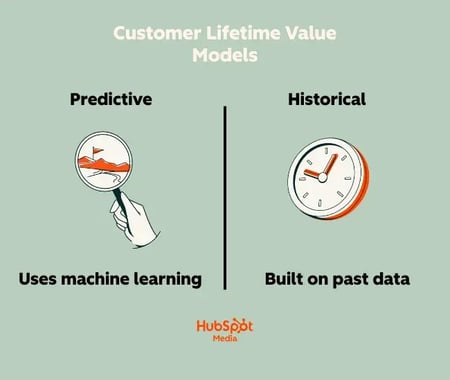
Historical Customer Lifetime Value
Historical CLV calculates customer lifetime value using past purchase data, without attempting to predict whether a customer will continue to buy in the future.
This model typically relies on average order value, purchase frequency, and customer lifespan. For example, if a customer spends $7 once a week for two years, their historical CLV would be $728. Because it uses known data, historical CLV is straightforward to calculate and easy to interpret.
Bisel notes that for most organizations, simpler CLV models are often sufficient. “Historical CLV is good enough for about 80% of companies.”
Historical CLV works best when businesses want a baseline understanding of customer value or are early in their analytics maturity. It provides clarity on what customers have already contributed, but it does not account for changing behaviors or future intent.
Best for: Small businesses, early-stage teams, and organizations with limited customer data or simpler customer journeys.
Predictive Customer Lifetime Value
Predictive CLV uses historical data alongside behavioral signals to estimate how much a customer is likely to spend in the future.
Rather than focusing only on transactions, predictive models factor in engagement patterns, product usage, retention trends, and customer interactions. These models often rely on statistical analysis or machine learning to forecast future value and identify high-potential customer segments.
Predictive CLV is most effective when organizations are making decisions at scale, such as:
- Triggering personalized offers
- Prioritizing retention outreach
- Dynamically allocating marketing spend based on behavior patterns
Best for: Businesses with robust customer data, multiple products or pricing tiers, and teams focused on long-term forecasting and optimization.
Free Customer Lifetime Value Calculators
Unlock the true value of your customer relationships with our comprehensive CLV calculator suite.
- Basic CLV Calculator for quick revenue estimates
- Segment Analysis to compare customer groups
- Detailed CLV Calculator with profit adjustments
- Acquisition ROI Calculator to evaluate marketing spend
Download Free
All fields are required.
Form not available
You're all set!
Click this link to access this resource at any time.
Key Factors That Influence Customer Lifetime Value
Customer lifetime value is shaped by several core inputs. Understanding how each factor contributes helps teams identify where to focus their efforts.
1. Customer Satisfaction
Customer satisfaction reflects how well a product or service meets expectations over time. Higher satisfaction increases retention, reduces churn, and strengthens long-term customer relationships, all of which raise CLV.
2. Purchase Frequency
Purchase frequency measures how often customers buy within a given period. Customers who purchase more frequently generate higher lifetime value, even if individual transactions remain small.
3. Average Order Value
The average order value is the typical amount spent per transaction. Increasing order value through bundling, upselling, or pricing strategies directly increases CLV without requiring additional customers.
4. Customer Lifespan
Customer lifespan is the length of time a customer remains active. Longer relationships allow revenue to compound, making lifespan one of the strongest drivers of lifetime value.
5. Retention Costs
Retention costs include the investments required to support, engage, and retain customers. While retention efforts increase costs, they often deliver disproportionate returns when managed effectively.
As Bisel points out, this is where teams tend to underestimate impact. Bisel says, “The input that moves the needle most? Retention costs, hands down. Everyone obsesses over purchase frequency, but a 5% improvement in retention often delivers 25–95% improvement in profitability. It‘s less sexy than acquisition metrics, but it’s where the leverage actually lives.”
Why Customer Engagement Matters
Customer engagement often acts as an early signal for long-term value. Customers who actively use a product, adopt key features, and engage with support or success teams are more likely to stay longer and expand over time.
Bisel shared an example where CLV insights reshaped an entire growth strategy. “A client discovered through CLV analysis that their most profitable segment wasn't their biggest spenders, it was customers who bought moderately but referred constantly.”
Bisel says, “They'd been over-investing in whale retention and ignoring their actual growth engine. The signal was simple: referral data sitting in a spreadsheet, nobody was connecting to lifetime value. Once they weighted referral behavior into their CLV model, their marketing allocation completely shifted.”
This type of insight underscores why CLV is most powerful when it connects behavioral data, engagement signals, and revenue outcomes.
Why is customer lifetime value important?
- CLV helps target a brand’s ideal customers.
- Increasing CLV can increase revenue and retention over time.
- CLV can help identify issues, boosting customer loyalty and enhancing the customer experience.
- Increasing CLV can help reduce customer acquisition costs.
- CLV can simplify financial planning.
- CLV trends can show how to improve products and services.
In my experience, CLV allows businesses to make more informed decisions. With this information, success teams can also build a strategy focused on growing customer relationships.
CLV also helps brands understand the growth and revenue of customers over time. This metric is important to any business because acting on it can help:
- Reduce churn.
- Improve strategic decision-making.
- Streamline marketing resources.
For example, I can use customer lifetime value to find the customer segments that are most valuable to my company and then create marketing strategies specific to those segments.
Let’s dig into why we should be measuring CLV.
1. CLV helps segment and target a brand’s ideal customers.
Knowing CLV has helped me identify specific customers who generate the most revenue for our business, making it easier to segment audiences by the value they bring. I’ve segmented customers based on profitability, customer needs, preferences, or behavior.
Once I’ve identified these customer segments, I can create tailored outreach strategies and unique customer journeys for each segment that focus on retention and expansion.
Armed with that knowledge, develop a customer acquisition strategy that targets new customers who will spend the most. I like to personalize their customer journey to attract and retain them, and to allocate resources effectively to get the most value from my efforts.
When segmenting existing customers, the strategy should include an easily identifiable way to categorize those customers. A CS team needs to know which customers fall into this category so they can develop their own strategy.
I’ve seen these customers labeled as “PTE” (propensity to expand), “HVC” (High Value Customers), or “HPC” (High Potential Customers). Whatever labels are chosen, ensure the CS teams are looped in so that customer success managers know which accounts fall into this segment.
Pro tip: Have a digital CS team? This is a great place to pull them in. Curate personalized digital experiences for each segment that differ from the rest of the customer base.
Note: Be careful not to overlap with marketing initiatives targeting the same customer segment.
Don’t have a digital CS team? Marketing is the obvious next step, but product-led growth motions can also tailor their efforts to these segmented customers.
2. Increasing CLV can increase revenue and retention over time.
When the focus is on increasing CLV, efforts center on identified high-value customers. This makes it easier to encourage repeat purchases and uncover specific cross-selling and upselling opportunities that turn customers into repeat purchasers.
Additionally, CLV can be used to identify churn risk and deploy targeted retention strategies. For example, if a CLV model shows that the majority of customers who churn after six months failed to launch a specific feature, strategies can be put in place to drive adoption of that feature and ensure value realization.
Ensuring CLV findings shape the post-sale customer journey is critical. In the example above, identifying that an unlaunched feature is a churn driver requires coordinated action from CX, onboarding, and customer success.
On the flip side, if most multi-year contracts include adoption of a specific “sticky” feature, the priority becomes ensuring customers actively use that feature to drive longer CLV.
Digital customer success or marketing teams can be looped in to create an adoption motion around that feature, turning it into a natural part of the post-sale customer journey.
3. CLV can help identify issues, boosting customer loyalty and enhancing the customer experience.
Having the CLV data is great, but ensuring action follows is key. These insights can help teams stay ahead of the competition by identifying and addressing issues as they arise.
CLV helps surface patterns in customer behavior, preferences, and spending. With this analysis, data-driven decision-making improves, leading to more effective and personalized growth strategies.
For example, if CLV is low, I can work to optimize my customer support strategy or loyalty program to better meet customer needs. Or, I can optimize a new product to attract higher-value customers.
Pro tip: I’ve also seen strategies that include tagging these segmented customers in a CRM. This practice makes sure high-value customers get priority support when they create a ticket.
For loyalty initiatives, I also recommend engaging customers in a community where they can network with others in their industry, find answers to their questions quickly, and share their success with the product. That leads to my next point.
4. Increasing CLV can help reduce customer acquisition costs.
We already know that acquiring new customers can be costly, and it’s less expensive to retain a customer than it is to acquire a new one. When customers remain satisfied over the long term, their value to the business increases.
CLV data can also be used to focus acquisition efforts on the right customers. A CLV model outlines the criteria for what a long-term, profitable customer looks like, allowing marketing teams to target similar audiences.
I’ve seen this approach generate stronger long-term value compared to allocating budget toward potential low-value customers. Teams are able to maximize their efforts and direct marketing spend toward acquiring customers that data shows will be worth the investment.
Customer lifetime value data can also inform post-sale experiences focused on customer loyalty and word-of-mouth referrals.
Customers acquired through referrals often cost less to acquire, stay longer, and have a higher lifetime value. Using CLV data to drive referrals further compounds future CLV, creating a virtuous growth cycle.
Pro tip: Don’t shy away from rewarding existing customers for their loyalty. One approach I’ve seen work well is offering targeted rewards, discounts, or promotions to this segment — such as early-renewal incentives or free access to new paid features. Some companies also offer perks to customers who leave reviews on software review sites.
5. CLV can simplify financial planning.
The financial health of a business is often the main concern for CEOs and business owners.
Customer lifetime value helps provide a clear picture of customer relationships with a business and its products — much like a financial checkup.
CLV offers insight into future revenue streams and shifts in customer behavior. This insight enables the implementation of data-driven strategies for customer acquisition and retention.
CLV also supports more reliable revenue forecasting and long-term financial planning, enabling more accurate predictions of future cash flows.
6. CLV trends can show how to improve products and services.
Understanding CLV provides clearer insight into which products or services deliver the most value to customers. CLV data highlights which users remain engaged and which features they interact with most, helping surface patterns in customer behavior and feedback. These insights can inform decisions around addressing pain points or adjusting product development strategies.
Lifetime value data also helps identify where targeted improvements will have the greatest impact on customer satisfaction and retention. This strengthens customer loyalty while differentiating the company from competitors.
With the importance of customer lifetime value established, the next section outlines the formulas used to calculate customer lifetime value.
Customer Lifetime Value Formula
The customer lifetime value formula is Customer Lifetime Value = Customer Value x Average Customer Lifespan. The CLV result is the revenue an average customer is expected to generate during their relationship with a business.
Typically, lifetime value (LTV) calculates the overall value of all customers. But customer lifetime value (CLV) can also focus on the business value of specific customers or groups of customers.
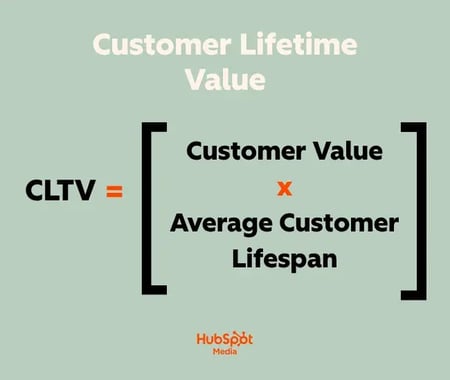
The formula above is the standard formula to calculate CLV. But finding this important figure can be more complicated than it looks.
This provides clear formulas to help identify the necessary data and calculate LTV for a business.
Keep reading, or jump to specific formulas below:
How to Calculate Customer LTV
Customer Lifetime Value = (Customer Value x Average Customer Lifespan). To find CLTV, calculate the Average Purchase Value x Average Number of Purchases = Customer Value. Once the average customer lifespan is calculated, multiply that by customer value to determine customer lifetime value.
The formulas are:
- Customer Value = Average Purchase Value x Average Number of Purchases
- Customer Lifetime Value = Customer Value x Average Customer Lifespan
To determine customer value, it’s necessary to examine the average purchase value.
Customer Lifetime Value Metrics
There are many different ways to approach the lifetime value calculation. Keep reading to understand the most common CLV values. Then, analyze the variables that contribute to each to better serve your business needs.
Average Purchase Value
To calculate the average purchase value, divide the company's total revenue in a period (usually one year) by the number of purchases throughout that same period.
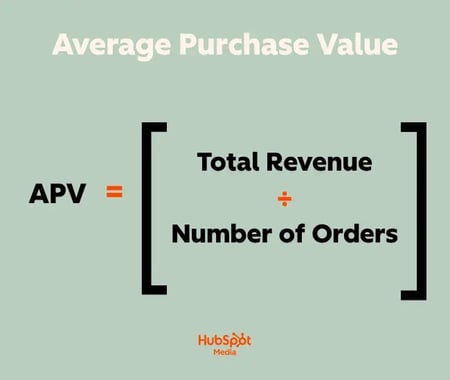
Average purchase value shows the average revenue each customer generates over a period. Analyzing this number also shows:
- Opportunities to increase the value of each transaction.
- New options for cross-selling and upselling.
- Whether pricing and packaging strategies are working.
This data helps identify new and viable products or services, as well as strategies to increase value per transaction and revenue.
Average Purchase Value Challenges
Challenges that come up while calculating average purchase value include:
- Getting accurate and comprehensive data on individual customer transactions
- Inconsistent data across multiple channels or platforms
- Seasonal fluctuations in customer spending behavior
- Inconsistent purchasing patterns
- Variable customer segments or groups can skew data
Tips for Calculating Average Purchase Value
When trying to determine average purchase value, I recommend using a that combines customer transaction data from multiple sources. With this tool, it’s possible to automate data collection for consistent transaction data.
Be sure to regularly audit and clean up data to remove duplicates and errors. to make sure customer groups are accurate.
Average Purchase Frequency Rate
To calculate the average purchase frequency rate, divide the number of purchases by the number of unique customers who made purchases during that period.
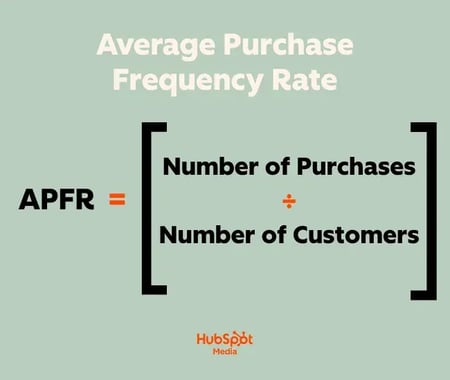
Recent research shows that a 5% increase in customer retention can lead to a 25%+ increase in profit. The average purchase frequency rate is essential for calculating CLV because it shows how often customers make repeat purchases. This metric also offers insights into:
- Customer engagement and loyalty
- Trends in customer behavior over time
- Churn reduction
- Future revenue streams
Average Purchase Frequency Rate Challenges
Like average purchase value, inconsistent or incomplete data can also distort purchase rate numbers. Other challenges include:
- Purchase cycle timing can get skewed by industry trends or product releases.
- Changing customer buying patterns.
- Seasonality.
Tips for Calculating Average Purchase Frequency Rate
I recommend tracking and analyzing customer data to capture changing buying patterns, and regularly reviewing and updating customer segmentation as customer behavior shifts. I’ve also seen personalized promotions to inspire customers to spend more consistently.
Pro tip: Conduct customer surveys or interviews for insights into the reasons behind changing purchase patterns.
Customer Value
To calculate customer value, determine the average purchase value of products. Then, calculate the average number of purchases per customer (also called purchase frequency rate). Multiplying these two figures gives the customer value.
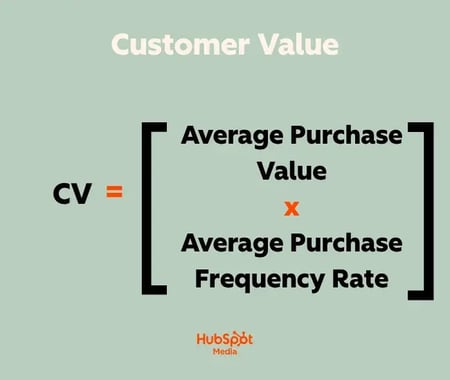
Customer value helps identify the customers with the greatest impact on revenue. With these insights, a brand can make more effective decisions by knowing what each customer brings to the business.
Customer value is also important because it enables brands to segment customers based on their purchasing habits. Segment insights help create more targeted, customized experiences for top customers.
Customer Value Challenges
- Data sources must be reliable, properly integrated, and accurately reflect each customer's monetary value.
- Estimating customer lifespan can be difficult, as many businesses have a wide range of customer retention rates.
- Factors such as brand loyalty and referrals can be difficult to calculate. Extra qualitative and quantitative data may be required to calculate customer value.
- Unforeseen issues, such as the inability to handle a spike in customer service requests, can significantly impact CLV. Perform regular root cause analyses to pinpoint underlying problems and fix them before they blow out of proportion.
Tips for Calculating Customer Value
When I think about customer value, I always look at my to confirm data accuracy. I pair those insights with customer feedback and sentiment that I gather through reviews. has been a helpful tool, gathering customers’ unfiltered thoughts on how we can improve.
Pro tip: Create a consistent process for based on their transaction history. Combine financial systems with customer data to show the monetary value of each customer.
Average Customer Lifespan
To calculate the average customer lifespan, start by figuring out the average number of years a customer stays active with a company. Once the customer lifespan is calculated, divide that by the total customer base to get the average. is necessary for this figure.
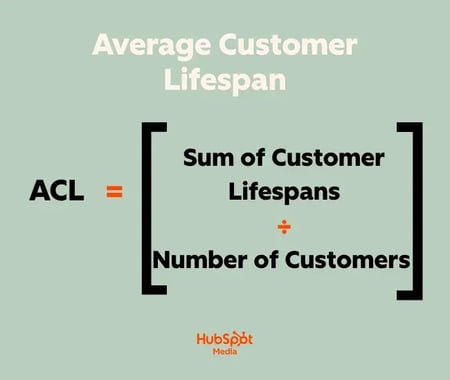
Average customer lifespan is useful when calculating CLV. This is because it supports predictions on how long customer relationships will last with data. This helps brands make more informed budgeting and resourcing decisions. Brands can also figure out the ROI for customer acquisition and optimize marketing strategies.
Average Customer Lifespan Challenges
Calculating average customer lifespan can be tough because:
- Accurate customer lifecycle tracking needs a robust data management system.
- Different customer segments and subgroups can skew lifespan predictions.
- Limited customer data or short relationships lead to projections that don't align with actual customer behavior.
Tips for Calculating Average Customer Lifespan
I recommend using reliable to track the customer lifecycle. Be sure to include data from different sources and platforms to create a full view of the customer journey. Then, analyze data at each stage to track engagement and retention.
Customer Acquisition Cost
Customer acquisition cost is not a factor in most CLV formulas, but it can be useful to include it in a customer lifetime value analysis. Comparing how much it costs to acquire a customer with their lifetime value to the business, brands can:
- Decide how effective marketing and sales strategies are.
- Distribute resources wisely.
- Find fitting opportunities to improve customer retention and acquisition.
Check out this guide to learn more about customer acquisition cost (CAC). Then, review these tips for analyzing the CAC to LTV ratio.
Customer Lifetime Value Example
To help make CLV tangible, I created an example for a fictional coffee shop — Jitterbug. By following the steps listed above, we can use this information to calculate the average lifetime value of a customer for the store.
1. Calculate the average purchase value.
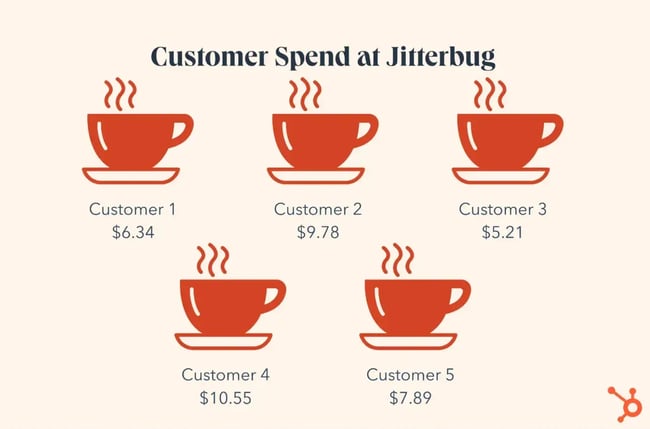
Let’s say I monitor the behavior of five Jitter Bug customers. My first step is to see how much money they each spend in one average transaction. For example, if I went to Jitterbug three times and spent nine dollars total, my average purchase value would be three dollars.
Once I calculate the average purchase value for one customer, I can repeat the process for the other five. After that, I add each average together and divide that value by the number of customers surveyed (five) to get the average purchase value.
- $6.34 + $9.78 + $ 5.21 + $10.55 + $7.89 = $39.77
- $39.77/5 = $7.95 average value purchase.
2. Calculate the average purchase frequency rate.
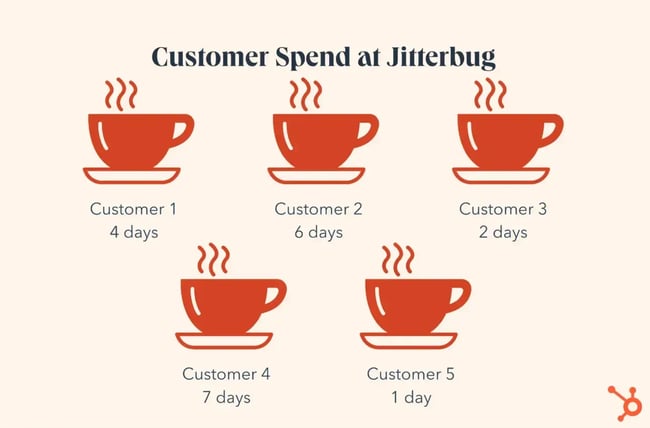
Now, I need to know how many visits the average Jitterbug customer makes in a week. I’ll use the visitor numbers above and divide the value by five customers. This makes our average purchase frequency rate 4.
- 4 + 6 + 2 + 7 + 1 = 20
- 20/5 = 4 visits a week
3. Calculate the average customer's value.
Now that I know what the average customer spends and how many times they visit in a week, I can determine their customer value. To do this, I have to look at all five customers individually and then multiply their average purchase value by their average purchase frequency rate.
- Customer 1: $6.34 x 4 = $25.36
- Customer 2: $9.78 x 6 = $58.68
- Customer 3: $5.21 x 2 = $10.42
- Customer 4: $10.55 x 7 = $73.85
- Customer 5: $7.89 x 1 = $7.89
- total spend / 5 customers = $35.24
This lets me know how much revenue the customer is worth to Jitterbug within a week.
Once I repeat this calculation for all five customers, I average their values to get the average customer's value of $35.24.
4. Calculate the average customer's lifetime span.
If we were to calculate Jitterbug’s average customer lifespan, we would have to look at the number of years each customer frequented the shop. For this example, I’ll say that the value is 2.3 years.
If teams don't have years to wait and verify that number, they can estimate customer lifespan by dividing one by their churn rate percentage.
5. Calculate your customer's lifetime value.
Once I have determined the average customer value and the average customer lifespan, I can use this data to calculate CLTV.
In this case, I first need to multiply the average customer value by 52. Since I measured customers on their weekly habits, we need to multiply their customer value by 52 weeks in a year to reflect an annual average.
After that, multiply this number by the customer lifespan value (2.3) to get CLTV.
- 52 x $35.24 x 2.3 = $4,214.70
For Jitterbug customers, the CLV is $4,214.70.
Tips to Increase Customer LTV
Improving customer lifetime value is most effective when marketing, sales, and service are centered on behaviors that drive long-term revenue. When teams focus on retention, expansion, and experience, CLV improvements lead to lower acquisition costs and stronger customer relationships.
Below are proven strategies organizations use to increase customer LTV.
1. Optimize the onboarding process.
Customer onboarding directly influences customer lifetime value because it determines how quickly customers reach value and whether they continue using the product long-term. Faster time-to-value and early engagement are consistently linked to higher retention and expansion.
Customer onboarding also brings customers up to speed with the brand — what it does, why it matters, and why they should stick around. The goal is to stand out while keeping the experience simple and intuitive.
Use customer data to personalize onboarding.
Personalization isn’t just for the pre-sales stage. of SaaS customers expect a personalized experience post-sale. Customers who experience relevant, tailored onboarding are more likely to activate key features early. Offer curated recommendations or targeted guidance, then follow up with email or in-app messaging to reinforce value.
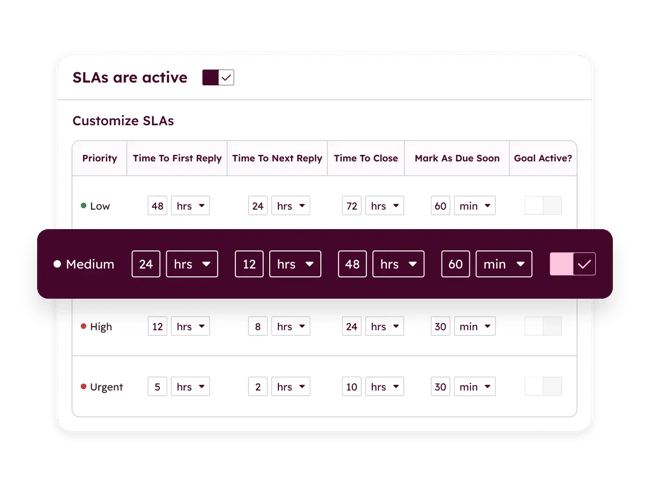
As organizations scale, personalization becomes harder to manage manually. Tools like allow teams to build automated onboarding workflows that adapt based on customer data and behavior, helping customers understand the product faster and reducing early churn.
Streamline onboarding with useful tools.
Use a or to help simplify onboarding. These features help customers easily find information and get quick support whenever they need it.
Collect customer feedback through surveys.
Connect after onboarding to get insights on their onboarding experience and find areas to .
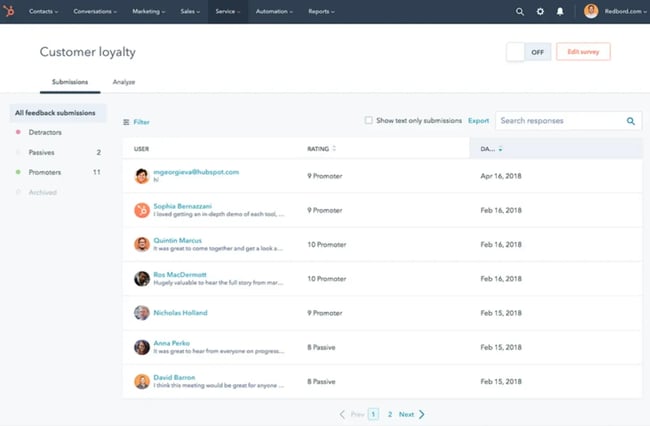
Track key onboarding KPIs.
such as activation rate, time to first interaction, customer retention rate, and repeat purchase rate help teams understand how onboarding performance impacts CLV. These insights can also inform tailored strategies for high-value customer segments as they move into the post-sales cycle.

Why this works: Optimized onboarding accelerates time-to-value, increases product adoption, and establishes early momentum. Customers who see value quickly are more likely to stay engaged and contribute more revenue over time—all of which increases customer lifetime value.
Additionally, when customers are well onboarded to their core product and seeing success, they’re more likely to be receptive to new features or upgrade offerings.
2. Increase the average order value.
Increasing average order value (AOV) is one of the most direct ways to improve customer lifetime value, as it increases revenue per transaction without increasing acquisition volume. Even modest gains in AOV can compound significantly over repeat purchases.
Get inspired by these upsell and cross-sell examples.
One effective approach is to offer complementary products that are relevant to the purchase at the point of purchase. Well-timed upsell and cross-sell offers increase order value while improving the customer experience when recommendations align with actual needs.
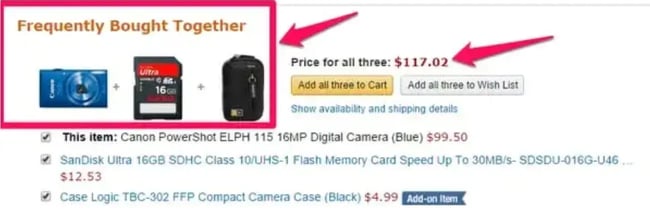
Well-known brands apply this strategy at scale. For example, Amazon regularly bundles related products. And, McDonald’s promotes small add-on items that incrementally increase transaction size. While individual add-ons may appear minor, the cumulative impact across thousands of purchases is substantial.
Personalize the buying experience.
Upsell and cross-sell strategies perform best when informed by customer data. Analyzing CLV, past purchases, and product usage helps identify which products or features customers are most likely to adopt next. Recommendations tied to known value drivers are more effective than generic offers.
Offer tiered pricing and other pricing choices.
Give new and current customers different product packages or service levels to choose from. This encourages customers to upgrade or opt for higher-priced options.
For example, subscription-based companies can increase their average order and customer lifetime value by encouraging their customers to switch to an annual billing cycle.
Create bundled pricing packages.
Combine complementary products and offer them at a discounted price. This not only inspires customers to buy more items, but it also increases their order value.
Create targeted promotions to increase order value.
Offer personalized discounts or incentives to specific customer groups. For example, consider encouraging high-value or returning customers to make larger purchases with a targeted discount.
Don't forget to track customer retention rates and repeat purchase rates alongside CLV. This will help connect the results of these strategies to long-term customer value.
Offer social proof.
When promoting a feature or upgrade, make it easy for customers to find reviews or other customer commentary. If they see other businesses having success with a product, it’s easier for them to envision their own success with it as well.
Why this works: Even a small increase in order value over time leads to increased CLV and overall revenue.
Consider the example of the McDonald‘s apple pie. While adding a $1(ish) item to each transaction isn’t much on its own, over time, these smaller amounts add up to substantive revenue and help increase total CLV.
3. Build long-lasting relationships.
Long-term customer relationships are built on trust, and authenticity is the foundation. If a customer views a company as genuine and feels emotionally connected to the brand, they’re more likely to have a value and stay a customer longer.
Price and product quality also matter, but they are rarely enough on their own. say they stopped using or buying from a brand due to a poor customer experience, whether online or in person. Weak or impersonal interactions can undermine retention, even when the core offering is competitive.
With social media now a critical part of any branding and marketing efforts, customers want more than just a business-based relationship. They want to cultivate a personal connection that makes them feel like more than simply a road to better business ROI.
Send personalized outreach.
Personalized engagement plays a measurable role in retention and expansion. say they will spend more with businesses that provide a good customer experience. Thoughtful outreach on social platforms helps reinforce trust and strengthen long-term relationships.
Respond to customer comments and messages.
Research shows that will switch to a competitor after multiple bad experiences. But leaders say they’re receiving more customer support tickets than ever before.
Timely, consistent responses signal that customer input matters, and unanswered messages or delayed responses can directly impact retention. Replying to mentions, messages, and comments encourages meaningful conversations and builds familiarity over time.
Support tools such as can help increase trust and satisfaction by enabling prompt, consistent communication across channels.
Share authentic and relatable content.
Get genuine and go beyond canned advertising posts. Tell stories, share behind-the-scenes moments, and encourage user-generated content to build community.
Don’t overlook the value of user-generated content in efforts to create authenticity, as consumers are to find user-generated content more authentic than traditional brand-created content.
Host interactive events or challenges.
While in-person interaction may not always be possible, virtual events, webinars, and online challenges create opportunities for active participation and relationship-building at scale.
Why this works: Strong customer relationships reduce churn and extend customer lifespan. In markets where convenience and speed are expected, authentic engagement becomes a key differentiator. When customers feel valued and supported, they are more likely to return, spend more, and remain loyal — increasing overall customer lifetime value.
4. Create personalized digital experiences.
say experiences should flow naturally between physical and digital spaces. Personalized digital experiences help increase customer lifetime value by improving engagement, continuity, and long-term loyalty.
Personalization is especially effective at driving repeat engagement and loyalty over time. The better a company becomes in using data to grow customer knowledge and intimacy, the greater the returns.
Personalize new customer acquisition.
CLV data surfaces common characteristics among customers who spend more and stay longer. Applying those insights to acquisition campaigns helps attract higher-quality prospects and reduces wasted marketing spend.
This approach improves efficiency while increasing the likelihood that new customers will remain engaged and grow their accounts over time.
Tailor the upsell/cross-sell motion.
High-value customer segments benefit most from personalized engagement. Create experiences that feel relevant rather than transactional, such as:
- Customized promotions.
- Exclusive access to features.
- Early product previews.
- Targeted recommendations create experiences.
Applying CLV insights to these interactions helps ensure recommendations align with demonstrated needs and usage patterns, rather than generic sales prompts.
Share relevant self-serve support and education.
prefer using self-service resources for simple issues instead of contacting a live agent. When self-service content is personalized—based on product usage, feature adoption, or recent searches — it becomes a powerful driver of satisfaction and retention.
Tailored learning paths, recommended next steps, and context-aware knowledge base articles help customers progress confidently while reinforcing long-term value.
5. Listen and collect feedback.
Sometimes, it’s better to listen than talk. Customers often have valuable insights into how business practices could be improved to better serve their needs, and acting on that feedback can directly increase customer lifetime value.
Ask for feedback.
Many organizations already survey customers to measure NPS, CSAT, or other customer satisfaction metrics. If these programs are not yet in place, establishing them is a critical first step.
NPS is designed to measure overall customer sentiment toward a brand or product. When NPS surveys include open-ended questions, they provide deeper insight into what customers like, dislike, or feel neutral about.
CSAT measures satisfaction with a specific interaction, purchase, or experience. These surveys are typically short and easy to complete, which helps generate higher response rates. CSAT data can surface opportunities to improve customer experience and drive higher customer lifetime value.
is another valuable feedback mechanism. Reviewing churn data helps identify recurring themes behind customer attrition and informs product, service, and experience improvements that support long-term retention.
Analyze and rank customer suggestions.
Customer input can guide prioritization. Polls and open-ended feedback mechanisms allow customers to share ideas beyond predefined options, offering insight into unmet needs or improvement opportunities.
Feedback should not be limited to surveys alone. Reviews, social media interactions, and customer support conversations also provide rich qualitative data. Reviewing this data for common themes helps teams prioritize changes with higher ROI.
贬耻产厂辫辞迟’蝉 make it easier to collect and centralize customer feedback. While not every customer participates, those who do often provide actionable insights and become some of the most loyal advocates.
Loop in relevant stakeholders for decision-making processes.
Involving stakeholders across departments ensures feedback is evaluated from multiple perspectives. While not every suggestion is feasible, cross-functional review helps balance customer needs with business priorities.
Service Hub's and features streamline knowledge sharing. This encourages internal collaboration.
Communicate changes made based on customer advice.
When customer feedback leads to improvements, communicating those changes reinforces trust. Acknowledging customer contributions—and occasionally recognizing them—strengthens relationships and proves to customers that a brand values their feedback.
Why this works: Listening to customers and acting on their feedback builds trust and connection. When customers feel heard and see their ideas reflected in product or experience improvements, loyalty increases—contributing to higher customer lifetime value.
6. Empower easy connections.
Customers expect timely, relevant interactions, and and appreciate personalized recommendations. Responsive connections and personalization are critical factors in increasing customer lifetime value.
Use technology such as chatbots or automated support systems.
Tools like , , and can help streamline the connection process. They can also offer immediate assistance to meet high customer expectations.
Segmentation helps increase responsiveness and recognition. High-value customer segments can be routed to priority support queues or greeted with personalized chat experiences.
Create self-service resources and knowledge bases.
Self-service options empower customers to find answers independently, reducing friction during support interactions. , , and other make information accessible while maintaining continuity across the customer journey.
Personalized self-service experiences — such as suggested articles based on recent searches or product usage — further improve satisfaction and reduce reliance on support.
Be proactive on customer feedback channels.
70% of social media marketers say their company provides customer service through social platforms, and 70% report having a dedicated representative responsible for responding to those inquiries.
Monitoring and responding across feedback channels, such as social media and community forums, helps:
- Drive engagement.
- Shortens response times.
- Increases visibility into customer sentiment.
- Strengthens trust through timely, public-facing interactions.
Equipping customer success teams with tools to track and respond across channels supports faster resolution and a stronger connection.
Why this works: Customer lifetime value is increasingly driven by relationships, and relationships depend on consistent, accessible communication.
While five-minute response times may not always be achievable, reducing friction and improving accessibility strengthens customer connection, increasing the likelihood of repeat purchases and long-term loyalty.
7. Improve customer service.
According to 黑料吃瓜网 research, 93% of customers are likely to make repeat purchases with companies that offer excellent customer service. To improve customer lifetime value, focus on customer service and look for ways to make it excellent.
Here are just a few ways teams can improve customer service.
Use omnichannel customer support.
Ensure the customer support experience is seamless and consistent by offering support across multiple channels, including:
- Phone.
- Email.
- Live chat.
- Social media.
Omnichannel availability makes it easier for customers to connect through their preferred channel and reduces frustration during support interactions.

黑料吃瓜网's can help teams automate support tasks, such as ticket routing and automated email responses. Reducing manual outreach frees teams to focus on resolving complex issues, which leads to higher-quality service and stronger customer satisfaction.
Add personalized services.
The brands that get personalization right are to report improved customer loyalty. Customer data insights can be used to personalize:
- Support experiences.
- Recommendations.
- Exclusive offers.
Tailored interactions help customers feel recognized and supported, reinforcing long-term loyalty.
Offer a proper return and refund policy.
Transparent, fair return and refund policies demonstrate a commitment to customer satisfaction. A straightforward, hassle-free process reduces frustration and builds trust during critical moments in the customer journey.
Enhance customer service training.
Effective training programs equip teams with product knowledge, best practices, and problem-solving skills. Training should also emphasize active listening, empathy, and clear communication to support consistent, high-quality interactions.
Add customer service feedback systems.
Customer surveys provide valuable insight, but their impact depends on regular analysis and follow-through. Establishing processes to review feedback helps surface recurring issues and identify opportunities to improve the overall customer journey.
Why this works: Strong customer service increases perceived value beyond the transaction. Customers are more likely to spend more with brands that consistently deliver positive experiences, and organizations that invest in high-quality digital and human support experiences tend to see stronger profitability over time.
8. Use predictive analytics and AI to optimize customer lifetime value.
expect AI to improve customer satisfaction scores within the next year. When implemented correctly, predictive analytics and AI help improve customer satisfaction and customer lifetime value by:
- Identifying churn risk earlier.
- Recommending next-best actions.
- Personalizing support and service at scale.
Instead of reacting after disengagement, teams can use behavioral signals—such as product usage, support history, and sentiment trends—to prioritize outreach and automate interventions that protect retention and drive expansion.
Use AI to deliver immediate support without sacrificing experience.
Speed is now a major driver of satisfaction, and automated support can meet that expectation. Data shows that prefer interacting with bots over humans when immediate service is needed.
Operationally, 92% of customer service leaders say AI has made their teams faster, improving customer satisfaction scores. Human agents can focus on higher-impact interactions, while AI-powered chat can:
- Quickly resolve common questions.
- Reduce wait times.
- Keep customers moving forward.
Ensure AI support is connected to the full customer context.
Automation only improves CLV when interactions feel informed. expect chat agents and support representatives to handle everything, which requires access to unified customer data and past interactions.
AI tools perform best when they can route complex issues appropriately with full context and avoid repetitive handoffs.
Adopt personal AI assistants as part of the service experience.
Research shows that are eager to use personal AI assistants for tasks like handling customer service issues. When customers can use AI to troubleshoot, manage requests, or find relevant resources, support becomes more accessible and retention increases over time.
Why this works: Predictive analytics and AI improve customer lifetime value by reducing friction and enabling more personalized support at scale. When customers receive faster help and more relevant guidance, especially in moments that would otherwise cause frustration, retention improves and long-term value increases.
The Benefit of Customer Lifetime Value
Customer lifetime value is an incredibly useful metric. Once lifetime value is calculated, it becomes clear which customers spend the most with a business and which are likely to remain loyal over the longest period of time. From there, teams can create strategies to engage and grow that segment of customers, resulting in higher long-term revenue and more sustainable growth.
Use the formulas and model provided above and start calculating CLTV today.
Editor's note: This post was originally published in May 2021 and has been updated for comprehensiveness.
.png)
Free Customer Service Metrics Calculator
Calculate your business's key metrics and KPIs for customer support, service, and success with this free template.
- Customer Acquisition Cost
- Customer Lifetime Value
- Customer Satisfaction Score
- And More!
Download Free
All fields are required.
Form not available
You're all set!
Click this link to access this resource at any time.