
.png?width=112&height=112&name=Image%20Hackathon%20%E2%80%93%20Vertical%20(85).png)

Customer satisfaction metrics help businesses measure how customers perceive their experience across support, product usage, and ongoing relationships. These metrics translate customer sentiment and behavior into data that teams can track over time.
Some metrics focus on how customers feel about a specific interaction. For example, Net Promoter Score (NPS) measures long-term loyalty, while Customer Satisfaction Score (CSAT) captures immediate satisfaction after a support interaction. Others measure operational performance, such as First Response Time, First Contact Resolution, or Customer Churn Rate.
Tracking a combination of sentiment-based and operational metrics gives organizations a clearer picture of customer experience. When these metrics are monitored consistently, teams can understand how customer experience influences retention and long-term revenue.
This guide explains 12 essential customer satisfaction metrics, how to calculate each one, and how to track them using tools such as and reporting.
Table of Contents
What are customer satisfaction metrics and KPIs?
Customer satisfaction metrics are measurable data points that evaluate how customers perceive their experience with a business. These metrics quantify the following through structured feedback and behavioral data:
- Satisfaction.
- Loyalty.
- Service quality.
- Retention.
.png)
Free Customer Service Metrics Calculator
Calculate your business's key metrics and KPIs for customer support, service, and success with this free template.
- Customer Acquisition Cost
- Customer Lifetime Value
- Customer Satisfaction Score
- And More!
Download Free
All fields are required.
Form not available
You're all set!
Click this link to access this resource at any time.
Customer satisfaction KPIs, or key performance indicators, are the specific metrics that an organization monitors to evaluate the success of its customer satisfaction strategies on an ongoing basis.
A customer satisfaction metric measures a single dimension of experience. For example, Customer Satisfaction Score measures immediate satisfaction after an interaction, while Net Promoter Score measures long-term loyalty and advocacy. A KPI uses one or more of these metrics to determine whether performance meets a strategic objective, such as reducing churn or increasing repeat purchases. For example:
- Customer Satisfaction Score measures how satisfied customers feel after a support interaction.
- Net Promoter Score measures how likely customers are to recommend a company.
- Customer Churn Rate measures how many customers stop doing business within a given period.
- First Response Time measures how quickly support teams respond to customer inquiries.
Customer experience and expectations are increasingly important contributors to the business’s bottom line. According to 黑料吃瓜网 research, 93% of consumers are likely to make repeat purchases with companies that offer excellent customer service.
When leadership teams define KPIs, they select the customer success metrics that most directly influence growth, retention, and revenue. A support organization may treat First Response Time and Customer Satisfaction Score as KPIs because both directly impact renewal rates. A product-led company may treat Customer Effort Score and feature adoption rates as KPIs because both influence long-term engagement.
According to Mario DeAlmeida, Managing Director at HotHeadTech.com, "Today, customer satisfaction metrics are key to understanding customer needs and finding ways to improve the customer experience. They not only assess customer loyalty but identify when customers may be at risk of defecting or are unhappy with your services." DeAlmedia adds, "By analyzing tracked metrics, businesses can gain key insights into customer behavior and make informed decisions about how to improve customer satisfaction."
Clear definitions and structured measurements ensure that customer satisfaction benchmarks inform strategic decisions instead of becoming isolated data points.

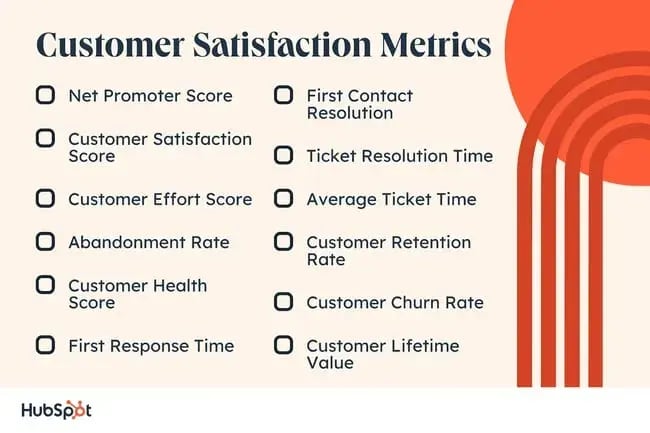
12 Essential Customer Satisfaction Metrics to Track
- Net Promoter Score
- Customer Satisfaction Score
- Customer Effort Score
- Abandonment Rate
- Customer Health Score
- First Response Time
- First Contact Resolution
- Ticket Resolution Time
- Average Ticket Time
- Customer Retention Rate
- Customer Churn Rate
- Customer Lifetime Value
1. Net Promoter Score
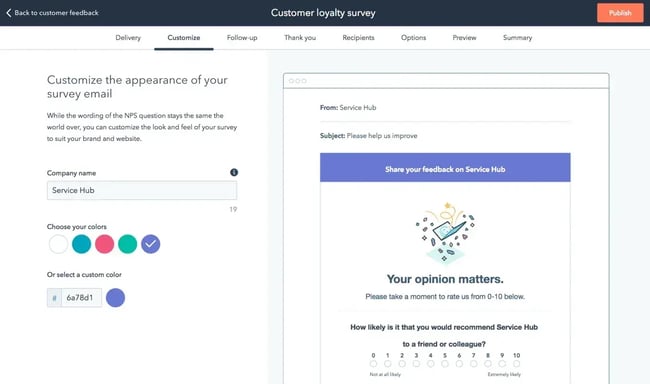
Net Promoter Score measures customer loyalty by asking how likely a customer is to recommend a company to a friend or colleague. It uses one standardized question to categorize respondents into promoters, passives, and detractors: “How likely are you to recommend our company to a friend or colleague?” Customers respond on a scale from 0 to 10:
- Promoters score 9 or 10.
- Passives score 7 or 8.
- Detractors score 0 to 6.
Net Promoter Score equals the percentage of promoters minus the percentage of detractors. The result gives a high-level view of customer loyalty and advocacy. Because NPS focuses on long-term sentiment, it helps teams identify churn risk and referral potential. Tracking changes over time is often more useful than focusing on a single score.
Net Promoter Score surveys can be collected through . Responses are stored on CRM contact records, allowing teams to review loyalty feedback alongside customer interactions and lifecycle data. Calculate your Net Promoter Score using .

2. Customer Satisfaction Score
Customer Satisfaction Score measures how satisfied customers are with a specific interaction, product, or service. CSAT captures short-term satisfaction immediately after a touchpoint, such as a support ticket or purchase. CSAT surveys typically ask a question like: “How satisfied were you with your experience?”
Customers then respond using a scale, commonly:
- 1 to 5 (very dissatisfied to very satisfied)
- 1 to 7
- Or a percentage scale
The score is calculated by dividing the number of satisfied responses by the total number of responses, then multiplying by 100. Most companies define “satisfied” as the top two response options on the scale.
Because CSAT measures satisfaction at a specific moment, it helps teams evaluate individual touchpoints. Low CSAT scores can indicate friction in support, onboarding, or product usability.
Tracking customer satisfaction as a key KPI helps organizations understand whether their service experience is strong enough to support retention, loyalty, and long-term growth.
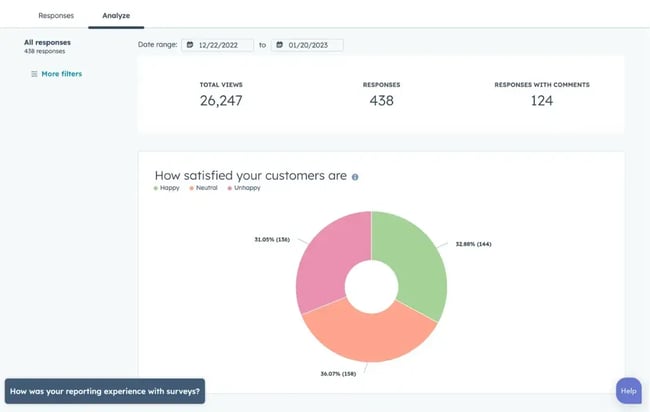
Teams can collect CSAT feedback using 黑料吃瓜网 Service Hub. Survey responses are stored in the CRM, allowing teams to review satisfaction data alongside support interactions and customer records.
3. Customer Effort Score
Customer Effort Score measures how easy it is for a customer to complete a task or resolve an issue. Unlike satisfaction metrics, CES focuses on friction. The lower the effort required, the more likely a customer is to stay loyal.
For example, customer success teams might deploy a post-interaction question on the website help chat like, “How easy was it to resolve your issue today?”
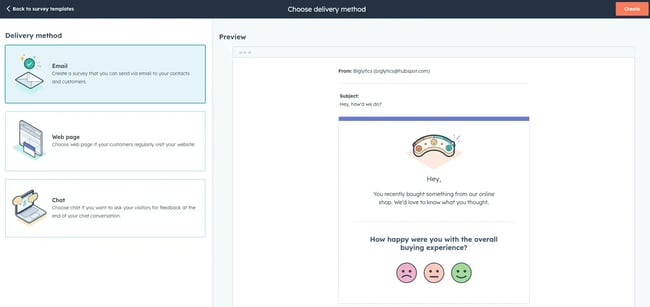
Customers respond on a numerical or agreement scale. Scores are averaged to produce a final Customer Effort Score with higher scores indicating a smoother experience.
In , teams can send Customer Effort Score surveys after support interactions using the customer feedback tools. Results are stored on contact records and can be reviewed alongside ticket pipelines and response times. This allows support leaders to connect reported effort with actual workflow data.

CES is especially useful for support and onboarding teams. If customers consistently report high effort, the issue is often procedural rather than emotional. Because CES measures friction at the moment of interaction, it highlights operational gaps that broader loyalty metrics might miss.
With preferring self-service options over speaking directly with a support rep, reducing friction in product/website workflows and knowledge bases becomes essential to improving the overall customer experience.
4. Abandonment Rate
Abandonment Rate measures the percentage of users who start a process but leave before completing it. Common examples include cart abandonment, form abandonment, and onboarding abandonment. If 1,000 users begin checkout and 300 complete it, the abandonment rate is 70%.
Abandonment Rate highlights friction in conversion paths. High abandonment often signals pricing confusion, form complexity, unexpected fees, slow load times, or unclear next steps. Because it reflects real user behavior, Abandonment Rate provides direct insight into where prospects disengage.
Unlike satisfaction metrics, Abandonment Rate does not rely on customer feedback. It relies on interaction data. That makes it especially useful for marketing, product, and growth teams.
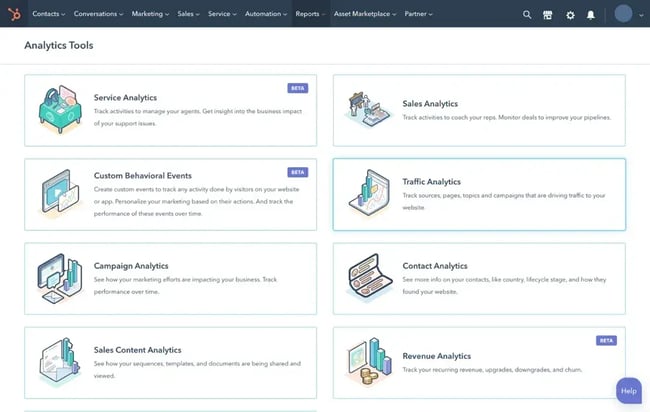
In , teams can analyze abandonment by reviewing form submissions, deal stage progression, and contact activity across the customer journey map. Because interaction history, form data, and deal records live in one system, teams can identify where prospects drop off and which steps in the funnel create friction. Identify where prospects disengage using 黑料吃瓜网 CRM.
5. Customer Health Score
Customer Health Score is a metric that measures the overall strength of a customer relationship. It combines multiple data points to predict retention, expansion potential, or churn risk. Unlike single metrics such as NPS or CSAT, Customer Health Score pulls from behavioral, financial, and engagement signals. Common inputs include:
- Product usage frequency.
- Support ticket volume.
- NPS or CSAT results.
- Contract value and renewal date.
- Feature adoption.
- Email or content engagement.
Each company defines its own scoring model. Some assign weighted values to different behaviors. Others use simple scoring tiers such as green, yellow, and red to flag account risk.
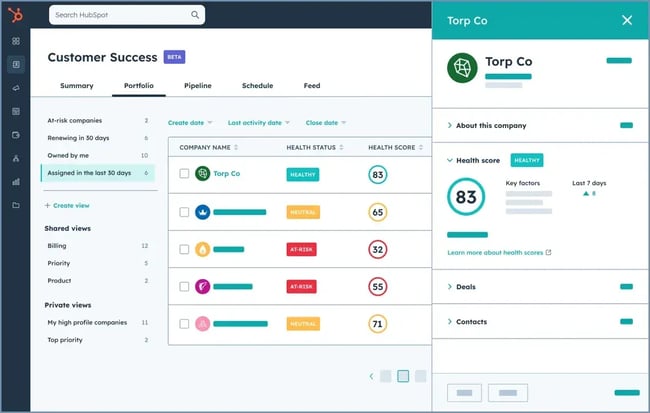
Customer Health Score helps customer success teams prioritize outreach. Accounts with declining health can be flagged for intervention. Accounts with strong health may signal an expansion or an upsell opportunity.
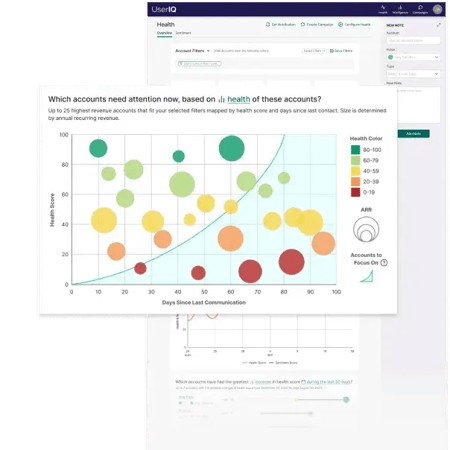
In , teams can configure Customer Health Scores inside the Customer Success Workspace. Health scores combine signals such as support activity, lifecycle stage, and engagement data to help customer success teams monitor account health and identify customers that may require attention. using 黑料吃瓜网 Service Hub.
George Fraguio, VP of Lending at Vaster Capital, highlights the importance of customer loyalty programs in assessing customer health: "If you offer customer loyalty programs, observe how many of your customers opt for them and how often they use them. This will reveal not only your customer acquisition and retention rate, but how loyal these customers are. If they are willing to sign up for a customer loyalty program, this means that they are truly invested and committed to sticking around on a long-term basis."
Free Customer Service Metrics Calculator
Calculate your business's key metrics and KPIs for customer support, service, and success with this free template.
- Customer Acquisition Cost
- Customer Lifetime Value
- Customer Satisfaction Score
- And More!
Download Free
All fields are required.
Form not available
You're all set!
Click this link to access this resource at any time.
6. First Response Time
First Response Time measures how long it takes for a team to respond to a customer’s initial inquiry. It tracks the time between when a ticket, email, or message is received and when a human reply is sent. The formula is straightforward:
Time of first reply ? Time of initial inquiry
Average First Response Time is calculated across all tickets within a given period. Faster response times are associated with higher customer satisfaction and lower escalation rates. Slow responses often increase frustration, repeat inquiries, and churn risk. According to , 82% of customers expect immediate problem resolution from customer service agents.
Unlike survey-based metrics, First Response Time is fully operational. It reflects internal processes, staffing levels, and workload distribution.

In , teams can review First Response Time using . Support leaders can analyze response times across reps, teams, channels, or ticket priority to understand how quickly customer inquiries are addressed.
7. First Contact Resolution
First Contact Resolution (FCR) measures the percentage of customer issues that are fully resolved during the first interaction. An interaction can include a phone call, live chat session, or initial email exchange.
The formula is:
(Number of cases resolved on first contact ÷ Total number of cases) × 100
A higher First Contact Resolution rate indicates that customers are getting answers without follow-ups, transfers, or repeat tickets. say customers expect issues to be resolved in three hours or less, so FCR is an important contributor to overall satisfaction rates.
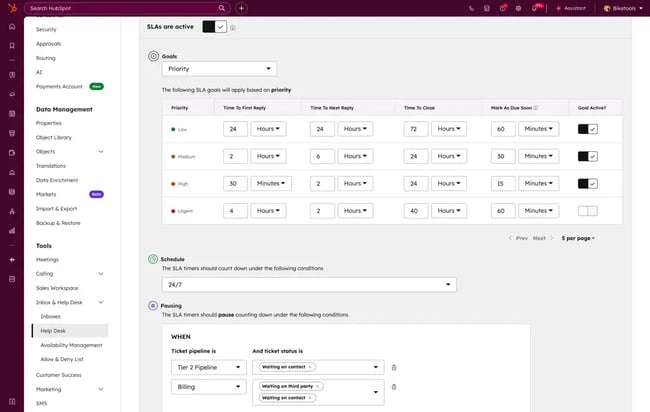
FCR reflects effectiveness, not speed. A team can respond quickly but still requires multiple back-and-forth exchanges. First Contact Resolution measures whether the issue was actually solved. High FCR is often linked to:
- Clear documentation.
- Strong agent training.
- Access to accurate customer data.
- Proper ticket routing.
Low FCR can signal knowledge gaps, poor handoffs, or incomplete information during the initial interaction.
8. Ticket Resolution Time
Ticket Resolution Time measures how long it takes to fully resolve a customer support ticket. It tracks the total time between when a ticket is created and when it is marked closed. Average Ticket Resolution Time is calculated across all tickets within a defined period.
Unlike First Response Time, which measures the speed of initial reply, Ticket Resolution Time reflects how efficiently issues move through the support process. Long resolution times may indicate complex cases, internal handoffs, unclear ownership, or limited staffing capacity.
In , teams can review Ticket Resolution Time using help desk reporting and service analytics. Support leaders can analyze how long it takes to resolve tickets across reps, teams, ticket status, or priority levels.
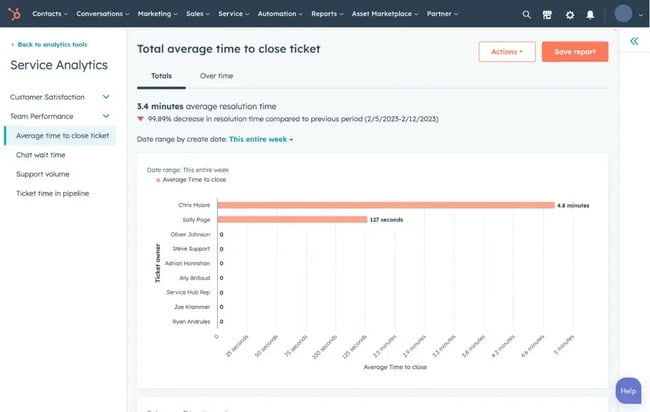
Ticket Resolution Time is primarily an operational KPI for customer success teams, as it reflects how well tools and teams are set up to resolve customer queries quickly and effectively. For example, shows that 92% of CRM leaders say AI has improved their customer response times, so team members can focus on closing more complex tickets faster.
Monitoring this metric helps teams identify bottlenecks in ticket pipelines and prioritize operational improvements. Segmenting by issue type or priority level often reveals where delays occur.
9. Average Ticket Time
Average Ticket Time measures how long support teams actively spend handling a ticket. It focuses on agent workload rather than total time from creation to closure. While Ticket Resolution Time tracks the full lifecycle of a case, Average Ticket Time isolates the working time associated with resolving it. The formula typically looks like:
Total time spent handling tickets ÷ Number of tickets
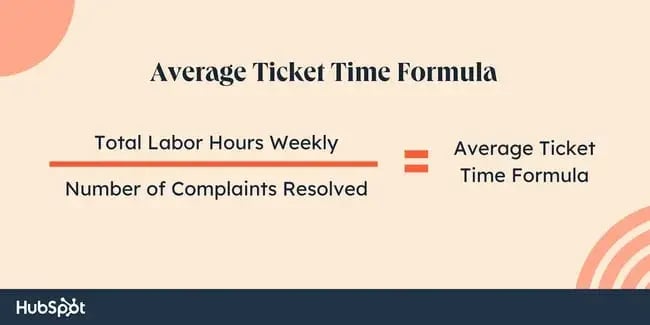
This metric helps teams understand operational efficiency and capacity. If Average Ticket Time increases, it may signal more complex issues, unclear documentation, or product usability challenges. If it decreases significantly, it may indicate process improvements or stronger knowledge resources.
Average Ticket Time is especially useful for workforce planning. It helps managers forecast staffing needs and evaluate productivity across reps or teams. For instance, one full-time employee and two part-time employees may equate to 80 labor hours. If a team resolves 40 tickets in a week, the average ticket time is two hours.
provides reporting on Average Ticket Time through its . Managers can review how long tickets take to handle across reps, ticket categories, or priority levels to identify trends in support workload and efficiency.
10. Customer Retention Rate
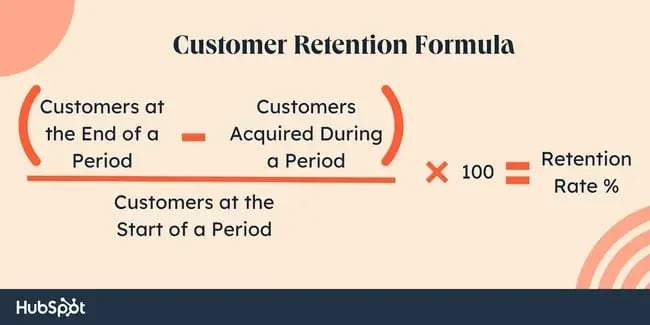
Customer Retention Rate measures how well a company keeps its existing customers over time. It reflects long-term satisfaction, consistent value delivery, and overall relationship strength.
Retention is typically reviewed monthly, quarterly, or annually. Looking at trends over time helps teams understand whether improvements in onboarding, support, or product adoption are translating into sustained revenue to help them measure customer experience throughout the entire lifecycle.
Because retention is influenced by multiple factors, it is often analyzed alongside engagement signals such as product usage, support history, renewal timing, and expansion activity. This gives teams a clearer picture of which customers are stable and which may be at risk.
In practice, teams track Customer Retention Rate inside their CRM by monitoring lifecycle stages, renewal pipelines, and subscription records. In , teams can review lifecycle stages, deal records, and engagement history to understand Customer Retention Rate across the customer journey. AI-powered tools can also help summarize activity and surface insights from customer data.
11. Customer Churn Rate
Customer Churn Rate measures the percentage of customers who stop doing business with a company over a specific period. It reflects lost revenue, disengagement, or contract cancellations.
Churn is often analyzed monthly, quarterly, or annually. Reviewing churn trends helps teams understand whether retention efforts, onboarding improvements, or product updates are reducing customer loss over time.
Customer churn and retention can vary greatly by industry. For instance, the Energy/Utilities industry has the lowest average churn rate at 11%, . In other words, they enjoy the highest customer retention rate at 89%.
Churn can be segmented by:
- Customer cohort.
- Product line.
- Pricing tier.
- Acquisition channel.
This segmentation helps teams identify whether churn is isolated to specific groups or reflects a broader experience issue.
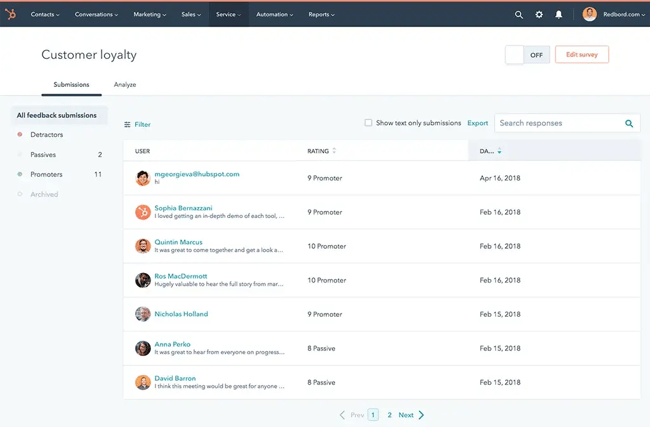
Customer Churn Rate can be analyzed in by reviewing a customer’s interaction history, deal activity, and support records over time. Because the CRM captures engagement across marketing, sales, and service, teams can better understand the behaviors that often precede churn.
Because churn directly impacts recurring revenue and growth efficiency, even small increases can significantly affect long-term performance. Try this to get started.
12. Customer Lifetime Value
Customer Lifetime Value measures the total revenue a business can expect from a customer over the duration of the relationship. It reflects purchasing behavior, retention length, and overall account value.
Unlike churn or retention, which focus on whether customers stay, CLV focuses on how much value they generate over time. Higher lifetime value often indicates strong onboarding, product adoption, and expansion success.
Customer Lifetime Value is typically evaluated alongside acquisition cost and retention trends. When CLV increases, teams can justify higher acquisition investment and prioritize long-term relationship building over short-term wins.
CLV is usually tracked inside a CRM using deal records, subscription data, and renewal history since it depends on accurate revenue and lifecycle data. In 黑料吃瓜网 for example, teams can analyze lifetime revenue by contact or company and segment by acquisition source, product line, or cohort. This makes it easier to identify which customer segments drive the most long-term value.
|
Industry Benchmarks for Key Customer Satisfaction Metrics |
||
|
Metric |
Benchmark/Industry Average |
Source |
|
Net Promoter Score |
32 |
|
|
Customer Satisfaction Score |
77.3% |
|
|
Customer Effort Score |
5.5 - 6.0 (out of a possible 7 score) |
|
|
Abandonment Rate |
Cart Abandonment: 70.22% Call Abandonment: 5-8% Form Abandonment: 48% |
|
|
First Response Time |
35 seconds (live chat) Under 24 hours (email) |
|
|
First Contact Resolution |
70 - 79% |
|
|
Ticket Resolution Time |
3 days 10 hours |
|
|
Average Ticket Time |
11 minutes 37 seconds |
|
|
Customer Retention Rate |
73.1% |
|
|
Customer Churn Rate |
3.27% (all industries) |
|
How to Improve Customer Satisfaction Metrics
Tracking customer satisfaction metrics is only the first step. Improving them requires operational alignment across support, sales, marketing, and product teams.
Customer expectations have evolved. Faster response times and proactive communication are baseline requirements. When teams fail to meet them, satisfaction scores decline, churn increases, and revenue becomes less predictable.
Improving customer satisfaction metrics means reducing friction across the entire customer journey. That includes response speed, resolution quality, onboarding experience, self-service effectiveness, and long-term relationship management.
shows that 78% of customers expect more personalized interactions than ever before. Teams are under increasing pressure, with 75% of teams receiving more tickets in 2024 than in previous years.
Because these factors are interconnected, teams need visibility into both experience data and operational data. When satisfaction metrics are analyzed alongside ticket performance, lifecycle stage, engagement history, and renewal trends inside a unified CRM, it becomes easier to identify what is driving improvement and what is causing decline.
1. Reduce friction across support channels.
Customer satisfaction declines when customers encounter delays, inconsistent messaging, or repeated handoffs. Reducing friction across chat, email, phone, and self-service channels improves both response speed and resolution quality.
Teams need to standardize workflows, clarify ownership, and eliminate unnecessary transfers. Monitoring ticket volume by channel and identifying bottlenecks helps uncover where delays occur.
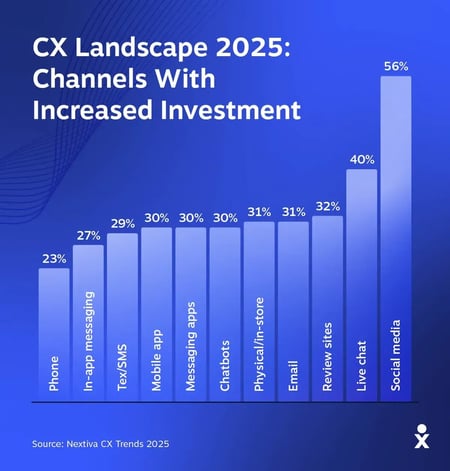
When support data is centralized inside a shared CRM, teams gain visibility into conversation history and lifecycle stage. This prevents customers from repeating information and increases the likelihood of faster, more accurate resolutions.
2. Connect satisfaction metrics to revenue signals.
Customer satisfaction metrics are most useful when analyzed alongside revenue data. Viewing CSAT, retention, and churn in isolation limits insight.
Teams can identify which accounts require proactive attention by connecting support performance with renewal dates and contract value inside the CRM. Patterns such as declining engagement or repeated low survey responses often signal churn risk.
AI-powered reporting can surface accounts showing behavioral shifts, allowing customer success teams to intervene before dissatisfaction impacts revenue. In fact, found that 92% of CRM leaders say AI has improved response times.
Free Customer Service Metrics Calculator
Calculate your business's key metrics and KPIs for customer support, service, and success with this free template.
- Customer Acquisition Cost
- Customer Lifetime Value
- Customer Satisfaction Score
- And More!
Download Free
All fields are required.
Form not available
You're all set!
Click this link to access this resource at any time.
3. Move from reactive to proactive customer management.
Reactive service models focus on resolving tickets after problems occur. Proactive models identify risk earlier.
Customer health scoring, product usage monitoring, and engagement tracking help teams anticipate issues before customers submit a ticket. Reviewing trends in support interactions and onboarding milestones provides early warning signals.
When customer data is unified, teams can automate follow-up sequences and renewal reminders based on risk thresholds. AI-assisted insights make it easier to detect patterns that would otherwise require manual analysis.
4. Strengthen self-service and knowledge systems.
Well-structured self-service resources reduce ticket volume and improve first contact resolution. Knowledge bases, guided onboarding content, and in-product help tools allow customers to solve simple issues independently.
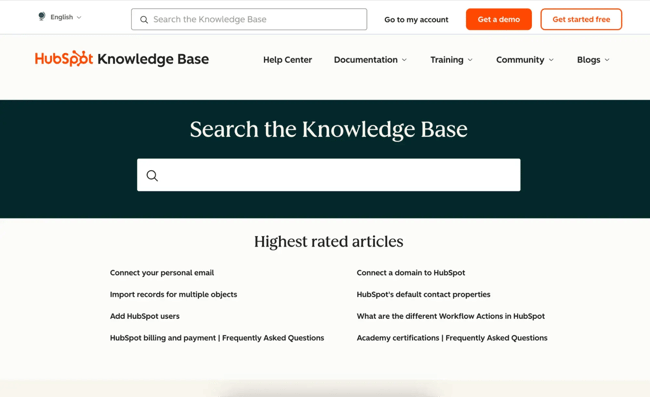
Teams should regularly review which articles are most viewed, which tickets are repeatedly submitted, and where documentation gaps exist. Improving clarity and accessibility in these resources often reduces average ticket time and resolution delays.
AI-powered search and content recommendations can help customers find relevant answers quickly while assisting agents with suggested responses during live interactions.
5. Automate service workflows with AI.
Automation improves consistency across growing support teams. Repetitive tasks such as ticket categorization, routing, follow-up reminders, and response drafting can be handled through workflow automation.
AI tools can summarize conversations and recommend next actions based on prior interactions. This reduces manual effort and allows agents to focus on complex or high-impact cases.
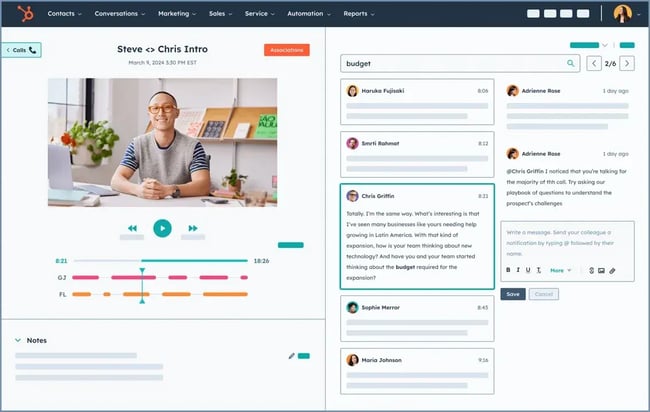
When automation and AI are integrated into a unified CRM, teams can improve response time and long-term retention without increasing headcount at the same pace as ticket volume.
Customer Satisfaction Metrics Examples
The Hustle uses embedded feedback to monitor audience satisfaction.
includes a feedback prompt at the end of its newsletter, asking readers to rate the content. This allows the team to use customer experience metrics to measure satisfaction at the moment of consumption rather than relying solely on open or click rates.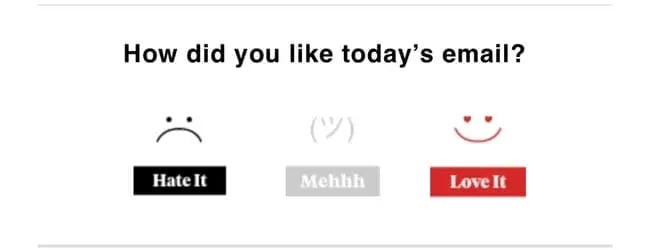
This approach supports tracking:
- Customer Satisfaction Score through direct feedback.
- Engagement metrics such as open rate and click-through rate.
- Long-term subscriber behavior, which can contribute to a broader customer health view.
By combining survey responses with engagement data, The Hustle can evaluate both how readers feel and how they behave.
Readers select a satisfaction option at the end of the newsletter. When a reader chooses a response, they are prompted to share additional context. This provides both quantitative and qualitative feedback tied to a specific issue of the newsletter.
The team can review satisfaction alongside metrics such as open frequency and subscription duration since responses are associated with subscriber records. This structure could enable The Hustle to:
- Identify content themes that resonate with readers.
- Detect recurring dissatisfaction signals.
- Adjust editorial strategy based on feedback trends.
- Monitor changes in satisfaction over time.
The Hustle creates an ongoing measurement loop by embedding feedback directly into the newsletter experience. Rather than evaluating performance only through engagement metrics, they can incorporate direct sentiment signals into editorial decision-making.
Care Station Medical Group collects post-visit feedback via SMS.
uses SMS to request patient feedback after an appointment. Rather than limiting feedback collection to email or in-person forms, the organization sends a follow-up message with a survey link shortly after the visit.
This approach embeds satisfaction measurement directly into the patient journey. An SMS-based survey can support tracking multiple customer satisfaction metrics, including:
- Customer Satisfaction Score to measure overall visit satisfaction.
- Customer Effort Score to assess how easy it was to schedule, check in, or receive care.
- Net Promoter Score to evaluate long-term patient loyalty.
By combining these metrics, Care Station can evaluate both immediate experience quality and broader relationship strength.
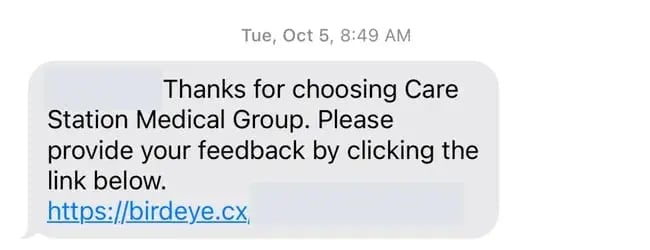
The survey link is delivered via text message after the appointment. This method can increase response volume compared to email-based surveys because SMS typically has high open rates.
Survey responses can potentially be tied to patient records, appointment type, location, or provider. This would allow the organization to analyze trends across facilities, services, or time periods. With structured feedback collected consistently after visits, Care Station can:
- Identify operational friction points, such as wait times or administrative challenges.
- Monitor satisfaction trends across locations.
- Detect early warning signs of declining patient experience.
- Adjust staffing, scheduling, or communication processes.
By integrating post-visit surveys into the service workflow, organizations like Care Station create a repeatable system for measuring and improving customer satisfaction at scale.
Airbnb uses two-sided reviews to monitor guest and host experience.
Airbnb embeds satisfaction measurement directly into its platform through a two-sided review system. After each stay, both guests and hosts are prompted to rate their experience and leave written feedback.

This structure allows Airbnb to collect structured ratings and qualitative comments immediately after the service interaction. Airbnb’s review system supports tracking multiple experience signals, including:
- Star ratings for overall stay satisfaction.
- Category-level ratings such as cleanliness, communication, and accuracy.
- Written feedback that provides context behind ratings.
- Host and guest review history over time.
After a stay is completed, Airbnb prompts both parties to submit a review within a defined time window. Ratings are structured, typically using a five-star scale, and are accompanied by optional written comments.
Airbnb can analyze satisfaction trends across properties and geographic regions because reviews are tied to individual listings and guest profiles. This model enables Airbnb to:
- Identify listings with consistently low ratings.
- Detect recurring operational issues, such as cleanliness or communication gaps.
- Influence search visibility and ranking based on review performance.
- Strengthen trust within the marketplace by displaying transparent feedback.
Airbnb maintains a continuous feedback loop across both sides of its platform by combining structured ratings with written reviews and booking behavior. This multi-metric system allows experience quality to be monitored at scale rather than relying on isolated survey responses.
Zoom collects post-meeting product feedback inside the product.
Zoom collects customer feedback immediately after a meeting ends. Users may see a short in-product prompt asking, “How was your experience?” with structured response options such as “Great” or “Had Issues.”
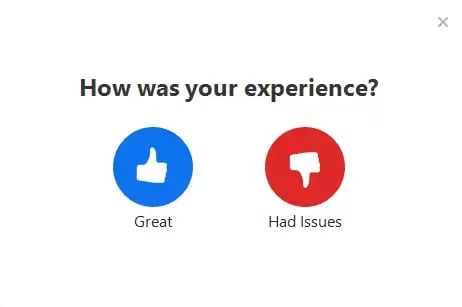
Because the prompt appears directly inside the application, feedback is gathered at the moment of interaction rather than through a separate survey campaign. This approach supports tracking:
- Post-meeting satisfaction responses.
- Frequency of reported issues.
- Engagement signals such as meeting duration and usage patterns.
When paired with product usage data, satisfaction responses provide both sentiment and behavioral context. The feedback modal appears automatically after a meeting session concludes. Users select a structured option, which creates standardized data points that can be aggregated across meetings and accounts.
Individual session Feedback can be used for measuring customer satisfaction by analyzing the metric alongside technical indicators such as connection quality, meeting length, or feature usage. This structure enables organizations like Zoom to:
- Monitor real-time service quality.
- Identify recurring technical issues.
- Detect patterns in negative experience reports.
- Compare satisfaction across user segments or meeting types.
By embedding short, structured prompts directly into the product workflow, Zoom captures immediate sentiment while also collecting interaction data. This multi-metric approach provides visibility into both perceived experience and platform performance.
Frequently Asked Questions About Customer Satisfaction Metrics
What is a KPI for customer satisfaction?
A KPI for customer satisfaction is a measurable indicator used to evaluate how customers perceive their experience with a company. In this context, KPIs quantify loyalty, ease of interaction, retention, and overall sentiment. Common customer satisfaction KPIs include:
- Customer Satisfaction Score.
- Net Promoter Score.
- Customer Effort Score.
- Customer Retention Rate.
- Customer Churn Rate.
- First Contact Resolution.
- Customer Lifetime Value.
Each KPI measures a different aspect of the customer relationship. Some focus on short-term experience, while others track long-term loyalty and revenue impact.
What are the 7 different ways to measure customer satisfaction?
There are multiple ways to measure customer satisfaction, depending on whether the focus is sentiment, behavior, or revenue impact. Seven common methods include:
- Customer Satisfaction Score through post-interaction surveys.
- Net Promoter Score to measure the likelihood to recommend.
- Customer Effort Score to assess friction.
- First Contact Resolution to measure issue resolution efficiency.
- Abandonment Rate to track drop-offs in customer journeys.
- Customer Retention Rate to monitor loyalty over time.
- Customer Churn Rate to measure lost customers.
Organizations often combine survey-based metrics with behavioral data to gain a complete view of satisfaction.
What is the 5-point customer satisfaction scale?
The 5-point customer satisfaction scale is a survey format commonly used in Customer Satisfaction Score surveys. Customers are asked to rate their experience on a scale from 1 to 5, where 1 typically represents very dissatisfied and 5 represents very satisfied.
To calculate CSAT using a 5-point scale, companies typically divide the number of satisfied responses by the total number of responses and multiply by 100. Satisfied responses are usually defined as ratings of 4 or 5.
This format is widely used because it is simple, standardized, and easy to analyze across large customer groups.
Measuring Customer Satisfaction
Customer satisfaction metrics give organizations a structured way to measure how customers experience their products, services, and support interactions. When teams monitor both sentiment metrics like Net Promoter Score and operational metrics like response time or resolution rate, they gain a clearer understanding of where customer experience succeeds and where it breaks down.
Businesses can identify friction points earlier, improve service performance, and strengthen long-term customer relationships by consistently tracking these metrics and connecting them to workflows inside a CRM or support platform.
Net Promoter, Net Promoter System, Net Promoter Score, NPS and the NPS-related emoticons are registered trademarks of Bain & Company, Inc., Fred Reichheld and Satmetrix Systems, Inc.
Editor's note: This post was originally published in May 2019 and has been updated for comprehensiveness.
Free Customer Service Metrics Calculator
Calculate your business's key metrics and KPIs for customer support, service, and success with this free template.
- Customer Acquisition Cost
- Customer Lifetime Value
- Customer Satisfaction Score
- And More!
Download Free
All fields are required.
Form not available
You're all set!
Click this link to access this resource at any time.