


Keeping your customers is harder than ever, and also more valuable. Retaining a customer costs less than a third of acquiring one, and existing customers generate, on average, 10% more revenue than new ones, . Yet most companies neglect a customer success strategy until something goes wrong.

Great customer success strategies in 2026 are proactive. They align your team, clarify what “success” means for your customers, and give you a repeatable way to deliver value at every stage of the relationship.
Whether you’re in SaaS, professional services, or any other industry, the tips and insights below will help you build a plan that improves retention, drives expansion, and turns customers into advocates.
A Customer Success Strategy Framework
Every company’s journey with its customers is different, but in this article, we share a general customer success methodology that any business, from any industry, can use as a framework to build an effective customer success program.
Expectations will vary among customers, as will what you want to accomplish, but no matter what, understanding and proactively improving your customer experience will contribute to customer success long term.
Let’s break it down.
7 Smart Customer Success Playbooks
Step-by-step guidance, proven strategies, and industry best practices to help you overcome challenges and achieve remarkable results.
- Execute a churn mitigation plan
- Highlight customer progress
- Reengage a disengaged customer
- And more!
Download Free
All fields are required.
Form not available
You're all set!
Click this link to access this resource at any time.
What is a customer success strategy?
A customer success strategy is a structured plan for helping customers reach their goals using your business’ product or service, so they stay, grow, and refer others to do the same. It covers everything from setting expectations before the sale to identifying upsell opportunities years into the relationship.
In some ways, I’ve always seen it as a more modern account management, but with a greater focus on experience than on sales.
Customer success is proactive by design. Rather than waiting for problems to surface, a customer success strategy anticipates customer needs at each stage of the journey and puts systems in place to meet and overcome them faster.
Why a Customer Success Strategy Matters
Without a clear strategy, both your customers and team feel the impact. Customer success becomes reactive and inconsistent, creating a less-than-delightful experience for buyers and your efforts become harder to measure for your team.
Here’s why getting intentional about customer success strategy pays off:
- Retention. Keeping a customer is less expensive and more lucrative than trying to get a new one. In fact, customer-focused organizations report 51% better customer retention than those that aren’t. A proactive strategy is the foundation for getting there.
- Revenue growth. What organization doesn’t want more revenue? , those with the most sophisticated value realization and customer success practices produce higher net revenue retention (NRR) than peers with basic practices in place.
- Advocacy. Social proof speaks louder than your own marketing. That’s why satisfied customers can actually be your best salespeople. A loyalty-focused customer success strategy creates a steady pipeline of return business, upgrades, references, case studies, positive reviews, and referrals.
Lastly, cross-functional alignment is both a requirement for and result of an improved customer success strategy.
Forrester’s research also found that customer-focused companies grow revenue 28% faster, achieve 33% higher profitability growth, and experience 43% better customer retention rates than non-customer-focused companies. That kind of performance cannot occur without the efforts of sales, marketing, product, and support as a whole.
The 4 Pillars of Customer Success
Before diving into specific strategies, it helps to understand the foundation they’re built on.
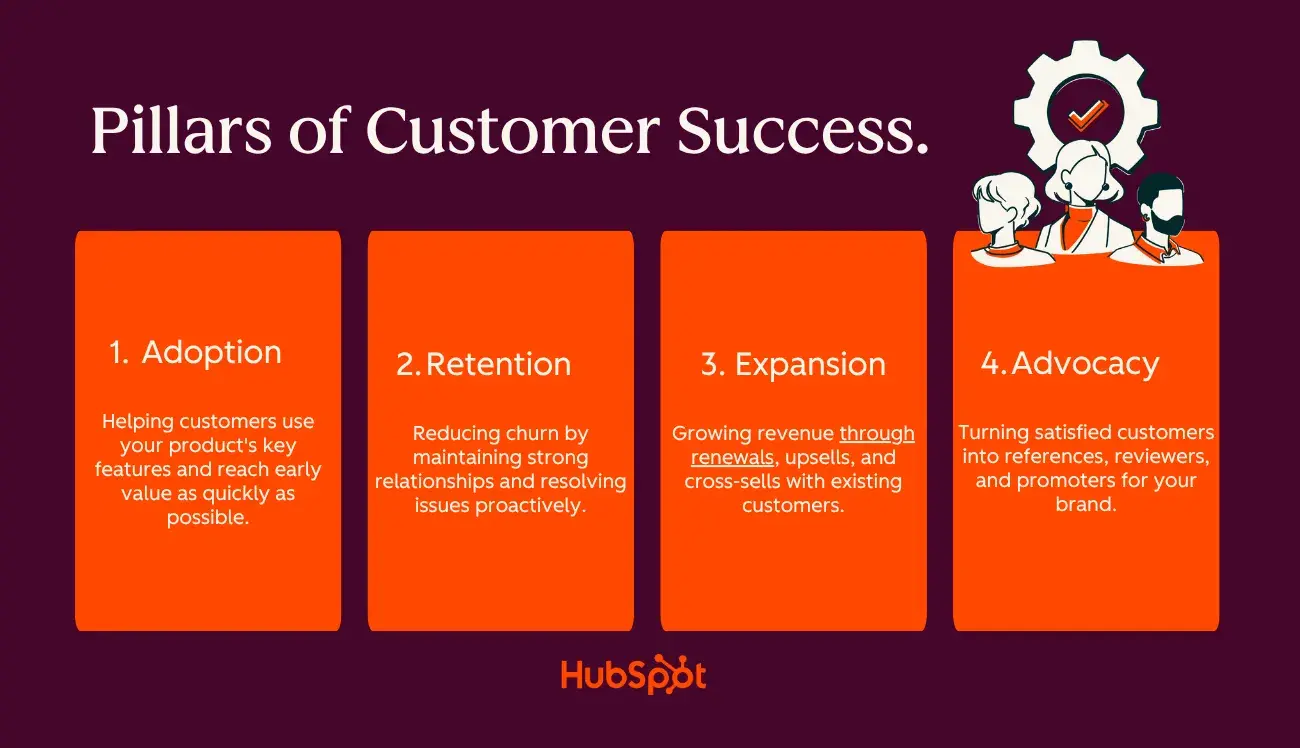
Every high-performing customer success program is designed around four core outcomes or “pillars”, reflecting actual stages of a customer’s relationship with your business and what your team needs to protect and grow at each one.
A customer who adopts your product but never fully sees the value won’t renew. A customer who renews but never expands represents untapped revenue. And a customer who never becomes an advocate is a missed opportunity for your most credible, cost-effective growth channel: word of mouth. Miss any pillar, and the whole structure weakens.
Think of these four pillars as your strategic compass to keep your customer success strategy strong and intentional. Every initiative, metric, and team decision should map back to at least one of them:
- Adoption. Helping customers use your product’s key features and reach early value as quickly as possible.
- Retention. Reducing churn by maintaining strong relationships and resolving issues proactively.
- Expansion. Growing revenue through renewals, upsells, and cross-sells with existing customers.
- Advocacy. Turning satisfied customers into references, reviewers, and promoters for your brand.
7 Smart Customer Success Playbooks
Step-by-step guidance, proven strategies, and industry best practices to help you overcome challenges and achieve remarkable results.
- Execute a churn mitigation plan
- Highlight customer progress
- Reengage a disengaged customer
- And more!
Download Free
All fields are required.
Form not available
You're all set!
Click this link to access this resource at any time.
How to Build a Customer Success Strategy: 7 Steps & Customer Success Strategy Best Practices
A customer success strategy isn’t a single document or a team charter. It’s an operational system that connects your customer’s goals to your internal processes, your data, and your people. So, how do you build a customer success strategy?
Here are some best practices to keep in mind.
Step 1: Define what success looks like for your customers.
You can’t lead your customer to success if you don’t know what success looks like to them, and this “value” varies from customer to customer. A logistics company may want leads, while a local business may want foot traffic into their shop.
So, before you build anything, get specific about what “success” actually means for the customers you serve.
What outcome did they buy your product to achieve? What does progress look like at 30, 90, and 180 days?
Start by segmenting your customer base. Without clear segmentation, your team ends up applying the same playbook to accounts with very different needs, and the ones that don’t fit will quietly churn.
Document success criteria for each segment and make them visible across every team that touches the customer: sales, onboarding, support, and CS.
Pro tip: Customer success begins long before anyone signs a contract. The customers most likely to succeed with your product are the ones who were the right fit from the start. That means your marketing needs to attract the qualified people, not just a lot of people.
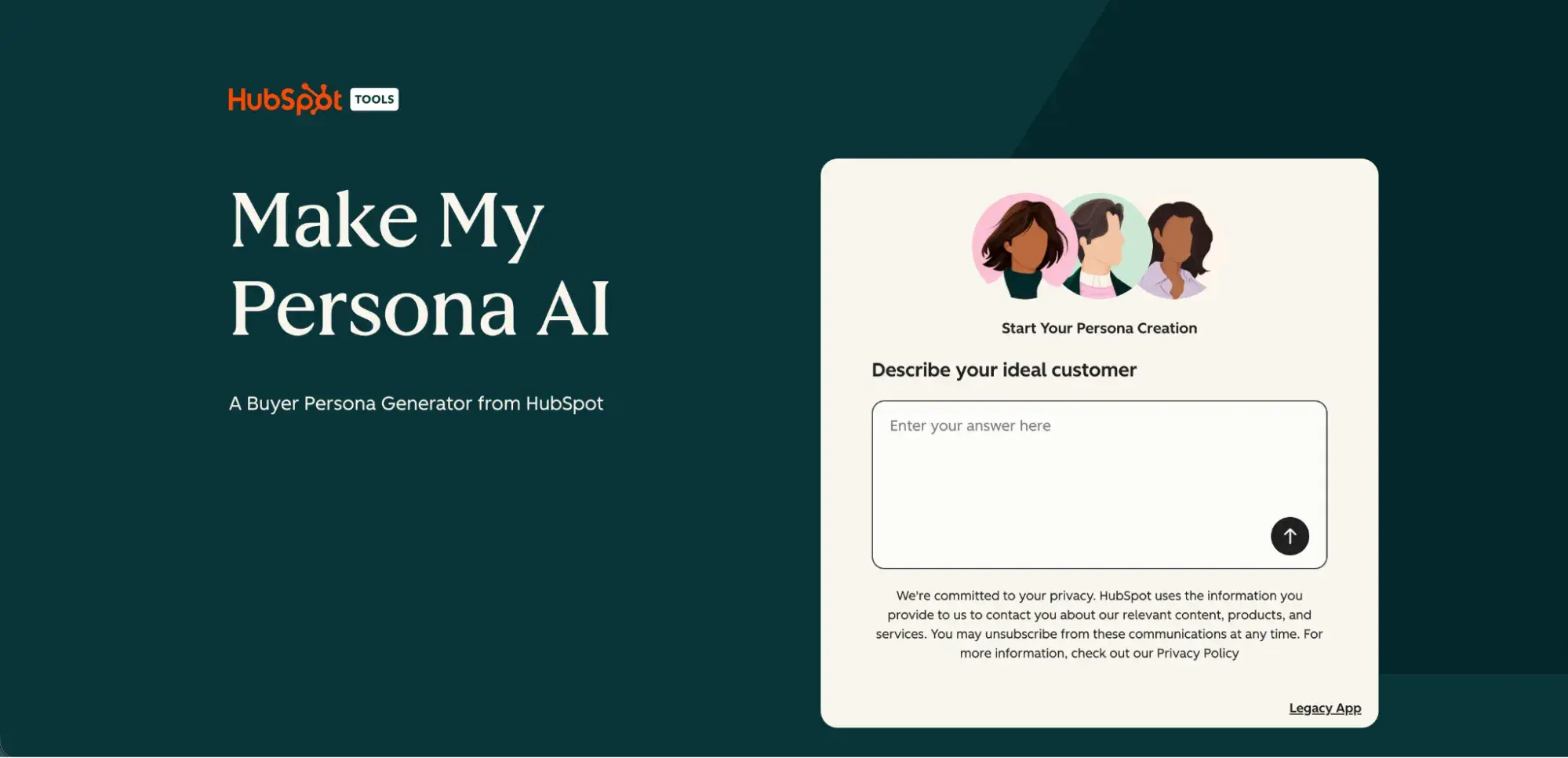
Start with a clear definition of your ideal customer profile (ICP) or buyer persona. Build your messaging, content, and targeting around that profile and will you naturally attract prospects more likely to adopt, retain, and expand successfully.
Use to build and document buyer personas your whole team can reference for their work. Misaligned expectations at the awareness stage become churn problems six months later. Clarity now saves rescue calls later.
Step 2: Map your customer journey.
Once you know what success looks like, map the path to get there. A customer journey map identifies every significant touchpoint and flags where customers typically get stuck, disengage, or churn.
Pay particular attention to transitions such as sales to onboarding, onboarding to adoption, and adoption to renewal. identified these ownership transitions as a leading source of friction, wasted effort, and poor customer experience in B2B. Smoothing them out removes some of the most predictable churn risks in the entire lifecycle.
Featured resource: 黑料吃瓜网 offers seven free templates to help you get started.

Pro tip: Align on the customer journey across the organization. One thing I learned early on in my agency days was that what marketing and sales promise, customer success and service have to deliver. When those teams aren’t aligned, expectations break down fast, and unhappy customers or worse, churn, follow.
Draft a shared journey that marketing, sales, and CS all sign off on. It should define your ICP, what value you deliver, and what each team is responsible for at each stage of the customer journey. It should also outline that:
- Product and marketing make sales teams fully aware of the offers available and the messaging being used.
- Sales loops in customer success or operations before a deal closes, especially for complex accounts.
- Every stakeholder who touches the prospect before close works from the same playbook. That means discovery call notes, use-case specifics, and any custom commitments should live in a shared CRM so everyone has the same resources available.
lets you build and visualize customer lifecycle stages directly in your CRM, so every team can see where each account stands at any point in the journey.
7 Smart Customer Success Playbooks
Step-by-step guidance, proven strategies, and industry best practices to help you overcome challenges and achieve remarkable results.
- Execute a churn mitigation plan
- Highlight customer progress
- Reengage a disengaged customer
- And more!
Download Free
All fields are required.
Form not available
You're all set!
Click this link to access this resource at any time.
Step 3: Assign clear ownership.
Customer success touches sales, marketing, product, and support — which means accountability easily falls through the cracks. Every stage of the customer journey needs a named owner responsible for outcomes, not just activity.
This doesn’t mean one team owns everything. It means that, for each phase, someone is accountable for the customer’s progress and empowered to act when things go off track.
Pro tip: Create a simple RACI (Responsible, Accountable, Consulted, Informed) matrix for your customer journey. It takes an hour to build and eliminates months of ambiguity.
Step 4: Build a customer health scoring model.
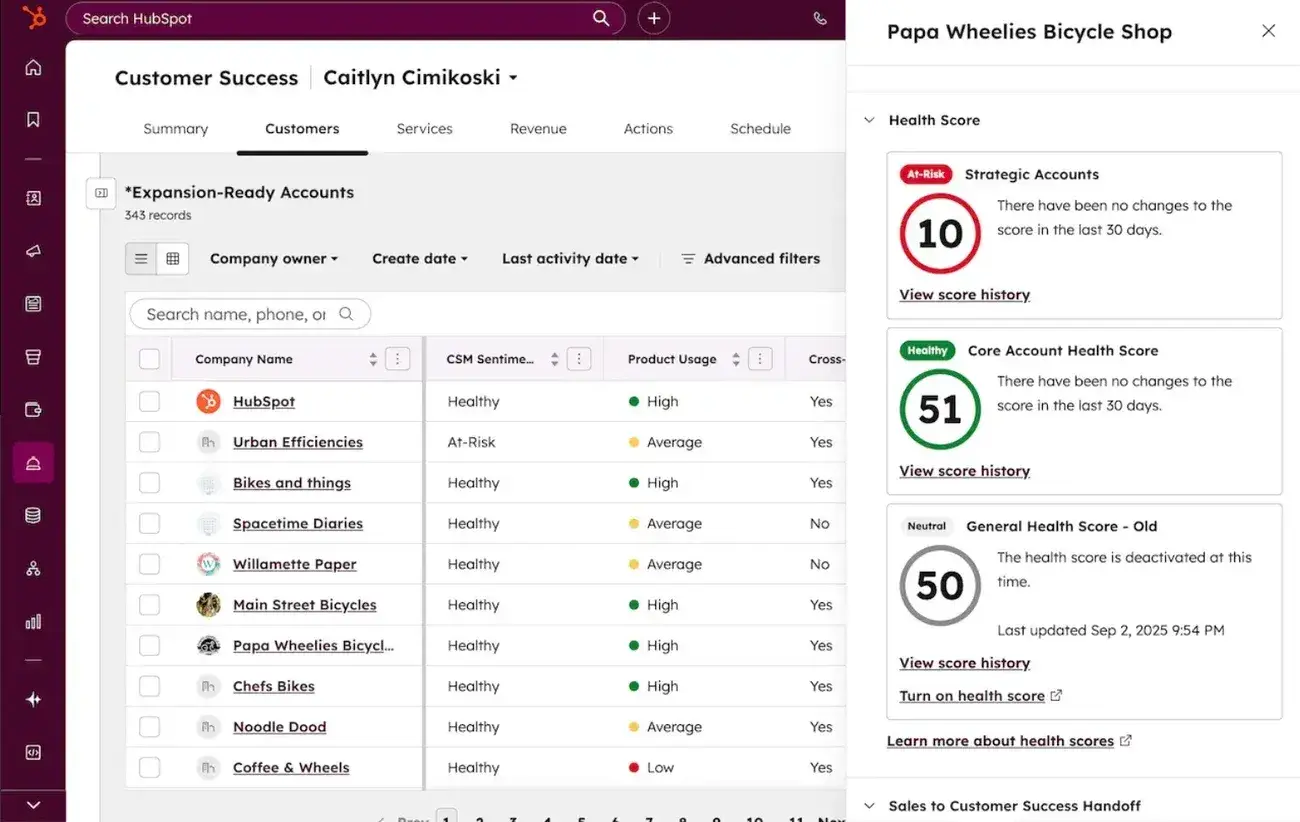
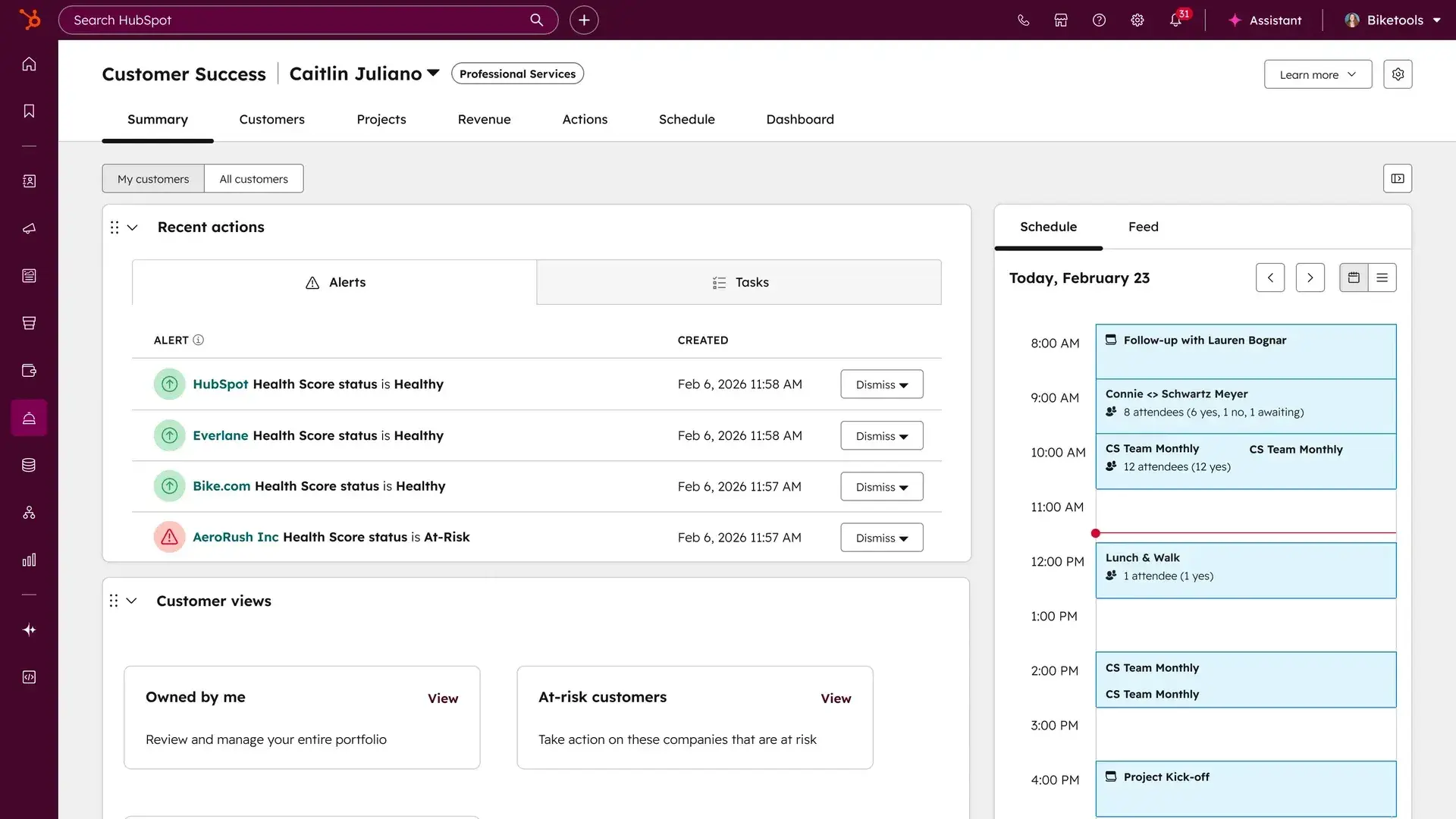
A health score is your early warning system. It combines signals into a single indicator of account risk or opportunity, and it was also a common factor among companies that produce the highest NRR.
Customer health signals can include data on:
- Product usage
- Login frequency
- Support ticket volume
- NPS responses
- Engagement with CS touchpoints
Start simple: pick three to five signals that most reliably predict churn or expansion in your customer base, weight them, and build from there.
has built-in health scoring tools that surface at-risk accounts automatically, so your team can prioritize proactively rather than reactively.
Step 5: Define your engagement cadence.
research noted that top-performing B2B SaaS companies embed outcome-based conversations regularly, including at critical moments in the customer journey, such as renewals and upsell opportunities.
Decide in advance how often you’ll connect with customers — and at what level. A typical cadence might include:
- Weekly or biweekly: Check-ins for new or at-risk accounts
- Monthly: Progress reviews tied to adoption milestones
- Quarterly: Business reviews focused on outcomes and expansion
- Annually: Strategic alignment with executive stakeholders
The cadence should flex based on customer tier and health score. High-touch accounts need more frequent contact; digitally-led accounts can be supported at scale through automated touchpoints and self-serve resources.
Regular check-ins (whether quarterly or more frequent) create space for candid conversations about what’s working and what isn’t. But don’t just report on outputs. Tie your conversations to the business outcomes customers actually care about: revenue, time saved, risk reduced, growth achieved.
Pro tip: Don’t leave expansion or customer growth conversations to chance. Define in advance the specific health signals (see step 5) that an account is ready for an upsell, cross-sell, or renewal conversation, and build those triggers into your CRM.
Expansion signals typically include consistent high product usage, milestone achievement, a positive QBR, an NPS score above a set threshold, or a significant business change at the account.
When those signals appear, tools like 黑料吃瓜网’s Smart CRM can automatically notify your customer success manager and even send emails to start the conversation.
Step 6: Define your KPIs and reporting cadence.
Decide how you’ll measure your strategy’s performance. Pick a few leading and lagging indicators (we’ll discuss those next), assign owners, and establish a regular reporting cadence.
The goal isn’t to track everything. It’s to track the right things consistently enough to spot trends early, course-correct fast, and demonstrate the revenue impact of customer success to the rest of the business.
Step 7: Build your onboarding process and playbook.
Now, we bring everything together in your onboarding playbook.
Onboarding is a big moment. It’s when customers determine, consciously or not, whether they made the right choice in buying from you. Get it right, and you build momentum. Get it wrong, and you’re already fighting churn.
Don’t believe me? found that effective onboarding is the most critical on-ramp to customer value, with faster time to value ranking as the primary driver of revenue retention and account growth in B2B. Get your customers to their first meaningful “aha moment” as quickly as possible.
Develop an onboarding playbook. This is the most important operational document your CS team will produce. It should define who does what, in what order, by when, and what “done” looks like at each milestone.
A strong playbook covers:
- Handoff from sales
- Opening call cadence
- Product activation steps
- Early success milestone
- Accountable parties accountable
- Criteria for graduating a customer from onboarding to ongoing success
Pro tip: includes SLA management, call tracking, customer portals, and a host of other customer success management tools that let you build repeatable onboarding processes for your customers. Use them to set up workflows, track account health, and automate follow-up check-ins based on the customer’s journey stage.
How to Measure Your Customer Success Strategy
Strategies need scorecards. Here are the six customer success metrics every team should track:
Net Revenue Retention (NRR). The percentage of recurring revenue retained from existing customers after accounting for churn, downgrades, upsells, and expansions. An NRR above 100% means you’re making more from your existing customers.
Gross Revenue Retention (GRR). Revenue retained from existing customers, excluding any expansion. GRR measures your ability to hold your base — nothing more. A healthy GRR is typically 85–90% or higher in SaaS.
Churn Rate. The percentage of customers (or revenue) lost over a given period. You want this number as low as possible.
Customer Health Score. A composite signal that combines product usage, engagement, support activity, and account risk into a single score. The higher, the healthier.
Net Promoter Score (NPS). A measure of customer sentiment and advocacy likelihood. Useful as a leading indicator, a dropping NPS often signals churn risk before it shows up in revenue data.
Time to Value (TTV). This is how long it takes a new customer to reach their first meaningful outcome. For example, signing up for a streaming service and watching your first show or buying an email marketing software and uploading a contact this. You want this to time period to be as short as possible.
Track these metrics in 黑料吃瓜网’s customer success dashboard to spot trends early and prioritize the right accounts.
Frequently Asked Questions About Customer Success Strategy
What are the 4 pillars of customer success?
The four pillars are adoption, retention, expansion, and advocacy.
- Adoption focuses on helping customers reach value early.
- Retention focuses on keeping them.
- Expansion focuses on growing revenue through upsells and renewals.
- Advocacy focuses on turning satisfied customers into active promoters of your brand.
What’s the difference between a CSM and a CRM?
The short version? CSMs are people, CRMs are things.
A CSM (Customer Success Manager) is someone responsible for helping customers achieve their goals and grow with your product. CRM refers to Customer Relationship Management software that stores customer data and interactions, often used by CSMs. is built to support both CS teams and the cross-functional workflows they depend on.
What does a customer success strategy look like in practice?
In practice, a customer success strategy looks like having:
- A documented onboarding process
- Defined success criteria for each customer segment
- Cadence of proactive check-ins
- A health-scoring model to flag at-risk accounts
- A clear playbook for expansion conversations.
Companies using can build these workflows directly into their CRM so CS, sales, and support all work from the same customer data.
Build a customer success strategy that sticks and scales.
Customer success is a discipline, not a department. And like any discipline, it only works when it’s practiced consistently, measured honestly, and owned across the whole organization.
You don’t need a perfect strategy on day one. You just need a clear starting point with defined success criteria, a mapped journey, the right owners in place, and a health scoring model that keeps your team one step ahead of churn.
Build those fundamentals right, and the retention and revenue follow naturally.
brings together customer success management, support, and customer data in one platform — so your team spends less time searching for information and more time actually helping customers succeed.
Start building your strategy today.
Editor's note: This post was originally published in May 2025 and has been updated for comprehensiveness.
7 Smart Customer Success Playbooks
Step-by-step guidance, proven strategies, and industry best practices to help you overcome challenges and achieve remarkable results.
- Execute a churn mitigation plan
- Highlight customer progress
- Reengage a disengaged customer
- And more!
Download Free
All fields are required.
Form not available
You're all set!
Click this link to access this resource at any time.