


Customer success is a proactive business function that helps customers achieve the outcomes they expected when they bought a product or service. In software-as-a-service (SaaS) and subscription businesses, customer success supports adoption, retention, renewal, expansion, and advocacy.

This guide explains what customer success means, how it differs from customer service, support, and customer experience, which metrics matter, and how teams can build or scale a customer success program. It also covers customer success management, digital customer success, and software such as Service Hub.
Use this as you work through the guide.

What is customer success?
Customer success (CS) is a proactive business function that helps customers achieve measurable outcomes with a product or service. Customer success teams define those outcomes, remove barriers, and guide customers toward value throughout the relationship.
Customer success differs from customer support because it begins before a problem occurs and continues across onboarding, adoption, renewal, expansion, and advocacy. The function became prominent in SaaS and subscription businesses, where recurring revenue depends on customers continuing to receive value.
Why is customer success so important?
Customer success supports retention, renewal, expansion, and advocacy by helping customers reach value and continue using the product. Those outcomes protect recurring revenue and give the business more opportunities to grow existing accounts.
In , 74% of respondents said most of their company’s revenue came from existing customers. That finding makes retention and expansion a core revenue concern for SaaS teams.
Customer success can improve business outcomes by:
- Reducing customer churn.
- Increasing renewal rates and overall customer satisfaction.
- Boosting revenue through retention and identifying upsell and cross-sell opportunities.
- Building a base of customers who refer peers, participate in case studies, share feedback, and recommend the product.
Customer success works best when onboarding, support, product education, and ongoing account management reinforce one another. Together, those functions help customers realize value sooner and provide the business with clearer signals about retention risk.

Free Net Promoter Score (NPS) Kit
Take control of your customer loyalty metrics with our complete NPS template + calculator.
- Easy-to-use NPS calculator
- Score interpretation tool
- Copy-and-paste survey template
- And more!
Download Free
All fields are required.
Form not available
You're all set!
Click this link to access this resource at any time.
What is customer success management?
Customer success management combines the people, processes, data, and technology a business uses to help customers achieve value over time. It turns customer outcomes into a repeatable operating strategy.
A customer success manager (CSM) owns or leads the ongoing customer relationship after the sale. Depending on the company’s structure, CSMs may report to a head of customer success, a service leader, or a revenue executive.
Customer success management supports retention, renewals, expansion, and advocacy by connecting customer goals with measurable product value.
Key Responsibilities of Customer Success Managers
- Help representatives guide customers toward measurable product or service outcomes that support retention.
- Hire, train, and coach customer success representatives on engagement, retention, and product knowledge.
- Develop and maintain the organization’s customer success strategy.
- Create the playbooks, templates, and education materials the customer success team needs.
- Segment customers by factors such as contract value, lifecycle stage, product adoption, and business size so the team can match each account with the right engagement model.
- Resolve escalated customer success issues and coordinate cross-functional follow-up.
- Collect through conversations and surveys.
- Analyze feedback, account performance, and retention trends to evaluate and improve the customer success strategy.
Customer success team structures vary with customer complexity, contract value, product complexity, and company size. A small team may combine onboarding and ongoing success, while a larger team may separate onboarding, customer success management, enablement, operations, renewals, and support.
Customer success also works closely with sales, especially during the handoff and expansion stages. Learn how customer success differs from sales.
People exploring the role can also review customer success career paths, responsibilities, and advancement options.
The diagram below shows one possible structure with separate teams for onboarding, ongoing customer success, and technical issues.
In this example, one team manages onboarding, another manages ongoing customer outcomes, and a technical team handles individual issues and requests.
Separating these responsibilities can clarify ownership while preserving collaboration across the customer journey.
Customer Success Metrics and KPIs That Matter
Customer success metrics show whether customers are adopting the product, reaching value, renewing, and expanding. Teams should track leading indicators that signal future risk and lagging indicators that report completed outcomes.
1. Net Revenue Retention (NRR)
NRR measures how much recurring revenue a company keeps and grows from its existing customer base over a set period. It factors in three things:
- Expansion revenue from upsells and cross-sells.
- Downgrades from customers shrinking their plans.
- Churn from customers who left entirely.
Calculate NRR by adding expansion revenue to starting recurring revenue, subtracting contraction and churned revenue, dividing the result by starting recurring revenue, and multiplying by 100. An NRR above 100% means expansion revenue exceeded contraction and churn for that customer cohort.
For example, suppose a company starts the quarter with $1m in recurring revenue from existing accounts. By the end of the quarter, those accounts generate $1.15m after expansion, contraction, and churn.
That cohort has a 115% NRR, meaning it generated 15% more recurring revenue after accounting for expansion, contraction, and churn.
2. Monthly Recurring Revenue (MRR)
MRR measures the predictable revenue a business earns each month from active subscriptions. It separates recurring subscription revenue from one-time payments and gives teams a consistent basis for tracking growth or loss.
Customer success work can protect MRR by improving onboarding, supporting product adoption, and identifying at-risk accounts before they churn or downgrade.
Customer success leaders can segment MRR by cohort or customer tier to see where onboarding, adoption, and renewal work affect revenue.
3. Customer Lifetime Value (CLV)
CLV estimates the revenue or gross profit a business expects to generate from a customer over the entire relationship. SaaS teams commonly calculate it using average revenue, gross margin, and the expected length of the customer relationship or the corresponding churn rate.
This metric helps customer success teams decide how to allocate time and resources. For instance, a customer with a projected CLV of $50k may require a different engagement model from a customer with a projected CLV of $2k.
CLV can also inform investments in dedicated CSMs, executive business reviews, customer education, and other retention programs by comparing the expected customer value with the cost of service.
4. Churn Rate
Churn measures the percentage of customers or revenue lost during a specific period. There are two types of churn:
- Customer churn tracks the percentage of customer accounts lost.
- Revenue churn tracks the percentage of recurring revenue lost.
Revenue churn can reveal risks that customer-count churn obscures, because a single large account may generate more revenue than several small accounts. High churn can point to problems with onboarding, product fit, adoption, service quality, or sustained value.
Customer success teams can compare exit interviews, support histories, product usage, and segment data to identify recurring causes of churn. Those patterns help the team prioritize the issues it can address.
5. Customer Health Score
A customer health score combines multiple data points into a single metric that predicts the likelihood that an account will renew, expand, or churn. Most scores pull from inputs like:
- Product usage and login frequency.
- Feature adoption depth.
- Support ticket volume and sentiment.
- Engagement with the CSM or training resources.
- Survey responses.
The score itself is usually color-coded (green, yellow, red) so CSMs can scan their book of business and immediately see which accounts need a check-in. A green account might get a quarterly touchpoint, while a red one triggers an urgent intervention.
The power of a health score lies in its ability to shift CS from reactive firefighting to proactive account management.
6. NPS and CSAT
These two survey-based metrics capture how customers feel, which usage data alone can’t capture.
- Net Promoter Score (NPS) asks customers how likely they are to recommend the product on a scale of 0 to 10. It’s a measure of overall loyalty and long-term sentiment.
- Customer satisfaction (CSAT) measures satisfaction with a specific interaction, such as a support ticket resolution or onboarding session. It captures a particular moment rather than the entire relationship.
Used together, they give CS teams both the big picture and the close-up.
A high NPS with dipping CSAT scores might mean customers still love the product but are getting frustrated with service quality, which is exactly the kind of insight that helps CS teams course-correct before sentiment turns into churn.
Free Net Promoter Score (NPS) Kit
Take control of your customer loyalty metrics with our complete NPS template + calculator.
- Easy-to-use NPS calculator
- Score interpretation tool
- Copy-and-paste survey template
- And more!
Download Free
All fields are required.
Form not available
You're all set!
Click this link to access this resource at any time.
Leading and Lagging Indicators
Not all metrics tell the same story.
Lagging indicators like churn rate and NRR show what has already happened. They’re useful for measuring outcomes and reporting to leadership, but by the time the number lands, the customer has already renewed, expanded, or walked away.
Leading indicators such as product adoption, engagement, onboarding progress, and customer health scores can warn teams about future risk before a customer leaves or downgrades.
The most effective CS programs track both. Leading indicators drive the daily work, like which accounts to call, which playbooks to run, and where to focus the team. Lagging indicators then confirm whether that work is actually moving retention and revenue in the right direction.
|
KPI type |
Metric |
What it measures |
How customer success teams use it |
|
Leading |
Product adoption |
How frequently and deeply customers use the product and its key features. |
Identify customers who may need education, outreach, or assistance in realizing value. |
|
Leading |
Engagement signals |
Customer activity, such as logins, email responses, training attendance, and meetings with a CSM. |
Spot declining engagement before it affects renewal or retention. |
|
Leading |
Onboarding milestones |
Progress toward setup, activation, training, and initial value. |
Find customers who have stalled and intervene before onboarding delays affect adoption. |
|
Leading or lagging, depending on timing |
NPS and CSAT |
Customer sentiment after a particular experience or at a specific point in the relationship. |
Use journey-based feedback as an early warning signal and review completed scores to assess past experiences. |
|
Lagging |
Net revenue retention |
Recurring revenue retained from existing customers after expansion, contraction, and churn. |
Evaluate whether retention and expansion offset revenue losses. |
|
Lagging |
Renewal rate |
The percentage of eligible customers or contracts that renew. |
Measure whether customers continue their relationships with the business. |
|
Lagging |
Gross churn |
Customers or recurring revenue lost during a given period, excluding expansion revenue. |
Quantify completed customer and revenue losses. |
|
Lagging |
Expansion revenue |
Additional revenue from existing customers through upgrades, added seats, or complementary products. |
Measure growth within the existing customer base. |
|
Lagging |
Customer lifetime value |
The expected revenue or gross profit generated during the full customer relationship. |
Assess the long-term financial value of retention and expansion. |
No metric is automatically leading or lagging in every context. Its role depends on when the team measures it and whether it signals a future outcome or reports one that has already occurred.
How Customer Success Differs From Customer Support and CX
Customer success, customer support, and customer experience (CX) contribute to the customer relationship in different ways. Customer support resolves specific problems, customer success helps customers receive long-term value, and CX shapes the overall experience across every touchpoint.
|
Function |
Role |
Timing |
Primary focus |
Where it overlaps |
Common metrics |
|
Customer support |
Resolves questions and product or service issues. |
Primarily reactive. |
Fast, accurate resolution. |
Shares issue patterns and customer context with success and CX teams. |
First-response time, resolution time, ticket backlog, and CSAT. |
|
Customer success |
Helps customers achieve their desired outcomes and continue to receive value. |
Proactive throughout the customer lifecycle. |
Adoption, retention, renewal, expansion, and advocacy. |
Uses sales, product, support, and feedback data to guide accounts. |
Product adoption, health score, renewal rate, churn, and NRR. |
|
Customer experience |
Shapes the customer’s perception of the company across all interactions. |
End-to-end, from discovery through post-purchase use. |
Consistency, ease, trust, and overall sentiment. |
Includes interactions with marketing, sales, the product, support, and customer success. |
NPS, CSAT, customer effort score, and journey-level. |
These functions work best when they exchange context. Support can surface recurring issues, customer success can connect those issues with account goals and adoption data, and CX teams can identify patterns across the full journey.
Customer success and account management can also overlap around renewals and expansion, although account management often carries more direct commercial ownership. Compare customer success and account management.
How does customer success work?
A customer success lifecycle typically moves through onboarding, adoption, value realization, renewal, expansion, and advocacy. Teams support that lifecycle with a clear strategy, defined processes, trained people, reliable customer data, and technology that turns those elements into repeatable work.
Most customer success programs need three operational components:
- Customer success software that centralizes context and supports repeatable workflows.
- A customer success manager and team with clear ownership.
- A customer success strategy and account-level plan.
1. Choose and use a customer success solution.
Customer success software ranges from dedicated platforms such as Gainsight and Vitally to connected customer service and CRM products such as Service Hub. The right choice depends on the customer journey, data sources, engagement model, and reporting needs.
When it’s set up well, the right stack helps CS teams track customer health, manage every interaction in one place, and automate the repetitive work that eats up a CSM’s day.
Customer success leaders should evaluate:
- Integration depth. The tool should connect cleanly with the CRM, support platform, and product analytics already in use, since data silos hold CS programs back.
- Health scoring. The software should combine usage, sentiment, and engagement data into a clear, actionable view for CSMs.
- Automation and playbooks. The platform should support automated workflows for onboarding, check-ins, and renewals, so CSMs spend less time on manual outreach.
- Reporting. Strong dashboards and segmentation make it easier to track NRR, churn, and adoption across customer tiers and surface trends before they become problems.
2. Hire and train a dedicated team.
Customer success requires clear ownership. A dedicated team can run proactive onboarding, adoption, renewal, and expansion work instead of treating those responsibilities as an add-on to support or sales.
Customer success representatives teach customers how to use the product, connect features with business goals, and identify risks before renewal. Team size should reflect customer volume, account complexity, and the chosen engagement model.
Pro tip: Scale the customer success team as the customer base grows. When CSM workloads rise, teams have less time for proactive adoption and renewal work.
3. Create a clear customer success strategy.
A customer success strategy defines how the business will help different customer segments reach value. A customer success plan turns that strategy into an account-level roadmap with desired outcomes, milestones, owners, engagement cadence, risks, and measures of success.
Most customer success strategies include the following steps:
- Assign ownership to a customer success team.
- Choose customer success software that connects the required customer data and workflows.
- Document each segment’s desired outcomes and barriers to success.
- Create a customer success plan with short- and long-term milestones, owners, and measures.
- Share the strategy across sales, onboarding, product, support, and customer success teams.
- Measure whether customers reach the expected milestones and receive the support they need.
- Revise the strategy, engagement models, and team structure as the customer base changes.
Pro tip: For more guidance and best practices, grab our .
The 4 Pillars of Customer Success
The four pillars below describe how customer value can grow across the lifecycle. Adoption supports retention, retention creates expansion opportunities, and successful outcomes can lead to advocacy.
Adoption
This is the stage where customers actually start using the product and weave it into their daily workflows. Real adoption isn’t just logging in once or twice; it’s customers hitting key milestones that prove the product delivers value.
For a project management tool, that might look like a team creating their first three projects, inviting collaborators, and setting up recurring tasks within the first 30 days. Without product adoption, everything downstream falls apart.
Retention
Once customers adopt the product, the team helps them continue receiving enough value to renew their contracts or keep their subscriptions active. Retention shows whether that value continues beyond the initial onboarding period.
CSMs drive customer retention through regular check-ins, business reviews, and quick interventions when usage dips or sentiment turns negative.
Expansion
Expansion is about growing the value of an existing customer relationship over time. As customers get more out of the product and their own needs evolve, there are natural openings to deepen the partnership and grow the account, including:
- Upsells: moving to a higher tier.
- Cross-sells: adding complementary products.
- Seat growth: adding more users to the account.
For example, a marketing team that started with a basic analytics plan might expand to the enterprise tier once it needs custom dashboards and SSO.
Expansion revenue grows an existing account after the customer has established a relationship with the business and received value from the product.
Advocacy
The final pillar turns successful customers into vocal champions.
Advocacy can include referrals, case studies, public reviews, participation in events, and introductions to peers. These activities give prospective customers evidence from people who have used the product.
CSMs typically identify advocates through high NPS scores and strong account health, then partner with the marketing team to activate them.
These four pillars form a continuous loop across the customer journey.
Adoption lays the foundation, retention protects the relationship, expansion grows it, and advocacy brings new customers into the funnel, restarting the cycle.
Teams can use these four pillars as a cohesive framework for planning customer goals, activities, and metrics across the customer lifecycle.
Read: Scaling Customer Success — The Complete Guide (+Expert Tips)
Free Net Promoter Score (NPS) Kit
Take control of your customer loyalty metrics with our complete NPS template + calculator.
- Easy-to-use NPS calculator
- Score interpretation tool
- Copy-and-paste survey template
- And more!
Download Free
All fields are required.
Form not available
You're all set!
Click this link to access this resource at any time.
Customer Success Software Tools to Know
Customer success software helps teams centralize account context, monitor health, coordinate outreach, and measure retention. The tools below support different parts of that work, from connected customer service products to shared inboxes and feedback platforms.
1.
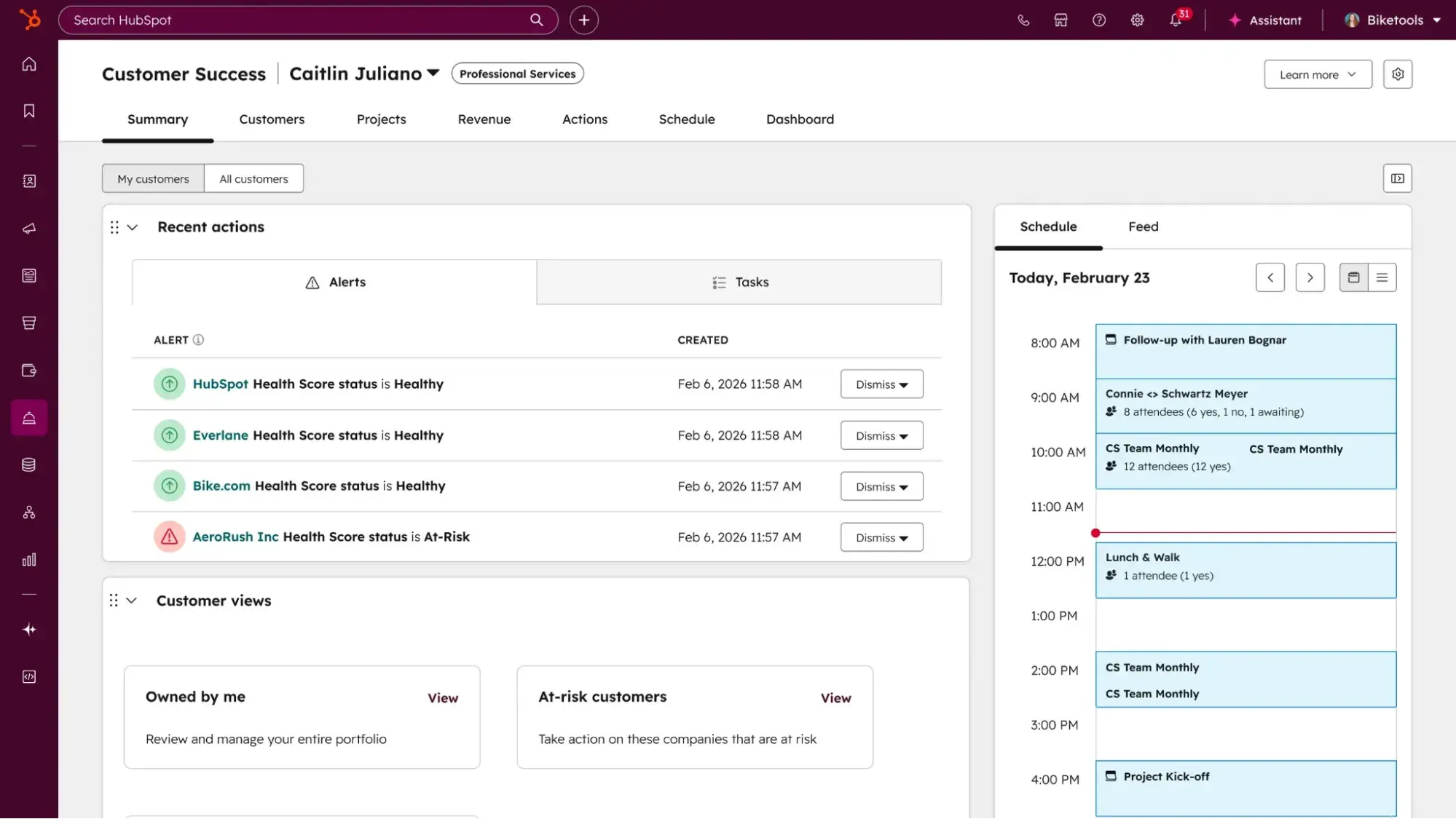
Service Hub is 贬耻产厂辫辞迟’蝉 customer service software for managing support and customer success on one platform. It connects , ticketing, , , , , and the with 黑料吃瓜网 Smart CRM.
Customer success teams can use the Customer Success Workspace to monitor account health, manage renewals, and prioritize outreach. can answer routine questions via email and live chat, while help desk tools route more complex issues to the appropriate people.
Key Features
- Customer Success Workspace. Monitors account health, renewals, and priority actions so CSMs can focus their outreach.
- Help desk and shared inbox. Centralizes customer conversations and tickets, then routes work across service teams.
- Knowledge base, feedback, and service analytics. Supports self-service content, collects NPS and CSAT feedback, and tracks service performance.
Best for: Teams that want customer success, support, sales, and marketing context connected to shared CRM data.
Pricing: Service Hub offers free customer service tools. Starter starts at $7 per seat per month with annual billing, or $20 per seat per month with monthly billing. Professional starts at $90 per seat per month with annual billing, or $100 per seat per month with monthly billing, and requires a one-time $1,500 onboarding fee. Enterprise starts at $150 per seat per month and requires a one-time $3,500 onboarding fee.
What we like: I use 黑料吃瓜网 for my side business, and its shared contact records and list tools help me coordinate follow-up without moving between systems. For customer success teams, that same connected context can reduce handoff gaps across service, sales, and marketing.
2.

Zendesk Suite centralizes customer conversations from email, messaging, chat, voice, and social channels in an agent workspace. Its ticketing, routing, automation, knowledge base, and reporting tools support high-volume service operations.
Customer success teams can use Zendesk interaction history to understand support patterns before check-ins, renewals, and account reviews. The platform’s rules and reporting also help service and success teams coordinate escalations.
Key Features
- Unified agent workspace. Brings customer conversations and history into one view.
- Triggers and automations. Routes, tags, and escalates tickets using rules the team defines.
- Knowledge base and analytics. Supports self-service content and tracks response, resolution, and satisfaction metrics.
Best for: Established support organizations that need configurable ticket routing, omnichannel service, and detailed operational reporting.
Pricing: Support Team costs $19 per agent per month when paid yearly. Suite Team costs $55 per agent per month, and Suite Professional costs $115 per agent per month when paid annually. Suite Enterprise + Copilot uses custom pricing. Zendesk offers a free trial.
What we like: I have managed support teams that relied on Zendesk, and its rules gave us granular control over routing, escalation, and notifications. The unified agent workspace also helped the team manage conversations across channels without losing context.
3.
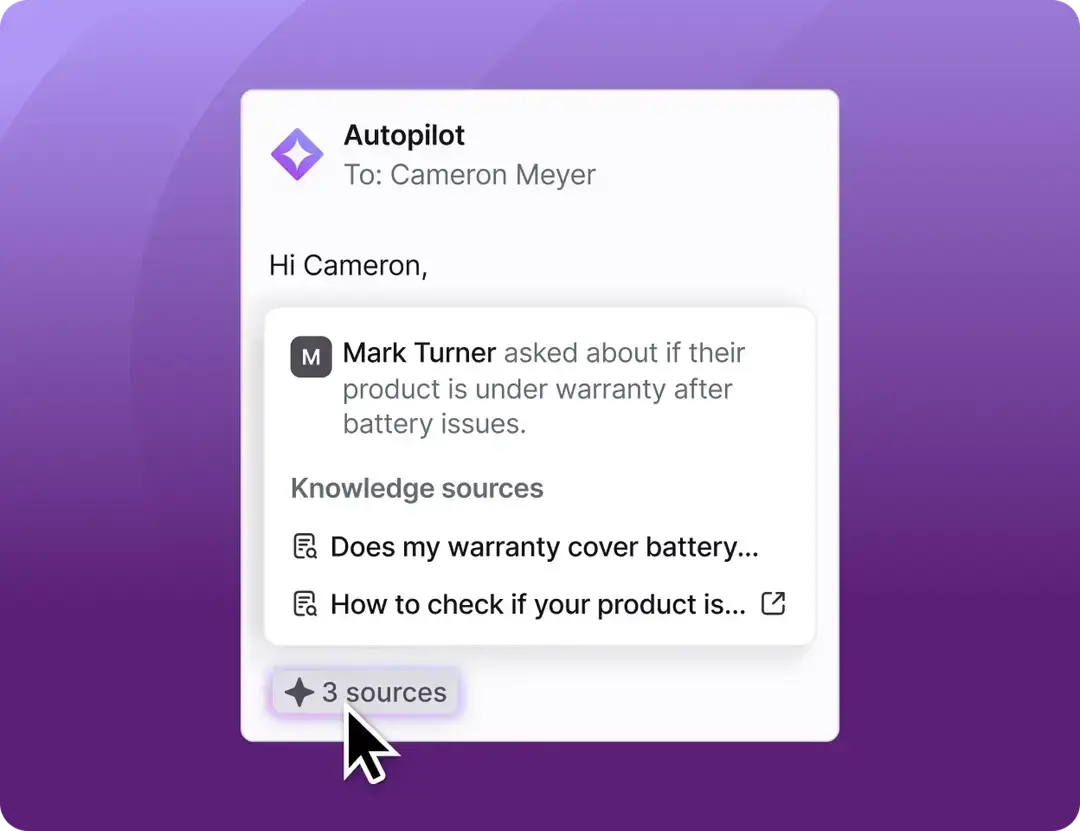
Front is a customer communication platform that combines shared inboxes, ticketing, internal collaboration, workflow automation, and analytics. Teams can assign conversations, discuss them internally, and coordinate responses without having to forward messages between systems.
Customer success teams can use Front when several people share responsibility for an account. CSMs, support representatives, and account managers can see ownership, conversation history, and internal context in the same thread.
Key Features
- Shared inboxes and assignments. Gives every conversation a visible owner and status.
- Internal comments and workflow automation. Keeps team discussion separate from the customer message and routes work using rules.
- AI and analytics. Supports reply assistance, conversation summaries, workload reporting, and customer-service analysis.
Best for: Teams that collaborate on high-volume shared inboxes or manage customer relationships across several roles.
Pricing: Starter costs $25 per seat per month for up to 10 seats when billed annually. Professional costs $65 per seat per month for up to 50 seats, and Enterprise costs $105 per seat per month. Front offers a free trial.
What we like: Front keeps internal discussion separate from the customer conversation, reducing forwarding and tool switching. That structure works especially well when several teammates share responsibility for the same account.
4.
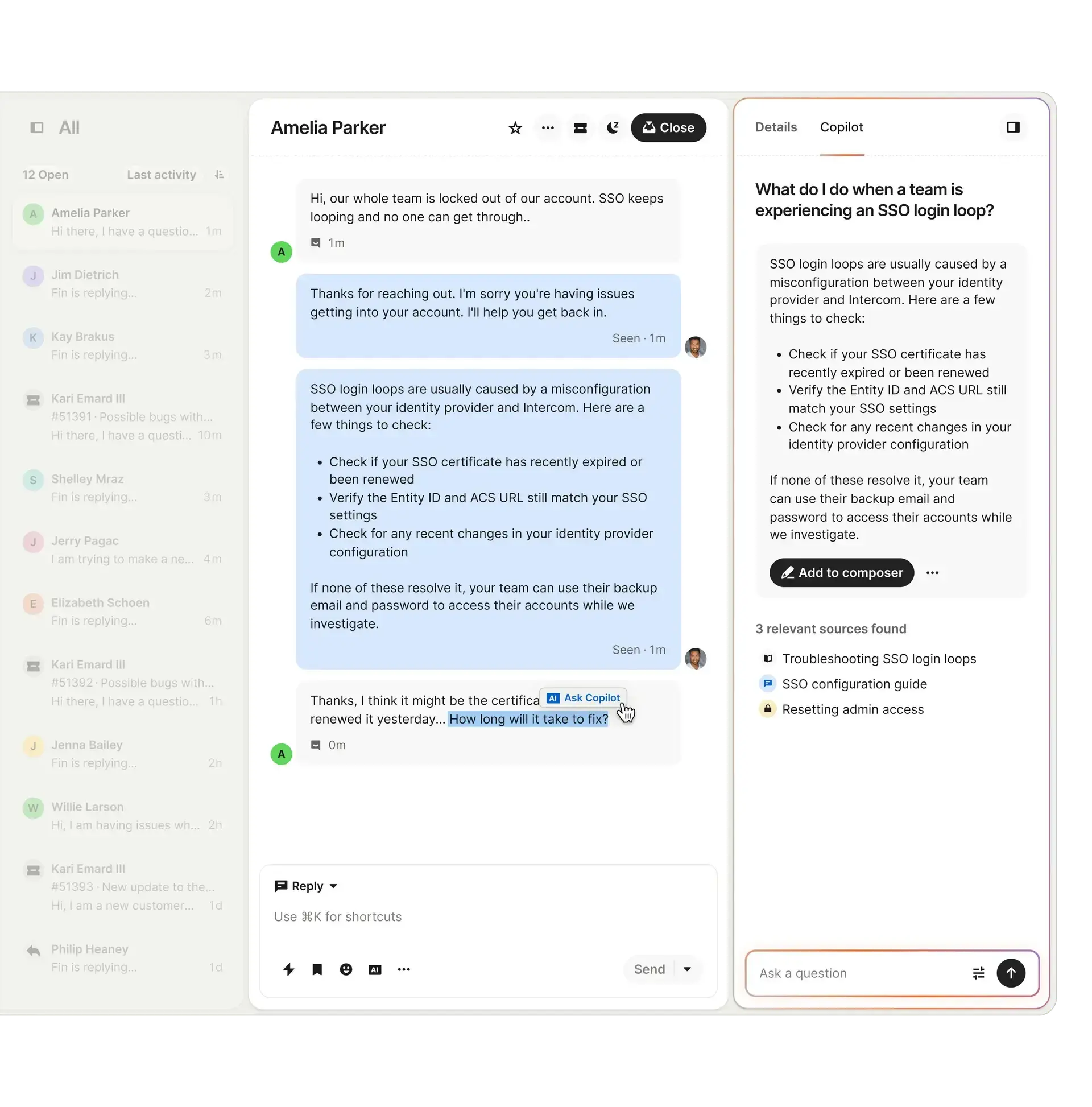
Intercom combines a help desk, customer messaging, automation, a help center, and Fin AI Agent. Its in-app messenger lets teams support customers within the product rather than moving every interaction to email or a separate portal.
Intercom can support digital customer success programs that serve large numbers of accounts. Teams can use behavior-based messages, product tours, self-service content, and Fin to automate routine guidance while directing higher-risk or more complex conversations to people.
Key Features
- In-app messenger. Allows teams to support customers within the product they are using.
- Fin AI Agent. Uses company knowledge to answer routine questions and complete supported customer-service outcomes.
- Product tours and outbound messaging. Delivers guidance based on user behavior, lifecycle stage, or product activity.
Best for: Digital customer success and service teams that need in-product support, automated education, and behavior-based engagement.
Pricing: When billed annually, Intercom’s pricing calculator lists Essential at $19 per full seat per month, Advanced at $85 per full seat per month, and Expert at $132 per full seat per month
What we like: Intercom can trigger in-app guidance based on customer behavior, such as offering help when a user stalls on a feature. That gives digital customer success teams a practical way to support adoption at scale.
5.
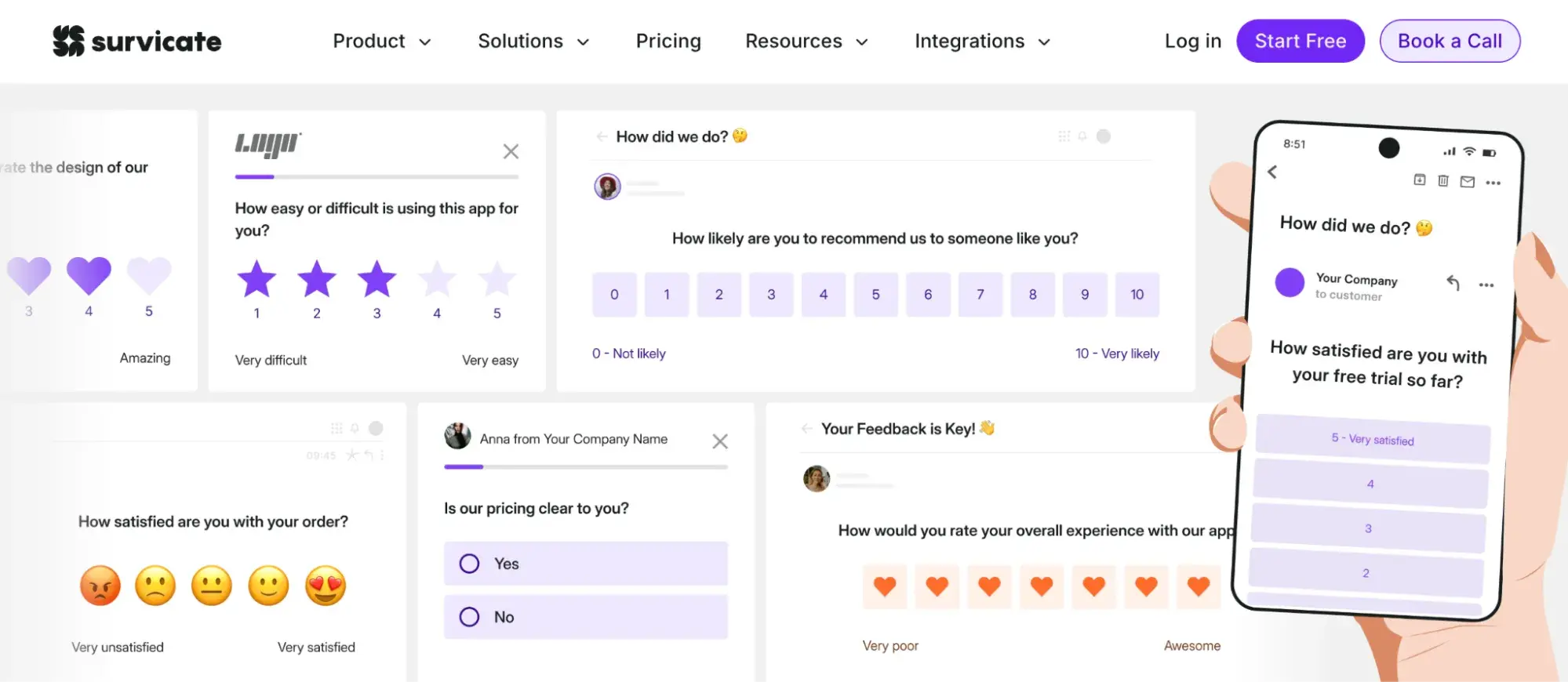
Survicate is a customer feedback platform for running website, mobile, email, in-product, and link-based surveys. Teams can collect NPS, CSAT, customer effort score, and custom feedback, then send results to connected CRM, service, and collaboration tools.
Customer success teams can use Survicate to collect feedback after onboarding, during support interactions, at product milestones, or during renewal conversations. Connecting those responses with account context can help teams identify risks and recurring customer needs.
Key Features
- Multichannel surveys. Collects feedback across websites, mobile apps, email, products, and shareable links.
- Targeting and survey logic. Shows surveys to specific customer segments based on attributes, behavior, or lifecycle stage.
- Integrations and analysis. Sends feedback to connected tools and tracks sentiment and response patterns.
Best for: Teams that need a dedicated survey and voice-of-customer layer across several customer touchpoints.
Pricing: Growth starts at $114 per month when billed annually and includes 250 survey responses and 1,000 data points per month. Pro starts at $349 per month, and Enterprise starts at $569 per month. Survicate offers a free trial.
What we like: Survicate can collect feedback inside a website or product at the moment a customer completes a task or encounters friction. That context can make the feedback easier to act on than a general survey sent later.
Free Net Promoter Score (NPS) Kit
Take control of your customer loyalty metrics with our complete NPS template + calculator.
- Easy-to-use NPS calculator
- Score interpretation tool
- Copy-and-paste survey template
- And more!
Download Free
All fields are required.
Form not available
You're all set!
Click this link to access this resource at any time.
Customer Success Best Practices
Effective customer success programs use repeatable practices to help customers reach value, maintain adoption, and receive the right level of support over time.
1. Implement a structured customer success program.
A structured customer success program defines the outcomes customers want, the milestones that show progress, and the actions the team should take at each stage. Teams should document ownership, engagement models, escalation paths, and success measures.
Use interviews, surveys, product data, support patterns, and renewal feedback to shape the program around real customer needs. Review the program as products, segments, and customer expectations change.
贬耻产厂辫辞迟’蝉 provides a framework for building the program.
Pro tip: As a small business owner, I have seen operating priorities shift quickly as a business grows. Schedule regular reviews so the customer success strategy changes with the product and customer base.
2. Educate and empower customers.
Customer education helps customers answer common questions, build confidence, and reach value sooner. Customer success teams should identify where users get stuck and create resources for those moments.
Education can reduce avoidable support requests and help customers complete complex product workflows without waiting for individual assistance.
articles, live chat, office hours, in-product guidance, and recorded demonstrations can support customers at different stages.
Webinars can teach product workflows, reinforce adoption milestones, and answer recurring questions for groups of customers at once.
3. Nail the onboarding process.
Customer onboarding should reduce time-to-value by helping new customers complete setup, learn core workflows, and reach an early success milestone.
A clear onboarding plan sets expectations for the relationship and gives the team an early baseline for adoption, engagement, and risk.
Useful onboarding materials include step-by-step tutorials, scheduled one-on-one guidance, demo videos, checklists, and milestone messages.
Pro tip: I have written FAQs and step-by-step guides for customers. I start with the customer’s goal, test every step from a new user’s perspective, and avoid assuming that an interface feels intuitive.
4. Segment customers to deliver the right level of attention.
Customer segmentation lets teams match service levels to account needs and value without overloading CSMs. Larger or more complex accounts may receive dedicated attention, while lower-touch segments can receive consistent support through pooled or digital programs.
Customer success teams commonly segment accounts by:
- Revenue or contract value. Higher-paying accounts typically warrant a dedicated CSM and more frequent touchpoints.
- Customer lifecycle stage. A brand-new customer in onboarding needs different attention than an account heading into year three.
- Product usage and adoption. Deeply engaged customers can be handled differently from those still ramping up.
- Strategic value. Some accounts matter beyond their contract size, like marquee logos or customers in high-growth segments.
Each segment then gets its own engagement model.
- Enterprise accounts might get quarterly business reviews and a dedicated CSM.
- Mid-market accounts could run on a pooled CSM model with scheduled check-ins.
- Digital customer success uses in-app guidance, automated email, webinars, and self-service content to support lower-touch segments at scale.
This way, CSMs focus their time where it matters most, and smaller customers still get a consistent experience.
5. Build cross-functional alignment.
Customer success teams need shared context and clear handoffs across sales, marketing, product, and support.
- Sales. Share customer goals, use cases, commitments, and risks during the post-sale handoff.
- Marketing. Create educational and advocacy content based on customer questions, outcomes, and recurring needs.
- Product. Route recurring feedback and adoption data to product teams so they can evaluate improvements.
- Support. Share issue patterns and escalation history so customer success teams can prevent repeat problems and prepare for account conversations.
Pro tip: At Skybound, I work with the game development team to resolve player-reported issues and communicate newly discovered problems before more players report them.
Read: How to Align Your Marketing and Customer Success Teams
6. Actively promote customer loyalty.
Customer loyalty grows when customers consistently receive value and trust the company to respond as their needs change. Customer success teams can support loyalty by:
- Creating customer loyalty programs that reward meaningful engagement.
- Building customer communities where users can learn from peers.
- Offering relevant education, perks, or early access.
Track renewals, referrals, reviews, case-study participation, and expansion to determine whether loyalty activities lead to measurable customer behavior.
Frequently Asked Questions About Customer Success
What is customer success?
Customer success is a proactive business function that helps customers receive measurable value from a product or service throughout the relationship.
Customer success teams support adoption, address barriers before they escalate, and connect product use with customer goals. This work can support renewal, expansion, and advocacy.
What’s the difference between customer success and customer service?
Customer service answers questions and resolves issues, usually through tickets, chat, email, or phone. Customer success proactively helps customers adopt the product, achieve their goals, and continue to receive value over time.
Customer service focuses on resolving the current need; customer success focuses on adoption, retention, renewal, and expansion across the relationship.
What metrics measure customer success?
Common customer success metrics include net revenue retention (NRR), monthly recurring revenue (MRR), customer lifetime value (CLV), churn rate, customer health score, product adoption, NPS, and CSAT.
Together, these metrics show customer outcomes, revenue performance, and accounts that may need attention.
What does a customer success manager do?
A customer success manager (CSM) guides a set of customers from onboarding through adoption, renewal, and expansion.
The role can include running check-ins and business reviews, tracking account health, coordinating expansion opportunities, and acting when an account shows signs of risk. CSMs help customers connect product use with the outcomes they want to achieve.
What’s the difference between low-touch and high-touch customer success models?
High-touch CS provides each account with a dedicated CSM who conducts personalized check-ins, business reviews, and strategic planning. This suits enterprise customers with complex needs and high contract values.
Low-touch, or digital, customer success uses automation, in-app guidance, webinars, and self-service content to support higher account volumes. Many companies combine high-touch and digital models based on customer needs, complexity, and value.
When customers win, businesses win.
Customer success provides teams with a repeatable way to help customers realize value throughout onboarding, adoption, renewal, expansion, and advocacy. A clear strategy, shared customer data, and consistent cross-functional follow-through make it easier to scale that work.
Service Hub connects help desk, shared inbox, knowledge base, feedback, service analytics, and the Customer Success Workspace with 黑料吃瓜网 Smart CRM. Customer Agent can resolve routine inquiries and route more complex work to people.
Explore Service Hub to see how it can support customer retention and growth.
Net Promoter, Net Promoter System, Net Promoter Score, NPS, and the NPS-related emoticons are registered trademarks of Bain & Company, Inc., Fred Reichheld, and Satmetrix Systems, Inc.
Editor’s note: This article was originally published in July 2017 and has since been updated for comprehensiveness.
Free Net Promoter Score (NPS) Kit
Take control of your customer loyalty metrics with our complete NPS template + calculator.
- Easy-to-use NPS calculator
- Score interpretation tool
- Copy-and-paste survey template
- And more!
Download Free
All fields are required.
Form not available
You're all set!
Click this link to access this resource at any time.