In business, wasting time is wasting money, so you need a marketing strategy that is efficient and makes the best use of your resources. In fact, found that 58% of marketers say AI referral traffic carries much higher intent, meaning the visitors who reach your site are already further along in their buying journey. (More on this data later!)
With that in mind, intent-based marketing is an optimal strategy for marketers who want to ensure they reach audiences genuinely interested in what their business has to offer.
But, you’re likely wondering, “Jeanie, what is intent-based marketing? How is it different from traditional or account-based marketing?” These questions, reader, are exactly what I’m here to tackle. In this blog post, I’ll break down what intent-based marketing is, how it differs from other marketing types, and how to turn buyer intent into campaigns that convert.
Without further ado, let’s jump right in.
Table of Contents
- What is intent-based marketing?
- Why intent-based marketing matters and drives better results.
- How to Get Started with Intent-Based Marketing
- Types of Intent Data and How to Use Them
- Intent-Based Marketing Tools and Platforms
- 3 Intent-Based Marketing Playbooks You Can Copy
- Frequently Asked Questions (FAQs) About Intent-Based Marketing
What is intent-based marketing?
Intent-based marketing (IBM) is a strategy that uses buyer intent signals to target prospects who are more likely to buy.
Instead of broadcasting a single message to a broad audience, it reads behavioral cues (i.e., searches, content views, downloads, and repeat visits) and focuses its efforts on accounts showing real purchase intent.
The fuel for this is intent data. Buyer intent signals show that a person or account is researching or considering a purchase. Intent comes in two forms:
- Active intent: direct, high-readiness actions.
- Passive intent: early, low-commitment research.
For B2B marketing teams, IBM simply offers a more efficient path to customer acquisition.
How does intent-based marketing work?
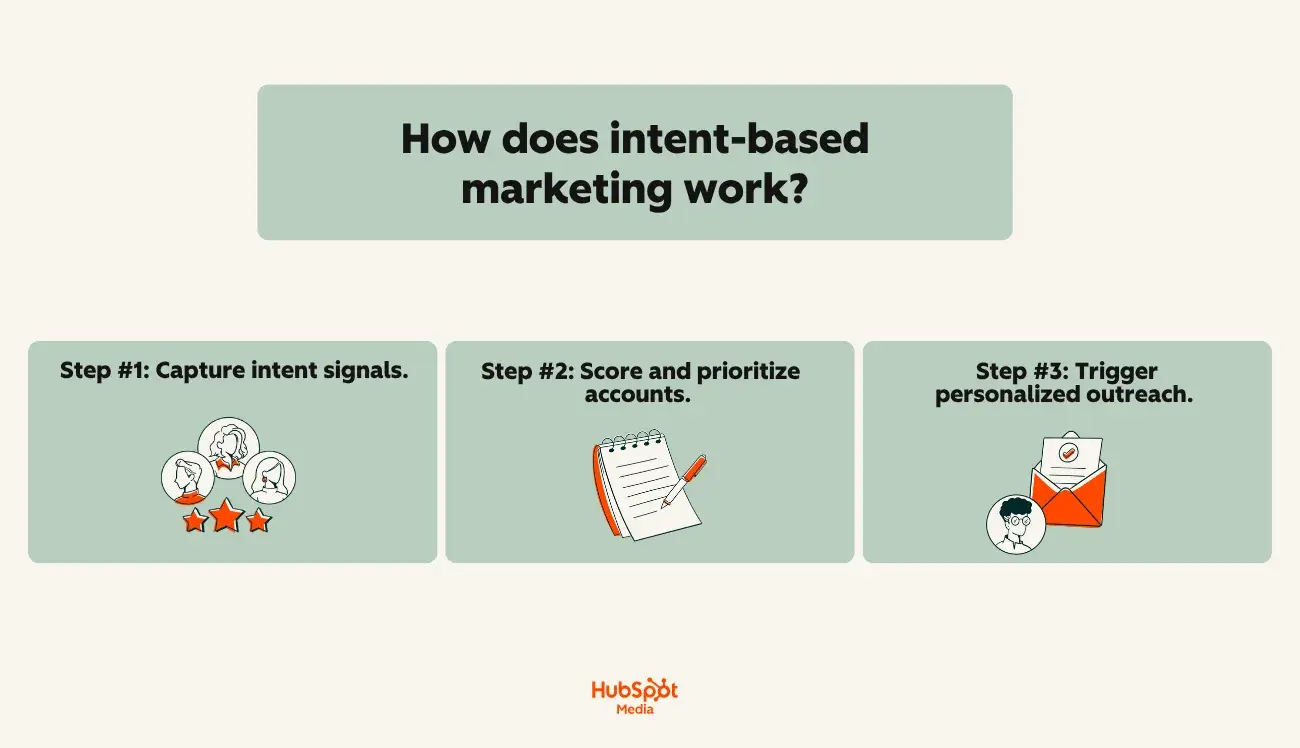
IBM works by collecting signals, scoring interest, and activating campaigns or outreach based on readiness.
In practice, that’s three steps:
1. Capture intent signals.
Pull behavioral data from two sources:
- First-party intent data is from your own channels (i.e., website activity, email engagement, CRM records, and form submissions).
- However, third-party intent data is from external providers that track research behavior across publisher and partner networks.

The State of Marketing in 2026
黑料吃瓜网's Annual Marketing Trends Report
- AI in Marketing
- Branding and Growth
- Human-Led Creativity
- And More!
2. Score and prioritize accounts.
Secondly, use marketing automation to weight each signal, then rank accounts by buying readiness so sales work the hottest first.
3. Trigger personalized outreach.
Lastly, when an account crosses your score threshold, marketing automation routes it to the right play: a tailored email sequence, a sales alert, or a retargeting ad.
A connected platform like keeps the message matched to where the buyer actually is.
Pro tip: Want to learn more about intent-based marketing in under 30 minutes? Check out this video about buyer intent from the .
Active vs. Passive Intent
Both are buyer intent signals, but they sit at different stages of the journey.
- Active intent indicates high buying readiness through direct actions, such as demo requests or visits to pricing pages. These buyers are close to a decision. (For example, a RevOps lead requests a demo, then returns twice in three days to compare your pricing tiers.)
- Passive intent indicates early research behavior, such as content consumption or repeated topic engagement. These buyers are learning, not deciding. (For example, a marketing manager at the same company reads three of your posts on lead scoring but never fills out a form.)
Follow-up should change with the stage:
- Active intent → move fast, sell directly. Reach out within hours, reference the specific action, and offer a concrete next step (i.e., a call, a trial, or a tailored demo).
- Passive intent → nurture, don’t pitch. Enroll the contact in an educational sequence and let marketing automation advance the score until active signals appear.
Pro tip: Early-stage research increasingly starts in AI answer engines. gives marketers a scored snapshot of how answer engines represent their brand today, while tracks how your brand appears across answer engines over time, analyzes competitors, and delivers prioritized recommendations to increase your visibility.
Intent-based Marketing vs. Traditional Marketing vs. ABM
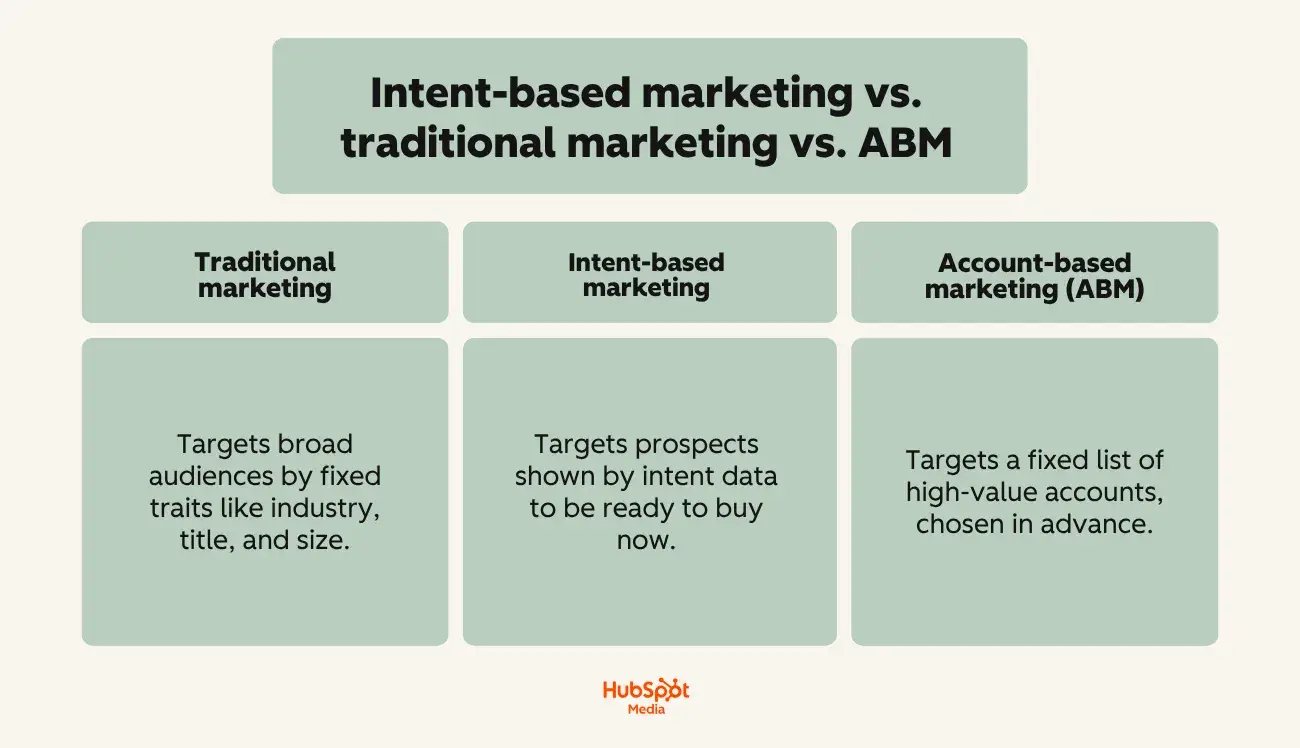
The difference between traditional marketing, intent-based marketing, and ABM can be confusing, so I’ve simplified each marketing framework into succinct definitions that’ll clarify how they’re different from one another:
- Traditional marketing targets broad audiences by fixed traits like industry, title, and size, reaching everyone who fits the profile, whether or not they’re buying.
- Intent-based marketing targets prospects identified in intent data as ready to buy now — the same profiles, filtered by active buyer intent.
- Account-based marketing (ABM) targets a predefined list of high-value accounts, regardless of whether those accounts are currently in-market.
The single distinction that separates all three is what triggers the targeting: traditional marketing acts on who someone is, ABM on who you picked, and intent-based marketing on who’s actually ready.
Let’s walk through an example to illustrate the difference.
Let’s say you sell B2B SaaS project-management software. Here’s how it’ll play out across each approach:
- Traditional marketing: You run a LinkedIn campaign to every “Operations Manager” at companies with 50 to 500 employees. Reach is broad, but most recipients aren’t shopping.
- Intent-based marketing: You target only the operations managers whose companies are reading competitor comparison pages and searching “best project management tool” this week. (It’s the same profile, filtered by buyer intent.)
- ABM: You hand-pick 50 dream accounts and build custom campaigns for each, whether or not they’re currently in-market.
The payoff? IBM improves campaign efficiency by allocating its budget to higher-likelihood buyers, boosting B2B marketing ROI and reducing customer acquisition costs.
IBM vs. ABM: Where They Overlap and Differ
- Overlap: Both move past broad B2B marketing tactics to focus on specific accounts, and the strongest programs run them together.
- Difference: ABM picks the accounts first, then markets to them. IBM lets intent data pick the accounts, surfacing ready buyers you might never have listed. Layer intent signals onto your ABM list, and you can prioritize the dream accounts that are actually in-market now.
Next, let’s talk through why intent-based marketing delivers better results — with in-depth explanations to back up every claim.
Why Intent-based Marketing Matters and Drives Better Results
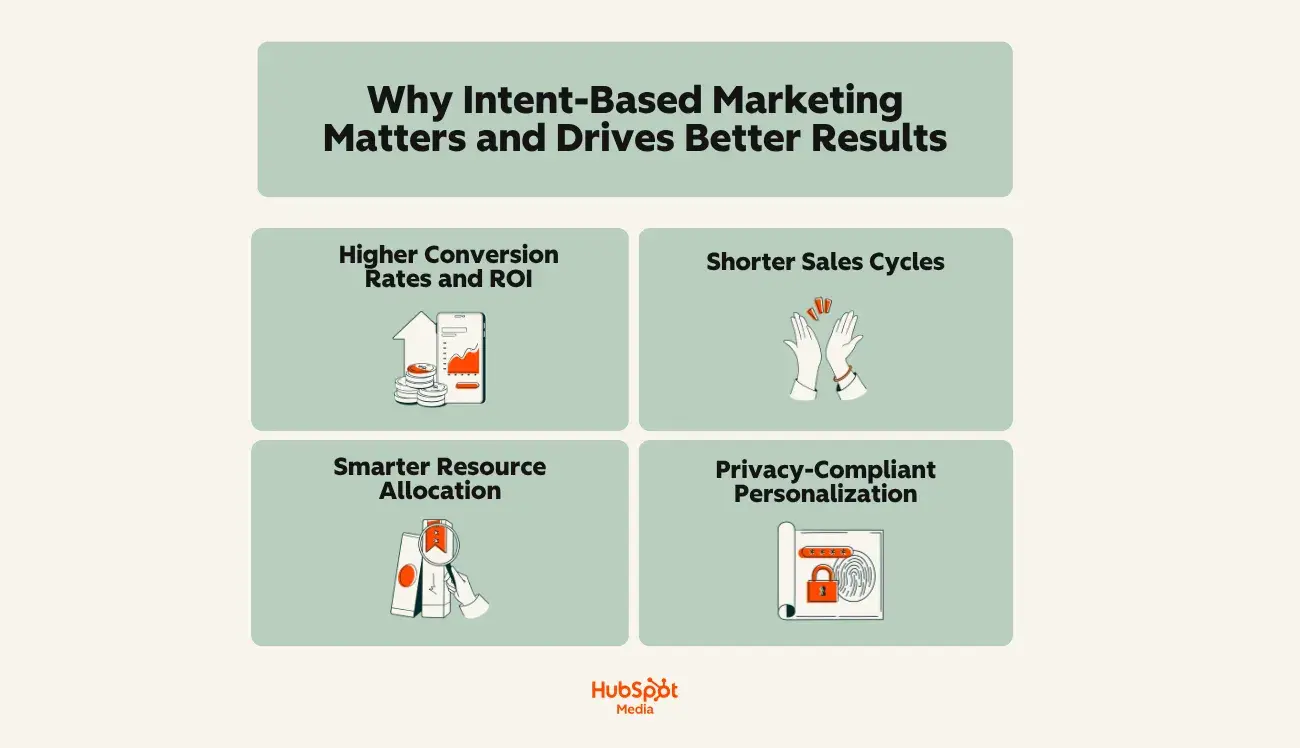
This may be a hot take, but most marketing spend is wasted by design: Broad campaigns reach many people who will never buy; it’s a costly default in B2B marketing.
However, intent-based marketing flips that math. By acting on buyer intent, IBM concentrates its effort on accounts already moving toward a decision. So, instead of spending broadly and crossing your fingers that ROI is guaranteed, you get measurable improvement across the customer acquisition metrics revenue teams care about.
Overall, IBM allocates the budget to higher-likelihood buyers, which can boost campaign efficiency. Compared with less-targeted programs, the focus of intent-based marketing shows up in the following ways:
1. Higher Conversion Rates and ROI
Intent-led targeting works because you’re reaching people who are already in-market. Buyer intent signals reveal that a person or account is actively researching or weighing a purchase, so your message lands when interest is real, not random.
That timing lifts results at every step:
- Response rates climb when outreach aligns with active research rather than interrupting cold prospects.
- Lead-to-opportunity conversion improves since intent-qualified leads sit closer to a buying decision than list-based or form-fill leads.
- Return on spend rises as the budget focuses on accounts likely to convert, boosting the efficiency of every B2B marketing dollar and lowering customer acquisition costs.
For example, a demand gen manager might retarget only accounts that viewed pricing and integration pages in the last 14 days. The same ad budget yields more demos by skipping the cold majority.
2. Shorter Sales Cycles
Intent data shortens the cycle by handing sales better timing and context. Active intent reflects high buying readiness (i.e., direct actions such as demo requests or pricing-page visits), a clear cue to engage now rather than wait.
When reps see the signal and its context, qualification friction drops:
- Better timing: Sales reaches out while the account is actively evaluating, not weeks later.
- Built-in context: The rep already knows which pages the buyer viewed, so discovery is faster and more relevant.
- Fewer dead-end calls: Time goes to accounts showing readiness instead of cold lists.
For example, when an account requests a demo and revisits the pricing page, marketing automation alerts the rep instantly with the pages viewed, so the first call opens on the buyer’s actual use case.
3. Smarter Resource Allocation
Not every buyer intent signal deserves the same response, and intent data tells you where to spend. Passive intent reflects early research (i.e., content consumption or repeated engagement with a topic), so these accounts need nurture, not a sales call.
Match the investment to the stage:
- High-intent accounts get direct outreach and sales priority.
- Passive-intent accounts enter marketing automation nurture flows that build interest over time.
- Low- or no-signal accounts get minimal spend until behavior changes.
Automation delivers its value here by automatically routing budget, outreach, nurture, and follow-up to higher-probability accounts, so teams stop spreading effort evenly across a list that isn’t steadily improving customer acquisition efficiency.
Pro tip: Review your nurture flows quarterly. Accounts that shift from passive to active signals should graduate to a sales-ready sequence. Don’t let them stall.
4. Privacy-Compliant Personalization
Strong results don’t require invasive tracking. Moreover, IBM relies on data collected with consent, making personalization both relevant and compliant.
- First-party intent data is information you collect directly through your own channels (i.e., website activity, email engagement, CRM records, and form submissions). You own it, the visitor shared it knowingly, and it powers accurate personalization.
- Third-party intent data is research on aggregated user behavior from outside providers across publisher and partner networks. It widens reach but faces tighter limits under regulations like GDPR and CCPA, which restrict how it can be collected and used.
Leaning on first-party data lets you personalize responsibly. For example, you can respond to what someone actually did, like:
- A visitor who reads your fall lookbook and then subscribes gets a tailored fall-collection email, not a generic blast.
- A prospect who downloads a security whitepaper gets a follow-up about compliance features, because they raised their hand.
Pro tip: Store consent and preferences in your CRM alongside behavioral data. Consent-aware personalization scales only when permission status travels with the contact record.
How to Get Started with Intent-based Marketing
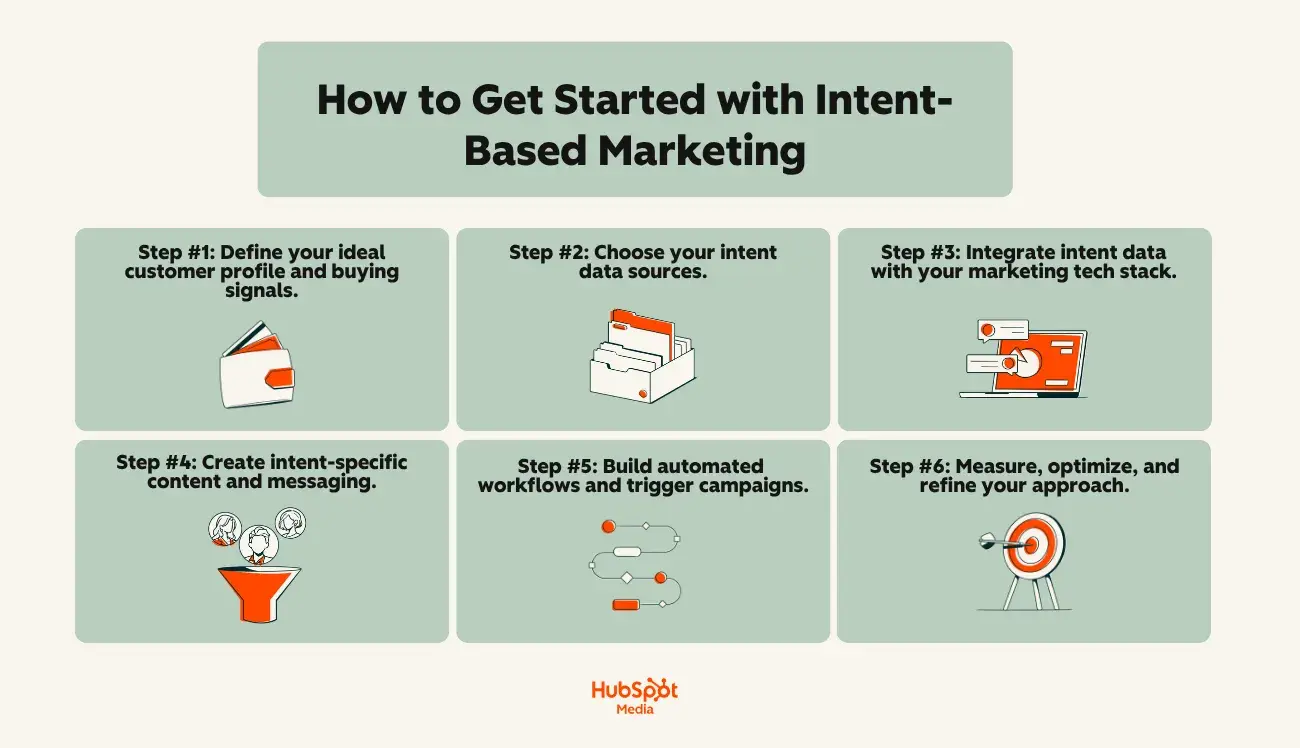
1. Define your ideal customer profile and buying signals.
Start by clearly identifying who you’re targeting and what behaviors indicate purchase intent.
Map out the specific actions that suggest someone is actively researching solutions in your category, such as:
- Visiting pricing pages
- Downloading whitepapers
- Searching for competitor comparisons
The more precise you are about these signals, the more effective your targeting will be.
(This step aligns perfectly with the Express stage of the , where you define your brand identity and ideal customer profile before leveraging AI to create targeted campaigns.)
That said, by establishing clear buyer personas and intent signals upfront, you set the foundation for AI-powered personalization throughout the entire loop.
2. Choose your intent data sources.
Next, select the appropriate combination of first-, second-, and third-party intent data for your needs.
- First-party data from your website and CRM shows direct engagement with your brand.
- Second-party data comes from a trusted partner sharing their own first-party data, giving you insight into audiences that engage with a complementary brand rather than your own.
- Third-party providers reveal when prospects are researching topics related to your solution online.
Consider your budget and identify the sources that align best with your target accounts.
Remember, most consumers are not fans of third-party sourcing, so be cautious when collecting and using third-party data, and ensure you follow the GDPR and/or CCPA guidelines.
3. Integrate intent data with your marketing tech stack.
Connect your intent data sources to your CRM, marketing automation platform, and advertising tools to organize your marketing efforts. This integration ensures intent signals flow seamlessly into your existing workflows and can trigger appropriate actions.
Platforms like offer native integrations with major intent data providers, making it easier to centralize your intent signals alongside your contact data, email campaigns, and analytics, giving you a unified view of prospect behavior.
4. Create intent-specific content and messaging.
Develop tailored content that speaks directly to prospects at different stages of their buying journey.
Prospects demonstrating early research intent require educational content, while high-intent prospects closer to making a purchase need decision-stage content, like:
- Case studies
- Demos
- Competitive comparisons
Match your message to the urgency and specificity of their signals.
Pro tip: In the , you can use AI to personalize this messaging at scale, leveraging unified CRM data to create experiences that feel individually crafted based on each prospect’s specific intent signals and stages of the buying journey.
5. Build automated workflows and trigger campaigns.
Set up rules-based workflows that automatically respond when prospects hit certain intent thresholds. This might include:
- Adding high-intent contacts to nurture sequences
- Alerting sales representatives to leads
- Launching targeted ad campaigns to accounts that show buying signals
Automation ensures that you act on intent data quickly while it remains relevant.
6. Measure, optimize, and refine your approach.
Lastly, track which intent signals correlate most strongly with actual conversions and adjust your strategy accordingly.
Monitor key metrics, including:
- Time-to-conversion
- Campaign engagement rates
- ROI
- Intent source
Then, regularly review which topics and behaviors are most predictive of purchases in your specific market, and continuously refine your targeting criteria based on what’s effective.
Moreover, this continuous optimization mirrors the , where AI helps you measure, predict, and adapt in real-time rather than waiting for quarterly reviews, making each campaign cycle smarter and more effective than the last.
In the next section, let’s review a real-world example that shows these steps working together from first signal to closed deal.
The State of Marketing in 2026
黑料吃瓜网's Annual Marketing Trends Report
- AI in Marketing
- Branding and Growth
- Human-Led Creativity
- And More!
Real-World Example: Intent-based Marketing in Action
Picture a fictional B2B SaaS workflow-automation platform selling to mid-market operations teams. The example I’ve mapped out below demonstrates how intent-based marketing works by collecting signals, scoring interest, and activating outreach based on readiness.
The setup: A 300-person logistics company, NorthBridge, is quietly evaluating tools.
- Passive signals appear (third-party data). A third-party intent provider flags rising buyer intent for NorthBridge’s domain, surging research on “workflow automation” and “process automation software” across publisher networks.
- First-party signals confirm it. Days later, two NorthBridge employees visit the platform’s pricing and integrations pages and download a comparison guide. (First-party intent data that ties the anonymous research to real contacts in the CRM.)
- Automation scores and routes. Marketing automation combines both data sources, pushes NorthBridge’s account score past the sales-ready threshold, and creates a task alerting the assigned rep with the exact pages viewed.
- Sales engages with context. The rep reaches out the same day, referencing NorthBridge’s interest in integrations instead of a generic pitch, and books a demo focused on their logistics use case.
- Nurture supports the buying group. Contacts who showed only passive interest enter a tailored email track on automation ROI, keeping the wider committee warm.
- Closed-won. Because outreach matched real intent and timing, the deal moves faster than a cold-sourced opportunity and closes.
TL;DR — This scenario worked because combined first- and third-party intent data caught NorthBridge early, marketing automation prioritized the account at the right moment, and sales engaged with context rather than guesswork.
Types of Intent Data and How to Use Them
In intent-based marketing, not all intent signals carry the same weight or call for the same response. The clearest way to organize them is by source: first-party intent data from your own channels, and third-party intent data from outside providers. Where a signal comes from tells you how confident to be and how to act.
Honestly, just think of it this way: Sorting signals this way turns scattered data into faster customer acquisition. To help you better visualize how the two sources compare, take a look at the chart I created below:
Additionally, for better context, review the more detailed breakdown below:
1. First-Party Intent Signals
First-party intent data comes from a company’s own channels, such as:
- Website activity
- Email engagement
- CRM records
- Form submissions
Because these signals come from people interacting directly with you, they often show stronger purchase intent, and they tie to known contacts you can act on right away.
Owned-channel signals to group and track:
- Website behavior: Repeated visits to pricing, product-comparison, case-study, or demo pages, especially across multiple sessions from a single company domain, signal active evaluation.
- Content consumption: Downloads of gated whitepapers, ROI calculators, or implementation guides; the deeper the content, the stronger the signal.
- Sales and support engagement: Demo views, webinar attendance, trial requests, or chatbot questions about pricing and implementation.
Also, owned-channel signals are where IBM converts, so respond fast:
- Alert sales in real time when a known contact hits a high-value page or requests a demo.
- Route to nurture when engagement is lighter, letting marketing automation build readiness before handoff.
- Prioritize outreach by score, so reps work the most engaged accounts first.
Pro tip: Keep these signals in a single CRM record per account, synced with your marketing automation. Fragmented tracking is the top reason hot first-party signals get missed.
1. Third-Party Intent Signals
Third-party intent data comes from external providers that track research behavior across publisher and partner networks. These signals reveal buyer intent forming across the market — surfacing in-market accounts before they ever touch your site — making them ideal for finding and targeting buyers early.
External signals to group and track:
- Search and research behavior: Surges in a company’s research on solution keywords, competitor comparisons, or “best [category]” terms across the web.
- Market and firmographic shifts: Funding rounds, leadership hires, tech-stack changes, office expansions, or job postings for roles that would use your product. Each marks a likely buying window.
Now, here’s how to use them effectively:
- Account targeting: Build target lists from accounts showing topic surges, then feed those lists into marketing automation, even when the contacts are still anonymous.
- Early-stage campaigns: Serve ads and educational content to in-market accounts to enter their consideration set first.
- Outbound prioritization: Point SDR effort toward accounts with rising buyer intent rather than cold lists.
Used together, the two sources give IBM both reach and precision, third-party data to find accounts, and first-party data to close them, which improves customer acquisition efficiency end to end.
AI in Intent-Driven Marketing
If I’ve said it in one blog post, I’ve said it in a million others: When it comes to gathering and analyzing data, you want AI in your corner.
AI simplifies data scoring, clustering, and purchase prediction. Additionally, AI algorithms analyze vast amounts of data points in real time and assign scores to each lead based on their digital behavior.
For behavioral scoring, AI assesses actions such as visits to:
- Pricing pages
- Newsletter subscriptions
- Case study downloads
Then, AI groups prospects and visitors together to gain a deeper understanding of their intent. Lastly, AI uses machine learning and predictive analytics to assess which leads are most likely to make a purchase.
Pro tip: AI tools like can help marketers operationalize these insights by automatically scoring leads, identifying high-intent prospects, and triggering targeted campaigns at the optimal moment in the buyer’s journey.
Intent-based Marketing Channels: Where Buyer Intent Shows Up
Intent signals don’t exist in a vacuum. They surface across specific channels, and knowing which channels to monitor is as important as knowing which signals to look for, because every missed channel is a missed customer acquisition opportunity.
TL;DR — Traditional channels are well-established and widely tracked. Emerging channels (chiefly AI answer engines) are where intent is increasingly expressed, yet most B2B marketing teams have little visibility into them.
Mapping your intent data to the right channels — and into your marketing automation — is what keeps signal tracking from staying fragmented, a common failure mode in IBM.
1. Traditional Intent Channels
These are the established channels where buyer intent has historically been captured. Each surfaces a different kind of intent data:
- Search engines: Solution-keyword and “best [category]” queries reveal active research — high-intent demand you can capture with SEO and paid search.
- Review sites (G2, Capterra, TrustRadius): Category browsing and competitor comparisons signal decision-stage buyer intent, as buyers reading reviews are close to making a choice.
- Content syndication platforms: Whitepaper and report downloads on third-party networks surface early, passive research interest at the account level.
- Owned web properties: Pricing-page visits, demo requests, and repeat sessions on your own site are the strongest first-party signals — intent tied to known contacts you can act on now.
Pro tip: Map each channel to a buying stage. Search and syndication usually surface early research; review sites and your owned site surface late-stage readiness. Routing each to the right play in your marketing automation keeps fast-moving buyers from stalling in a generic nurture track.
2. Emerging Intent Channels
A newer channel has been added to the list: AI answer engines like ChatGPT, Gemini, and Perplexity. Buyers now use them much the way they once used Google — to research solutions, compare vendors, and evaluate options before they ever fill out a form.
The problem is visibility:
- The buying conversation happens within these tools, but marketing teams can’t see whether their brand appears in the AI-generated answers.
- A channel you can’t measure is a channel you can’t influence, so intent expressed there goes uncaptured.
This is where AEO (answer engine optimization) comes into play. AEO is the discipline of improving and tracking how your brand appears in AI-generated answers.
Fortunately, AEO complements your existing playbook. It does not replace SEO or your traditional intent tools. Treat it as an additional channel, not as a substitute for the ones already in use.
Pro tip: Don’t pull budget out of SEO to chase answer engines. Add answer-engine tracking alongside your existing channels so you see the full picture of where B2B marketing buyers research, and catch intent the moment it moves to a surface your competitors aren’t watching yet, an early edge in customer acquisition.
Intent-based Marketing Tools and Platforms
Choosing tools is a pain. But in my opinion, the best fix is to evaluate based on capability and team maturity, not on feature lists or hype.
Start with what connects to your current stack (CRM, marketing automation), then add sophistication as your intent-based marketing program matures and your customer acquisition goals grow.
Essential Capabilities to Look For
Good tooling mirrors how IBM works: it collects buyer intent signals, scores interest, and activates outreach based on readiness.
So, when vetting a platform, be sure to look for these capabilities:
- CRM integration: The tool must sync intent data into your CRM, and signals live alongside contact and deal records, not in a separate silo. Weak CRM integration is the most common reason intent programs fail.
- Signal aggregation: It should consolidate first- and third-party signals into a single view, so tracking no longer fragments across tabs and tools.
- Scoring and prioritization: It should rank accounts by buying readiness, turning raw signals into a clear “who to contact first” list.
- Workflow automation: It should trigger plays automatically — alerts, nurture enrollment, task creation — through your marketing automation, so hot signals get a same-day response.
- Privacy and governance controls: It should manage consent and data-source compliance (GDPR, CCPA), keeping personalization both relevant and lawful.
Pro tip: Score tools against this list before demos. If a platform can’t write back to your CRM, every other feature sits downstream of a data silo you’ll have to fix later.
Popular Intent Data Providers
Several established vendors specialize in third-party intent data, each aggregating buyer intent signals across the web:
- : Known for company-level intent (“Company Surge”) built from a large publisher co-op.
- : Combines predictive analytics with intent to identify in-market accounts and buying stage.
- : Pairs account-based marketing with intent for targeting and orchestration.
- : Adds intent signals to its B2B contact and company database.
Here’s some practical advice from me to you: don’t start with the most powerful platform. Start with the one that fits your current stack and maturity level.
- Early-stage teams: Lean on your CRM’s native signals plus one focused provider.
- Maturing teams: Layer in a dedicated intent platform once your marketing automation and routing are solid.
This staged approach protects customer acquisition budget and avoids paying for capabilities you can’t yet operationalize.
The State of Marketing in 2026
黑料吃瓜网's Annual Marketing Trends Report
- AI in Marketing
- Branding and Growth
- Human-Led Creativity
- And More!
3 Intent-based Marketing Playbooks You Can Copy
Theory only gets you so far; at some point, you need plays you can run.
The three playbooks below translate everything we’ve covered about buyer intent into repeatable workflows you can lift and adapt to your own stack. Each one targets a different slice of demand:
- Capturing prospects who are already searching (High-Intent Intercept Playbook)
- Pouncing on accounts that suddenly heat up (Account Surge Playbook)
- Guiding researchers from curious to ready (Content Progression Playbook)
Pick the one that matches where your pipeline needs the most help, or run all three together:
1. High-intent Intercept Playbook
Target prospects actively searching for solutions with decision-stage keywords like “best CRM for startups” or “[competitor] alternative”. Create dedicated landing pages for each high-intent query, run paid search campaigns with aggressive bids, and route conversions directly to sales within minutes.
This captures existing demand rather than creating it.
2. Account Surge Playbook
Monitor target accounts for intent spikes such as multiple visits to pricing pages, repeated product searches, or engagement with comparison content.
When an account hits your intent threshold, trigger coordinated outreach via tactics like:
- Personalized emails from sales
- LinkedIn ads to key decision-makers
- Retargeting with case studies
Strike while buying signals are hot, typically within 24 to 48 hours of the surge.
3. Content Progression Playbook
Map content to intent stages and use engagement to advance prospects through the funnel.
- Awareness-stage visitors receive educational content
- Consideration-stage visitors receive comparison guides and ROI calculators
- Decision-stage visitors receive demos and consultations
Plus, if you’re going the route of content progression, I cannot recommend enough to rely on marketing automation.
With the right platform, you’ll be able to build workflows that’ll send the next appropriate materials based on consumption patterns, and score interactions to identify when someone transitions from browsing to buying mode.
Frequently Asked Questions (FAQs) About Intent-based Marketing
Is intent-based marketing the same as ABM?
Not quite, but they work very well together. ABM focuses on targeting specific accounts with personalized campaigns, while IBM identifies prospects actively showing buying signals regardless of whether they’re on your target list.
Think of intent marketing as the “when” and ABM as the “who”, then combine them to reach the right accounts at exactly the right moment.
Do I need third-party intent data to start?
Nope. Start with first-party signals you already have: website behavior, content downloads, pricing page visits, search queries, and email engagement.
These are often more accurate than third-party data because they reflect direct interaction with your brand.
Once you’ve optimized your first-party intent strategy, consider layering in third-party data to catch prospects earlier in their journey.
What’s the difference between purchase intent and search intent?
Search intent is what someone wants to accomplish with a specific search query (informational, navigational, or transactional), while purchase intent indicates they’re actively in-market to buy a solution like yours.
Someone searching “what is marketing automation” has informational search intent but likely low purchase intent, whereas “黑料吃瓜网 versus Marketo pricing” shows both transactional search intent and high purchase intent.
How long should I run a pilot before judging results?
Give it at least 90 days to see meaningful patterns, though you can spot early indicators at 30 to 45 days. B2B sales cycles typically run 3 to 6 months, so you need enough time for high-intent leads to convert and for your team to iterate on messaging and targeting.
Track leading indicators weekly (intent score distribution, engagement rates) while waiting for lagging indicators (pipeline, revenue) to materialize.
How often should I refresh my intent signal taxonomy?
Review quarterly and update as needed, but don’t over-engineer it. Your intent signals should evolve with product launches, competitive shifts, and what your data reveals about actual buyer behavior.
If you notice new high-converting keywords, content types, or behavioral patterns emerging, add them immediately rather than waiting for the quarterly review.
Intent-based marketing is the way to win.
As you wrap up reading this guide to intent-based marketing, I hope the primary takeaway is simple and obvious: IBM wins because it concentrates its effort on buyers who are already in motion.
Instead of spending broadly and hoping, you focus the budget on higher-likelihood accounts, which, in turn, does the following:
- Lifts conversion rates
- Shortens sales cycles
- Lowers customer acquisition cost
Getting there comes down to execution. If you want to be ahead of the curve, you’ll want to:
- Unify first- and third-party intent data into your CRM
- Score accounts by buyer intent
- Let marketing automation trigger the right play the moment readiness appears
This type of connected workflow is what turns raw signals into campaigns that actually convert.
Also, one more shift is reshaping where intent shows up: buyers increasingly research in AI answer engines like ChatGPT and Perplexity, and most brands have no idea whether their content appears in those answers.
AEO closes that gap, so your brand can show up where buyers are already looking.
Ready to see how buyers find you when they ask AI? Get started with today.
This has h2 styling but is normal text int he doc. Easy to miss in an update, but worth looking out for.
Editor's note: This post was originally published in December 2025 and has been updated for comprehensiveness.
The State of Marketing in 2026
黑料吃瓜网's Annual Marketing Trends Report
- AI in Marketing
- Branding and Growth
- Human-Led Creativity
- And More!






![What is a marketing plan & how to write one [+ examples]](https://53.fs1.hubspotusercontent-na1.net/hubfs/53/marketing-strategy-examples-1-20240801-4880441-1.webp)